Skip to content
A loved one gets better, and the whole family feels the relief. The hospital discharge is behind you. The confusion has lifted. Then the practical question lands hard, because the guardianship is still in place, the bank still wants authority letters, and the court still controls the legal status of the ward.
That is the part many families miss. In Texas, recovery does not end a guardianship by itself. The court has to be asked to act, and if the ward has recovered enough capacity, the judge can close the case, narrow the guardian's powers, or leave the matter open until the evidence is stronger. For families trying to keep things calm in places like Harris County Probate Court, that formal step matters just as much as the medical improvement.
When Recovery Does Not Automatically End a Guardianship
A daughter calls after her father comes home from a temporary medical crisis. He is paying his own bills again, speaking clearly, and insisting he wants his rights back. Another family sees the same thing after a younger adult finishes treatment and starts handling daily decisions without help. Everyone feels the same hope, but Texas law still treats the guardianship as an active court case until a judge closes it.
That's because guardianship is not just a family arrangement, it is a court-supervised status. Under Texas law, capacity restoration is a direct statutory basis for closing a guardianship when the court finds the ward has full capacity or sufficient capacity with supports and services to care for himself or herself and manage property, which is the rule reflected in Texas Estates Code § 1202.001(b)(2) (Texas Estates Code § 1202.001). In plain terms, recovery alone is not enough. The judge has to see the evidence, review the file, and enter the order.
The court, not the family, ends the guardianship.
Texas also gives the ward, or any interested person, a formal path to ask for that relief. The Texas State Law Library explains that the ward's Bill of Rights includes the right to ask the court to change the guardianship, appoint a different guardian, or have legal capacity restored and the guardianship ended, and that requires a petition with the court (Texas State Law Library guardianship modification guide). That matters in real life because a doctor's note or a family agreement doesn't close the case on its own.
For families who want a starting point, what happens if a ward wants their rights back in Texas is a useful way to think about the problem. The legal system is built around petition, proof, and hearing. Recovery is the beginning of the process, not the end.
The Legal Standard for Restoring Capacity in Texas
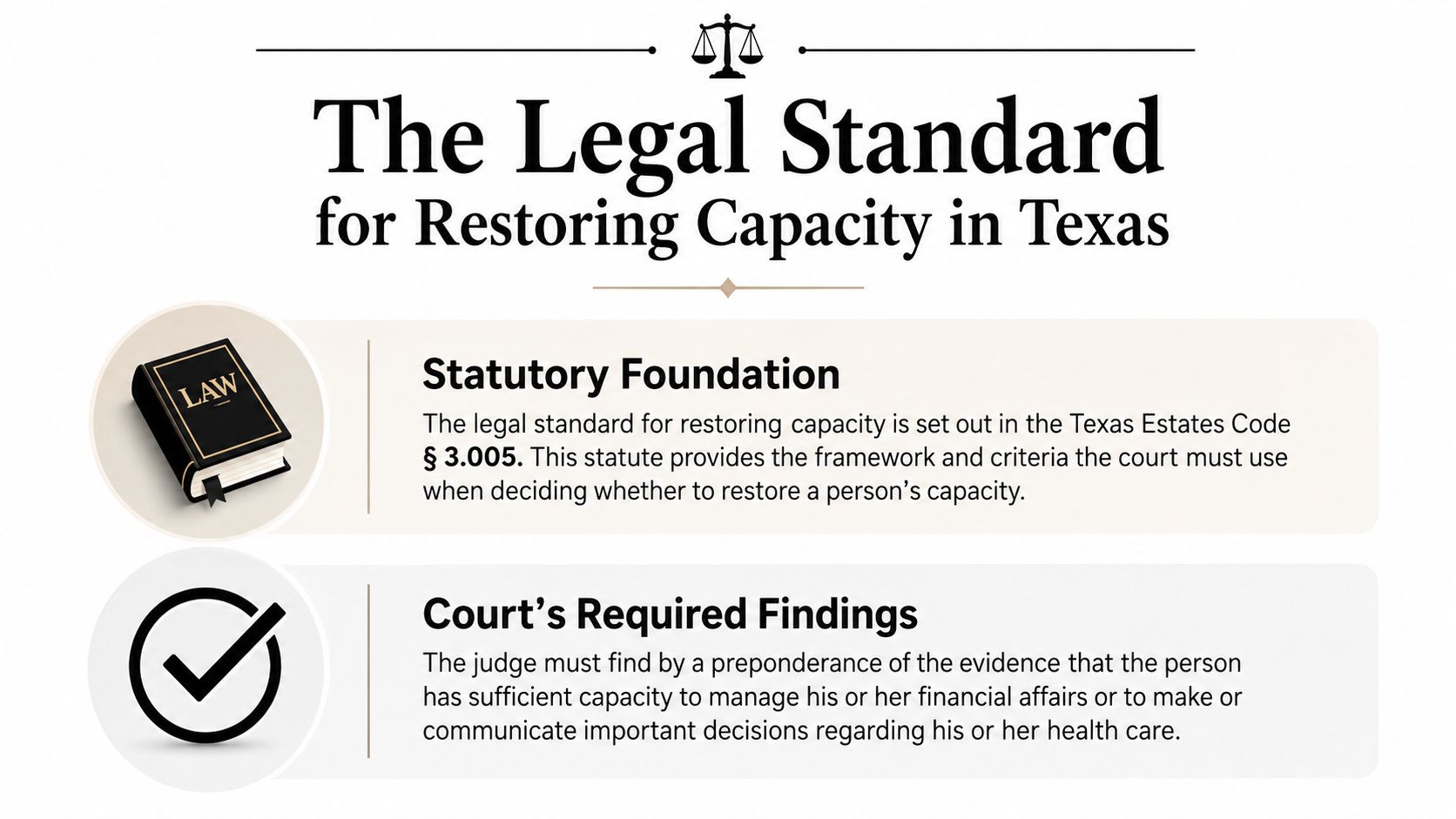
Texas law gives the court two paths when a ward's capacity has returned enough to end a guardianship. Under Texas Estates Code § 1202.001(b)(2), the court may close the case if the ward has regained full capacity, or if the ward has enough capacity, with or without supports and services, to care for the person and manage property (Texas Estates Code § 1202.001). The practical difference matters. Some people are ready for full restoration. Others still need a narrower order that reflects the support they use.
A recovery story that sounds good at the kitchen table does not always satisfy the statute. The judge still has to decide whether the ward can function safely and consistently in real life, not just whether the medical crisis has passed. For families, that means capacity restoration is only part of the work. The court also has to see that the guardianship can be wound down cleanly, including the guardian's final accounting and any remaining fiduciary duties before the case is closed.
Full restoration versus partial restoration
Full restoration is the simplest outcome, but Texas law does not require an all-or-nothing result. If the ward can make personal and financial decisions independently, the court can terminate the guardianship and return legal control. If the ward can manage only some matters, Texas Estates Code § 1202.051 allows the court to partially restore capacity and limit the guardian's powers instead of ending the case outright (Texas Estates Code § 1202.051).
That flexibility fits modern guardianship practice in Texas, where supported decision-making often solves the problem better than a complete release. A person may be able to choose a doctor, sign routine papers, or express a stable preference, yet still need help with investments, deed transfers, or larger financial decisions. In those cases, the court can tailor the order to the person's actual abilities instead of forcing a result that is broader than necessary.
What the judge has to find
The court does not restore capacity based on a casual conversation or a family member's summary of improvement. The Texas Bar practice materials explain that the judge must find by a preponderance of the evidence that the ward is no longer partially or fully incapacitated before ordering settlement and closing (Texas Bar practice materials). In plain terms, the evidence has to tip in favor of restoration.
That finding usually rests on current medical proof, but the court also looks at the bigger picture. The ward's ability to manage daily decisions, keep appointments, handle medication, respond to financial obligations, and understand risk all matter. A doctor's opinion is important, yet the judge still has to decide whether the legal standard has been met.
Families often ask whether a petition for restoration is the same thing as a petition to end a guardianship. It can be, but the central issue is whether the proof supports complete closure or only a narrower change. Ending or Modifying a Texas Guardianship addresses that decision point from the legal side, since the court may restore rights, reduce the guardian's authority, or terminate the case depending on the evidence.
The first petition matters because Texas law can restrict repeated filings for a period of time after a denial. If the court denies the request, the family may have to wait before trying again unless the court allows a new filing sooner. That is one reason the initial motion should be prepared carefully, with the medical proof, the proposed scope of restoration, and the final accounting issues all thought through before the hearing.
Gathering Medical Evidence and Capacity Evaluations
A strong restoration petition starts with current, concrete medical evidence. A court wants to know what the ward can do now, not just what diagnosis appeared months ago. A vague letter that says “improved” usually won't carry much weight. The judge needs a recent evaluation that speaks to decision-making ability, stability, and daily function.
What the medical proof should show
Texas practice materials point families toward a current medical capacity evaluation before filing the restoration or termination pleading (Texas Bar practice materials). In practical terms, that evaluation should address how the person handles routine choices, understands risks, communicates preferences, and manages property. A diagnosis alone is not enough. Capacity is about function.
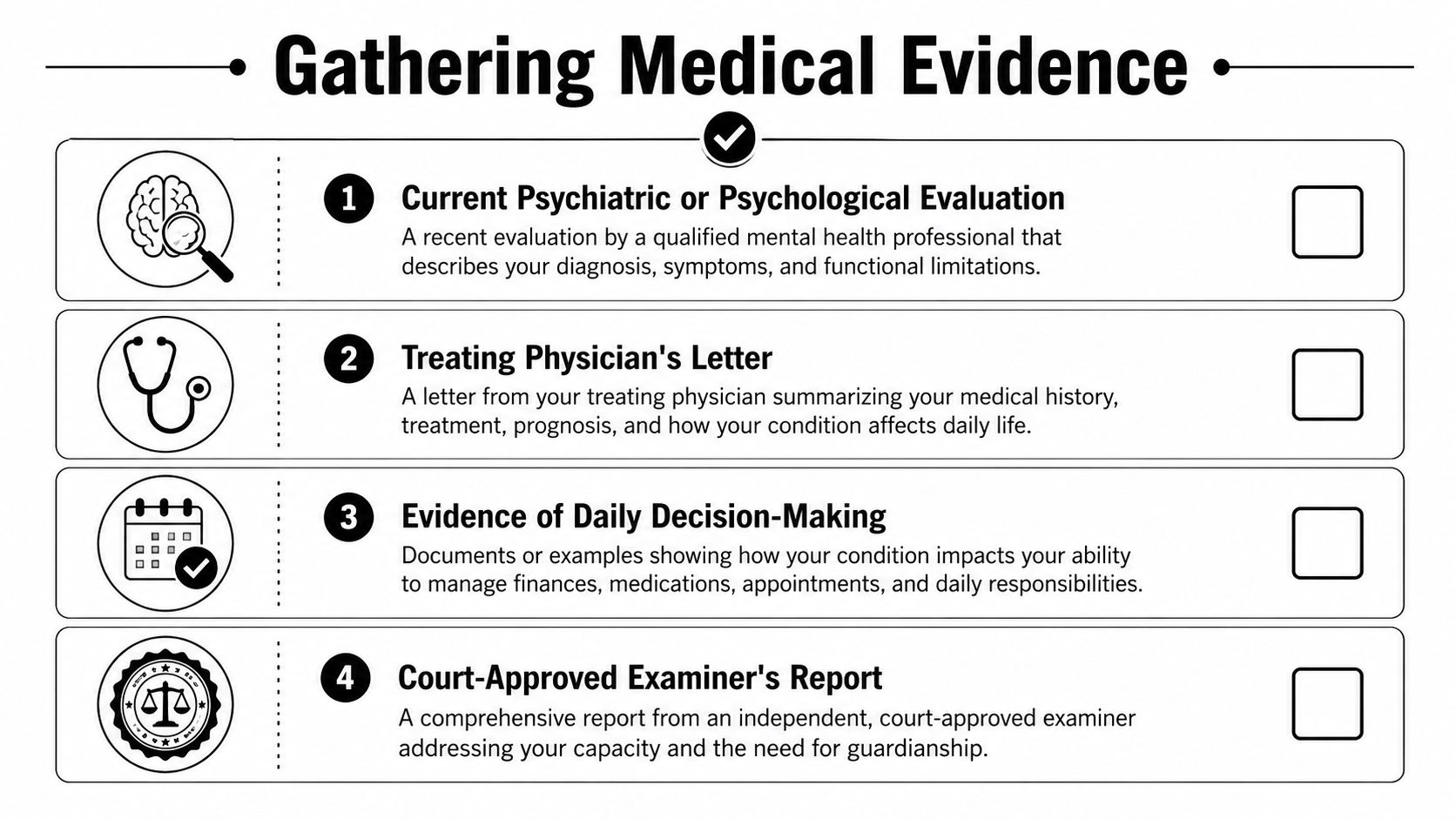
The cleanest record usually includes:
- Current psychiatric or psychological evaluation. This helps show whether the improvement is sustained, not a one-day burst of clarity.
- Treating physician's letter. A doctor who knows the recovery timeline can describe progress in plain language.
- Evidence of daily decision-making. Bills paid on time, appointments kept, medication management, or other routine acts can help.
- Court-approved examiner's report. In some cases, the court gives more weight to a formal report than to a casual note.
A current treatment relationship matters because courts often look for consistency. A family in Travis County may have the same legal issue as a family in Harris County, but busy probate courts want the same thing, reliable evidence tied to the person's actual abilities.
Practical rule: the best medical evidence answers specific questions about daily life, not broad labels about illness.
The physician section of the case can get technical fast, so many families use a resource like a complete guide to the physician certificate for guardianship Texas to understand what the court expects from medical paperwork. That kind of preparation often prevents delay.
When the file is thin, the hearing usually turns into a credibility fight. A well-supported packet does the opposite. It gives the judge a clear record to rely on and gives the family a better chance of avoiding another round of filings later.
Filing the Motion and Preparing for the Court Hearing
Once the medical proof is in hand, the case moves from the doctor's office to the courthouse. Texas Estates Code § 1202.051 starts with a written application filed by the ward or any interested person (Texas Estates Code § 1202.051). That pleading asks the court to find that the ward is no longer incapacitated, or to restore capacity only in part and narrow the guardianship order to fit the person's current condition.
A petition has to match the relief being requested. If full restoration is the goal, the filing should ask for settlement and closing of the guardianship. If the ward still needs some help, the petition should explain why a limited guardianship remains appropriate instead of a full termination. In a busy probate docket, including courts in Harris County or Dallas County, a clean filing can prevent weeks of corrections and reset notices.
The Texas State Law Library makes clear that this is a court-driven process, not an automatic administrative update (Texas State Law Library guardianship modification guide). The judge cannot act on a vague request. Families should expect notice requirements, a hearing setting, and the possibility that other interested persons may object if they believe the ward still needs protection.
The hearing is where the judge decides whether the guardianship should end, change, or continue. Texas practice materials explain that the court reviews the evidence before ordering settlement and closing, and objections can still be raised before discharge and asset turnover (Texas Bar practice materials). That means the hearing file has to be organized and complete. The ward should be ready to answer direct questions about work, money, medications, housing, and support, because the court is looking for practical functioning, not labels.
A hearing checklist often helps:
- Confirm notice. Every required person should have been served or otherwise properly notified.
- Organize exhibits. Medical reports, account statements, and supporting affidavits should be easy to follow.
- Prepare the ward. The court may want to hear the ward's wishes in person.
- Expect objections. Family conflict can surface quickly, especially if finances are involved.
A family that wants the case closed should also think ahead about the final accounting process, because restoration of capacity does not finish the job by itself. For a practical overview of the records that usually matter at that stage, see this annual accounting guide for Texas guardianships. If an attorney ad litem or guardian ad litem was appointed earlier in the case, that person's position can still shape how the court reads the evidence. Probate hearings are formal, but the decision usually turns on whether the judge can trust the record and whether the proposed order matches the ward's present abilities.
Final Accounting and Fiduciary Wrap-Up Requirements
This is the step families overlook most often. Even when the judge agrees that capacity has returned, the case still is not fully closed until the guardian finishes the fiduciary wrap-up. Texas Estates Code Chapter 1204 governs the final settlement, accounting, and discharge when a guardianship is ending (Texas Estates Code Chapter 1204). The guardian has to file a final accounting, the court must review it, and only after the estate is settled can the guardian be discharged and the case closed.
Why the accounting matters
The final accounting is more than paperwork. It is the court's way of confirming that money and property were handled correctly during the guardianship. If the guardian skips this step, the case can stall even after the ward has recovered. The guardian can also stay exposed to liability because the estate still has not been formally wrapped up.
That's why the asset turnover process has to be handled carefully. Bank balances, personal belongings, and other property need to be returned to the ward or the ward's representative in the way the court approves. If the records don't match or something is missing, the judge may ask for more information before discharge. Families going through this often feel the tension, especially when the guardian and ward have had a difficult relationship.
Common mistakes that delay discharge
A useful way to think about this stage is as a compliance audit. The court is not just asking, “Is the person better?” It is also asking, “Has the guardian finished the accounting job?”
- Missing final accounting. The case can't close cleanly without it.
- Incomplete records. Gaps in receipts or bank statements raise questions.
- Improper turnover. Property must be returned through the right process.
- Unresolved objections. Disputes over money can hold up discharge.
For families who need more detail on the ongoing accounting obligation, annual accounting guardianship Texas is a practical reference point because the same fiduciary discipline carries into the final wrap-up. The difference is that now the goal is closure.
When the court approves the final accounting, the guardian is discharged, letters can be revoked, and the case can end. Until then, the guardian still has responsibilities. Recovery is important, but the legal finish line is the accounting.
When Full Restoration Is Not the Right Outcome
Not every recovery is complete, and Texas law recognizes that a person may regain enough ability to handle some decisions without regaining all of them. That's why a partial restoration or modified guardianship can be a better fit than full termination. The court can narrow the guardian's powers instead of removing every safeguard at once.
Choosing the right level of support
A ward may be ready to decide where to live, but still need help managing investments. Another person may handle daily spending but need support with larger financial transactions. In those situations, a limited guardianship can preserve autonomy without leaving the person unprotected. That approach often feels more respectful to the ward and less disruptive to the family.
The modern alternative is not always another court order. Texas families also use supported decision-making agreements or other less restrictive tools when the facts allow it. Those tools work best when the person can understand choices with help, rather than needing a guardian to act for them. If the improvement is real but incomplete, forcing total termination can backfire.
Comparing the options
| Option | Best fit | Practical effect |
|---|---|---|
| Full termination | Ward can manage personal and financial affairs | Guardian is removed and rights return fully |
| Partial restoration | Ward can handle some tasks, but not all | Court narrows the guardian's powers |
| Supported decision-making | Ward needs help, not substitution | Person keeps more autonomy outside guardianship |
A modification request can be filed with or instead of a full termination petition, depending on the evidence. That flexibility helps when the medical proof shows progress but not enough for a clean end to the case. It also helps families avoid an all-or-nothing fight in court.
The point is simple. Texas law is built to match the order to the person's actual capacity, not just their diagnosis. When that match is done well, the ward gets more independence and the family gets a more workable legal structure.
Your Guardianship Termination Checklist and Next Steps
A closing case moves fastest when the family stays organized. Start with a current capacity evaluation, then confirm whether the evidence supports full restoration or only a limited order. After that, file the written application, make sure notice goes out properly, and prepare for the hearing with a clean packet of exhibits.
A practical checklist helps keep the process on track:
- Get current medical evidence. Outdated records are a common reason petitions stall.
- Choose the right request. Full termination is not always the best legal result.
- Serve notice correctly. Missing an interested person can delay the hearing.
- Prepare the final accounting. The case is not done until the fiduciary wrap-up is approved.
- Plan for objections. Disputes over capacity or money can change the hearing quickly.
Families often try to handle the process alone because they're relieved the loved one is improving. That's understandable, but guardianship termination is still a legal case with deadlines, evidence rules, and accounting duties. If the estate is complex, the family is split, or the petition is contested, legal help usually saves time and frustration.
The Law Office of Bryan Fagan, PLLC handles guardianship, probate, and estate planning matters for Texas families, including restoration, modification, and discharge issues. If you're dealing with a recovering ward and want help closing the loop the right way, schedule a free consultation so you can get guidance for your county, your records, and your next hearing.
The Law Office of Bryan Fagan, PLLC helps Texas families with guardianship restoration, modification, probate, and estate planning matters from filing through final discharge. If you're working on closing a Texas guardianship when the ward recovers capacity, visit Law Office of Bryan Fagan, PLLC to schedule a free consultation and get clear guidance for your next step.