Maria in Harris County thought the hard part was over when the judge signed the guardianship order for her mother. Then the clerk handed her two forms, one for the guardian of the person and one for the guardian of the estate, both tied to the same deadline, and she was left wondering why the court needed two filings when she was already trying to keep up with doctors, bills, and a new routine at home.
That confusion is common, and it's fixable. In Texas, the court separates personal care reporting from financial accounting because those are two different jobs with two different kinds of proof. If you just qualified in a Harris County probate court, or you're waiting on a similar order in Dallas, Travis, or Bexar County, the safest approach is to treat both forms like parallel tracks on the same calendar.
| Filing | What it measures | Who files it | What the court wants most |
|---|---|---|---|
| Annual Report of the Person | The ward's condition and care | Guardian of the person | Health, living situation, and day-to-day well-being |
| Annual Account of the Estate | The guardianship money trail | Guardian of the estate | Receipts, disbursements, and proof the funds still match the records |
Texas families often try to make one form do both jobs. That shortcut usually creates more work later, because the court is looking for different evidence in each packet. For a plain-English overview of what happens after the order is signed, this post on what happens after guardianship is granted in Texas helps frame the post-hearing stage without mixing the duties together.
Why Two Reports Show Up After Qualification
James had the same reaction many Houston-area families have after a qualification hearing. He thought he had finished the legal battle, then the probate clerk handed him a stack with two different annual forms and a deadline that started running whether he felt ready or not. One form asked about his father's care. The other asked where the money went.
That split isn't accidental. Texas law treats guardianship of the person and guardianship of the estate as separate responsibilities, even when the same family member holds both roles. A guardian of the person answers for daily care, living conditions, and the ward's overall condition. A guardian of the estate answers for the money, assets, and transactions under court supervision.
The court is tracking two different risks
The personal report helps the judge see whether the ward is safe, stable, and receiving appropriate care. The financial account helps the judge see whether guardianship funds are being handled consistently. When a family member holds both roles, the court wants both pictures, not one blended narrative.
That's why the filing packet feels repetitive at first but makes sense once you separate the duties. The court doesn't want a medical summary in place of receipts, and it doesn't want a bank statement in place of a care update. Families in Fort Bend County and Harris County run into trouble when they try to save time by pushing everything into the wrong form.
Practical rule: if the fact answers “How is the ward doing?”, it belongs in the personal report. If the fact answers “Where did the money go?”, it belongs in the annual account.
This is also where good post-qualification habits matter. A calendar, a folder for medical notes, and a separate folder for bank records can prevent most of the scramble that follows a first appointment. For a straightforward explanation of annual reporting expectations, annual reporting requirements for guardians in Texas is a useful companion page.
If the case started as Guardianship of an Incapacitated Adult in Texas, the reporting duties still follow the same division. The underlying court finding changes the person's legal status, but it doesn't collapse the distinction between care oversight and money oversight.
What Each Filing Is Under Texas Law
Texas Estates Code Title 3, Subtitle E governs the annual report for the guardian of the person, while the estate accounting sits on the financial side of the guardianship framework. In practice, the court is asking for two different records that serve two different functions. One is a sworn update about the ward's condition. The other is a detailed accounting of guardianship property and transactions.
Personal report versus financial account
The Annual Report of the Person is a sworn annual report covering the ward's mental and physical health, social and intellectual functioning, and living conditions. Texas court guidance also recognizes that the report can include receipts and disbursements for support and care when those details relate to the ward's needs rather than asset management. That makes it a care document with limited financial elements, distinct from the estate accounting.
The Annual Account of the Estate is a far more technical control document. It records money coming in and going out, separates principal and income, identifies the property being administered, and shows the cash balance on hand plus the depository location. In practice, it reads like a reconciliation, not a narrative.
The cleanest way to think about it is this. The personal report tells the court whether the ward is being cared for. The account tells the court whether the money can still be traced.
Who files what depends on the role. A guardian of the person files the personal report. A guardian of the estate files the financial account. If one person holds both appointments, that person files both, on parallel tracks, for the same reporting cycle.
That distinction matters in daily practice. A daughter in Tarrant County might know her mother's doctor, medications, and placement by heart, but still need separate bank records to satisfy the estate side. The court expects each form to stand on its own. For a straightforward overview of the filing duties, annual reporting requirements for guardians in Texas explains how the personal report fits into the broader guardianship process. If you're comparing those duties to fiduciary obligations in other contexts, protecting your investment rights gives a helpful look at why courts insist on careful money stewardship.
Side by Side What Goes Into Each Filing
A family in Bexar County can keep the two filings straight with one simple habit. Put the personal care notes in one folder and the financial records in another. The court is asking different questions, and the documents should answer them without overlap.
| Element | Annual Report of the Person | Annual Account of the Estate |
|---|---|---|
| Core purpose | Update the court on the ward's care and condition | Reconcile the ward's money and property |
| Main content | Health, residence, functioning, and living conditions | Receipts, disbursements, principal, income, and cash balance |
| Signer | Guardian of the person | Guardian of the estate |
| Level of detail | Narrative and care-focused | Technical and ledger-focused |
| Supporting proof | Medical updates, placement notes, care decisions, living arrangement details | Bank statements, invoices, receipts, and other transaction records |
The personal report should stay centered on the ward's lived reality. Has the ward moved? Is the care plan still working? Are there new medical or social concerns? Those are the kinds of issues the judge wants to see. The annual account, by contrast, should track the estate from a records standpoint, with no loose ends and no unexplained gaps.
That's where people get tripped up. They try to make the personal report sound financial, or they stuff medical notes into the accounting. Neither approach helps. The court reads the annual account to see whether the numbers reconcile, and it reads the personal report to see whether the ward's condition supports continued guardianship or some change in authority.
For more detail on the money side, annual accounting guardianship Texas fits naturally beside your own records. Families handling a guardianship matter involving an older parent or adult child with disability needs often benefit from keeping the legal and medical materials apart from the start, especially when they're also navigating broader probate or estate planning issues.
Filing Deadlines and the Anniversary Calendar
The reporting calendar in Texas is fixed, and that helps more than it hurts once families understand it. Under Texas Estates Code § 1163.102, the annual report covers a 12-month reporting period that starts on the date the guardian qualifies to serve, or on each anniversary of that date. The report is due no later than the 60th day after the reporting period ends.
That means the deadline does not float with the calendar year. It follows the guardianship appointment. A January qualification does not create a December filing date just because year-end feels tidy. The court ties compliance to the qualification anniversary, and that's what families need to track.
Build the calendar around the qualification date
The easiest system is boring, and boring is good here.
- Mark the qualification date: Put the exact date on the first page of the guardianship file and in your phone calendar.
- Set an anniversary reminder: Use the date one year later as the first checkpoint for both reports.
- Add two follow-up alerts: Set one reminder around 50 days after the anniversary and another at the 60-day mark.
- Confirm local practice: If the probate court in your county sent a different filing instruction, follow the court's directions and verify the deadline before you assume anything.
Texas rules let the court change the reporting period, but only if the period still stays within 12 months. That's a narrow adjustment, not a reason to drift away from the statutory cycle. In Harris County Probate Court, Dallas County probate practice, and smaller county courts alike, the safest habit is to anchor everything to the qualification anniversary unless the court says otherwise.
The point isn't to memorize the statute. It's to keep from missing the filing because nobody tracked the date that started the clock. A single reminder system can cover both the personal report and the annual account, which is exactly what busy caregivers need.
A Real World Example Holding Both Roles
A sister in Dallas County is appointed guardian of both the person and the estate for her father. By the end of the year, she is handling assisted living placement, refill orders, family calls, and a checking account that has become the center of every receipt. One qualification anniversary still controls both filings, but the records she gathers are different enough that she has to treat them as two separate jobs.
Her personal report says her father moved to assisted living, saw the doctor several times, and had a hospital stay that changed his care needs. That filing tells the court whether the living arrangement still makes sense and whether his condition supports continuing the guardianship as ordered. It reads like a care update because that is exactly what the court wants in that report.
Her annual account tells a different story. Social Security deposits came in, a small piece of real property was sold, care facility invoices were paid, and the guardianship account had to be reconciled line by line. The judge needs the money trail to add up in that filing, with no gaps between the deposits, the expenses, and the balance on hand.
Why the same family can't use one file for both jobs
The personal report answers the safety question. The financial account answers the stewardship question. If the sister tries to merge them, the filing gets messy fast. The doctor's notes belong in one place, the bank statements in another, and the receipts should support the numbers without turning the account into a second care narrative.
Families in Houston or Austin often breathe easier once they see the structure. The reporting system is strict, but it makes sense once the two tracks are separated. The paperwork stops feeling like a pile of random court demands and starts looking like a checklist.
Keep one running folder for care information and one for money records. That habit saves far more time than trying to rebuild a year of history at the end of the reporting cycle.
A guardian who holds both roles should think in two columns from day one. The ward's daily condition goes in one lane. The estate's transactions go in the other. That discipline cuts down on mistakes and makes court review much smoother.
Building the Financial Accounting the Court Will Accept
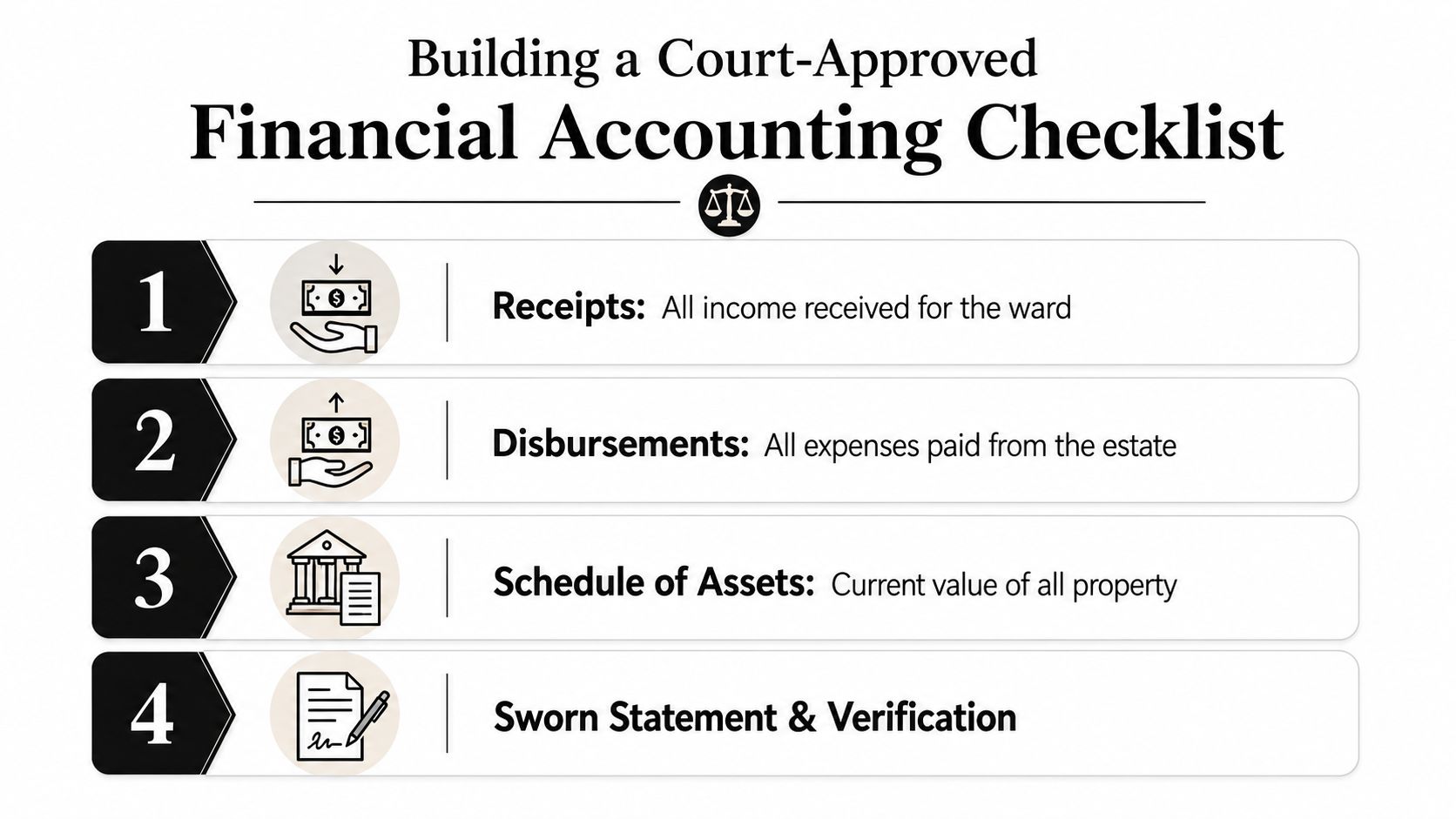
The annual account is the one that usually creates the most anxiety, because it is less forgiving than the personal report. Texas Estates Code Chapter 1163 requires a complete account of receipts and disbursements, separate listings for principal and income, a description of the property being administered and its condition or use, and the cash balance on hand plus the depository location. That is a lot of moving parts for a family member who is already doing caregiver work.
Gather the records before the deadline pressure starts
The best accounting files are built month by month, not in a panic during the last week.
- Bank statements: Keep every statement for the guardianship account so deposits and withdrawals can be matched.
- Invoices and receipts: Save care facility bills, medication purchases, and other support records tied to estate spending.
- Asset notes: Track the property being managed, including any real estate or other major asset under the guardianship.
- Investment or liability records: Keep anything that shows performance, changes, or debts affecting the estate.
- Depository details: Record the bank name and location exactly as the court expects to see it.
The financial report is a reconciliation-style control document. That means the numbers have to line up, and the support has to be organized enough for someone else to follow the trail. Court auditors and judges don't want a shoebox of paper. They want a report that proves the estate is still intact and the transactions make sense.
The mistake I see most often is starting with memory instead of records. Families remember why money was spent, but the court needs proof. If a withdrawal paid for care, the receipt, invoice, or statement should show it. If an asset was sold, the file should show what changed and where the proceeds went.
Use the first month after qualification to set up the paper trail. If the records are clean from the beginning, the accounting becomes much more manageable when the deadline arrives.
Common Pitfalls and What Courts Actually Do About Them
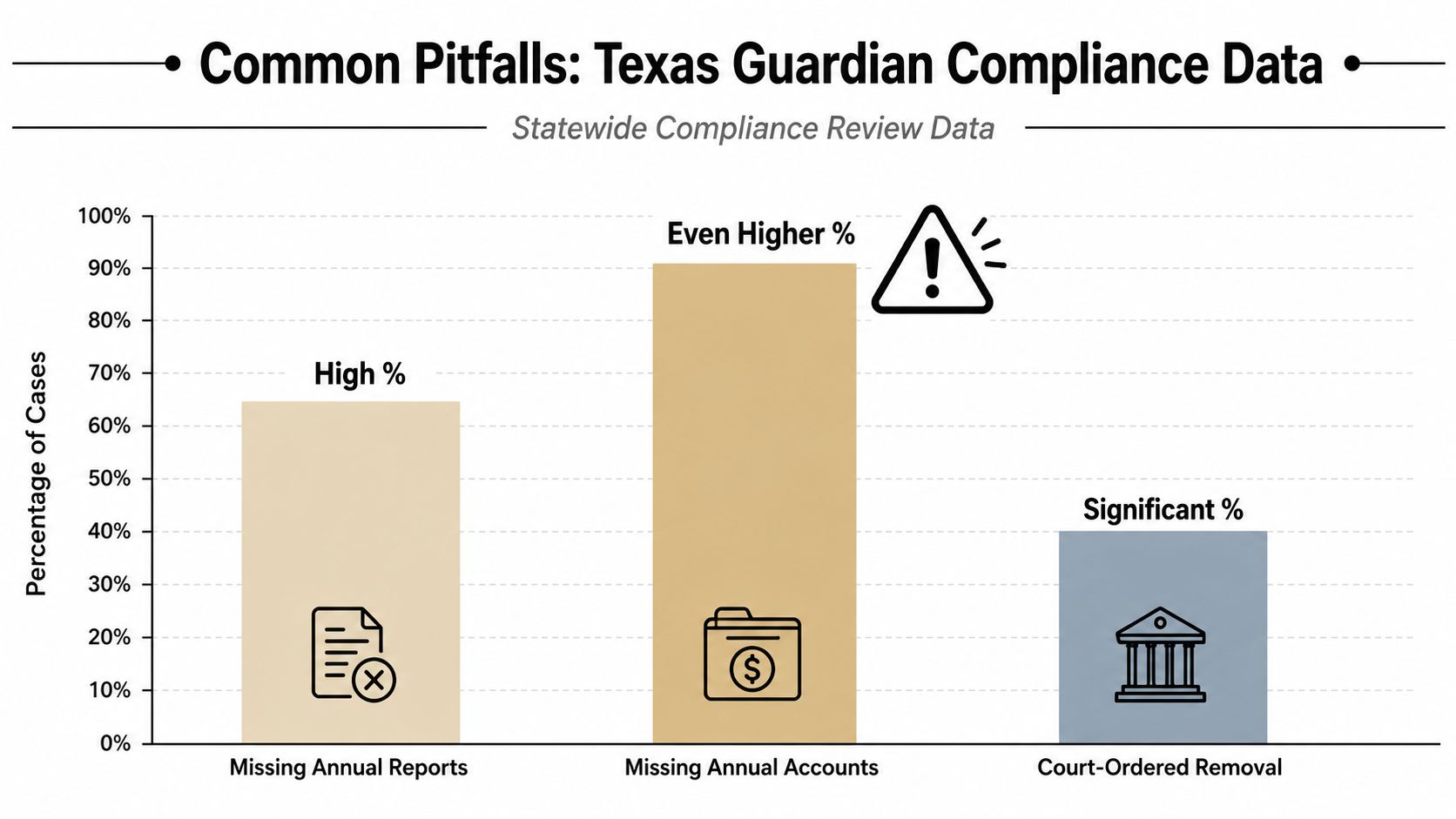
Texas statewide compliance data show why this topic matters. In the Texas judiciary's FY 2023 annual statistical report, new guardianship cases increased 8% from the prior year, with 5,125 adult guardianship filings and 688 minor guardianship filings, while reported active guardianships rose 2% year over year. The Texas Guardianship Compliance Project's FY 2023 review found 11,426 cases reviewed, 4,619 active cases identified, and 1,721 guardianships out of compliance; it also found 24% of cases were missing annual reports and 48% were missing annual accounts. Those numbers show that missed filings are not rare, and they affect real court oversight.
The common assumption that gets people in trouble
Many families treat the annual report like a formality. That assumption can be expensive. Texas Bar guidance warns that missing the annual report can lead to removal and a fine of up to $1,000. That's not just a late notice and a polite reminder.
The edge cases matter too. If the court changes the reporting period, the new period still has to stay within 12 months. If a successor guardian steps in, a final account is required when the guardianship ends or when control passes to the next person. And if one family member serves in both roles, the two filings still run on separate tracks even though they share the same anniversary-based deadline.
Here's where people get caught off guard:
- They miss the anniversary date: The filing cycle starts with qualification, not the calendar year.
- They mix the forms together: Medical notes end up in the accounting, or bank records get pushed into the personal report.
- They fail to close out a transition: A successor guardian inherits a file with gaps that should have been resolved by a final account.
- They assume one role covers both jobs: The person report and the estate account are not interchangeable.
The court's response usually starts with oversight, not chaos, but the risk grows when the file stays incomplete. If the records show repeated gaps, judges can press for explanations and, in serious cases, move toward removal. Families should take that seriously even when everything else in the home feels stable.
Choosing Your Next Step and Getting Help
If you hold only the guardian of the person role, focus on the care report, the anniversary date, and the ward's condition. If you hold only the estate role, give the financial account the attention it deserves and keep your source documents organized from the start. If you hold both, build one calendar system for the same 60-day window but send two separate packets to the court.
A simple DIY filing can work when the facts are straightforward, the records are complete, and you're not managing a transition. The moment the accounting includes sold property, multiple deposits, or a successor guardian, the technical side gets harder fast. That is usually the point where a lawyer who handles Texas guardianship compliance can save time and reduce mistakes.
Families who need help with filing strategy, court deadlines, or cleanup after a missed report can work with the Law Office of Bryan Fagan, PLLC in Houston, Dallas, Austin, or San Antonio, or through a statewide virtual consultation. The firm handles guardianship, probate, and estate planning matters, so the conversation can cover the guardianship forms and the broader family plan in one place.
If you're staring at two court forms and a deadline that doesn't wait for family life to calm down, the Law Office of Bryan Fagan, PLLC can help you sort out which filing belongs where and what the court will expect. Visit Law Office of Bryan Fagan, PLLC to schedule a free consultation and get personalized guidance for your Texas guardianship reporting duties.