Skip to content
When a parent passes away after years of nursing facility care, families are usually bracing for funeral plans, probate questions, and a stack of account paperwork. Then a letter arrives from the state about Medicaid estate recovery, and the person who served as guardian of the estate realizes the problem isn't just grief, it's whether the home, bank accounts, or probate assets may now face a claim. That surprise is common in Texas because guardianship helps manage property during incapacity, but it doesn't erase what can happen after death.
For many families, the hardest part is that the guardianship felt like the main legal protection. A court had already stepped in, accounts were being tracked, and bills were being paid, so it seems natural to assume the estate is safe. In reality, Texas Medicaid estate recovery and Texas guardianship of the estate operate on different tracks, and that separation is where confusion often starts.
If you're trying to sort through this after a loved one's death, the first job is to understand what MERP can touch, what it can't, and how guardianship decisions made during life can affect the estate later. A little context can save families from making rushed choices when the clock is already moving.
Helpful background on guardian duties after death can also make this less overwhelming, especially if you're trying to line up paperwork and court deadlines at the same time. For a general overview of post-death fiduciary duties, trustee responsibilities after death offers a useful comparison point, even though a trustee and a guardian are different roles.
Why Medicaid Recovery Letters Surprise Texas Guardians
A daughter in Harris County spends two years serving as guardian of her mother's estate. She pays the utility bill, keeps the homestead insured, and brings annual accountings to the probate court. After her mother dies, she opens a letter from HHSC saying the state may seek recovery, and she's stunned because no one ever told her that guardianship and Medicaid recovery would meet at the end of the road.
That reaction makes sense. Guardianship is a court-supervised system for managing the ward's finances and property, but MERP is a separate collection process that starts after death. Families often think the guardianship order protected everything, when it really only governed who could manage the assets during incapacity.
Why the letter feels so out of place
The surprise is emotional as much as legal. Families are already handling burial decisions, closing accounts, and trying to understand whether there is a probate estate, so a recovery notice can feel like one more blow at the worst possible time. Texas families also tend to think in practical terms, if the guardian kept the books straight, the state should already know what happened.
That's why a clear paper trail matters. A guardian who documented payments, court approvals, and title records is in a stronger position when the recovery process starts. Texas probate and guardianship law both reward organized records, especially when a home or other real property is involved.
Practical rule: if you're the guardian of the estate, assume every major property decision may be reviewed later, even if it seemed routine at the time.
Families who want the basic legal framework can also review Guardianship and Probate resources early, before the first notice arrives. Those pages help separate incapacity planning from post-death estate administration.
Understanding Medicaid Estate Recovery and Guardianship of the Estate
A Texas family can do everything by the book during a guardianship, then still be caught off guard when a Medicaid recovery notice arrives after death. That reaction makes sense. The guardian was managing the ward's property under court supervision, while Medicaid estate recovery starts later, after the person has died and the state looks to see whether the probate estate can satisfy a claim. In Texas, that recovery is generally narrower than in many states because it usually reaches the probate estate rather than every asset the person ever owned. The federal and state policy context is also modest in scale nationwide, since Medicaid estate recovery collected about $733.4 million in fiscal year 2019, which was only about 0.55% to 0.62% of national Medicaid fee-for-service LTSS spending in FY 2015 to FY 2019 and roughly 0.1% of total Medicaid spending in 2019 (MACPAC).
Guardianship of the estate under Texas Estates Code Title 3, Subtitle G is the court-supervised job of managing a ward's money, property, and financial records while the ward is alive and incapacitated. The guardian pays bills, preserves assets, seeks court approval when needed, and accounts to the court. The guardian does not own the property. The role is closer to a court-monitored steward than a personal owner, which is why routine decisions about a house, title paperwork, or accountings can matter later when a recovery claim is reviewed.
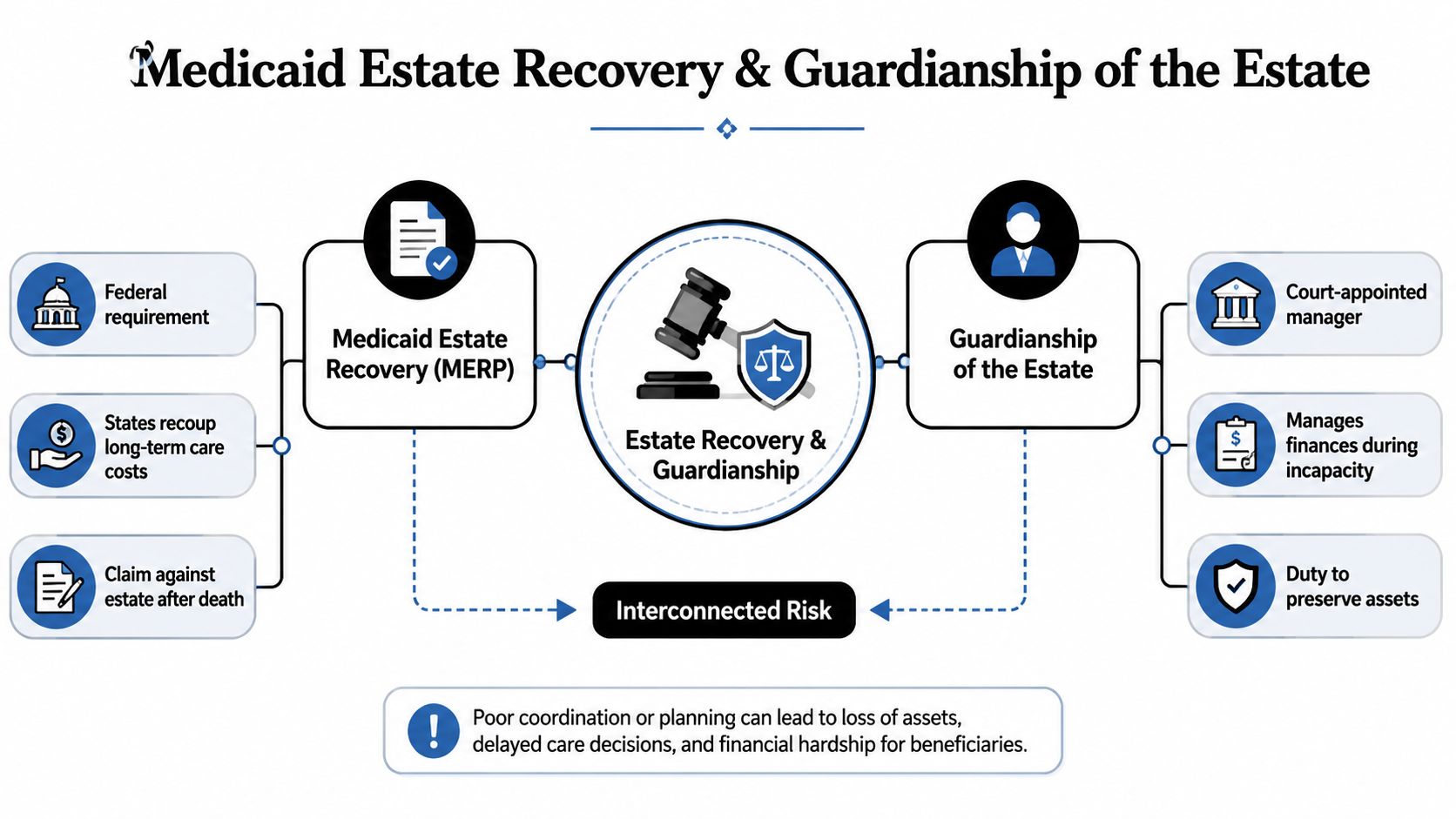
How the two systems connect
The connection is easiest to see in three stages.
- During life, the guardian manages the ward's finances and property under court supervision.
- While Medicaid pays for qualifying long-term care, records start building in the background.
- After death, Texas may file a claim against the probate estate if the legal conditions are met.
That sequence sounds simple, but the paperwork can shape the result. A deed that was never updated, a home that still sits in the ward's name, or accountings that do not match how property was handled can affect how a recovery claim is analyzed. Texas is distinctive because its recovery rules are relatively narrow. Texas HHS explains that MERP generally limits recovery to the probate estate and uses specific notice procedures, plus exceptions for some small estates and small Medicaid-paid amounts (Texas HHS MERP guide). The state's own guidance also helps families understand how those rules fit with probate administration and claim review.
A practical way to read the system is this, the guardian protects and administers property during life, then the estate either stays outside recovery or becomes part of the MERP process after death. A Texas Guardianship Lawyer resource can help families sort out how guardianship of the person and guardianship of the estate fit into that larger picture, and the Boston to Texas 2026 relocation guide can also be useful when a family is dealing with a move that affects where records, property, and estate administration end up.
The key question is not only whether the ward had Medicaid, it's whether the assets left at death are part of the probate estate Texas can reach.
When MERP Can File a Claim Against a Texas Estate
A Texas family often learns about MERP only after the ward has died and the paperwork starts arriving. By that point, the guardian may already be closing accounts, updating the court, and trying to figure out which assets belong in the estate file. Texas MERP does not apply to every Medicaid case. HHSC's claim authority is tied to recipients who were age 55 or older and who received covered long-term care services, including nursing facility care and home- and community-based services. The legal trigger is death, but the filing timeline starts when MERP has actual notice of that death, and the administrative rule requires the claim to be filed within 70 days after that notice (Texas Administrative Code).
That timing matters because probate, guardianship closure, and creditor notice can overlap fast. A guardian or executor may be gathering death certificates, notifying the court, and sorting title records at the same time the state's deadline clock is already running. If the sequence is missed, the family can lose ground before it fully understands what the claim is reaching for.
The legal checks MERP must make
Before recovery moves forward, the claim has to fit the statutory status rules. Texas MERP claim materials must identify the amount owed, the dates of covered services, and the legal status checks showing there is no surviving spouse, no qualifying minor or disabled child, and no qualifying unmarried adult child living in the homestead for at least one year (Texas Administrative Code).
That means a family's living arrangement can matter as much as the claim paperwork. A home that was shared by a qualifying relative may be treated differently from a home that was left vacant or transferred in a different way. If the facts support one of the recognized protections, the estate may have a defense before MERP ever gets to the next step. Families who want to protect property while still planning for long-term care often benefit from reviewing ways to protect assets from nursing home costs before the estate is ever opened.
Timeline insight: the estate's best defense is often built before the claim lands, because the facts about family members, residency, and title control are already set by the time HHSC acts.
For families comparing legal strategies, it helps to remember that state recovery is not automatic against every asset. Texas law focuses on the probate estate, while nonprobate planning can change the analysis. That is one reason people who are relocating, reorganizing property, or handling accounts in more than one state need to think several steps ahead, and the Boston to Texas 2026 relocation guide is a practical reminder that life changes often create legal paperwork changes too.

Exceptions and Defenses That Can Block Recovery
Some MERP claims never move forward because the law does not allow them to begin. In Texas, recovery generally does not apply if the estate is $10,000 or less or if Medicaid-paid long-term care costs were $3,000 or less. Those limits matter because families often assume every estate is fair game, but small estates may be outside recovery from the start (Texas HHS MERP guide, Elder Law Austin).
Blocked versus allowed
A plain comparison helps.
| Situation | Likely result |
|---|---|
| The estate is very small, or the Medicaid-paid amount is very small | Recovery may be blocked under Texas rules |
| A surviving spouse remains | Recovery is generally barred against that estate interest |
| A qualifying minor or disabled child survives | Recovery may not proceed in the usual way |
| An unmarried adult child lived in the homestead for at least one year | The homestead claim can be blocked |
| No qualifying survivor exists, and the probate estate remains open | MERP may pursue recovery |
A family example makes the point clear. If an adult child lived in the family home for more than a year before the parent died, that fact can protect the home differently than if the child moved out six months earlier. The law turns on residency and survivor status, not just family loyalty or informal care.
Nonprobate transfers can change the picture
Texas recovery is generally limited to the probate estate, so assets that pass outside probate can fall outside recovery. That can include beneficiary-designated accounts or certain deed-based transfers, depending on how they were created and how title reads at death. For families trying to sort out those choices before a crisis, protecting assets from nursing home costs is often part of the same conversation (Texas Law Help, Elder Law Austin).
The hard part is that a family can accidentally undo that protection if the property is handled the wrong way during guardianship. A court-approved sale, a title correction, or a poorly timed transfer may change what ends up in the probate estate. Guardian decisions about deeds, account titles, and closing paperwork can shape MERP exposure long after the ward's death.

The same facts that help a family defend a claim can also be lost if the record is thin. Good title records, clear court orders, and a clean accounting history often make the difference between a recoverable probate asset and one that stayed outside MERP in the first place.
Guardian Duties That Affect MERP Exposure
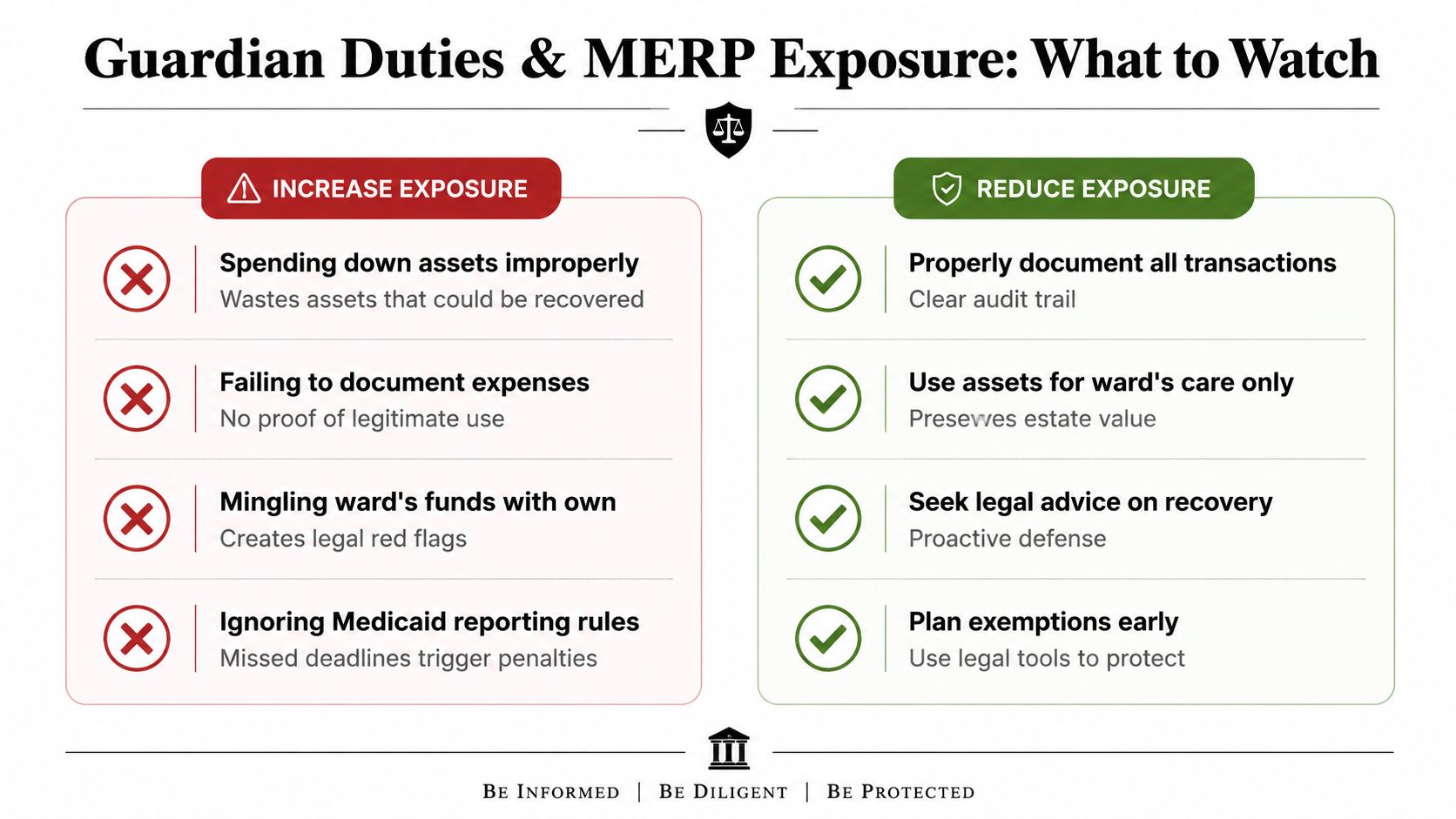
A guardian of the estate can make routine choices that later decide how much, if anything, MERP can reach. Paying property taxes on the homestead, keeping insurance in force, and preserving title records may sound like ordinary maintenance, yet each step shapes the paper trail the estate leaves behind. Texas guidance makes clear that MERP stays focused on the probate estate, so title changes made during the ward's life can matter as much as what happens after death.
What to document in guardianship records
Guardians should treat each major action as something the probate court may later want explained. Annual reports to a court like the Harris County Probate Court should be consistent, complete, and easy to follow.
- Keep title records current: Save deeds, payoff statements, insurance declarations, and any court orders affecting real property.
- Track every estate expense: Record why money was spent, who approved it, and how the expense benefited the ward.
- Separate assets cleanly: Do not mingle the ward's money with personal funds.
- Note any transfer strategy: If a Lady Bird deed, transfer-on-death arrangement, or other title plan is involved, keep the paperwork together so counsel can review it later.
- Get court approval before big moves: A sale, transfer, or settlement can affect later recovery analysis.
A guardian who documents carefully is doing more than checking a court requirement. That record may become the proof that a disputed asset was maintained properly, sold with approval, or never belonged in the probate estate the state is trying to reach.
Practical rule: if a decision changes title, ownership, or where the property sits at death, assume MERP counsel will care about the record.
Families often miss the tension between preserving value and creating exposure. Keeping a home in good shape may protect its value, but handling it carelessly can also create probate problems later. That is why the duties listed in guardian of estate responsibilities in Texas connect so closely to estate recovery risk.
How to Respond to a Medicaid Recovery Claim
Maria opens the notice and sees a claim for $87,000 in nursing facility costs after her mother's death. Her first move is not to panic, it's to check the claim line by line. She compares the dates of service to her mother's Medicaid records, confirms whether the estate is probate-only, and asks whether any survivor exemption might apply.
Step by step response
Maria's response process is organized, not emotional.
- Verify the claim amount. She checks whether the billed services match the periods her mother received covered care.
- Review the estate structure. She looks at deeds, beneficiary designations, and probate filings to see what property is exposed.
- Pull guardianship accountings. Her annual reports show where the money went and whether any asset transfers were court approved.
- Check exemptions and defenses. She looks for a surviving spouse, qualifying child, small-estate issues, or a hardship argument.
- File a written response on time. She submits the challenge in the probate process rather than waiting and hoping the claim disappears.
A hardship waiver request needs evidence, not sympathy alone. Families usually need documents showing that recovery would cause serious unfairness, especially when the estate contains the family home or the only practical housing for a survivor. Court records, bills, residence evidence, and proof of caregiving can all help tell that story.
Maria's next move is to talk, not fight. In many Texas estates, the state will consider negotiation, correction of the claim, or narrowing the assets involved if the family presents organized facts early. A quiet deadline missed in the first round can be much harder to fix later.
Response tip: the best claim file is often the one built before death, because guardianship records, title documents, and care records are much easier to gather when someone has tracked them all along.
When to Seek Legal Counsel for Guardianship and MERP
Some families can handle a simple notice on their own, but many can't. If the recovery claim is large, the exemptions are disputed, the property is hard to value, or the estate includes nonprobate planning questions, it's time to get help before you sign anything.
The Law Office of Bryan Fagan, PLLC helps Texas families with guardianship establishment, compliance, estate planning, and responses to Medicaid recovery claims. The firm also handles issues tied to temporary or emergency guardianships, accountings, and disputes over fiduciary conduct. Families who want a deeper look at Medicaid-related planning can also review the firm's elder law attorney for Medicaid resource, especially when recovery concerns overlap with long-term care planning.
If you need to understand the difference between who manages the person and who manages the money, the guardian of the person vs. guardian of the estate concept page is a useful place to start. That distinction matters when you're deciding whether a problem is about healthcare authority, property control, or both.
Families in Houston, Dallas, Austin, and San Antonio, and those who need virtual consultations statewide, can use counsel to sort out deadlines, court filings, and recovery defenses without guessing. A guardianship and MERP issue is often too expensive to handle casually, because the wrong move can change what the estate owes.
If you're facing a guardianship accounting, a MERP notice, or a probate question about a Texas home, the Law Office of Bryan Fagan, PLLC can help you sort through the documents and deadlines with care. Visit Law Office of Bryan Fagan, PLLC to schedule a free consultation and get personalized guidance for your family's situation.