Skip to content
A move out of Texas can feel simple at first. You get a job offer in another state, or you need to be closer to siblings who can help with care, and your first thought is practical: “I'm the guardian, so I'll take my loved one with me.”
That instinct is understandable. It's also where many families get into trouble.
When a Texas court appoints a guardian, that court keeps legal authority over the case until the law says otherwise. So if you're asking, what happens when a guardian moves out of state, the answer is not “you update the address and keep going.” The answer usually involves court approval, ongoing reporting duties, and a plan to avoid a gap in legal authority for medical care, housing, school, finances, or daily decision-making.
Texas law treats guardianship as a court-supervised relationship. Under Texas Estates Code Title 3, Subtitle G, the court stays involved because the ward's rights, safety, property, and care are at stake. That's true whether the case is in Harris County Probate Court, a Dallas County probate court, or another Texas court with guardianship jurisdiction.
Families often feel overwhelmed when they learn this. The good news is that a careful plan can protect your loved one and keep you compliant.
A Guardian's Dilemma Moving Out of State
Angela lives in Houston and serves as guardian for her mother, who has dementia. Angela gets a job offer in Colorado. The new job means better income, better housing, and help from her sister who already lives there. On a human level, the answer seems obvious. Move together and start over.
But guardianship law doesn't work that way.

The problem is that physical relocation isn't the same as legal relocation. A guardian can cross a state line in a day. Court authority usually can't. Many families don't realize that the original court often keeps jurisdiction until a formal transfer is complete, the guardian may still need to file reports there, and the new state may refuse to recognize the guardianship until its own process is finished, as explained in McAndrews on transferring guardianship after a move.
Why families get caught in the middle
This is the risky in-between phase. You may have already moved. Your loved one still needs medication, consent for treatment, access to money, and stable placement. But the Texas court still expects compliance, while the new state may not yet honor your authority.
That overlap can create very real problems:
- Medical consent problems if a hospital in the new state asks for proof of authority it won't accept on its face.
- School or placement delays for a minor ward if local systems want state-specific court paperwork.
- Banking and benefits issues if institutions question whether your Texas letters still give you power where you now live.
- Texas compliance risks if you miss reports, accountings, or court instructions because you assumed the move changed everything.
Practical rule: Moving the ward first and sorting out the court process later can expose both the ward and the guardian to avoidable problems.
The better way to think about the move
Instead of asking only, “Can we move?” ask two separate questions.
First, can the ward physically relocate safely?
Second, can the guardianship legally continue without interruption?
Those are not the same question. Once you understand that, the path forward gets clearer. You need to protect continuity. In plain terms, that means making sure one court still has recognized authority at every stage until the next court properly accepts the case or Texas orders a different arrangement.
Understanding Guardianship Jurisdiction in Texas
When a Texas court appoints a guardian, that court becomes the legal home base for the case. In many situations, it keeps continuing authority unless a law-based process changes that. A move to another state doesn't cancel the original order.
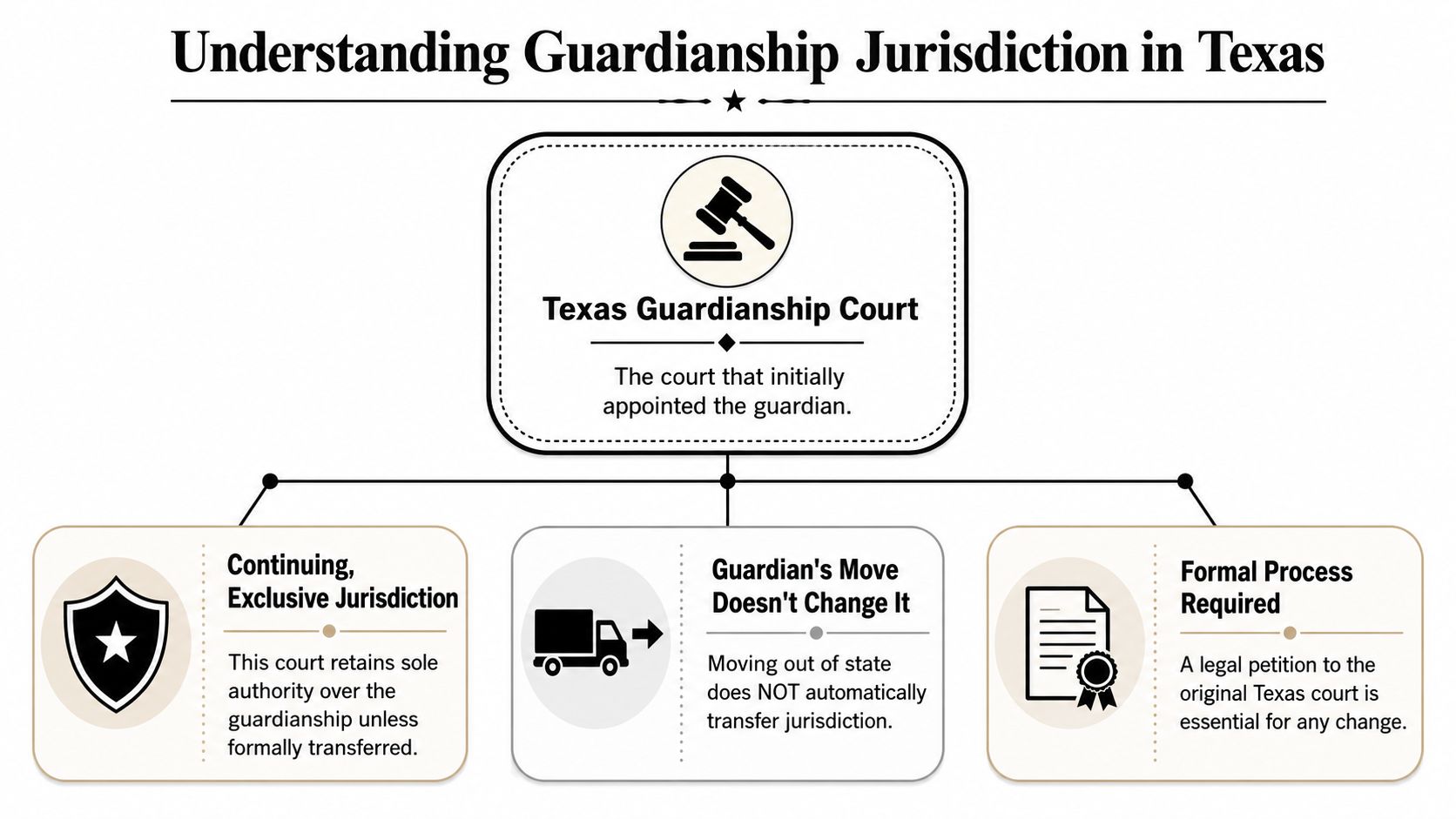
Under Texas Estates Code Title 3, Subtitle G, guardianship is a supervised court proceeding, not a private caregiving arrangement. That matters because the judge who appointed the guardian is responsible for ongoing oversight of the ward's person, estate, or both. If your case began in a court such as Harris County Probate Court or a statutory probate court in Travis County, that court doesn't lose interest just because a moving truck leaves Texas.
What jurisdiction means in plain English
Think of jurisdiction like the home stadium for the case. Texas is where the game started, where the rules were applied, and where the referee still has authority unless there is a formal handoff.
That's why a guardian usually can't just send a letter saying, “We moved to Oklahoma,” and expect the case to follow automatically. The court has to know where the ward will live, who will provide care, how money will be managed, and whether the move protects the ward's best interests.
Why interstate transfers have a separate rulebook
A major turning point came in 2007, when the Uniform Law Commission completed the Uniform Adult Guardianship and Protective Proceedings Jurisdiction Act, often called UAGPPJA. It was created to address recurring interstate problems such as identifying the ward's home state, deciding which state can appoint a guardian, transferring guardianships, and enforcing out-of-state orders, as described in this discussion of interstate guardianship transitions.
That matters because before a standardized approach, families could end up stuck between states with conflicting expectations.
If your family is dealing with a long-distance move for work or caregiving reasons, practical planning matters too. For example, families researching housing, transport, and timelines during a 2026 Boston to Texas relocation often discover that logistics move faster than court orders. Guardianship planning has to start earlier than the move itself.
The move is personal. Jurisdiction is legal. Texas courts care about both, but they treat them differently.
Texas law and the need for court supervision
Texas Estates Code provisions in Title 3, Subtitle G govern how guardians are appointed, supervised, modified, and, when appropriate, discharged. The details depend on whether the guardianship is over the person, the estate, or both, and whether the ward is an adult or a minor. But the core idea stays the same: the court must protect the ward from confusion, neglect, and unauthorized decision-making.
That's why a formal process matters even when everyone in the family agrees.
For a closer look at relocation-specific issues, families often find it helpful to review interstate guardianship issues involving moves to or from Texas.
The First Legal Step Court Notification and Approval
Before you focus on the new state, focus on Texas. In most situations, the first move is not packing. It's filing with the court.
A Texas guardian should expect to seek court permission before moving the ward's residence out of state. The exact filing name can vary by county and court practice, but families often describe it as a motion or application to change the ward's residence. The point is the same. You are asking the Texas court to approve the relocation and review the plan.
What the judge wants to know
A probate judge isn't looking only at your reason for moving. The judge is looking at the ward's life after the move.
That usually means the court wants clear information about:
- The new residence where the ward will live, including stability and suitability.
- The reason for the move, such as family support, employment, or access to care.
- The care plan for doctors, medications, supervision, schooling, therapy, or daily needs.
- The support network available in the new location.
- The ward's preferences if the ward can express them.
- The impact on assets and administration if there is a guardianship of the estate.
In Texas, courts act under a best interest standard in guardianship matters. That means the judge wants more than a good reason for you. The judge wants proof that the move helps the ward or, at minimum, doesn't harm the ward.
A simple example
Suppose James is guardian of his adult son in Bexar County. James wants to move to New Mexico after retirement. If he tells the court, “I just want to be closer to friends,” that may not be enough by itself.
If instead he shows that his son will live near a hospital system already familiar with his condition, that a sibling will help with transportation, that current benefits and care can be coordinated, and that housing is secured, the request becomes much stronger.
Courts respond better to a documented care plan than to a general promise that “we'll figure it out after the move.”
What to prepare before filing
A careful filing often includes records and details that answer concerns before the judge has to ask.
Consider gathering:
- Medical information that explains the ward's current needs.
- Residential details for the new home or facility.
- Provider information for doctors, therapists, or care staff in the new state.
- Transportation and support information showing how daily needs will be met.
- Family notices if relatives must be notified under court rules.
- A transition timeline that shows the move is planned, not rushed.
If your case involves a minor, notice and move rules can be especially technical. Families often benefit from reviewing Texas guardianship notice requirements before filing anything.
When emergency issues exist
Sometimes there isn't a clean timeline. A housing crisis, sudden medical need, or safety concern may force fast action. In those cases, temporary or emergency guardianship issues can overlap with relocation questions. Texas courts may still require formal approval, and the urgency doesn't erase the need for court authority.
If there is an emergency, act quickly, but don't skip the court process. Fast action and proper filings usually need to happen together.
Navigating Your Three Main Options After Approval
Once the Texas court approves the idea of relocation, the case usually moves into a decision phase. Approval to move does not always mean the same thing as approval to end Texas supervision. Families often have three practical paths, and each one works differently.
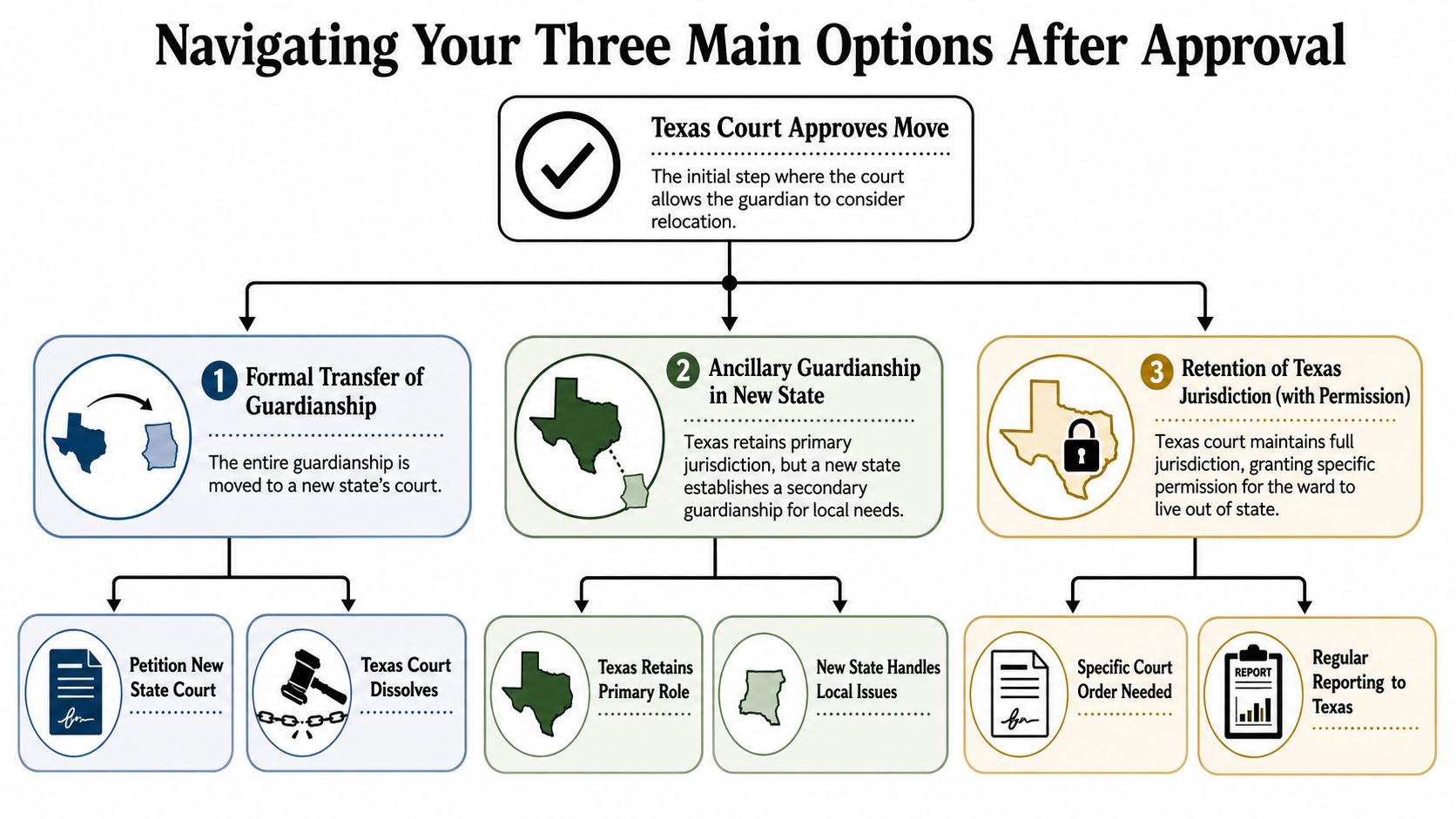
Maria, who lives in Houston, is guardian for her father. She needs to move to Colorado. Her father has medical needs, a monthly income, and a small estate. Maria has to decide not just whether he can move, but how the legal authority will follow him.
Option one formal transfer to the new state
This is often the cleanest long-term option when the ward is permanently relocating.
Under UAGPPJA, a transfer is designed as a two-step process. The original state issues a provisional transfer order, and the receiving state then decides whether to accept the case. Legal authority usually remains with the original court until the receiving court confirms the transfer, as explained by the Special Needs Alliance discussion of transferring guardianship between states.
For Maria, this path may make sense if her father is settling in Colorado for the foreseeable future and most care decisions will happen there.
Pros
- Better fit for a permanent move
- Local court oversight where the ward lives
- Easier day-to-day coordination after transfer is complete
Concerns
- Two courts are involved
- Timing matters
- Final authority doesn't shift until the receiving state accepts the case
A related planning issue is whether someone else may need to step in later. Families working through that question often also look at successor guardian appointment in Texas.
A short video can help make the options easier to picture before you choose a path.
Option two appoint a successor guardian
Sometimes the best answer is not moving the guardianship with you. It's handing responsibility to another qualified person.
That might be a sibling who remains in Texas, a relative already living in the destination state, or another suitable person approved by the court. This option can be helpful when the current guardian's move makes daily supervision unrealistic, or when the ward's strongest support system is somewhere else.
For Maria, if her father's doctors, community, and routines are all in Houston, and his brother is willing to serve locally, successor appointment may cause less disruption than a full interstate transfer.
Option three keep Texas jurisdiction with permission
In some situations, Texas may continue supervising the guardianship even after the ward lives elsewhere, so long as the court allows it and the guardian remains fully compliant.
This can work for a temporary arrangement, a trial period, or a situation where the family expects to return to Texas. It can also make sense when the estate is still centered in Texas and the court wants to keep close oversight.
But this path has a catch. The in-between risk doesn't disappear. You may still need extra steps in the new state for practical acceptance by providers or institutions.
If Texas keeps the case, that doesn't guarantee every out-of-state provider will immediately treat your authority as settled.
A side-by-side comparison
| Option | Best fit | Main benefit | Main risk |
|---|---|---|---|
| Formal transfer | Permanent move | Long-term authority shifts to the new state | Delay between provisional order and acceptance |
| Successor guardian | You can't continue effectively | Local decision-maker stays close to ward | Emotional difficulty of stepping aside |
| Texas retains jurisdiction | Temporary or mixed situation | Continuity with current Texas court | Ongoing overlap and reporting burdens |
Estate planning often overlaps with this decision. If your family is naming backups, reviewing powers of attorney, or planning for future incapacity, those steps should align with the guardianship strategy.
Your Unchanging Fiduciary Duties During a Move
Many guardians make the same mistake. They think once the court says the move is allowed, their Texas duties fade into the background.
They don't.
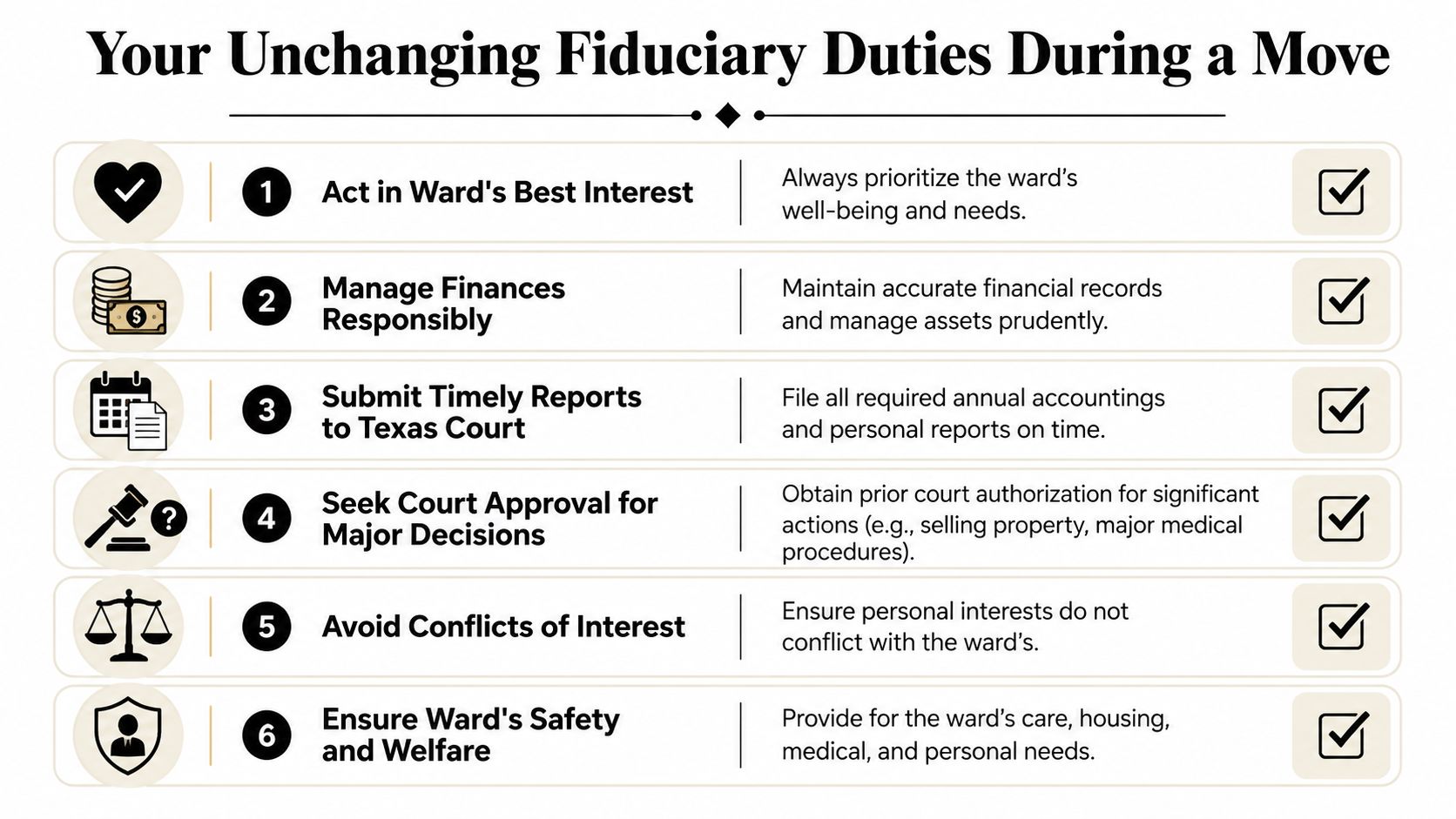
A guardian remains a fiduciary. That means you must act for the ward's benefit, follow court orders, protect money and property, and complete required reports until the Texas court officially transfers, modifies, or terminates your authority. Moving does not suspend those obligations.
Duties that stay in place
Under Texas guardianship practice, ongoing responsibilities may include annual reports about the ward's condition, annual accountings if there is a guardianship of the estate, recordkeeping, court approvals for certain major acts, and careful management of the ward's assets and care.
Here is a practical checklist to keep in front of you during a move:
- Track filing deadlines: Put Texas reporting dates on a shared calendar before you relocate.
- Keep complete records: Save receipts, bank statements, care invoices, and notes about major decisions.
- Update contact information properly: Give the court and counsel any change of address the right way and at the right time.
- Ask before taking major actions: If a decision normally requires court approval in Texas, the move doesn't erase that requirement.
- Separate your money from the ward's money: Never blur personal funds and guardianship funds during moving expenses.
- Monitor the ward's care daily: Housing, medication, appointments, and safety still come first during the transition.
Why this matters so much
The dangerous period is often not before the move. It's after the truck is unloaded and everyone is exhausted. That's when deadlines get missed and assumptions creep in.
A Texas court may still expect performance exactly as before. If you stop filing or stop following the order, the court may question whether you are still serving appropriately. In contested cases, another relative may use that lapse to seek removal or other relief.
Compliance protects more than the court file. It protects your ability to keep helping the person who depends on you.
If there is conflict in the family
Relocation often stirs up old disagreements. One sibling says the move is necessary. Another says it isolates the ward. A cousin raises concerns about spending. Those disputes can quickly turn into guardianship litigation.
When that happens, judges usually pay close attention to whether the current guardian followed rules carefully. Good records, timely reporting, and prior court approval can make a major difference in how the court views the move.
The same fiduciary principles often come up in probate and estate-related disputes too. Families dealing with asset management questions alongside guardianship concerns often need coordinated legal guidance rather than treating them as separate problems.
Get a Clear Path Forward for Your Family
If you're facing this issue now, the big takeaway is simple. What happens when a guardian moves out of state is a legal transition, not just a family decision.
You need a path that keeps authority continuous. That usually means asking the Texas court first, choosing the right legal structure after approval, and continuing every fiduciary duty until the court says otherwise. Skipping any of those steps can create confusion at exactly the wrong time.
A steady plan reduces the stress
Families usually feel better once they break the problem into pieces:
- First, confirm whether the move is in the ward's best interest.
- Then, get the right Texas court order before relocating.
- Next, decide whether transfer, successor appointment, or continued Texas supervision makes the most sense.
- Finally, keep every reporting and compliance duty active until the case is formally changed.
That sequence matters because it protects the ward from a lapse in decision-making authority.
When legal help is especially useful
Interstate guardianship issues can involve two courts, two sets of paperwork, and two different local practices. Even when the family agrees, the process can still be technical. If there is conflict, an emergency, a minor child involved, estate assets, or a need for temporary orders, the stakes go up fast.
One practical option is working with a Texas firm that handles guardianship filings, hearings, compliance, and related probate or estate planning issues, such as Law Office of Bryan Fagan, PLLC. The point isn't to add complexity. It's to create a clear roadmap and reduce the risk of a gap in legal authority.
No two families move for the same reason. Some are leaving Texas for medical support. Some are following work. Some are trying to keep an aging parent close to children and grandchildren. The legal answer should fit the specific family circumstances, not a generic checklist.
If your family is considering a cross-state move involving a ward, schedule a free consultation with Law Office of Bryan Fagan, PLLC. We can help you understand the Texas court process, evaluate transfer or successor options, and build a practical plan that protects your loved one without losing legal authority during the move.