Skip to content
Your brother lives in Georgia. Your mother is in Houston. The bills keep coming, the bank keeps asking for authority, and someone in the family has to make hard decisions fast. That is often the moment when people start asking whether a nonresident person appointed guardian for a Texas ward can happen, or whether Texas forces the family to pick someone who already lives here.
Texas does allow out-of-state guardians in some situations, but the rules are tighter than many families expect. The court will care about where the ward's estate is located, who can prove the need for guardianship, and whether a less restrictive option could work first. If you are sorting through funeral planning, property, or urgent care decisions from another state, a practical resource like out-of-state funeral planning tips can also help you think through the logistics families face when they live far apart.
If your concern is how a guardian move affects an existing case, this overview pairs well with what happens when a guardian moves out of state, because the friction often starts the moment distance enters the picture.
When Family Lives Out of State but the Ward Is in Texas
A daughter in Oklahoma may be the person who knows her father's bank accounts, mortgage, and medical paperwork better than anyone else. A son in Arizona may be the one keeping track of his mother's care, her Texas home, and the unpaid bills piling up while everyone else is trying to decide what to do next. Distance does not make those problems smaller. It usually makes the legal process harder to see.
Texas law does not close the door on an out-of-state family member. A nonresident can be appointed as guardian or co-guardian of a nonresident ward's estate located in Texas, and the county court where the ward's principal estate is located has jurisdiction to make that appointment (Texas Estates Code). For families, that gives a real path to protect Texas property without requiring a relative to relocate just to satisfy a court file.
Why the location of the estate matters
Guardianship is not only about family connection. It also depends on where the ward's property sits and where the court administration belongs. Texas follows the location of the estate, so an out-of-state applicant has to focus on the Texas county tied to the assets, not only on where the proposed guardian lives.
Practical rule: If the ward owns Texas property, the county tied to that estate can matter more than the proposed guardian's home state.
That point often catches families off guard. A relative may be fully willing to help, but the court still wants a filing that matches Texas procedure, a clear account of the Texas assets, and a proposed arrangement that can be carried out from another state. In some families, the cleanest answer is a local co-guardian who can handle tasks that require in-person contact while the out-of-state family member manages records, decisions, or oversight. When funeral issues are part of the same family planning conversation, out-of-state funeral planning tips can also help families think through the practical side of living apart.
For families trying to handle distant property, healthcare questions, and court deadlines at the same time, the issue is usually not care or commitment. It is whether the proposed guardian can show the court a workable plan under Texas procedure. Starting early, gathering records, and identifying the Texas assets before anyone files can reduce a lot of avoidable friction.
Texas Residency and Qualification Rules for Guardians
A family member can be willing to help and still fail the court's qualification test. Texas judges begin with the person, not the sympathy behind the request. They look at adulthood, any disqualifying issues, and whether the proposed guardian can carry out the job. Residency matters, but it does not automatically end the inquiry.

The general rule and the exception
Texas courts usually want a guardian who can stay involved and respond quickly. A nonresident can still serve in the right estate-based case, so living outside Texas does not close the door by itself. The practical question is whether the proposed guardian can handle a Texas ward's affairs from another state without creating gaps in care or court compliance.
That said, the court still checks suitability. Suitability includes whether the person is reliable, honest, available, and able to follow court orders. A person who lives far away and cannot realistically keep up with ongoing duties may not be the best fit on their own. A local co-guardian can sometimes solve that problem by handling tasks that require in-person attention while the out-of-state family member stays involved in decisions, records, or oversight.
The product page for Guardianship of an Incapacitated Adult in Texas explains how Texas courts create guardianships for adults who cannot manage their affairs, and that framework helps families decide whether a full guardianship is the right tool or whether a less restrictive option may fit better.
Where families get tripped up
A close family relationship does not automatically satisfy the court. Texas judges still want proof that the proposed guardian can do the work, protect the ward, and follow the order once the appointment is made. Some families assume a resident will always be preferred over a nonresident, but the court's focus stays on who can serve effectively.
If a family member lives out of state but already manages the ward's property carefully, that can support the appointment. If the person is hard to reach or slow to respond, the court may hesitate.
A Texas co-guardian strategy can help when duties are split between distance and daily contact. One person can handle on-the-ground issues, while the nonresident family member monitors finances, communication, or larger decisions. That kind of arrangement can reduce friction for families dealing with interstate guardianship issues when moving to or from Texas, but the judge still has to approve the structure before it becomes effective.
Jurisdiction and Venue in Texas Guardianship Cases
A Texas guardianship filing can stall when a family treats jurisdiction and venue as the same thing. They are related, but they answer different questions. Jurisdiction asks whether the court has authority to hear the guardianship at all. Venue asks which county is the proper place to file. If those two ideas get crossed, the case can start with confusion instead of forward motion.
For a ward whose principal estate is in Texas, the county tied to that estate may have authority to appoint a guardian, as explained in the Texas Estates Code. That is why a family with property in one county may need a different filing plan than a family dealing with records, accounts, or land in Harris County Probate Court. The court looks at where the Texas connections really are, not just where a relative hopes the case will be heard.
Filing in the right county
An out-of-state applicant should start with three questions. Where does the ward live? Where is the ward's Texas property? Which county has the strongest connection to the ward's principal estate? Those facts usually point to the county that should receive the application.
A simple way to look at it is this, the filing should match the Texas facts that matter most. If the ward has a home, accounts, or land in a particular county, that county may be the one the court expects to see in the petition.
Practical rule: A guardianship filing that ignores the Texas county tied to the estate can create avoidable delay.
Venue disputes often surface when relatives are not on the same page. One sibling may want the case filed near the ward's residence. Another may want the filing where the property records, bank records, or other documents are kept. Those disagreements can slow the case, increase cost, and add pressure to an already difficult family situation.
If the family is dealing with a move into Texas, a move out of Texas, or a ward whose affairs cross state lines, the filing questions can become harder to sort out. The guide on interstate guardianship issues moving to or from Texas can help families compare those filing choices, since interstate cases often rise or fall on where the court should hear the matter.
Why local court practice matters
Even when the statutes point to a county, the local court still expects a careful filing. Probate judges want organized petitions, clear exhibits, and proof that the chosen county really fits the case. If the papers are incomplete or the venue choice is weak, a family may have to correct the filing or fight over the proper court before the case can move ahead.
The safest approach is to match the application to the Texas estate facts, then support that choice with records. Deeds, account statements, and medical records often help show why one county is the right place to file. That kind of preparation gives the court a clearer path to review the request without unnecessary confusion.
How an Out-of-State Person Can Be Appointed Guardian
A Texas guardianship case for an out-of-state family member starts with proof, not promises. The judge must find, by clear and convincing evidence, that the proposed ward is incapacitated, that guardianship serves the ward's best interest, that the ward's rights or property will be protected, and that alternatives to guardianship and available supports and services were considered and found not feasible (Texas Estates Code). The court must also find, by a preponderance of the evidence, that venue is proper, the proposed guardian is eligible, and the ward lacks the needed capacity.

Build the case before filing
The first step is to gather evidence that answers the court's practical questions. Families usually need medical records, a physician's explanation of the ward's condition, and facts showing why less restrictive options will not solve the problem. Texas judges want concrete information, not general concern or a family argument about who should be in charge.
That proof should also show what the ward can still do safely and where help is needed. A partial-capacity case may call for a specific order that addresses decisions about residence, voting, driving, and marriage. The same point appears in the statute, but the key idea is simple, the court may narrow the guardianship instead of giving one person full authority over every decision.
Out-of-state applicants often do better when they organize the file like a court-facing plan. That means identifying the ward's property, collecting account information, and documenting the choices the ward can and cannot make without help. A judge can follow that path more easily than a file built only around urgency.
Anticipate the judge's concerns
Distance is the first concern the court usually sees. A guardian who lives in another state may still be the right person, but the judge will want to know who can check on the ward in person, how bills will be handled, and how the guardian will stay current with court orders and deadlines. Those questions are practical, because a distant guardian can care and still miss the day-to-day tasks that keep the case on track.
A strong filing answers those concerns before the judge asks them. Name the local doctors, the banks, the caregivers, and the family members or helpers who can handle immediate logistics. Then explain the system for tracking paperwork and staying in contact with the Texas court.
The guide on Less Restrictive Alternatives to Guardianship in Texas is useful here because Texas courts must consider alternatives before appointing a guardian. Powers of attorney, supported decision-making, and similar arrangements may solve part of the problem while preserving more independence for the ward. A family that shows it has considered those options usually gives the court a clearer basis for deciding whether guardianship is needed.
Temporary emergencies need stronger proof
When the situation is urgent, the court still expects specific proof. The temporary guardianship statute requires a substantial threat of imminent harm to the ward or the ward's estate, and the danger must require immediate appointment to protect the person or property (temporary guardianship statute). Recent hospital records, financial records, or witness testimony often matter most in that setting because they show why the court cannot wait.
Emergency guardianship is narrow for a reason. Judges want facts that show delay could cause real harm.
If the court grants temporary relief, the guardian can act for up to 60 days, and the court can extend that for one additional 60-day period if needed. That short window gives the family time to stabilize the situation while the full guardianship case moves ahead.
Common Scenarios Where Nonresident Guardianship Makes Sense
Some family setups work well with a nonresident guardian. Others create more trouble than they solve. The right answer depends on who is closest to the ward, who understands the finances, and who can satisfy the court that the arrangement will work.
Situations that can fit a nonresident guardian
An out-of-state adult child may be a good fit when that person already handles the money, keeps the records, and stays in regular contact with doctors in Texas. A sibling living elsewhere may also be the practical choice if the ward's Texas property needs oversight and no local relative is willing or able to step in.
The setup can also work when the family has one person with the most financial knowledge, even if that person does not live in Texas. The court usually cares less about geography than about whether the guardian can protect the ward and follow orders.
Where friction usually shows up
Distance complicates oversight. A guardian who lives several states away may struggle with hospital visits, bank issues, and quick court deadlines. That does not make the person unfit by itself, but it does force the family to build a stronger support system.
There is also the issue of local familiarity. A guardian who has never dealt with a Texas probate court may need more help understanding filing practices, notice rules, and accounting expectations. Families sometimes underestimate that part until a deadline is missed.
When another structure may be better
A Texas-based co-guardian can solve some of the distance problems. In other situations, a power of attorney or supported decision-making can avoid the need for guardianship altogether if the ward still has enough capacity to use those tools. A nonresident guardian is not always the most efficient answer.
The best structure is the one the court can supervise and the family can actually maintain.
Texas courts also respect family dynamics, which means a judge will look closely at disagreements among relatives. If the nonresident applicant is calm, organized, and backed by records, the case is easier to defend. If the applicant is only one voice in a conflict, the court may look for a less contentious solution.
Fiduciary Duties and Ongoing Court Compliance
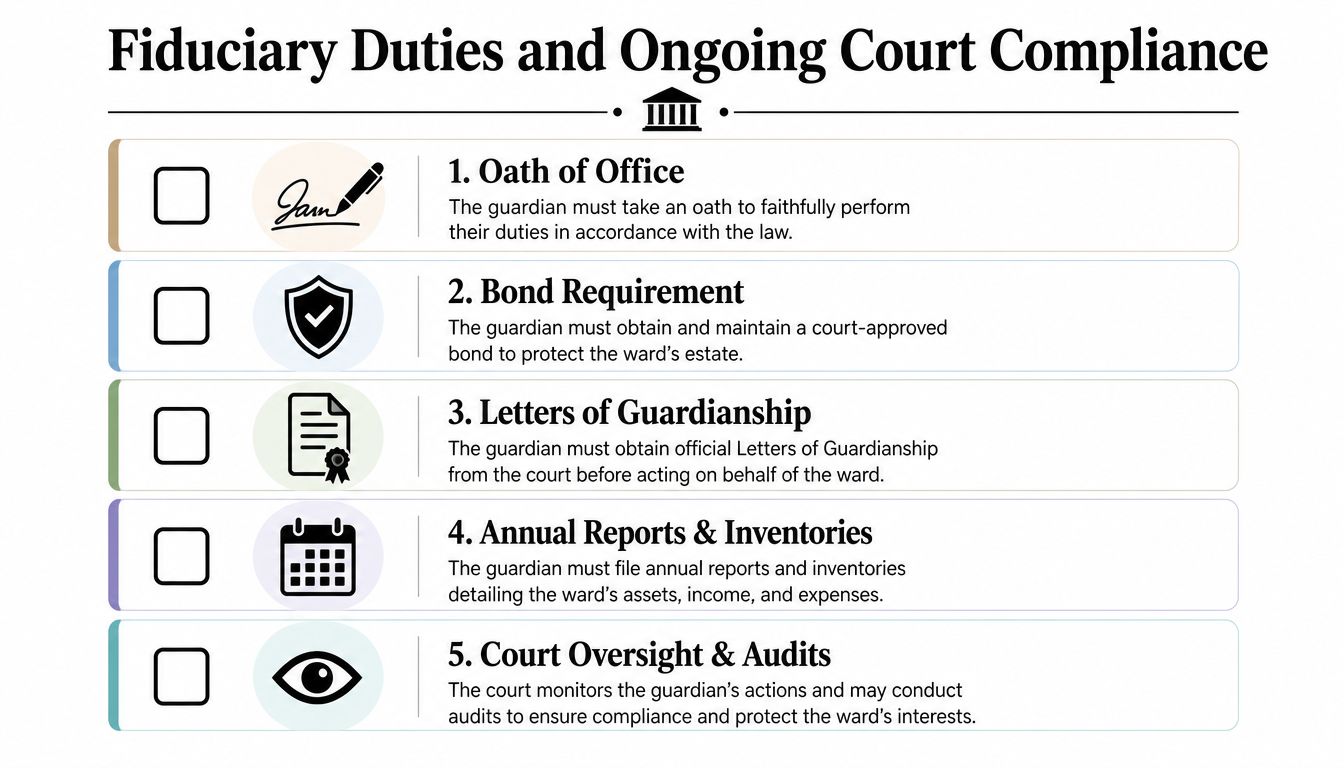
Once a guardian is appointed, the work begins. Texas law and court guidance require the guardian to take an oath, post any required bond, and obtain Letters of Guardianship to prove authority; those letters expire after 16 months, so they must be renewed through the required filing process (TexasLawHelp). Courts rely on those filings to see whether the guardian is still acting in the ward's best interest, so missed deadlines can create immediate problems.
The job after appointment
A guardian must keep reporting and accounting obligations current, including annual reporting and financial oversight. For a nonresident guardian, that duty carries extra weight because the court may want to see that distance has not turned into missed notices, scattered records, or slow responses to problems. The guardian has to show that remote management is still organized management.
A filing system should work like a standing calendar, not a folder that gets opened only when someone remembers it. Save receipts, track bank activity, keep medical updates, and store copies of every order and letter. If something changes, write it down right away so the court record matches the guardian's conduct.
The risk of missing compliance
Texas courts can intervene when a guardian misses reports, mishandles funds, or fails to comply with filing deadlines. In a dispute or termination case, that can decide whether the guardian keeps authority or loses it. Families often focus on getting appointed and overlook the fact that compliance is part of the appointment itself.
For an out-of-state guardian, local support can prevent avoidable mistakes. A Texas accountant, attorney, or trusted family contact can help catch a missed filing or a banking issue before it turns into a court problem. The goal is not to hand off responsibility, it is to build a system that can be sustained from a distance.
Families that want a closer look at those post-appointment duties can review ongoing responsibilities of a guardian what most people underestimate, which explains how quickly the day-to-day side of guardianship can become harder than the appointment process itself.
When guardianship may no longer be needed
Guardianship is not meant to continue unchanged if the ward improves or if a less restrictive option starts to fit better. Families should revisit the arrangement when the ward's condition changes, because the court can consider whether continued guardianship still makes sense. If the ward regains capacity or another structure can protect the person better, termination or modification may be appropriate.
Keep asking one simple question. Does the current guardianship still protect the ward in the least restrictive way possible?
Next Steps for Families Considering a Nonresident Guardian
If you are weighing whether an out-of-state relative should serve, start with the facts. Collect medical records, identify the Texas property, and think through whether a local co-guardian, agent, or supported decision-making arrangement could reduce court concerns. The earlier you sort out the county, the evidence, and the day-to-day logistics, the fewer surprises you will face in probate court.
A Texas guardianship lawyer can help you decide whether the case belongs in full guardianship, temporary guardianship, or a less restrictive path. That guidance matters most when family members live in different states and everyone is trying to protect the same person in different ways.
The Law Office of Bryan Fagan, PLLC helps Texas families evaluate guardianship options, prepare filings, and understand court duties in cases involving a Texas ward and an out-of-state family member. If you need guidance on residency, venue, compliance, or whether a nonresident person appointed guardian for a Texas ward is the right solution, visit Law Office of Bryan Fagan, PLLC to schedule a free consultation and get personalized help for your family's situation.