Skip to content
A lot of families reach this question in the same painful way. A parent falls at home. An adult child with disabilities starts needing more support than the family can safely provide. Siblings disagree about whether a loved one should stay in their house, move in with family, or enter assisted living. What starts as a caregiving problem quickly becomes a legal one.
If you're asking whether a guardian can control where someone lives in Texas, you're probably not looking for abstract legal theory. You want to know who gets to decide, what limits apply, and what to do if the family disagrees. You may also be worried about doing the right thing without taking away more independence than necessary.
The short answer is yes, a guardian of the person may have authority over where a ward lives in Texas. But that power isn't absolute. In Texas, residence decisions sit inside a court-supervised guardianship process, and the court can narrow, review, or limit that authority based on the ward's actual needs and best interests.
That distinction matters. A guardianship order isn't a blank check. It's more like a set of instructions from the court. The judge decides what powers the guardian has, what rights the ward keeps, and when the guardian must come back to court before making a major change.
The Heart of the Matter Protecting a Loved One's Home
Maria lives in Dallas. Her mother has been living alone in Fort Worth for years, and she's proud of it. After a recent hospital stay, Maria starts noticing missed medications, spoiled food in the refrigerator, and confusion about doctor appointments. Her brother says their mother should stay home with help. Maria thinks assisted living may be safer. Their mother says she isn't going anywhere.
Many Texas families find themselves in this position. The issue isn't just housing. It's dignity, safety, routine, family guilt, and the fear of making the wrong choice for someone you love.
When people ask, "Can a guardian control where someone lives in Texas?" they're often really asking several questions at once:
- Can safety outweigh independence
- Does the loved one's own preference still matter
- Can one family member force a move
- Will a judge review the decision
- Is guardianship even the right tool
Practical rule: In Texas, the real question usually isn't who wants the move. It's whether the guardian has that authority in the court order and whether the move serves the ward's best interests.
Texas guardianship law tries to balance two important goals that can feel like opposites. One is protection. The other is preserving as much personal freedom as possible. That's why families are often surprised to learn that even after a guardian is appointed, the court may still limit what that guardian can do.
If you're carrying this decision right now, you're not alone, and you're not expected to guess your way through it. The legal system can provide structure. It can also slow things down, which is frustrating when a loved one needs help quickly. Still, that court oversight exists for a reason. It protects the ward from unnecessary loss of rights and helps families justify difficult decisions when conflict arises.
Guardianship of the Person vs The Estate in Texas
The first source of confusion is simple. Not every guardian has the same job.
Under Texas Estates Code Title 3, Subtitle G, guardianship can be split into different roles. One person may be in charge of personal decisions. Another may be in charge of money and property. Sometimes the same person fills both roles, but not always.
Two different kinds of guardians
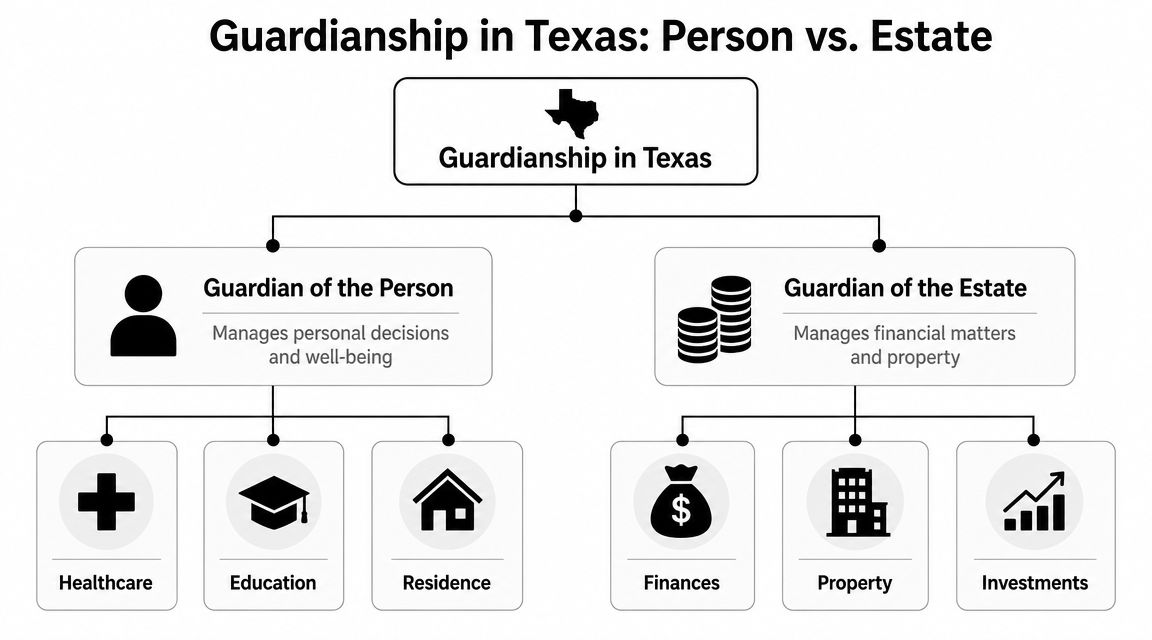
Think of a guardianship order like a job description signed by a judge.
| Role | Main focus | Typical decisions |
|---|---|---|
| Guardian of the person | Daily life and personal well-being | Residence, care, supervision, medical support |
| Guardian of the estate | Money and property | Bills, assets, financial management |
If the question is where someone will live, you're usually looking at the authority of the guardian of the person, not the guardian of the estate.
A guardian of the estate may control funds that pay for housing, but that doesn't automatically mean they decide the actual placement. That distinction matters when family members assume the person handling the money also controls personal decisions.
Full authority and limited authority
Texas doesn't treat every guardianship the same way. As explained in Texas guidance on who can serve as a guardian, a guardian of the person can make decisions about a ward's living arrangements, but Texas uses a limited-versus-full guardianship model, so the court can restrict authority to only those areas where the person lacks capacity.
That means the answer isn't a simple yes or no. It depends on the court's order.
A full guardianship gives broader authority. A limited guardianship gives only the powers the judge believes are necessary. If the person can still make some decisions safely, the court can preserve those rights.
A limited guardianship is the court's way of saying, "Protect the person, but don't remove more decision-making than necessary."
This is one reason families should read the signed guardianship order carefully. People often rely on assumptions. Judges rely on the wording of the order.
Why this matters in real life
Suppose an adult son is appointed guardian for his father in Harris County Probate Court. If the order gives him full authority as guardian of the person, he may have broad power to address residence issues. If the order is limited, the judge may have left some housing-related choice with the ward or required extra review before a move.
Families comparing Texas law to other states also get tripped up by terminology. Some states use "conservatorship" in ways that overlap with guardianship. If that has caused confusion in your family, this guide on guardianship vs. conservatorship for Texans can help sort out the language.
Another practical issue involves who can serve. Texas sources note that a guardian generally must be an adult and, unless the court approves an exception, a Texas resident. A non-resident may still serve if the court allows it and the person appoints a Texas registered agent. That doesn't answer where the ward will live, but it often affects who is in a position to ask the court for authority in the first place.
Defining a Guardian's Authority to Choose a Residence
The direct answer is this. A guardian of the person with full authority can establish the ward's residence in Texas. But that power comes bundled with duties. The law doesn't let a guardian move someone around based on convenience, family pressure, or personal preference alone.

Residence power comes with care duties
A guardian of the person isn't just allowed to pick an address. The guardian must also provide or arrange care, supervision, protection, food, clothing, medical care, and shelter. That's why housing decisions are tied to the person's actual needs.
As described in Texas guidance on a guardian's powers and duties, a guardian of the person with full authority can establish the ward's residence, but must also give prior notice to the court before placing the ward in a more restrictive care facility.
That changes how families should think about a move. The issue isn't "Can the guardian make Mom move?" The issue is more like, "Can the guardian show that this placement matches Mom's care needs and follows court rules?"
What counts as a more restrictive move
A move from one apartment to another may not raise the same concerns as a move from home into a locked memory care setting. The more restrictive the placement, the more likely it is that the court will expect notice, supporting information, or closer review.
Here is a simple way to understand it:
- Less restrictive setting means more personal freedom, more privacy, and fewer limits on daily movement.
- More restrictive setting means closer supervision and more limits, often because of safety, medical, or cognitive concerns.
The law treats a residence decision as part of the ward's care plan, not as a simple family housing choice.
The best-interest standard
Texas guardians must act in the ward's best interests. In real life, that standard often sits at the center of family conflict.
A ward may want to remain at home because home feels familiar and dignified. A guardian may believe the home has become unsafe. A sibling may think the guardian is overreacting. Another may think the guardian waited too long.
The best-interest standard doesn't erase the ward's wishes, but it does mean the guardian must weigh those wishes against safety, medical needs, supervision, and available support. Courts tend to look closely at whether the guardian can explain the decision in concrete terms.
Questions a guardian should be ready to answer
Before changing a ward's residence, a careful guardian should be able to explain:
- Why the current living arrangement no longer works
- What specific care needs the new placement addresses
- Whether the move increases restriction
- How the ward's preferences were considered
- What alternatives were tried first
Those aren't just good family talking points. They're often the same issues that matter if the court reviews the decision later.
Navigating Real-Life Residency Decisions
The hardest part of this area of law is that no two families walk into the same facts. A rule that seems clear on paper can get messy fast once you add distance, sibling conflict, and a loved one's own wishes.
Texas families often do better when they stop asking whether a guardian has total control and start asking what facts would justify the move if a probate judge reviewed it later.
A move from home to assisted living
A daughter in Dallas is guardian of the person for her mother, who lives alone in Fort Worth. After repeated medication mistakes and nighttime wandering, the daughter finds an assisted living community close to her own home. She wants the move so she can visit often and respond quickly if something goes wrong.
That may be a sensible plan. But the guardian should still think through several points:
- Safety needs: What changed in the mother's condition
- Care fit: Can the new facility meet those needs
- Distance from supports: Will the move cut the mother off from familiar doctors, church, or friends
- Restriction level: Is this placement more restrictive than the current one
If the move is to a more restrictive facility, prior notice to the court may be required. The decision should be grounded in care, not convenience.
An out-of-state guardian wants to move the ward
This scenario comes up often. A son lives in Oklahoma or Louisiana and wants his father moved out of Texas so he can personally supervise care.
Texas law can make this more complicated than families expect. Residence issues are tied to the guardianship order and the Texas court supervising the case. If the ward is in Bexar County or Harris County, that Texas court retains an important role in reviewing changes that affect the ward's living situation.
The practical question becomes whether the move serves the ward's best interests better than staying in Texas with local support. Family availability matters. So do medical providers, continuity of care, and disruption to the ward's routine.
The ward objects to the move
A ward may say clearly, "I want to stay in my own home." That statement matters, even when the guardian disagrees.
According to the Lone Star Legal Aid Guardianship 101 guide, the legal question isn't just whether a guardian can control where someone lives, but when a court can review or limit that control. Because Texas requires guardians to act in the ward's best interests, conflict between the guardian, family, and ward can become a reason for court review.
A ward's preference isn't automatically controlling, but it should never be treated as irrelevant.
If you're dealing with a nursing home or facility decision specifically, this discussion of whether a guardian can put someone in a nursing home in Texas may help you frame the issue.
What judges often care about most
When families fight over residence, courts usually focus less on who is the loudest and more on who is the most prepared. A guardian who has medical records, a clear care plan, and a thoughtful explanation will usually stand on stronger ground than one who says only, "I think this is best."
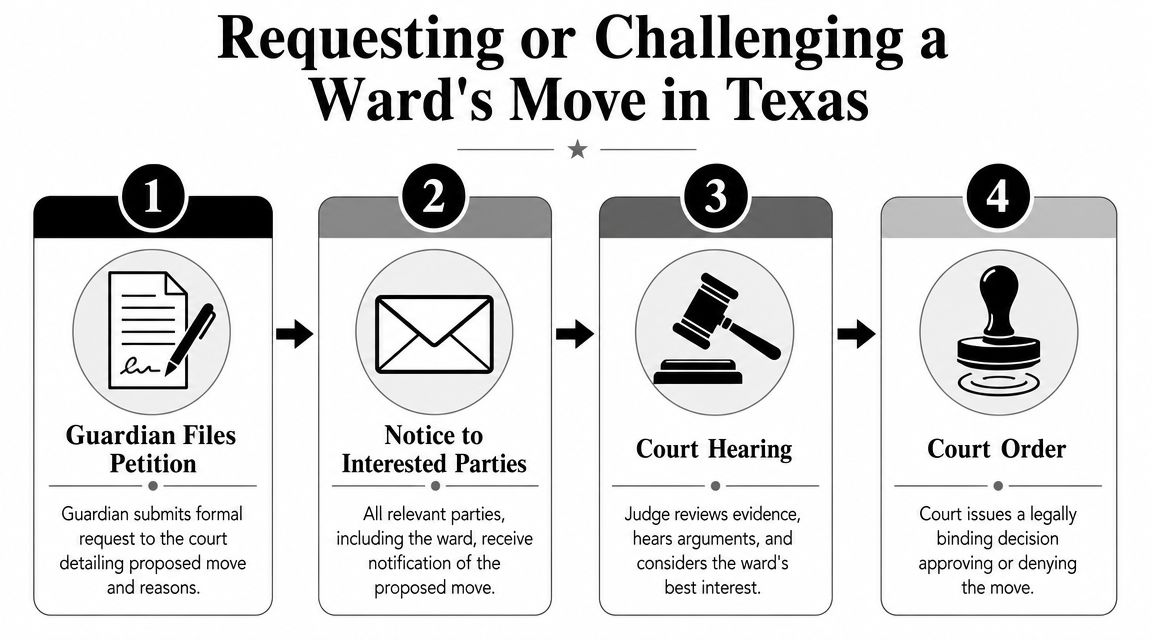
How to Get Court Approval or Challenge a Move
When a residence change may need court involvement, families need a practical plan. That usually means gathering records, identifying the legal request, and making sure the judge sees a complete picture of the ward's needs.
This is also where timing matters. Guardianship in Texas is supervised closely, and the guardian's authority doesn't last forever without compliance.
Building a request the court can evaluate
Under Texas Law Help's guardianship overview, guardianship is highly procedural. After appointment, a guardian must sign an oath within 20 days, post a bond, and receive Letters of Guardianship that expire after 16 months. To continue authority, the guardian must complete the required renewal steps. Texas Law Help also notes that a doctor must certify incapacity, the proposed ward must be personally served, an attorney ad litem is appointed, and the probate court monitors the case.
That means a guardian asking to change residence should start by checking the basics:
Confirm your authority
Make sure your Letters of Guardianship are current and your appointment is active.Review the signed order
Look for any limits on residence decisions or notice requirements.Gather supporting proof
Doctors' letters, care assessments, discharge paperwork, or facility acceptance information can help the court understand why the move is needed.Use the right filing
Depending on the situation, the attorney may recommend a motion to modify the guardianship, a request related to placement, or a venue-related filing if the case needs to be handled in a different county.
A transfer issue may need its own legal analysis. If county location is part of your problem, this article on transfer of guardianship to another county in Texas is a useful starting point.
Here is a short overview of the process families often want to understand visually:
How to challenge a proposed move
Family members sometimes believe a guardian is acting too quickly, choosing an unnecessarily restrictive setting, or ignoring the ward's wishes. In that situation, the challenge usually centers on the same core point: the move is not in the ward's best interests.
A challenge may involve:
- Filing an objection: Ask the court to review the proposed change.
- Presenting alternatives: Show that in-home care, a different facility, or local family support would protect the ward with less restriction.
- Working with the attorney ad litem: The ward's court-appointed lawyer may help bring the ward's wishes and concerns to the judge's attention.
Courts want specifics. "This move feels wrong" is weak. "This facility is more restrictive than necessary, and home care is available" gives the judge something to evaluate.
Temporary and emergency concerns
Sometimes families don't have the luxury of waiting calmly. A ward may be leaving the hospital, may be unsafe at home, or may need immediate supervision. In those moments, temporary or emergency guardianship issues can arise.
Even then, families should resist shortcuts. Fast action still needs legal support, clear evidence, and attention to the ward's rights. In busy courts such as Harris County Probate Court or Dallas County probate courts, preparation often makes the difference between a smooth hearing and a delayed one.
Exploring Alternatives and Seeking Legal Guidance
Guardianship can be necessary, but it should never be the automatic first answer. Texas law generally aims for the least restrictive means of protection. A guardianship case is usually filed in the county where the proposed ward resides, and the court can tailor the scope of authority rather than grant blanket control, as reflected in Texas guardianship venue and scope rules.
For some families, a less restrictive option may work better. That can include powers of attorney, supported decision-making, or structured caregiving help. If you're sorting out planning tools before capacity is fully lost, this resource on understanding power of attorney gives a plain-language overview of why advance planning matters.
Options families often discuss first
- Medical and financial planning documents: These can help a trusted person assist with decisions before guardianship becomes necessary.
- Supported decision-making: In some situations, a person can keep decision-making rights while getting help understanding choices.
- Targeted court relief: Sometimes the problem is narrow, and the family doesn't need full guardianship authority.
Families also benefit from looking at connected areas of planning. Questions about residence often overlap with probate matters and estate planning options. If guardianship is already on the table, a focused guardianship overview can help you organize the next step.
The practical reality is that residence disputes are rarely just about an address. They're about care, rights, evidence, and court supervision. The Law Office of Bryan Fagan, PLLC handles guardianship applications, modifications, disputes, and compliance matters for Texas families who need help presenting those issues clearly to the court.
If your family is struggling with whether a loved one can stay at home, move into assisted living, or challenge a guardian's decision, a personalized legal review can make the next step much clearer. Law Office of Bryan Fagan, PLLC offers free consultations for Texas families who need guidance on guardianship, probate, and planning options.