Skip to content
A lot of families reach this point the same way. An elderly parent can no longer manage alone in a smaller county, and the adult child who has been serving as guardian needs to move that parent closer to specialists in Houston, Dallas, Austin, or San Antonio. Or a minor under guardianship needs to relocate because the family’s housing, school support, and daily care are now in a different part of Texas.
When that happens, the legal question usually sounds bigger than it is. Families ask whether they have to start all over, whether the court will force them to stay in the original county, and whether moving the ward will interrupt medical decisions, finances, or reporting duties. Those fears are understandable. Guardianship already carries a lot of responsibility, and a move can feel like one more layer of stress.
In many situations, transfer of guardianship to another county texas is the tool that keeps the guardianship practical and centered on the ward’s daily life. The goal isn’t paperwork for its own sake. The goal is to place the case in the county that now makes the most sense for hearings, care coordination, family access, and court supervision.
Why Families Need to Transfer a Guardianship
A transfer usually becomes necessary because life changed after the guardianship was opened.
One common example is an aging parent who originally lived in a smaller community but now needs regular appointments at a major medical center. Another is a guardian who has been faithfully caring for a loved one but can no longer do that from a distance after a job change or family move. In both situations, leaving the case in the old county often creates avoidable strain. Hearings are harder to attend. Local providers may no longer be near the ward. Family support may now exist somewhere else.
Real life reasons courts understand
Courts tend to understand practical reasons when they are clearly tied to the ward’s welfare. That includes situations such as:
- Medical access: The ward now receives care in a different county and needs doctors, therapy, or support services there.
- Family support: The ward moved to be near the guardian or relatives who help with daily care.
- Residential stability: The ward now lives in a more suitable home, assisted living setting, or other supervised environment.
- Court convenience: It makes more sense for future hearings and filings to happen where the ward lives.
These cases are rarely just about geography. They’re about whether the court supervising the guardianship still matches the ward’s real life.
Families often feel guilty about the move itself. In practice, a well-supported transfer request often shows the opposite of neglect. It shows the guardian is trying to keep the arrangement workable and safe.
What transfer means in plain English
A county-to-county transfer doesn’t mean you are creating a brand-new guardianship from the ground up. It means asking the current Texas court to send the existing case to another Texas county so the receiving court becomes the one supervising it going forward.
That distinction matters. When families understand that the transfer is meant to preserve continuity, the process usually feels less intimidating. The right preparation can make it much smoother.
Understanding the Legal Grounds for a Transfer
Texas courts don’t approve a transfer just because a family prefers a different courthouse. The request has to fit the legal standards in the Estates Code, and the court will focus on what protects the ward.

Under Texas Estates Code Section 1023.005, a court may transfer an existing guardianship to another county if the transfer is in the ward’s best interest and the ward has lived in the new county for at least six months, or if there is no good cause to deny the transfer, while also considering convenience, justice, and the ward’s preference if the ward is 12 or older, as discussed in this overview of Texas guardianship transfer rules under Section 1023.005.
Best interest of the ward
Best interest of the ward is the center of the analysis. In everyday terms, that means the court wants to know whether the move improves the ward’s care, stability, or access to support.
That can include facts like these:
- the ward now lives near treating physicians
- the guardian can provide more direct supervision in the new county
- close relatives who assist with transportation or daily needs are nearby
- the ward’s housing is more secure or better suited to the ward’s limitations
A weak transfer request usually focuses on the guardian’s convenience alone. A stronger request ties every reason back to the ward’s health, safety, comfort, and ongoing supervision.
The residency piece
The six-month residency point matters because courts want to see that the move is real, not tentative. If the ward has been in the new county long enough, that helps show the transfer reflects an established living arrangement rather than a temporary plan.
Still, residency is not the only consideration. The statute also allows room for the court to consider whether there is any good cause to deny the transfer. That means a family should think beyond addresses and prepare a fuller picture of why the move makes sense.
The ward’s own voice
If the ward is 12 or older, the court may consider the ward’s preference. That doesn’t mean the ward alone decides venue. It does mean the court may want to hear whether the ward feels safer, more supported, or more comfortable in the new county.
For families, this is an important human step. Don’t treat the ward as an afterthought. If the ward can express a preference, prepare respectfully. Explain where hearings may happen, who will be nearby, and how daily care will continue.
Practical rule: A transfer request is stronger when the papers, the witnesses, and the ward’s day-to-day reality all point in the same direction.
Grounds that usually work and grounds that usually don’t
The difference often comes down to proof.
| Situation | Usually stronger | Usually weaker |
|---|---|---|
| Move for medical reasons | Records, appointment history, provider proximity | General statement that care is “better” |
| Move near family | Names of caregivers and specific help provided | “Family is around there” without details |
| New residence | Lease, placement paperwork, stable address | Temporary stay with no long-term plan |
| Ward preference | Age-appropriate explanation of the ward’s wishes | No effort to address the ward’s viewpoint |
Title 3 Subtitle G matters here
Guardianship transfer issues sit within Title 3, Subtitle G of the Texas Estates Code, which is the larger part of Texas law dealing with guardianship procedure, duties, and court supervision. That matters because the transfer isn’t isolated from the rest of the case. The judge will still expect the guardian to be in compliance, still focused on the ward, and still acting as a fiduciary.
Families sometimes assume a move itself will persuade the court. Usually, it won’t. A clear legal reason, backed by practical proof, is what moves the request forward.
Your Roadmap for Filing a Motion to Transfer
A transfer case usually goes off track for ordinary reasons. The ward has already moved, the family is focused on care, and the court file has not caught up. What the judge sees is not the stress behind the move. The judge sees an application, the supporting papers, the notice, and whether the file is current enough to be transferred.
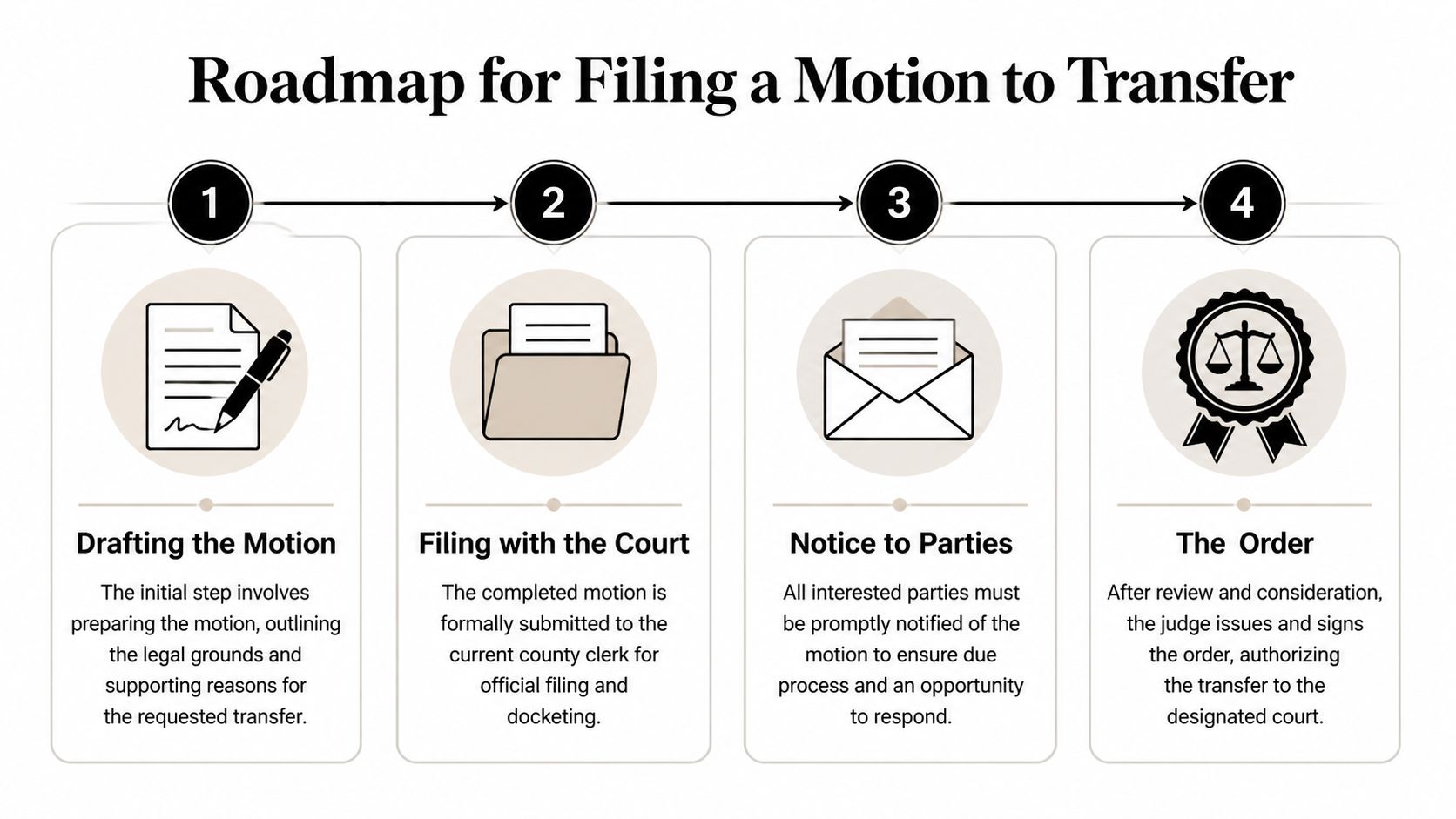
Under Chapter 1023 of the Texas Estates Code, the transfer starts in the county where the guardianship is pending now. The application is generally filed under Section 1023.003. Notice follows under Section 1023.004. If the court signs the transfer order, the receiving county accepts the case under Section 1023.008 and becomes the court with continuing jurisdiction. Those steps sound mechanical, but they are not. Each one gives the two courts enough information to pass the file cleanly without losing supervision of the ward.
File in the current court, with facts the receiving court can use
The request begins in the original court, not the county where the ward recently moved. If the guardianship is open in Harris County, the transfer application starts there even if the ward now lives in Dallas County or Tarrant County.
That point causes confusion more often than it should.
Families sometimes assume the new county can take over because the ward now lives there. It cannot. The original court has to authorize the transfer first, and the receiving court needs a clear record showing why the move makes sense and where the ward is living now.
A useful application answers the questions both courts will ask:
- Where is the case pending now? Identify the current court and cause number.
- Where should it go? State the county where transfer is requested.
- Where does the ward live today? Give the full current address or facility information.
- When did the move happen? Include the date or at least the time frame.
- Why did the move occur? Explain the actual reason, such as medical care, family support, placement, or guardian relocation.
- How does the move improve supervision and care? Connect the transfer to daily life, appointments, caregiving, and oversight.
- What type of guardianship is involved? Clarify whether it is guardianship of the person, the estate, or both.
The stronger filings read like a record of real life, not a form filled out in a hurry.
Notice needs the same care as the application
Notice problems create delays that families often do not see coming. A clerk may accept the filing, but that does not mean notice was complete or properly documented. If notice is late, sent to the wrong person, or unsupported by proof in the file, the court may pause the case until it is corrected.
For that reason, review the Texas guardianship notice requirements before filing. Then keep a clean paper trail showing who received notice, how it was sent, and when it went out. That record matters if an interested person later says they were left out.
Supporting records matter because the clerk and judge do not know your family
Courts do not need a dramatic presentation. They need enough reliable paper to see that the move is established, beneficial, and administratively workable.
Helpful records often include:
- Proof of residence: Lease, utility record, facility admission packet, or placement paperwork
- Medical records tied to the new county: Appointment confirmations, provider letters, discharge planning records, or treatment schedules
- Caregiver information: A short affidavit or statement identifying who is helping the ward and how often
- Program or school records: Useful when the ward receives local services in the new county
- Current guardianship compliance documents: Recent reports, accountings, receipts, or orders showing the case is in good standing
I tell families to organize these papers as if two separate offices will review them, because that is exactly what happens. One court decides whether the case should leave. Another court has to accept it, open it correctly, and continue supervision without guessing what is missing.
Coordination between courts starts before the hearing
This is the part many guides skip. A transfer is not only a legal request. It is also an administrative handoff between counties, and handoffs are where delays happen.
A practical filing plan usually works best:
Confirm the ward's living arrangement is stable
If the move is temporary or still changing, the application is harder to prove and harder for the receiving court to process.Draft the application with enough detail to stand on its own
Assume the judge has never heard the family history before. State the facts plainly.Collect the supporting records before filing
Waiting until a hearing is scheduled often creates unnecessary pressure.Complete notice and document it carefully
Keep copies of everything served and filed.Check the status with the clerk after filing
Polite follow-up helps. Transfer files sometimes sit because a missing certificate, an unsigned proposed order, or an indexing issue has not been caught yet.Make sure the existing case is current
If annual reports or accountings are overdue, deal with that early. A pending transfer does not excuse noncompliance.
That follow-up step matters more than families expect. In practice, one county may process the signed order quickly while the receiving county needs time to open the file, assign a cause number, or confirm that the transmitted record is complete. A short call at the right time can save weeks.
A simple example
Take a common situation. A guardian moves her mother from Brazoria County to Harris County after a hospitalization because the mother now needs assisted living, specialists, and help from nearby adult children. The guardianship case is still pending in Brazoria County.
If the guardian files a detailed application in Brazoria County, gives proper notice, attaches residence and medical records, and stays on top of clerk communication, the transfer has a workable path. The original court can evaluate the request on a clear record. The receiving court can accept the file with enough information to continue supervision.
If the filing says only that the transfer would be easier for the family, the court may question whether the move is settled, whether the new county is the ward's county of residence, and whether the transfer serves the ward or only convenience.
Common filing mistakes to catch before they slow the case
Several mistakes show up again and again:
- Leaving out the ward's current address
- Describing the move as a future plan instead of a present fact
- Using broad statements without names, dates, or locations
- Failing to file or update required reports and accountings
- Assuming the signed transfer order ends the work
That last point deserves attention. The case is not functionally transferred until the file is accepted and opened in the receiving county. Families feel relief when the original judge signs the order, but there is still administrative work happening behind the scenes.
For difficult transfers, some families bring in counsel for the full matter. Others ask a lawyer to handle drafting, review notice, or troubleshoot compliance issues before the file stalls. Firms that work in this area, including the Law Office of Bryan Fagan, PLLC, handle Chapter 1023 transfer filings and related guardianship compliance questions.
Navigating Hearings and Coordinating Between Courts
The transfer often feels most uncertain after filing. Families wonder whether there will be a hearing, what the judge will want to know, and how the file moves from one county to another. This period of questioning underscores that the human side of guardianship matters as much as the paperwork.

Consider a common scenario. A ward lived for years in Fort Bend County, but after a decline in health, the guardian moved the ward to Dallas County to be near adult children, specialists, and a residential setting that can meet daily needs. The application is filed in the original court. Notice goes out. Then the family waits and worries.
What happens in the original court
The first judge usually wants to know whether the transfer is justified and whether the request is procedurally clean. If the matter is set for hearing, the court may review documents, hear brief testimony, or both.
Bring proof that shows the move is not just convenient but sound. Useful examples include:
- a letter or record showing treatment in the new county
- paperwork for the new residence
- testimony from the guardian about day-to-day care
- information showing family support near the ward
- records showing the guardianship is still in compliance
The most persuasive testimony is usually calm and specific. A guardian who can explain where the ward lives, who assists the ward, where care happens, and why the original county no longer fits the ward’s circumstances is far more effective than someone who speaks only in broad conclusions.
The order is only part of the handoff
If the judge approves the request, the court signs an order of transfer. Many families think that ends the process. It doesn’t. The case still has to be transmitted and accepted by the receiving county.
Communication gaps can cause frustration. One clerk may be waiting on certified documents. Another may need time to open the transferred matter on the docket. The family may hear very little during that handoff.
Call both clerk’s offices respectfully, keep notes of each conversation, and confirm what each office says it needs next. A short, documented follow-up often helps more than repeated general calls asking whether the case is “done yet.”
For a broader discussion of moves that cross state lines instead of county lines, this article on interstate guardianship issues when moving to or from Texas helps explain why staying within Texas is usually much more manageable.
How to prepare the ward for the change
Court transfer is an administrative event. For the ward, it may feel very personal.
If the ward can understand the move, offer a clear explanation. Tell the ward where future court matters may happen, who will remain involved, and what will stay the same. Familiar routines matter. So do trusted faces. If the ward is anxious, avoid framing the transfer as a loss of control. Frame it as moving the case closer to home and care.
A short overview can help if you're trying to picture how these court steps play out in real life.
What families can do to reduce delay
The smoothest transfers usually involve steady, organized follow-through.
| Task | Why it helps |
|---|---|
| Keep stamped copies of filed papers | You may need them when speaking with either county |
| Track dates for notice and settings | It prevents confusion about whether the case is ripe for action |
| Maintain one contact list | Include both clerks, counsel, facility staff, and providers |
| Stay courteous with court staff | Clear, respectful communication usually gets better results |
If your case involves a busy court like Harris County Probate Court or Dallas County probate court, patience matters. So does persistence. Clerks handle large volumes, and transfer files can slow down when one missing item interrupts the sequence. Families who stay organized usually regain control of the process faster.
Preparing for Potential Complications
Even when the transfer is well founded, families can run into problems that have less to do with the law and more to do with timing, compliance, or unexpected events. The best approach is to think ahead before those issues become urgent.

If an emergency happens during the transfer
Families often ask what happens if the ward needs an immediate medical decision while the case is in transition. In most situations, the guardian’s existing authority doesn’t disappear, even though the transfer paperwork is pending. Still, if there is confusion about the scope of authority, a fast court response may be needed.
That is especially true when there is a temporary placement issue, a dispute over care, or a sudden change in condition. In those moments, waiting for the ordinary transfer timeline may not be enough. Emergency or temporary guardianship tools may need to be considered depending on the facts.
Compliance still matters while the case is moving
One of the most common mistakes is assuming the pending transfer pauses the guardian’s ordinary duties. It doesn’t.
If an annual report, accounting, inventory update, or other required filing is due, handle it. Judges notice when a guardian seeks relief from the court while falling behind on fiduciary obligations. A transfer request is much easier to defend when the guardian’s record shows attention to detail and ongoing care.
Pending transfer is not a free pass. Keep filing what the current court requires until the receiving court clearly takes over supervision.
Person and estate issues may not move neatly together
Some guardianships involve the person, the estate, or both. The practical realities can differ. A ward may now live in one county, while estate administration still has ties to property, accounts, or other issues elsewhere.
That doesn’t always create a bar to transfer, but it does require planning. Families should think carefully about where records are kept, where bills are paid, whether local property issues remain active, and how the move affects oversight. If the case is more complex, specific legal advice is worth getting early rather than trying to fix structural problems after the file moves.
Administrative delay is common and manageable
Transfers often slow down for ordinary reasons. A clerk may be waiting for a signed order. Certified copies may not have been transmitted yet. A receiving court may need time to process the incoming file. None of that necessarily means something is wrong.
A practical response helps:
- Keep a running file log: Note filing dates, call dates, names, and what each office said.
- Ask specific questions: Instead of “What’s happening?” ask “Has the signed transfer order been sent?” or “Has the receiving court opened the transferred file?”
- Confirm in writing when appropriate: A short follow-up email or portal message can create a clear record.
- Stay respectful: Frustration is understandable, but professionalism usually gets better cooperation.
What if the guardian can no longer serve after the move
Sometimes the move reveals a larger issue. The original guardian may have done well for years but can no longer continue because of health, distance, or burnout. In that situation, transfer may overlap with the need to appoint someone else.
When that issue appears, families should address it directly rather than hoping the court won’t notice. A change in county can be the right time to evaluate whether the current arrangement still serves the ward. This resource on appointing a successor guardian in Texas may help if the move and the guardian’s future role are both in question.
Alternatives and related concerns families shouldn't ignore
Not every move requires the same legal response. Before pushing forward, consider whether one of these issues is also present:
- Alternatives to guardianship: If the ward has regained some ability or a less restrictive arrangement now works, the court may need to hear that.
- Guardianship disputes: Relatives may object to the move because they disagree about care, control, or access.
- Termination issues: If the guardianship itself may no longer be necessary, transfer may not be the only question.
- Minor guardianship concerns: For minors, schools, settlement funds, and parental issues can complicate venue decisions.
Families feel less overwhelmed when they stop treating every problem as a filing problem. Sometimes the issue is capacity, compliance, family conflict, or whether the same guardian should continue serving. The transfer process can expose those questions. It’s better to answer them directly.
Why Partnering with a Guardianship Attorney Is Key
A county transfer looks simple on paper. In practice, it requires coordination between two courts, correct notice, a legally sufficient application, and steady follow-through while the guardian continues to meet fiduciary duties. That’s a lot for a family already managing medical care, housing decisions, transportation, and the ward’s emotional adjustment.
A lawyer helps in ways that are practical, not abstract. Good counsel can frame the transfer around the ward’s actual needs, prepare the application so it answers the judge’s likely concerns, and organize the supporting records before the hearing is set. Just as important, counsel can help the family avoid preventable mistakes such as weak notice, incomplete filings, or missed compliance deadlines.
This area of law also connects to the larger structure of Title 3, Subtitle G of the Texas Estates Code. Transfer issues don’t stand alone. They can overlap with disputes, temporary needs, emergency decisions, alternatives to guardianship, successor guardian questions, and possible termination or modification issues. Families often come in thinking they only need a venue change. After a close review, the actual need may be broader.
A seasoned Texas guardianship attorney also understands the local rhythm of probate practice. A transfer through Harris County Probate Court may move differently from one involving a court in a smaller county. Some judges want a very clean documentary record. Some cases require more direct coordination with clerks. Knowing how to prepare for those differences can save time and reduce stress.
Most of all, legal help gives families room to focus on the person at the center of the case. That may be a parent with dementia, an adult child with disabilities, or a minor whose circumstances changed suddenly. The court file matters, but the family’s daily job is still caregiving. Having someone handle the legal side can make that burden more manageable.
If you’re weighing a transfer, or if the move is already underway and you’re unsure what to file next, it helps to get specific advice. Guardianship matters often touch related concerns like Guardianship, Probate, and Estate Planning, so a full review is often worth it.
If your family needs guidance on a transfer of guardianship to another county in Texas, the attorneys at Law Office of Bryan Fagan, PLLC can help you understand the process, prepare the right filings, and address related guardianship, probate, or estate planning concerns. Schedule a free consultation to get advice specific to your county, your court, and your loved one’s needs.