Maria and Elena stand in their father's hospital room the week after his stroke, trading text messages about who can drive him to therapy next Tuesday. Maria lives in Houston, Elena in Corpus Christi, and both names appear on their father's emergency contact list. They've shared caregiving for years, so they assume guardianship can be split down the middle.
Then the attending social worker asks which daughter will apply. The question feels unfair. Maria knows the doctors. Elena has handled their father's bills. Neither sister wants to exclude the other, but Texas guardianship law doesn't treat family cooperation as the same thing as formal shared authority.
The answer to can siblings share guardianship in Texas is more complicated than yes or no. Texas law generally centers on one guardian for each role, but it permits a split appointment in which one person serves as guardian of the person and another serves as guardian of the estate. Siblings may also cooperate outside the appointment, use estate-planning documents when available, or nominate a successor.
Those choices affect medical decisions, living arrangements, financial management, Medicaid-related timing, court reporting, and personal liability. Families also face the emotional weight of choosing one sibling over another while a parent is vulnerable. For a helpful general discussion of conservatorship concepts, families may also review this Brillant Law Firm expert conservatorship overview, while remembering that Texas guardianship law controls a Texas proceeding.
When Two Sisters Try to Share Care for Their Father
Maria wants authority over her father's medical care because she attends appointments and speaks with his doctors. Elena has managed his household expenses for years and believes she should oversee his bank accounts. Their arrangement sounds practical: one sister handles health decisions, the other handles money, and both continue sharing transportation, visits, and family communication.
That plan may fit Texas law better than asking two siblings to serve jointly in the same role. Under Texas Estates Code Section 1104.001, the baseline is generally one guardian of the person or estate. The statute permits the court to divide those roles when the court finds the arrangement serves the ward's best interest. It also recognizes limited joint appointments in specified categories, but siblings aren't included in that exception.
Practical rule: Shared caregiving is not the same as shared legal authority.
Maria can still drive her father to therapy without being guardian. Elena can help organize receipts without controlling the estate. But a hospital, bank, Medicaid office, or care facility may need to know exactly who has legal authority to act. Informal family agreements often work for routine support, but they can fail when siblings disagree about treatment, placement, spending, or access to records.
The rest of this guide focuses on the gap between the statute and the family's daily reality. It explains when a split appointment may work, how courts choose between equally related siblings, what agreements can accomplish, and when a power of attorney or successor designation may offer a better path. It can't predict how a particular probate court will rule, but it can help your family prepare for a more informed conversation.
How Texas Organizes Guardianship Law
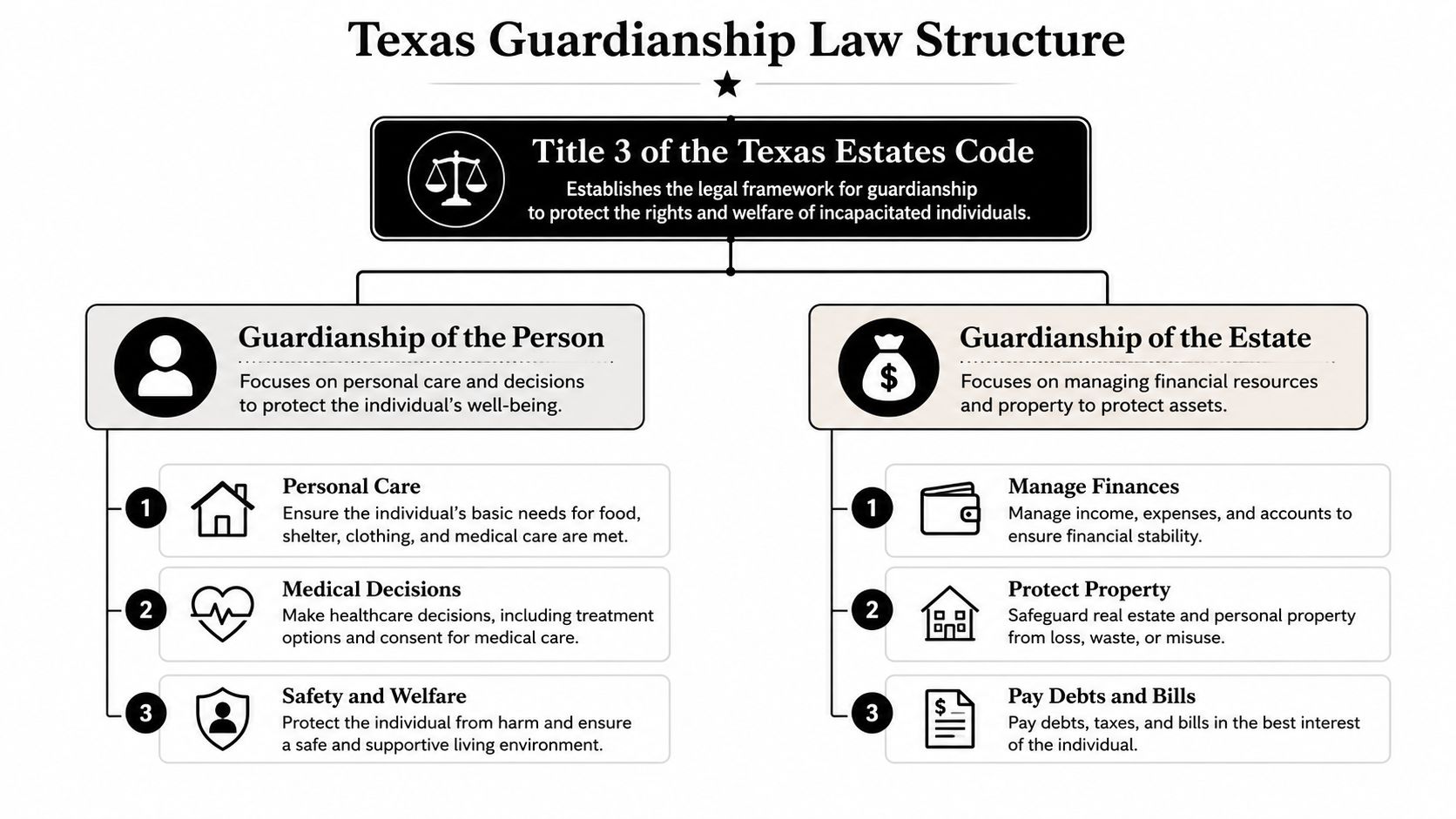
Texas guardianship law sits in Title 3 of the Texas Estates Code. Families often find the numbering intimidating, but the structure gives you a useful map. Subtitle D contains general guardianship rules, including appointment standards and limits on conflicting powers. Subtitle G addresses special types of guardianships, including temporary and interstate or nonresident proceedings. That distinction matters when a family needs emergency authority or when one sibling lives outside Texas. See the broader Texas Estates Code Title 3 structure for the statutory organization.
The two roles families need to separate
A guardian of the person handles personal needs. That may include medical consent, residence, daily care, and other personal decisions authorized by the court.
A guardian of the estate manages property and finances. That role can involve protecting assets, handling income, preparing required records, and following fiduciary duties. Some courts appoint one person to both roles, while others separate them when different skills or conflict concerns make a division more suitable.
The chapters also organize specific steps:
- Chapter 1104 addresses appointment and related authority.
- Chapter 1105 addresses the guardian's oath and bond requirements.
- Chapter 1151 addresses important duties after appointment, including responsibilities tied to the ward and the estate.
These matters generally belong in a Texas probate court or court handling probate jurisdiction, not a family court. A filing in Harris County, for example, may go to the appropriate Harris County probate court. The correct county and court depend on the ward's circumstances and local jurisdiction rules, so families should confirm the filing location before preparing documents.
Knowing the chapter that controls each step helps prevent a sibling petition from becoming a procedural problem. The statutes aren't obstacles to work around. They define who can act, what authority lasts, and how the court protects the person who needs assistance.
What the Estates Code Actually Allows for Siblings
Section 1104.001 starts with a straightforward principle. One person generally serves as guardian of the person or guardian of the estate. The court may divide the appointment between those roles when doing so serves the ward's best interest. The statute also allows joint appointments only in limited categories identified by law, such as spouses, joint managing conservators, and certain out-of-state co-guardians. Siblings aren't listed in that joint-appointment exception.
That means two brothers or sisters usually can't ask the court to give both of them equal authority as joint guardians of the person. They also generally can't serve as joint guardians of the same estate just because they're equally close relatives. The more realistic statutory possibility is a split appointment, with one sibling appointed guardian of the person and another appointed guardian of the estate.
The practical meaning of a split appointment
Suppose Maria understands medical care and Elena has experience with finances. A court could consider assigning Maria the personal role and Elena the estate role if the evidence shows that arrangement protects their father's interests. The court still controls the order, and the two roles must be defined so their powers don't duplicate or conflict.
A split appointment isn't a rotating schedule. It doesn't mean the sisters can alternate signing documents, each make decisions whenever available, or override the other's assigned authority. Texas law also says an order appointing a guardian may not duplicate or conflict with another guardian's powers, which makes poorly defined shared arrangements especially risky. See this discussion of when courts split the guardian role for additional context.
| Appointment Structure | Statutory Basis | Sibling Eligibility | Practical Effect |
|---|---|---|---|
| One guardian of the person | Texas Estates Code §1104.001 | Generally available to one qualified sibling | One person holds personal and care authority assigned by the order |
| One guardian of the estate | Texas Estates Code §1104.001 | Generally available to one qualified sibling | One person manages the estate authority assigned by the order |
| Split appointment | Texas Estates Code §1104.001 | Two siblings may be considered for different roles | Each sibling has a separate role, with boundaries set by the court |
| Joint appointment in the same role | Allowed only in statutory exceptions | Siblings generally aren't included in the listed exception | Usually unavailable as a default sibling arrangement |
A court may be cautious about splitting roles within one family when the siblings already distrust each other. If every medical decision could trigger a financial dispute, separating titles may create more litigation rather than more accountability. Families exploring the adult process can review Guardianship of an Incapacitated Adult in Texas, which describes how a court establishes guardianship for an adult who cannot manage their affairs.
Guardianship of the Person, the Estate, or Both
The best arrangement depends on the authority your parent needs. A guardian of the person focuses on care and personal decisions. A guardian of the estate focuses on money and property. One guardian may hold both appointments when a single decision-maker is workable and qualified.
The difference matters because a sibling can be strong in one area and unprepared for the other. A nurse or experienced caregiver may understand treatment plans and residential care, while another sibling may have the organizational skills needed for inventories, records, and financial oversight. Neither role is automatically easier. Each carries responsibilities imposed by the court.
| Duty Area | Of the Person | Of the Estate | Both (Combined) |
|---|---|---|---|
| Medical and personal decisions | Primary responsibility, within the court's order | Usually outside the role | One guardian handles both when authorized |
| Residence and daily care | Primary responsibility | Usually outside the role | One person coordinates care and finances |
| Asset management | Limited or outside the role | Primary responsibility | One guardian tracks assets and care needs |
| Inventories and accountings | Usually outside the role | Required estate responsibilities may apply | One guardian must manage both categories |
| Family communication | Often connected to care decisions | Often connected to financial transparency | One point of contact may reduce confusion |
Matching the role to the family
Maria might be a sensible guardian of the person if she already coordinates doctors, transportation, and rehabilitation. Elena might be better suited to the estate if she can maintain records, communicate with financial institutions, and meet court reporting obligations.
That doesn't make the appointment a reward for past caregiving. The court's focus is the ward's best interest and the proposed guardian's qualifications. A family should propose the structure that reduces confusion, not the structure that gives each sibling a symbolic share.
If one sibling is appointed guardian of both the person and estate, the other can still provide valuable support through a written cooperation plan. But the court order controls legal authority, and family members should avoid representing themselves as co-guardians when they aren't appointed.
How Courts Choose Between Competing Siblings
Texas priority rules give family members a place in the appointment process, but priority doesn't guarantee appointment. Under the framework described in Texas Estates Code Section 1101.001, the court considers kinship ranking. When eligible people are equally entitled and related in the same degree, the court appoints the person who is best qualified.
For siblings, that often means competition rather than automatic shared authority. The judge may compare practical facts, including who has provided care, who lives close enough to respond, who can manage records, and who can meet fiduciary obligations. A sibling living in Corpus Christi may still be qualified to serve for a parent in Houston, but distance can affect the court's assessment of availability and day-to-day supervision.
Evidence carries more weight than accusations
A sibling who wants appointment should prepare evidence that shows capacity to serve, rather than relying only on an emotional account of family history. Useful materials may include:
- Caregiving records: Keep appointment calendars, transportation records, medication lists, and notes showing who has handled recurring needs.
- Medical information: Ask whether medical providers can provide appropriate affidavits or records supporting the ward's condition and care needs.
- Financial organization: Gather records showing the proposed guardian can track income, expenses, property, and communications with institutions.
- Character information: Character letters may help, especially when they address reliability and caregiving rather than only praising the person.
- Conflict documentation: If the other sibling has created a concrete risk, preserve messages, account records, or other admissible evidence instead of repeating broad accusations.
A criminal history, protective-order history, unmanaged conflict, or potential conflict of interest may matter. So may a sibling's willingness to cooperate with the court visitor, guardian ad litem, attorneys, doctors, and required reporting process. Courts usually need facts they can evaluate, not a contest over who feels more devoted.
What works: Present a specific care and oversight plan. Explain who will do each task, how records will be shared, and how disagreements will be handled.
Mediation can be especially useful before a contested hearing. It won't replace the judge's authority, but it may help siblings agree on a proposed appointment, a split structure, or a cooperation protocol. Families facing competing applications can also review competing guardianship applications in Texas.
Benefits and Risks of Sharing Guardianship Decisions
A split or cooperative arrangement can solve a real family problem. One sibling may understand medical care, while another can manage investments, bills, and records. Dividing responsibilities can also create a second set of eyes on major decisions and preserve continuity if one sibling becomes unavailable.
Those benefits depend on clear authority. A split appointment works best when the order draws a clean line between personal and estate duties, and the siblings communicate consistently. It works poorly when each person assumes the other must approve every decision or believes cooperation gives them authority the court didn't grant.
Where cooperation helps
A sibling arrangement may provide:
- Checks on unilateral decisions: Separate roles can improve transparency when the siblings respect their boundaries.
- Division of labor: The person who understands care can focus on providers, while the estate guardian handles financial records.
- Continuity: A family may be less dependent on one person's availability when another sibling has a defined supporting role.
Families sometimes look to custody discussions for general ideas about how courts evaluate authority and responsibility. The legal standards differ, but this resource on how Texas courts decide custody can help explain why shared decision-making isn't the same as automatic equal control.
Where shared decisions break down
Deadlock is the central danger. A guardian of the person may believe assisted living is necessary, while the estate guardian objects to the expense. A financial guardian may choose an investment or payment strategy that the personal guardian believes undermines care. If the court's order is vague, both siblings may send conflicting instructions to providers or institutions.
Guardians also face fiduciary duties. Under Texas Estates Code Section 1151.151, a guardian can face consequences for failing to perform required duties. A person who shares authority may also share exposure when the arrangement permits joint action or when the guardian fails to supervise responsibilities properly. Passive involvement isn't a substitute for understanding the order and monitoring compliance.
Geographic distance, different values about care, and the absence of a written decision protocol predict trouble. Before proposing a split, siblings should agree on communication, records, emergency contacts, and a process for resolving disagreement. If they can't do that before appointment, the court may question whether dividing authority will protect the ward.
Practical Agreements and Alternatives to Joint Appointment
When Texas law won't allow siblings to co-serve in the same guardianship role, families can still create a workable support system. The strongest arrangements begin by separating legal authority from caregiving participation. A sibling may have no power to sign a medical consent but can still provide transportation, attend meetings, and share information with the appointed guardian.
Build a cooperation agreement around real tasks
A written sibling cooperation agreement can address:
- Medical decisions: Identify who schedules visits, communicates with providers, and handles urgent questions.
- Living arrangements: Set out how siblings will evaluate in-home care, rehabilitation, or residential options.
- Financial oversight: Establish how the estate guardian will share statements, receipts, budgets, and major expense information.
- Communication: Choose a regular update method and identify what requires prompt notice.
- Dispute escalation: Agree to a family meeting, neutral professional, or mediation before filing a motion.
- Cost sharing: Clarify how siblings will handle agreed caregiving expenses, travel, or professional services.
These clauses help show the court that the family has thought through operations. They don't transfer guardianship powers, override a court order, or guarantee that a sibling can access restricted records. Language promising perfect agreement is aspirational. A clause requiring timely notice, preserving records, or identifying a dispute process is more useful.
Consider a successor or power of attorney
A successor guardian designation under Texas Estates Code Sections 1104.151 through 1104.153 can identify a backup sibling. That person may become relevant if the appointed guardian dies, resigns, or is removed, subject to the court process and statutory requirements. It's different from joint appointment because the successor doesn't act at the same time as the current guardian.
A durable financial power of attorney or medical power of attorney may help avoid guardianship when the parent still has capacity to sign valid documents. A financial agent can handle authorized financial matters, while a medical agent's authority is limited to healthcare decisions under the document and applicable law. If a guardianship already exists, a power of attorney may not override the guardian's court-granted authority.
Use a cooperation agreement when one sibling needs support but not legal power. Consider a successor designation when continuity matters. Explore powers of attorney and other estate planning resources before incapacity prevents your parent from making informed choices. Guardianship remains a court-supervised option when less restrictive planning tools don't meet the need.
Filing, Modifying, and Resolving Disputes in Texas Courts
A family that decides to proceed should prepare for a court process, not just submit a form. The application identifies the proposed guardian and the ward's circumstances. Texas law also requires information about a minor ward's siblings, including each sibling's name and age if known, and the sibling's address or a statement that the sibling is deceased, as reflected in the Texas Estates Code provisions governing minor guardianship applications.
For an adult case, families should gather medical evidence addressing incapacity, identify the requested authority, and prepare for court-appointed professionals such as a guardian ad litem or court visitor when applicable. The court must make the findings required by the Estates Code before appointing a guardian. Families should also identify whether a less restrictive alternative, such as a valid power of attorney, can address the concern.
Emergency situations require a separate path
Temporary guardianship belongs to Texas's special guardianship procedures in Title 3, Subtitle G. A probate court may appoint a temporary guardian when there's substantial evidence of incapacity or minority and probable cause to believe immediate appointment is required. The process requires a sworn written application before appointment, prompt court supervision, and a hearing. The cited law limits the temporary appointment to a short period, with the source stating it may not remain in effect for more than sixty days unless appointed pending a contest, and that it ends when the contest hearing concludes or a permanent guardian qualifies. See the temporary guardianship hearing procedure for the cited scheduling rule.
If circumstances change, a party may seek modification through an application under Section 1202.051. Siblings who cannot work through a disagreement may also explore mediation under Section 1109.001. Serious misconduct can support a removal proceeding under Section 1201.055, but the evidence and procedure matter. Courts need documented facts showing why authority should change, not only proof that relatives are unhappy with one another.
Before filing, gather medical records, identify qualified proposed guardians, collect caregiving and financial documentation, and draft any cooperation or successor instruments. Families can also review how to handle disputes among co-guardians in Texas before a conflict becomes a crisis. The Law Office of Bryan Fagan, PLLC offers guidance on guardianship applications, temporary proceedings, modifications, contests, fiduciary compliance, and family disputes, including consultations for Texas families deciding whether one guardian, a split appointment, or an alternative plan fits their loved one's needs.
Schedule a free consultation with the Law Office of Bryan Fagan, PLLC to review your parent's capacity, existing estate-planning documents, and the practical roles each sibling can handle. Bring medical records, proposed caregiving plans, and any prior powers of attorney so a Texas guardianship attorney can help you choose a legally sound path before filing.