Skip to content
A daughter in Austin notices that her father's guardian has stopped returning calls. Bank statements show withdrawals she can't explain, and no one can tell her whether her father is receiving the care he needs. She wants to know how to remove a guardian in Texas, but the family conflict is only part of the problem. The court needs facts tied to a legal ground for removal.
Texas treats guardianship as an ongoing court-supervised relationship. A guardian may be removed for statutory failures involving reporting, property, care, qualifications, service, or abuse. The right approach is to document the specific failure, file in the proper probate court, protect the ward during the dispute, and plan for a successor or a less restrictive option.
When Texas Families Start Thinking About Removing a Guardian
Removal often begins with a missed call, a late report, or a bank account that no longer makes sense. Families may already feel shut out of medical decisions or worry that the guardian has moved the ward without explaining why. Those concerns deserve attention, but a Texas judge won't remove a guardian because relatives dislike one another.
The legal question is whether the guardian has violated a specific duty or no longer qualifies to serve. Texas law gives courts broad authority to remove a guardian in defined situations, including failure to qualify, failure to file a required inventory within 30 days after qualifying, failure to post a new bond, an unauthorized absence from Texas for 3 or more consecutive months, being unreachable for service, abuse, neglect, exploitation, or failure to educate or maintain the ward as the ward's means allow. These grounds appear in Texas Estates Code Section 1203.051.
Practical rule: Don't build a removal case around anger. Build it around dates, records, missed duties, and the statutory trigger that fits those facts.
The map for the problem in front of you
The next sections address the main decisions families face:
- Grounds for removal: Match the guardian's conduct to a Texas Estates Code provision.
- Filing and service: Prepare the application, evidence, citation, and notice correctly.
- Hearing preparation: Organize exhibits and witnesses so the judge can evaluate proof.
- Choosing the right remedy: Decide between removal, modification, and successor appointment.
- Emergency protection: Consider temporary guardianship when immediate harm or dissipation threatens the ward.
- Compliance and legal help: Avoid procedural mistakes and get counsel when the case involves serious risk.
A removal request may feel like betrayal, especially when the guardian is a sibling, child, or longtime caregiver. Still, the court must focus on the ward's safety, rights, care, and property. Families needing a starting point on misconduct can review this Texas guardianship misconduct resource before gathering documents.
The same framework applies whether the case is in an Harris County Probate Court, Dallas County, Travis County, or Bexar County. Your best exit ramp depends on identifying what failed and choosing the remedy that protects the ward without imposing more court control than necessary.
Legal Grounds That Support Removal in Texas
Texas removal law is specific. Under Texas Estates Code Section 1203.051, a court may act on its own motion or on the motion of an interested person, including the ward. In several high-risk situations, the court may remove a guardian without notice, including failure to qualify, failure to file the inventory within 30 days after qualifying, failure to post a required new bond, an unexplained absence from Texas for 3 consecutive months, inability to be served, or suspected misapplication or embezzlement of guardianship property. The statute also covers abuse, neglect, exploitation, and failures involving the ward's education or maintenance. Review the statutory removal grounds before filing.
Annual reporting deserves special attention. Guardians must file annual reports within 60 days after the guardianship anniversary, and Texas court guidance warns that failure to file can result in removal and fines. The Texas Judicial Branch explains the continuing annual reporting requirements for guardians. A Houston guardian who misses annual reports and fails to provide required account information creates a stronger statutory issue than a relative who merely says the guardian is difficult to reach.
Match the conduct to proof
A San Antonio guardian who moves a ward without proper authority may raise care, custody, or compliance concerns. A guardian who mixes estate funds with personal money may create evidence of misapplication or poor fiduciary management. Medical records, bank statements, care notes, court filings, service records, and written communications can show what happened.
| Statutory Ground | Example Conduct | Typical Evidence |
|---|---|---|
| Failure to qualify or maintain required bond | Guardian never completes a required qualification step or fails to post a new bond | Clerk records, bond notices, court orders |
| Failure to file required inventory | Inventory is not filed within 30 days after qualification | Docket sheet, clerk correspondence, missing filing |
| Reporting or accounting failures | Annual reports or accounts are missing or incomplete | Court records, account notices, bank records |
| Misapplication or embezzlement | Ward's money is used for unexplained personal expenses | Bank statements, canceled checks, receipts |
| Absence or inability to be served | Guardian leaves Texas without permission or cannot be located | Address records, returned citation, communications |
| Abuse, neglect, or exploitation | Ward lacks needed care, medical attention, or protection from financial pressure | Medical records, caregiver statements, welfare records |
| Failure to maintain or educate the ward as means allow | Guardian fails to provide appropriate support from available resources | Care records, expense records, witness affidavits |
| Disqualification or inability to serve | Guardian no longer meets legal requirements or cannot perform the role | Court documents, medical or service evidence |
A poor family relationship alone usually won't meet the legal standard. Before spending money on a petition, identify the exact conduct, the applicable code section, and the records that prove it. Families dealing with a broader estate dispute may also benefit from expert probate guidance on organizing contentious probate issues. For background on how a court establishes guardianship in the first place, see Guardianship of an Incapacitated Adult in Texas.
Filing the Petition and Serving the Right People
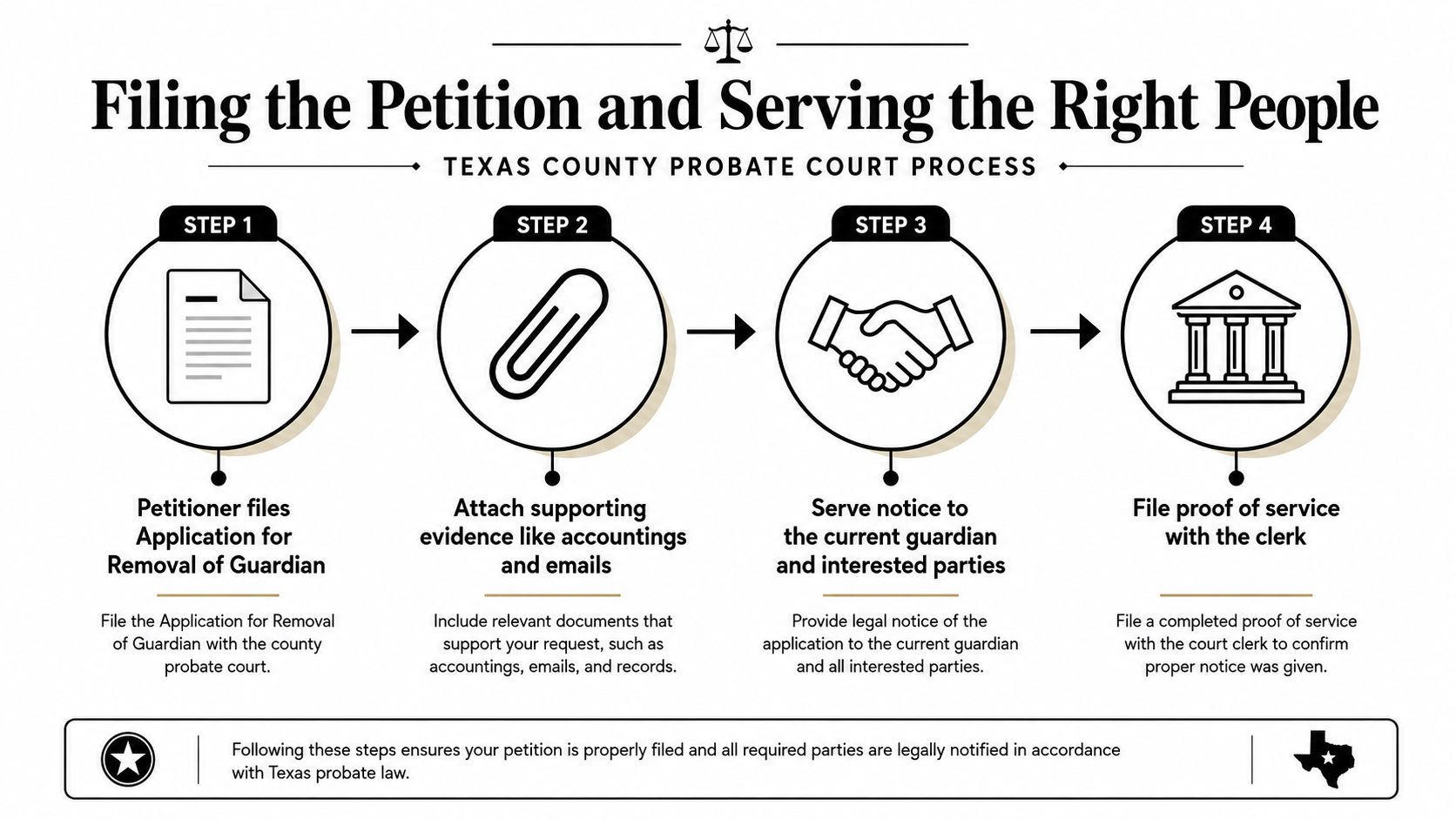
A removal case starts in the Texas probate court handling the guardianship. The interested person generally files an Application for Removal of Guardian, identifies the statutory basis, and attaches available proof. That proof may include accountings, bank records, emails, medical information, care logs, or sworn witness statements.
The application should tell the judge what happened and why the facts fit the statute. A general accusation that the guardian is “bad” is weak. A statement that the guardian failed to file a required inventory, cannot be served, or misapplied estate property is much more useful when supported by a docket record or financial document.
Service is not a technical detail
The clerk issues citation and notice according to the court's requirements. The current guardian must be served, and the ward's participation and notice rights must be handled carefully. In a removal matter involving abuse, neglect, or exploitation, the court must appoint both a guardian ad litem and an attorney ad litem. Those appointments provide separate protections for the ward and can significantly affect the litigation.
Families should preserve proof that service was completed. If the petitioner skips required service or fails to address the ward's rights, the court may be unable to proceed safely, and the case can be delayed or challenged.
The timing depends on the county, the complexity of the evidence, and whether the matter is contested. Families should expect time for service, review by court-appointed representatives, and a hearing date rather than assuming the judge will decide immediately. Harris, Dallas, Travis, and Bexar counties may use different local forms and filing practices, so check the applicable clerk and court rules. The Texas guardianship notice and citation requirements before a hearing should be reviewed before filing.
Preparing for the Court Hearing
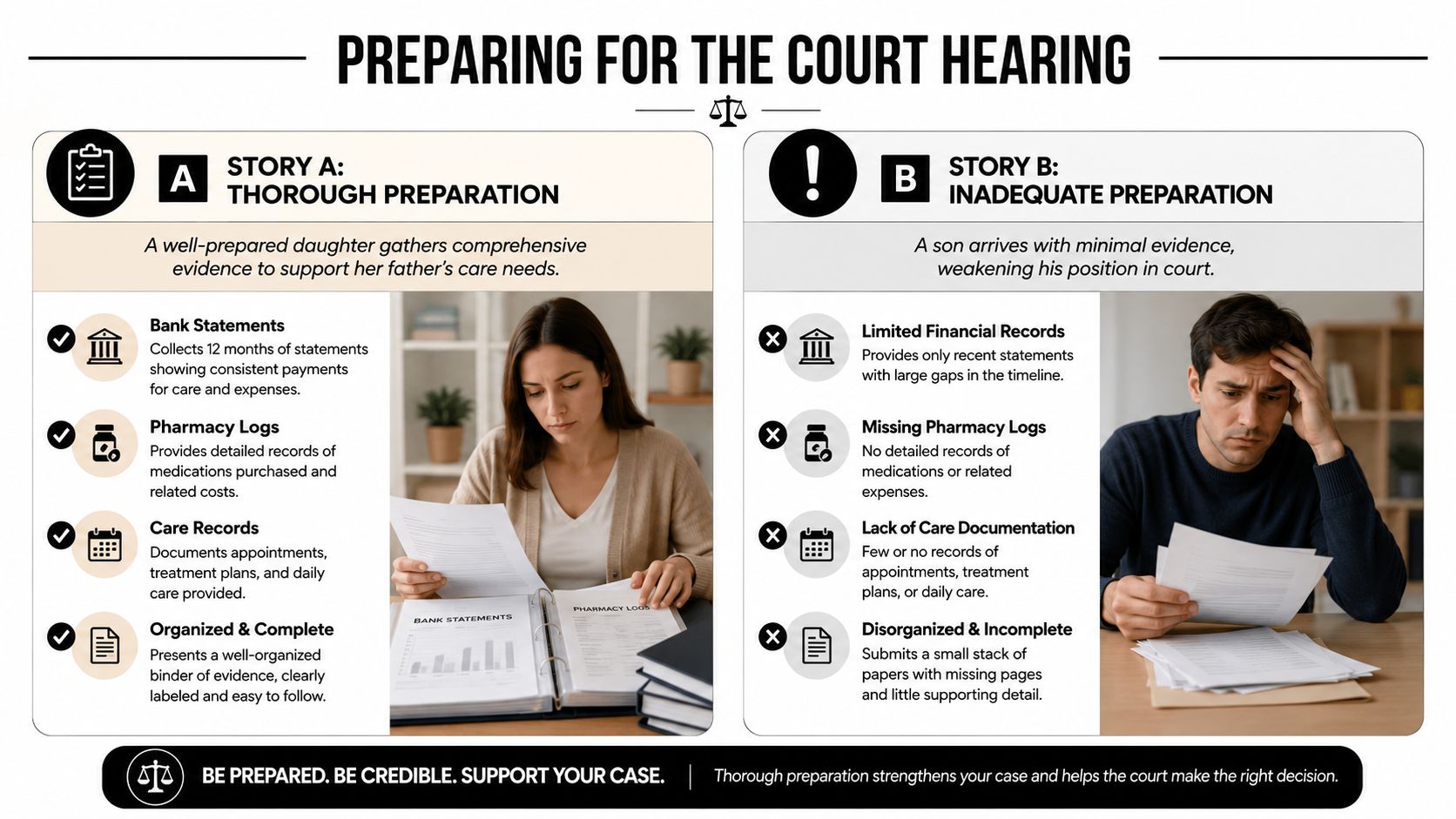
Two families arrive at a Texas probate hearing with very different cases.
In the first, a daughter gathers bank statements, pharmacy refill logs, unfiled annual reports, and affidavits from caregivers. The documents show repeated gaps in care and unexplained financial activity. Her lawyer organizes each exhibit around the relevant Texas Estates Code ground, and the judge finds the written proof sufficient to support removal.
In the second, a son arrives with emotional testimony but no exhibits. He believes the guardian is neglecting the ward, but he can't identify missing reports, specific transactions, dates of missed care, or witnesses with direct knowledge. The court reappoints the current guardian and orders a Guardian Ad Litem investigation.
The difference isn't compassion. Both families may be sincerely worried. The difference is whether the evidence gives the judge a reliable legal basis to act.
Build a hearing file the judge can use
Organize the case around the statute, not the family history.
- Create a timeline: List qualification, reporting, medical, financial, and contact events in date order.
- Separate exhibits by issue: Keep financial records together, care records together, and court filings together.
- Identify firsthand witnesses: Caregivers, medical providers, bank personnel, and people who personally observed the ward may carry more weight than relatives repeating what they heard.
- Prepare for the defense: The guardian may offer receipts, care notes, medical opinions, or proof that reports were filed.
- Rehearse testimony: Witnesses should answer clearly and distinguish what they saw from what they believe.
- Tie every claim to authority: Write the relevant Texas Estates Code section beside each major allegation.
A contested hearing can involve difficult testimony about incapacity, family conduct, medical care, and money. The court may appoint representatives to investigate the ward's interests, especially when the evidence is disputed. Families can review this Texas guardianship evidentiary hearing guide for a clearer picture of hearing preparation.
The strongest presentation is calm, dated, and documented. Do not assume the judge will fill gaps in your story or investigate every allegation raised in court.
Removal Versus Modification and Successor Appointment
Removal, modification, and successor appointment solve different problems. Choosing the wrong one can waste time and leave the ward exposed.
Removal is appropriate when the guardian has failed in a serious statutory way. The court can remove the guardian, cancel the letters of guardianship, require surrender of estate property, and direct the guardian to relinquish control of the ward. It's the right tool when mismanagement, abandonment, disqualification, or abuse means the current arrangement can't safely continue.
Modification may fit when the ward still needs protection but the existing authority is too broad or circumstances have changed. Texas Estates Code Chapter 1201 addresses review of continuation, modification, or termination using reports and accounts. A family may seek a narrower arrangement instead of eliminating court protection entirely.
Successor appointment focuses on replacing the person in the role. When a guardian resigns, is removed, or dies, the court may appoint a successor, and it may do so without citation or notice if an immediate appointment is necessary. The Texas successor appointment statute shows why removal often triggers an urgent continuity decision.
| Path | Texas Estates Code Basis | When to Use | Typical Timeline | Outcome |
|---|---|---|---|---|
| Removal | Chapter 1203, including Section 1203.051 | The guardian has violated a statutory ground or can't serve | Depends on notice, evidence, and court schedule | Current guardian loses authority |
| Modification | Chapter 1201 review provisions | The ward still needs protection, but authority or duties should change | Depends on the requested change and evidence | Guardianship continues in a revised form |
| Successor appointment | Chapter 1203 successor process and related provisions | The person is unavailable, resigns, dies, or is removed | May require immediate action when protection is at risk | A new guardian assumes the role |
Decision point: Remove the guardianship structure only when the structure itself has failed. Seek a successor when the problem is the current guardian, and seek modification when the court's role remains useful.
Emergency and Temporary Guardianship Options
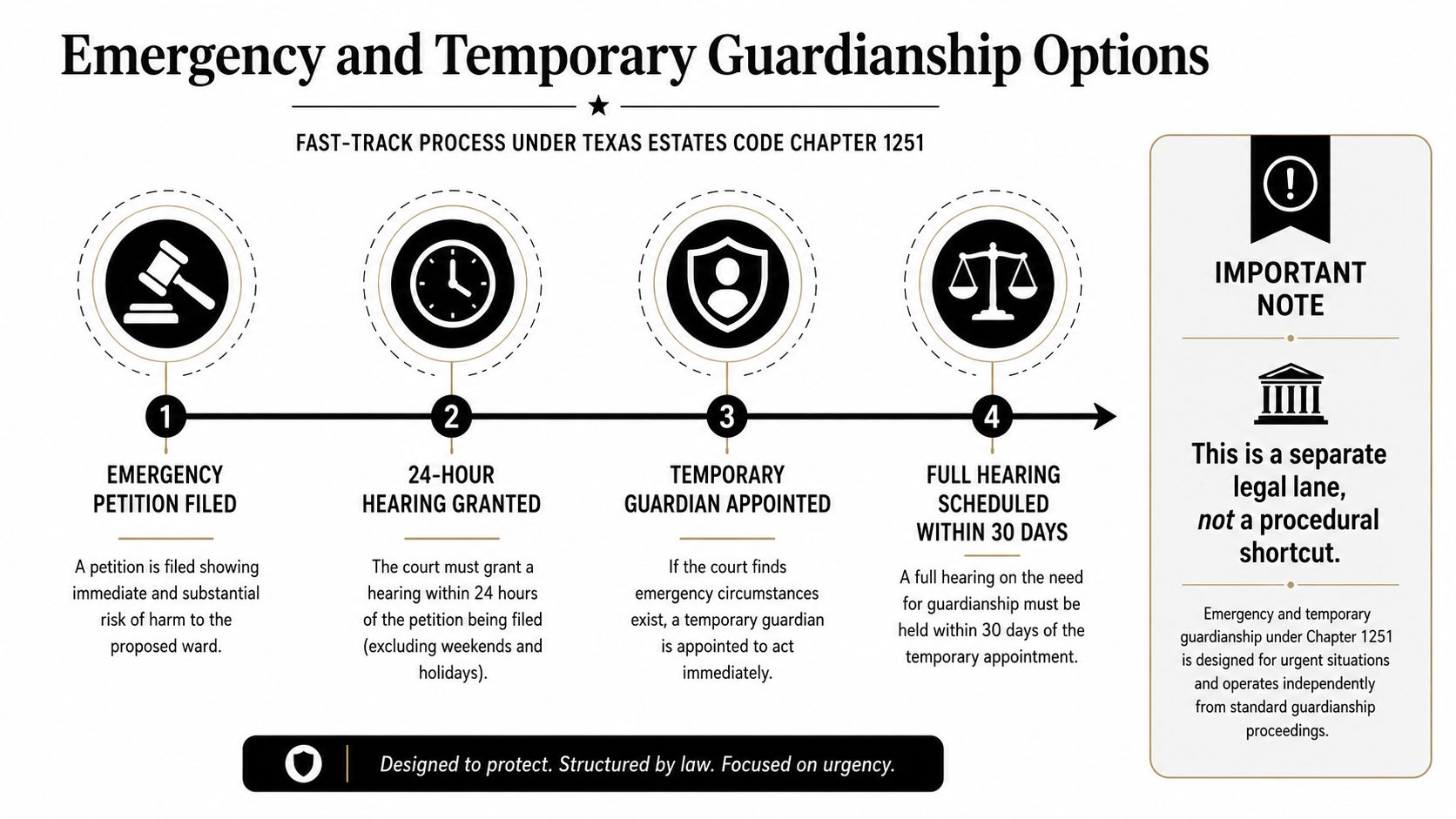
A temporary guardianship is an emergency remedy, not a way to avoid ordinary procedure. Under Texas Estates Code Section 1251.010, the court may appoint a temporary guardian only when there is substantial evidence of incapacity and immediate action is needed because the ward's physical health or safety may be seriously impaired, or the estate may be seriously damaged or dissipated. The application must be sworn and written before appointment, and the ward keeps all rights and powers that the order doesn't specifically give to the temporary guardian. Review the temporary guardianship statute.
A practical example is an adult with a sudden brain injury who is being pressured to empty a bank account. A temporary order may give the court a way to limit immediate financial harm while the family prepares for a full guardianship hearing or pursues removal of an existing guardian.
Know the limits before asking for emergency relief
Texas sources describe temporary guardianship as limited to emergency situations and explain that it expires after 60 calendar days unless extended by the court. The order controls the temporary guardian's authority, so the proposed guardian must understand exactly what decisions the court permits.
Prepare sworn facts showing the immediate danger, the ward's condition, and the threatened loss or harm. Include available financial, medical, residential, or caregiver evidence. The court still must protect the ward's rights, and an emergency application that merely repeats a family disagreement may not justify temporary relief.
Temporary guardianship can stabilize a crisis while the court considers the longer-term answer. That answer might be removal, modification, a successor appointment, or no continuing guardianship if a less restrictive option can protect the ward.
Common Mistakes and When to Call a Texas Attorney
Removal petitions fail for predictable reasons. Families file in the wrong county, use the wrong local form, fail to serve the guardian or ward, or present a long family history without identifying a statutory ground. Others overlook annual reporting and accounting records that could support the case, or make unsupported claims of self-dealing that the documents don't confirm.
Another error is treating temporary guardianship as permanent protection. The temporary appointment has a 60-calendar-day limit unless the court extends it, so the family must plan for the next hearing and the long-term remedy. Families also confuse modification with termination. If the ward still needs limited protection, asking to end everything may create an unnecessary risk. If the guardian is the problem, seeking only a modification may leave the wrong person in control.
Red flags that deserve immediate legal review
Call a Texas guardianship or probate attorney before filing when:
- The guardian controls the ward's money and expects to inherit: That relationship can create a serious conflict that requires careful financial review.
- Medicaid, trusts, or multiple accounts are involved: Asset rules and court reporting can overlap in ways that make informal corrections dangerous.
- The ward's capacity is disputed: Medical evidence, court-appointed counsel, and the ward's own rights may become central.
- The matter crosses counties: A guardian living in one county and a ward living in another can create filing and service problems.
- Criminal conduct is alleged: Potential theft, exploitation, or abuse may require coordinated legal and protective action.
- The guardian has disappeared or can't be served: The court may have authority to act quickly, but the filing still must identify the proper statutory basis.
Judges notice inconsistent stories, missing annual reports, unexplained transactions, and claims that lack supporting records. They also look at whether the requested remedy protects the ward while respecting the ward's remaining rights. Keep copies of every filing, report, bank record, medical note, and communication, and don't alter original records after a dispute begins.
A guardian who is removed must deal with more than the removal order. The order must state the cause, cancel the letters of guardianship, direct surrender of estate property, and require relinquishment of control of the ward as directed. Final estate closure generally requires full administration, approval of the final settlement account, and delivery of remaining property to the proper recipient. Texas law also provides a fast post-removal process in abuse, neglect, or exploitation cases. The removed guardian has 30 days to apply for a hearing to contest reinstatement.
Guardianship may also become unnecessary when the ward's condition improves. Texas law allows court review of continuation, modification, or termination, and Texas recognizes alternatives such as a medical power of attorney, durable power of attorney, declaration for mental health treatment, representative payee, joint bank account, management trust, special needs trust, predesignation of a guardian, and other person-centered supports under Texas Estates Code Section 1002.0015. Families should consider less restrictive alternatives to guardianship in Texas before asking the court to impose or continue more control than necessary.
Schedule a consultation before the next filing deadline, especially if the guardian controls money, the ward faces immediate danger, or the case involves contested capacity. The cost of legal advice is easier to evaluate than the cost of a denied petition, defective service, lost records, or a reset hearing that leaves the ward in the same unsafe situation.
The Law Office of Bryan Fagan, PLLC helps Texas families establish, contest, modify, and remove guardianships, including emergency matters and disputes involving fiduciary misconduct. Schedule a free consultation through Law Office of Bryan Fagan, PLLC to discuss the right filing, evidence, and protective strategy for your loved one.