Skip to content
A hard phone call often starts this problem.
Your mother has been forgetting medications, missing bills, and letting strangers into the house. You’ve been taking her to doctor visits. Your brother has been helping with the bank account. Both of you believe you’re protecting her. Then one of you files for guardianship, and the other files too.
That doesn’t mean your family is broken. It means the outcomes are significant, emotions are raw, and more than one person cares enough to step forward.
In Texas, this situation has a name: competing guardianship applications texas. It means two or more people ask the same court to appoint them as guardian for the same proposed ward. The court must choose. That choice matters because guardianship gives someone real legal authority over another person’s care, finances, or both.
If you’re in the middle of this, you’re probably carrying fear, guilt, frustration, and urgency all at once. That’s normal. Families in Harris County Probate Court, Dallas County probate courts, and courts across Texas face this issue when a loved one develops dementia, suffers a serious injury, or can no longer make safe decisions.
Texas law does provide a path forward. It isn’t always quick, and it isn’t always painless, but it is structured. The court looks at legal priority, evidence, the proposed ward’s needs, and whether a guardianship is necessary under Texas Estates Code Title 3, Subtitle G.
When Families Disagree Who Knows Best
An adult daughter may spend every day helping her mother bathe, eat, and get to appointments. A son may manage online banking, pay the mortgage, and handle insurance calls. Each sees a different part of the crisis. Each may believe, “I’m the one who should be guardian.”
That kind of conflict is common in guardianship disputes. It often grows from love, history, and old family wounds all meeting one legal question.

Why these cases feel so personal
Guardianship cases aren't just about paperwork. They touch daily life.
One person may worry about unsafe driving. Another may worry about unpaid bills. A new spouse may feel shut out by adult children from a first marriage. An out-of-state child may suddenly return and question everything the local caregiver has been doing.
Practical rule: A guardianship contest usually isn't about who loves the person more. It's about who can show the court they can serve safely, responsibly, and in the proposed ward's best interest.
Sometimes the concern is financial exploitation. If you suspect that risk, practical education outside the courtroom can help families protect seniors from financial scams while they sort out legal next steps.
A dispute is not the same as wrongdoing
Families often assume that if someone files a competing application, that person must be acting selfishly. Sometimes that’s true. Often it isn’t.
A competing application may come from:
- Different caregiving roles: One person handles health needs, another handles money.
- Different views of safety: Family members may disagree about whether the loved one can still live alone.
- Different legal goals: One applicant may seek authority over the person, the estate, or both.
If your family is already in conflict, it helps to understand how Texas courts approach a family dispute over guardianship in Texas. Once you know the court’s framework, the situation usually feels less chaotic.
What Are Competing Guardianship Applications in Texas
A competing guardianship application means separate applications have been filed asking the court to appoint different people as guardian for the same proposed ward.
Consider it akin to a hiring decision for a very sensitive job. The “job” is caring for a vulnerable person. The court acts like the hiring authority, but with much stricter duties than an employer. The judge isn’t choosing the nicest applicant. The judge is choosing the person legally permitted and suited to protect another human being.
One person, two possible guardianship roles
Many readers get confused here, because Texas guardianship can involve two distinct roles.
| Type | What it covers | Example |
|---|---|---|
| Guardianship of the Person | Personal care decisions | Medical treatment, living arrangements, daily care |
| Guardianship of the Estate | Financial management | Paying bills, protecting assets, managing income |
A family may compete over one role, or both.
For example, a daughter who has been coordinating doctors may ask to be guardian of the person. A son with accounting experience may ask to be guardian of the estate. In another family, both children may seek both roles, and the court must sort out whether one person should handle everything or whether duties should be divided.
Why the court gets involved at all
Texas doesn’t appoint a guardian just because a family is arguing. The court first looks at incapacity, legal procedure, and whether less restrictive options can meet the person’s needs.
That matters under Title 3, Subtitle G of the Texas Estates Code, because guardianship removes rights. The law treats it as a serious remedy, not a convenience. If a valid power of attorney, medical power of attorney, supported decision-making arrangement, trust structure, or other workable tool already protects the person, a court may question whether guardianship is necessary.
Courts don't treat guardianship as a prize. They treat it as a protective appointment with limits, duties, and ongoing court supervision.
The proposed ward stays at the center
The person at the heart of the case is called the proposed ward. In real life, that may be your mother, spouse, adult child with disabilities, or injured relative.
That person is not supposed to disappear behind the family conflict. The court’s role is to keep the proposed ward’s welfare at the center, even when the loudest people in the room are relatives arguing with each other.
A few examples make this clearer:
- Two adult children file. One says Mom needs help with memory loss and wandering. The other says Mom only needs bill-pay support.
- A spouse and an adult child file. The spouse says he has been caring for the ward at home. The adult child says the spouse is isolating the ward and mishandling money.
- A relative and a non-relative file. A niece applies, but so does a long-time caregiver or family friend who has been handling day-to-day care.
In each example, the court asks two broad questions. Is guardianship needed? If so, who should serve?
The Statutory Priority List Who Texas Courts Prefer
A contested guardianship case often feels personal because it is personal. One child may say, "I have been here every day." A spouse may answer, "I am the one who shares a home and a life with them." Texas law does not ignore those emotions, but it does impose an order so the court has a starting point instead of sorting family conflict from scratch.
Under Texas law, the judge does not arbitrarily choose whoever speaks first or sounds most convincing. The court begins with a priority system set out in the Texas Estates Code guardianship provisions, including Section 1104.002. That system gives preference first to a spouse, then to nearest kin, and then to another suitable person the court finds acceptable if the people with higher priority cannot serve properly.
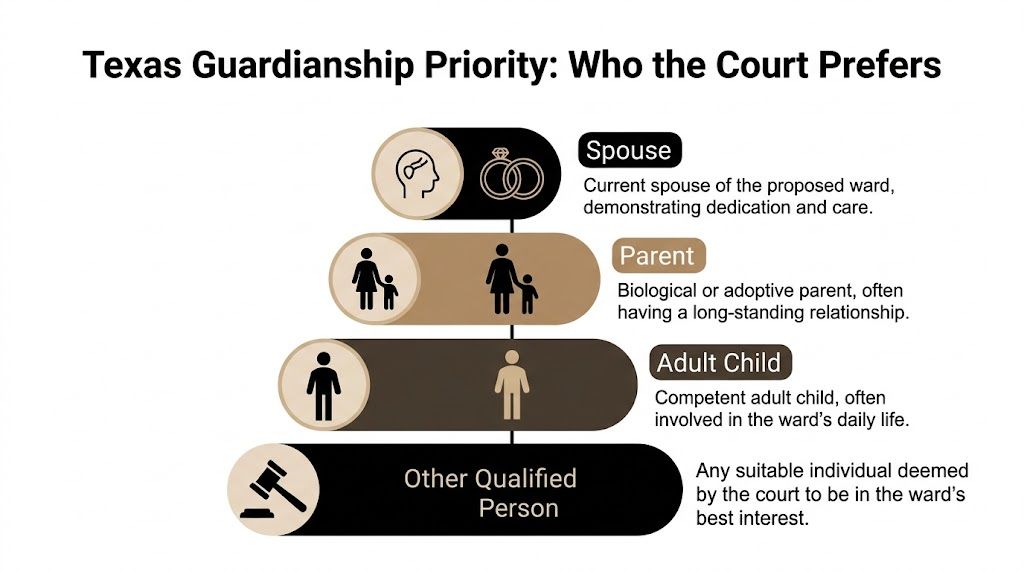
The court’s starting order
The usual order is:
- Spouse
- Nearest kin
- Any other suitable person acceptable to the court
That list works like a line at the courthouse door. It tells the judge where to start looking. It does not guarantee who will walk out with the appointment.
This distinction matters. Families often hear "priority" and assume "automatic right." Texas courts do not treat it that way. The judge still has to decide whether the person with priority is qualified, trustworthy, and able to serve the proposed ward's best interests over time.
Why Texas uses a priority list
The rule exists to protect the vulnerable person at the center of the case.
Without a priority system, every dispute could turn into a pure popularity contest. The loudest relative, the best storyteller, or the person with the most resources could try to take control. The statute gives the court a default order because close family relationships often carry legal responsibilities and a history of caregiving. It creates structure at a moment when families are often frightened, grieving, and suspicious of one another.
The list also saves time. If a spouse has been handling medications, meals, doctor visits, and household finances responsibly for years, the law recognizes that history may matter. But the law also leaves room for the court to step past that spouse if the evidence shows real danger to the proposed ward.
What "nearest kin" means in real life
"Nearest kin" sounds simple until real families get involved.
Sometimes it means an adult child. In other cases, a parent, sibling, or another close blood relative may be in the picture. If two adult children apply, they may stand in the same legal category. At that point, the dispute usually stops being about who is first in line and starts being about who can do the job safely and faithfully.
Judges often look at practical facts such as:
- Actual caregiving history: Who has been taking the person to appointments, arranging care, or responding to emergencies?
- Ability to manage responsibilities: Who can keep records, meet deadlines, and follow court orders?
- Stability: Who has steady housing, sound judgment, and enough time to serve?
- Risk of conflict: Who is more likely to place the ward's needs above old grudges, inheritance disputes, or personal control?
A courtroom example helps. If two sisters both apply for their father's guardianship, and one lives nearby, attends neurology visits, and keeps careful records while the other has had little recent involvement, the judge may give more weight to that day-to-day pattern than to emotional claims about who "loves Dad more."
How a higher priority applicant can lose that advantage
Priority gets your foot in the door. Fitness keeps you in the room.
A spouse or close relative can be passed over if the court finds that person disqualified, unwilling, or unfit. That is where strategy matters. The judge is not looking for vague accusations. The judge is looking for evidence tied to the proposed ward's welfare.
Examples include:
- Financial mismanagement: missing funds, suspicious transfers, unpaid bills, or poor records
- Conflict of interest: pressure involving property, beneficiary changes, or personal financial gain
- Care failures: missed medical treatment, unsafe living conditions, or refusal to arrange needed support
- Isolation or undue influence: cutting off trusted family members, controlling access, or pressuring the proposed ward
Consider a common family conflict. An older man with dementia remarries late in life. His wife applies for guardianship. His adult son objects and files his own application, claiming the wife has isolated him and used his money for herself. Because a spouse usually has first priority, the wife begins in the stronger legal position. But if bank records, caregiver testimony, text messages, or medical evidence show exploitation or neglect, the court can pass over her and appoint someone else.
That is the heart of these cases. The statute gives order. The evidence decides whether the preferred person is safe to appoint.
Why the choice matters after the hearing
The appointment is the start of a legal duty, not the end of a family argument.
A guardian may have to make medical decisions, manage money, file inventories or accountings, report to the court, and act as a fiduciary. In plain English, the court is choosing someone to hold another person's rights and property in trust, under supervision. That is why judges look past titles like spouse, son, or daughter and ask a harder question. Who can carry this responsibility carefully, consistently, and with integrity?
For families, that point can change how you prepare. If you are asking the court to bypass a person with higher priority, your argument should show more than family tension. It should show why the proposed ward needs a different guardian to stay safe and properly cared for.
The Court Process for Competing Applications
Most families feel calmer once they know the path.
A contested guardianship case usually goes through the probate court with jurisdiction over the matter. In places like Harris County Probate Court, these cases move through a structured process. The details can vary by county, but the broad pattern is similar across Texas.

Filing and consolidation
When two people file for guardianship of the same proposed ward, the court usually won’t run two separate full cases forever. Instead, the matters are typically handled together. Lawyers often call this consolidation, even if the local court uses its own scheduling language.
That keeps the judge from hearing the same medical issues, family history, and evidence twice.
The early stage often includes:
- Application filing: each applicant files pleadings asking for appointment
- Notice: required relatives and the proposed ward receive formal legal notice
- Initial review: the court checks whether the filings and medical support meet legal requirements
If your dispute is heading toward a hearing, this overview of the guardianship trial process in Texas can help you understand what the courtroom phase may look like.
The proposed ward has rights
This point gets lost in family conflict. The proposed ward still has rights in the process.
The court often appoints an attorney ad litem to represent the proposed ward’s interests. That lawyer is not the lawyer for the daughter, son, spouse, or applicant. The ad litem focuses on the proposed ward.
Medical evidence also matters. Courts usually want clear proof of incapacity, often through a physician’s certificate or similar supporting medical documentation required by the Estates Code.
A contested guardianship case slows down for a reason. The court is balancing protection, due process, and the proposed ward’s rights.
Discovery, evidence, and pretrial conflict
After filing, families may move into a period of information exchange. Lawyers gather medical records, financial records, care notes, text messages, witness statements, and other evidence.
This stage can be emotionally draining because it often pulls private family issues into the open.
A judge may have to sort through questions like:
- Who has been paying the proposed ward’s bills?
- Has anyone transferred money?
- Who takes the ward to doctors?
- Has anyone prevented visits or blocked information?
- Is there a realistic care plan if one applicant is appointed?
Later in the case, the court may hold hearings on temporary concerns, scheduling, or disputed evidence.
A short video can also help if you prefer to hear the process explained out loud.
Hearing or trial
Some cases resolve through agreement. Others go to a contested hearing or trial.
At that point, the judge hears testimony and reviews documents. In some situations, a jury may become involved on limited issues, but many appointment decisions are ultimately made by the court.
The final hearing usually focuses on two core issues:
| Question | What the court is deciding |
|---|---|
| Is guardianship needed? | Whether the proposed ward lacks capacity and needs this level of court protection |
| Who should serve? | Which applicant is legally preferred and factually best suited |
Temporary or emergency guardianship can also come up when someone’s health, safety, or property is in immediate danger. Those cases move faster, but they don’t erase the need to address a full guardianship case if long-term authority is sought.
Building Your Case Evidence and Strategy
In a competing case, good intentions aren’t enough. Judges need proof.
A strong guardianship case looks less like a speech and more like a well-organized file. The person who walks in with records, witnesses, a care plan, and a realistic understanding of the ward’s needs usually presents far better than the person who only says, “Trust me, I’m family.”

What persuades a probate judge
Judges often care less about who is the loudest and more about who is prepared.
Useful evidence may include:
- A care plan: where the proposed ward will live, who will help, how medical appointments will be handled
- Financial records: organized documents showing responsible handling of money
- Medical information: doctor records that help explain functional limitations
- Witness testimony: caregivers, neighbors, friends, social workers, or relatives who have direct knowledge
- Communication history: texts, emails, or notes showing involvement, or showing obstruction by another applicant
A practical comparison helps.
| Applicant | What the judge may see |
|---|---|
| Sibling A | Weekly medication chart, transportation plan, doctor contact list, budget, clean financial records |
| Sibling B | General statements about love and concern, but no detailed plan and few supporting records |
Both may care a great deal. Only one has shown the court how the guardianship would function.
The best argument is specific
If you want the court to appoint you, avoid broad claims like “I’ve always been there” unless you can back them up.
Better proof sounds like this:
- I took her to these appointments.
- I arranged in-home care on these days.
- I paid these bills from her account and kept receipts.
- I spoke with these providers.
- I can move her into this safe living arrangement immediately.
Courts respond to facts tied to the proposed ward’s daily life. Vague promises usually don't carry much weight.
Challenging the other applicant
Sometimes your case depends not only on showing your own fitness, but also on showing why the competing applicant shouldn’t serve.
That doesn’t mean making personal attacks. It means presenting relevant evidence tied to the ward’s protection.
Examples include:
- Mismanaged money: unexplained withdrawals, unpaid taxes, missing records
- Unstable living conditions: no safe housing plan for the ward
- Poor judgment: repeated neglect of medical needs
- Conflicts of interest: trying to control the ward’s assets for personal advantage
A common mistake is overstating the problem. If you accuse someone of abuse, theft, or manipulation, the court will expect support. Bring bank statements, messages, witnesses, or records. Don’t rely on courtroom drama.
Strategy matters as much as evidence
The order and presentation of evidence can matter. So can your tone.
Judges often notice:
- Whether you answer questions directly
- Whether your paperwork is complete
- Whether you seem focused on the ward, not revenge
- Whether your plan is realistic for your actual schedule and resources
If the case is getting serious, families often work with a probate litigator, a guardianship attorney, and supporting professionals such as treating physicians or care managers. The Law Office of Bryan Fagan, PLLC handles guardianship applications, disputes, temporary guardianship matters, and compliance issues for Texas families, and a firm in that role can help gather records, prepare evidence, and present the case in court.
Evidence families often overlook
Some of the most helpful proof is ordinary.
Keep and organize:
- Calendars: appointment logs, care schedules, visit records
- Receipts and invoices: prescriptions, caregivers, transportation, home safety items
- Contact lists: doctors, pharmacy, caseworkers, facility staff
- Written observations: wandering, missed medications, confusion, falls, unpaid bills
These details can show a pattern. They can also protect you if another applicant claims you were absent or uninvolved.
After the Decision Rights Duties and Next Steps
The judge has ruled, and a family often feels two things at once: relief that someone is now legally in charge, and anxiety about what that means tomorrow morning.
That reaction is normal.
A guardianship order is less like winning a contest and more like receiving a court-issued set of keys. The keys open certain doors, such as access to medical decisions, living arrangements, or financial management. They also come with rules about how those doors can be used. Texas courts structure it this way for one reason: the person at the center of the case is vulnerable, and the court wants protection to continue after the hearing, not stop at the courthouse.
If you were appointed guardian
Your authority starts with the court’s order, and your duties start immediately after that.
Depending on the kind of guardianship, you may need to:
- Take an oath: formally accept the role and the legal duties that come with it
- Post bond if required: provide the financial safeguard the court orders
- Qualify with the court: complete the steps required before acting fully in the role
- File inventories, accountings, or care reports: give the court an ongoing picture of the ward’s property or well-being
- Follow the limits in the order: act within the powers the judge granted, not beyond them
A guardian of the person usually handles care decisions, residence, and daily welfare. A guardian of the estate handles money, property, bills, and recordkeeping. Sometimes the same person serves in both roles. Sometimes the court separates them because that arrangement better protects the ward.
The distinction matters. A person who is excellent at hands-on caregiving may not be the best choice to manage accounts, investments, or property paperwork. The court can tailor the arrangement to fit the actual needs of the ward instead of forcing one person into every job.
Court supervision continues for a reason
Texas guardianship stays under court supervision because authority over another adult’s life is serious.
That supervision protects everyone.
It protects the ward from neglect, financial misuse, and avoidable isolation. It also protects a careful guardian by creating a paper trail that shows what was done, why it was done, and how money or care decisions were handled. If a relative later accuses the guardian of wrongdoing, clear records often become the best defense.
A guardian who misses deadlines, ignores reporting duties, or blends the ward’s money with personal funds can face court action. In the worst situations, that can lead to removal, repayment obligations, or other penalties.
If you were not appointed
This part can be painful, especially in a family dispute where you believed the judge would choose you.
Still, the ruling does not always cut you out of your loved one’s life. In many cases, the better question is not, "Did I win?" but, "How can I still help this person stay safe?" That shift in perspective can lower conflict and protect the ward from being pulled into a second round of family tension.
You may still be able to:
- Maintain a healthy relationship: visit, call, and provide support if appropriate
- Watch for warning signs: missed care, unexplained isolation, or financial problems
- Document concerns carefully: keep specific notes if serious issues arise later
- Return to court if necessary: ask for review if the guardian is failing in the role
Courts understand that circumstances change. A guardian may become ill, move away, stop communicating with providers, or fail to keep up with required filings. If that happens, the original decision is not frozen forever.
Modification, removal, and termination
Guardianship orders can be changed when the facts change.
That flexibility matters because life changes. A ward’s condition can improve or worsen. Family support can grow stronger or fall apart. A guardian who looked reliable during the hearing may struggle later with time, distance, or finances.
Future court action may include:
- Modification: changing the guardian’s powers or adjusting practical arrangements
- Removal: replacing a guardian who is no longer serving the ward properly
- Termination: ending the guardianship if it is no longer needed or if rights should be restored
For families, the practical lesson is simple. Keep records, follow the order closely, and stay focused on the ward’s well-being rather than old arguments. That approach usually serves both the family and the court better than anger ever will.
Related legal issues may also arise later, especially if the family needs to address property, end-of-life planning, or affairs after a death. Those are separate matters, but they often connect to the same larger goal: protecting a loved one with as little conflict as possible.
When to Call a Guardianship Attorney
Some guardianship matters are straightforward. Competing applications usually aren't.
Once two people are asking for the same appointment, small mistakes can become major problems. Missed deadlines, weak evidence, incomplete medical support, or poor courtroom preparation can change the outcome for your loved one.
Signs you need legal help soon
You should strongly consider calling a guardianship attorney if:
- Another person has filed or plans to file: once you know there is competition, delay can hurt your position
- You believe the other applicant is unfit: claims about financial misuse, neglect, or manipulation need evidence and careful presentation
- The proposed ward objects: cases become more sensitive when the proposed ward resists the application
- There are assets or property issues: estate-related disputes often require tighter record review
- Emergency action may be needed: immediate danger can change the kind of relief requested
What an attorney actually does
A lawyer in a contested guardianship case doesn't just “go to court.”
An attorney can help:
- evaluate whether guardianship is necessary at all
- prepare the application correctly under the Texas Estates Code
- gather records and witness testimony
- respond to attacks from the competing applicant
- present evidence in a clear way for the probate court
- advise on temporary guardianship when a crisis develops
- explain post-appointment duties if you are selected
For many families, legal counsel also lowers the emotional temperature. Instead of arguing through group texts or hospital hallways, you have a structured way to present your position.
A steady guide matters
Contested guardianship cases are about law, but they’re also about family history, grief, and fear. People say things they don’t mean. They make assumptions. They panic.
A careful attorney helps separate what feels urgent from what the court needs to see.
If you’re dealing with competing guardianship applications texas, don’t wait until the hearing date is close. The earlier you get advice, the more options you usually have.
If your family is facing a guardianship dispute, a sudden decline in a loved one’s capacity, or a conflict over who should serve, Law Office of Bryan Fagan, PLLC can help you understand your options under Texas law. A free consultation can give you clear next steps, help you evaluate evidence, and reduce the stress of trying to handle a contested guardianship alone.