Skip to content
Maria thought she was walking into a family meeting, not a legal disaster. Then she learned her father had already been declared incapacitated, and her brother had been named guardian without telling her. If that sounds familiar, you're probably dealing with fear, anger, and a stack of unanswered questions at the same time.
A Texas guardianship can change who controls medical care, bills, living arrangements, and even access to the ward. That's why how to object to a guardianship Texas is not just a filing question, it's a rights question. Texas law keeps this process tightly regulated under Title 3, Subtitle G of the Estates Code, because guardianship is part of a high-volume court system with 47,834 active guardianships in FY 2023 and thousands of required reports and accounts filed statewide (Texas Estates Code Chapter 1055).
When Families Need to Push Back on a Texas Guardianship
Maria's first clue wasn't a court notice, it was silence. Her father stopped returning her calls, her brother started controlling the bank account, and no one would tell her what doctor visits were happening. In many Texas families, that's the moment a guardianship objection starts to feel necessary.
What usually triggers the objection
Families often push back when they see sudden control over finances, isolation from medical decisions, or signs that one relative has taken over without real oversight. Others notice that a guardian is missing reports, skipping accountings, or using the guardianship to shut out everyone else. Those concerns matter because Texas courts don't treat guardianship as a private family arrangement, they treat it as a court-supervised legal status with ongoing duties.
Texas also gives families a separate path once a guardianship already exists. The ward can ask the court to modify the guardianship, appoint a different guardian, or restore legal capacity and terminate the guardianship through the ward's rights described by the Texas State Law Library (Texas State Law Library guardianship modification guide). That's different from objecting to the original petition. One challenge targets the proposed guardianship before it starts, the other asks the court to change or end an existing order.
Practical rule: if the guardianship has not been signed yet, focus on objection. If it already exists, look at modification, removal, or restoration.
An objection does one key thing in probate court. It forces the judge to hear the dispute instead of letting the guardianship proceed automatically. That means evidence, notice, and a real hearing. For a family in Harris County Probate Court, Travis County Probate Court, or any other Texas probate court, that hearing is where facts start to matter more than family assumptions.
If you're trying to sort through the next move, the rest of this article breaks it down into who can object, how to file, what proof helps, what happens in court, and when termination or restoration may be the better path.
Who Can Object and the Deadlines That Protect That Right
A guardianship case can feel like the court is already moving ahead without the family. Texas law does not let just anyone step in and stop it. Chapter 1055 limits who has standing, because the judge needs an objection from someone with a real legal stake in the proposed ward's life, health, or property.
Who usually has standing
The people most often allowed to object include the proposed ward, the spouse, an adult child, a parent, a sibling, next of kin, a person named as a devisee in the proposed ward's will, and someone who would inherit from the ward under intestacy. Chapter 1055 also restricts a person with an adverse interest to the proposed ward from filing the application, contesting the guardianship, seeking restoration or modification, or asking to remove a guardian.
That part matters because an objection is not a complaint box. It is a legal challenge, and the court wants it tied to a recognized interest, not family tension or disagreement over who should be in charge.
The timing that protects the objection
Deadlines matter just as much as standing. A written objection must be filed before the application is heard, and notice must follow Section 1051.103. If you miss that window, the hearing may go forward as uncontested, and the chance to stop the appointment becomes much harder to recover later.
Families sometimes wait for the hearing date to “see how it goes.” That delay can cost the right to object. Probate clerks in Texas counties can confirm the hearing setting for the cause number, and that date controls the filing window. Call the clerk, check whether the hearing has been reset or continued, and do not rely on old paperwork.
For the notice side of that timeline, Texas guardianship notice and citation requirements before hearing explains how the court expects notice to work before the hearing starts.
For a wider view of how adult guardianship cases are built, Guardianship of an Incapacitated Adult in Texas lays out the basic framework without the courtroom clutter.
Filing the Objection Step by Step
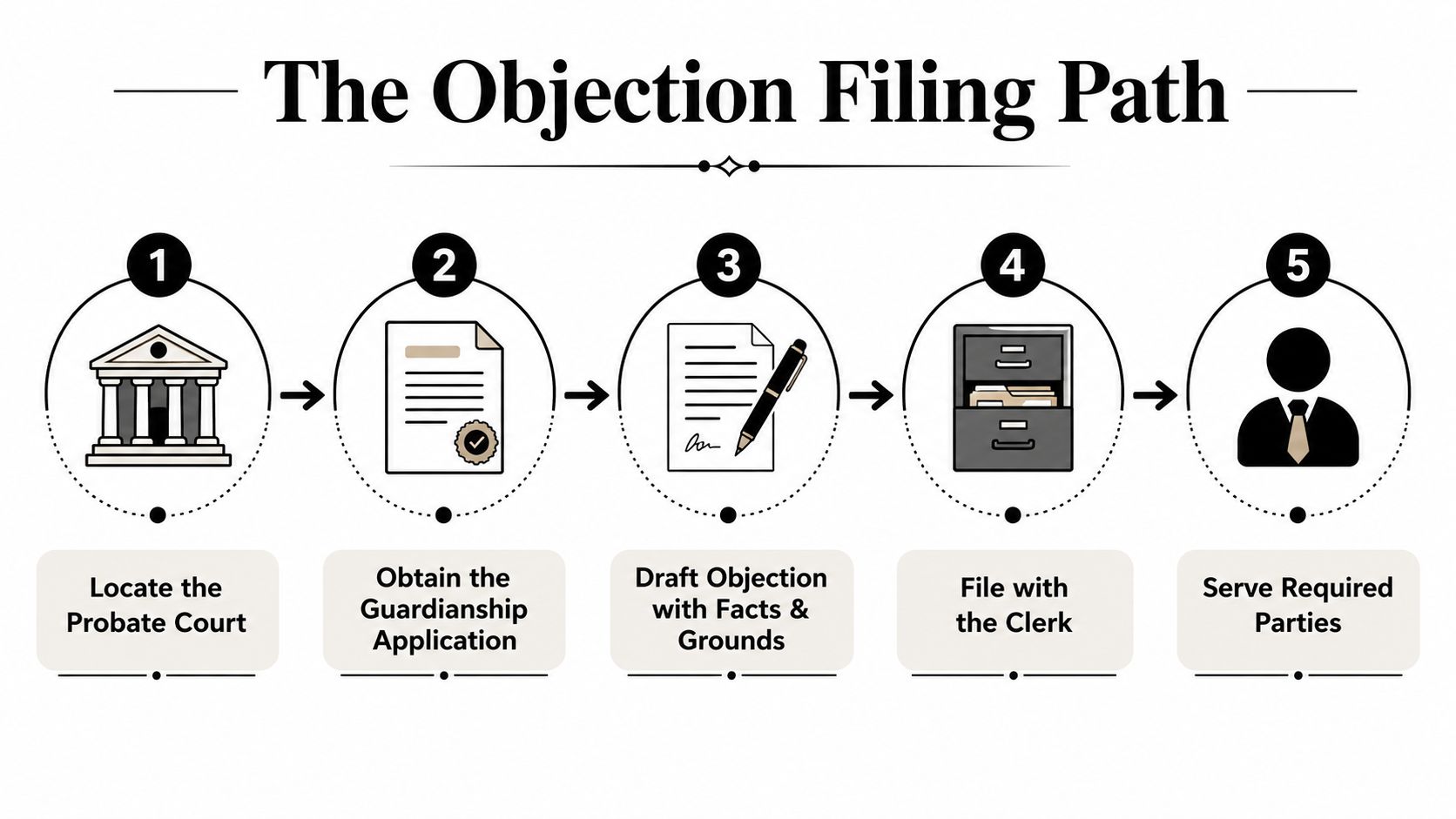
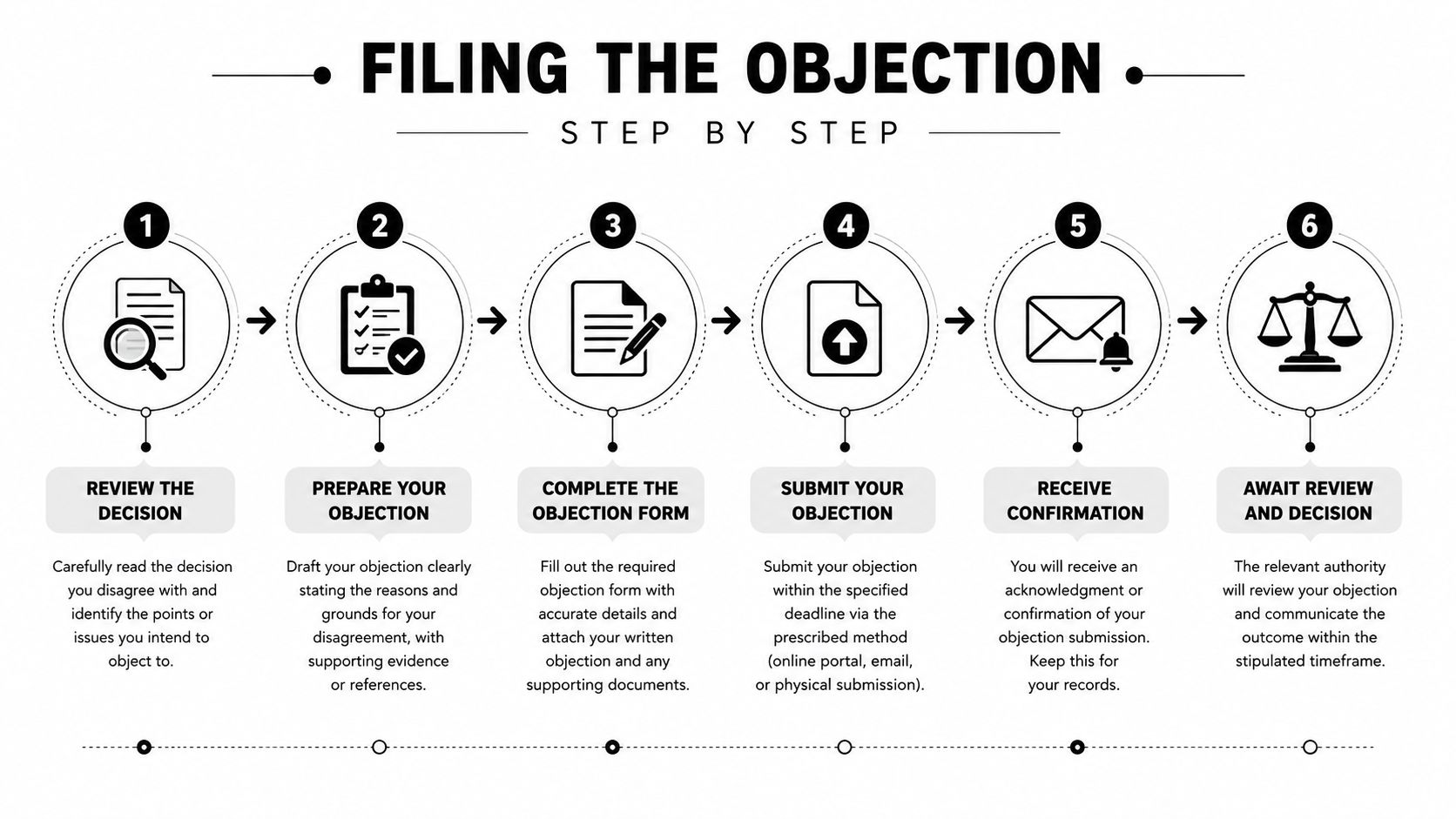
The objection belongs in the same county probate court where the guardianship application was filed. If the case is in Dallas County Probate Court, for example, the objection goes into that cause number, not into a separate family law file or a random district court packet. The goal is simple, give the judge a written reason to stop the guardianship from moving forward without a fight.
What the filing usually needs
Texas does not require a single state-wide objection form. In practice, lawyers usually file a verified pleading that says who the objector is, why they care, and what facts show the guardianship should be denied, narrowed, or assigned to someone else. The pleading should include specific grounds under Chapter 1055, not just general frustration.
Common filing pieces include:
- Written objection. State the case name, cause number, and the exact problem with the application.
- Certificate of service. Show that the applicant and the proposed ward's attorney ad litem got notice.
- Supporting exhibits. Add records, letters, reports, and anything else that backs up the facts.
- Request for hearing. Ask the court to set the objection for contested review.
Practical rule: a strong objection reads like a court filing, not a family text message.
Clerks often want copies for service and filing fees at the time of submission. Some counties accept e-filing, some still require paper copies for attachments, and all counties expect the cause number to match exactly. If the guardian application is already on file, coordinating with the court investigator or attorney ad litem can help the judge see that the objection is tied to the underlying dispute, not just a personality conflict.
The exact wording matters too. A sample opening might say, “The objector opposes appointment of John Doe as guardian because the proposed ward is not shown to lack capacity to this extent, and because John Doe's financial conflict raises concerns about suitability.”
That is the kind of filing that sets up the evidence discussion. The next step is proving the objection with records the court can trust.
Building Evidence Using Compliance Records and Capacity Evaluations
A generic complaint rarely moves a probate judge. A documented pattern of missed filings, missing inventories, or weak medical support can. Texas guardianship compliance data shows why. In FY 2021, statewide review found 27% missing annual reports, 41% missing annual accounts, 42% missing inventories, and 39% out of compliance overall (FY 2021 statewide compliance review). By FY 2025, the program still found about 34% out of compliance, with 23% missing annual reports, 40% missing annual accounts, and 41% lacking inventories (FY 2025 compliance reporting).
That data doesn't prove one specific guardian did something wrong. It does show where the court system expects defects to appear, and where an objector should look.
Records that can make the objection concrete
| Common Texas Guardianship Compliance Gaps and Their Value as Evidence | Statutory Source | Evidence Objector Can Submit |
|---|---|---|
| Missing inventory | §1101.101a | Court file printout, sworn statement, bank records, asset list |
| Missing annual report | §1101.153 | Clerk's docket sheet, hearing notice, prior report history |
| Missing annual accounting | §1102.002 | Accounting gap, receipts, statements, payment history |
A family member objecting in Fort Worth, El Paso, or a smaller county can ask for the case file and compare it to those filing duties before the hearing. That turns suspicion into a chart the judge can read in minutes. The statewide reporting system also creates a recurring checkpoint under Section 72.124, so missed filings aren't just technical mistakes, they can signal a larger oversight problem.
For capacity, the key question is whether the proposed ward needs the level of protection requested. Medical records, physician letters, and a current evaluation can show what the person can still do. If the court orders an independent exam under §1102.012, that report can either support or weaken the application depending on what the examiner finds.
If you want a deeper look at evidence choices, the guide on guardianship contests in Texas evidence that actually matters is a good companion. The point is to walk into the hearing with documents, not just concern.
Preparing for the Courtroom Hearing
A guardianship hearing in Texas usually feels formal and quiet, even when the family tension is obvious. In a county probate courtroom, the applicant, the proposed ward, the attorney ad litem, the court investigator under §1058.103, and the objector may all be present. The judge will call the case, hear preliminary issues, take testimony, and ask direct questions about capacity, need, and suitability.
What to do before you walk in
Dress neatly. Bring paper copies of every exhibit. Address the judge as Your Honor, not by first name, and don't interrupt other speakers even if they say something unfair. The court is watching whether you can stay factual under pressure.
Keep your comments short, specific, and tied to documents the judge can verify.
If the hearing is a bench trial, the judge decides the facts. If a jury is demanded under §1055.053, the process changes and the case may include jury selection and a different evidence rhythm. Either way, continuances usually happen only when the court sees a real reason, like missing notice, needed records, or a witness who can't be present.
A one-page summary helps a lot. List the exact objections, the key exhibits, and the names of any witnesses. Put your best records on top, such as medical letters, banking records, or missed filing reports. If the case has contested evidence problems, the hearing guide at evidentiary hearing guardianship Texas can help you think about how judges sort proof.
The hearing is also where respectful tone matters most. Don't turn the courtroom into a family argument. Tell the judge what happened, what document proves it, and what you want the court to do about it. That approach gives your objection credibility, even if the family conflict has been ugly for months.
Possible Outcomes After the Judge Rules
When the evidence closes, a Texas probate judge has more than one option. Sometimes the application gets dismissed because the court doesn't find enough basis for guardianship. Sometimes the judge refuses the proposed guardian but appoints someone else under §1104.103, which can be important when the problem is the person, not the need for protection. The court can also limit the guardianship under §1101.101 so the ward keeps some rights.
A few outcomes families should expect
- Dismissal of the application. The court may decide guardianship isn't proven.
- Alternate guardian. The judge may reject one applicant and appoint another qualified person.
- Limited guardianship. The ward keeps some decision-making power.
- Guardianship with conditions. The court can keep the guardianship but add restrictions or oversight.
A judge may also encourage mediation under §1056.052 if the family can work out a safer arrangement without a full fight. That can matter in cases where relatives agree on care, but disagree on who should control money or medical choices.
In one common scenario, a judge hears testimony that the proposed ward still handles some daily decisions, but the family has real concerns about bill payment. The result may be a narrower order instead of a total loss of rights. That's often a more realistic outcome than the all-or-nothing picture families fear.
If a party loses, the case still isn't over. A motion for new trial under TRCP 329b may be available within thirty days, and appeal rights can exist under §1051.103. Later, if the ward's condition changes, the family may seek modification under §1202.001 or restoration under §1202.151. For cases where expert testimony matters, attorney resources on forensic witnesses offers a useful look at how specialized witnesses support contested proceedings.
When to Get a Lawyer Involved and What Comes Next
Some objections are straightforward. Others turn into a fight over medical records, financial control, and whether the guardian has already overstepped. If the court is weighing a contested capacity finding, alleged fiduciary misconduct, restrictions under Chapter 1102, or any involvement by the Department of Family and Protective Services, self-representation can get risky fast.
A Texas guardianship attorney looks at the whole case, not just the objection. That means asking whether the better move is to oppose the original petition, seek a narrower order, request removal of the guardian, or pursue restoration under Section 1202.151 if the ward has regained capacity. The right answer depends on the papers, the witnesses, and what the probate court is likely to trust.
Practical next steps
- Gather medical records. Get recent evaluations, treatment notes, and any physician letters.
- Collect financial records. Pull bank statements, accountings, and bills paid by the guardian.
- Request court filings. Ask for the investigator's report and the case docket.
- Identify witnesses. Choose people who saw the ward's daily abilities or the guardian's conduct.
- Check fees and jury deadlines. Filing fees and jury demands can change the strategy quickly.
The other question is timing. If a temporary guardianship is involved, the emergency clock can be short, and if annual reporting issues are part of the objection, the file has to be organized before the hearing. In that setting, a lawyer can spot whether the case is really about incapacity, or whether the guardian's reporting failures and conflicts are the stronger story.
If you're trying to protect a parent, spouse, or adult child, you don't have to sort out every Estates Code detail alone. A consultation can help you choose between objection, modification, restoration, or removal and avoid filing the wrong thing in the wrong court.
If you're facing a guardianship dispute in Texas, the Law Office of Bryan Fagan, PLLC helps families evaluate objections, gather records, and prepare for contested hearings with a clear plan. Visit Law Office of Bryan Fagan, PLLC to schedule a free consultation and get guidance that fits your family's situation.