A sibling calls after an aging parent near San Antonio suffers a stroke and is placed under guardianship. The appointed guardian now controls important decisions, family members disagree about what the parent can still do, and nobody is sure which objections belong in court. The situation feels personal, but the legal response must be precise.
Contesting a guardianship in Texas means formally challenging a court-ordered guardianship, the appointment of a particular guardian, or the continuation of an existing order. It isn't the same as telling a relative that you disagree. A probate court must receive a proper filing, determine whether the person contesting has legal standing, and decide whether the dispute should proceed to evidence.
Texas guardianship law can affect personal autonomy, medical decisions, property, finances, and family relationships. The process is demanding, but families have options. The right strategy may involve challenging incapacity evidence, presenting a less restrictive alternative, opposing a conflicted guardian, requesting modification, or seeking termination when the guardianship no longer serves the ward's needs.
Why Families Consider Contesting a Guardianship in Texas
Families usually begin this process because something important has changed or something seems wrong. An adult child may believe a parent can still make many decisions after rehabilitation. A sibling may suspect that the proposed guardian wants control of property. A caregiver may see that the guardian isn't filing required reports or isn't following the court's restrictions.
Texas Estates Code Section 1055.001 generally gives a person the right to appear and contest a guardianship proceeding or the appointment of a particular guardian. But the same statute bars a person with an adverse interest to the proposed ward or incapacitated person from contesting the creation of the guardianship, appointment of a guardian, restoration of capacity, modification, or removal. That means standing is often the first fight, before the judge considers medical evidence or family testimony. Texas Estates Code Section 1055.001 provides the governing statutory language.
Timing can affect the available remedy
The strongest opportunity to object often comes before the court issues Letters of Guardianship. At that point, the proposed ward and eligible family members can challenge whether guardianship is necessary, whether the proposed guardian is suitable, and whether a less restrictive option would protect the person without removing broader rights.
An existing guardianship isn't necessarily permanent. Texas Estates Code Section 1151.001 gives the court authority over the guardian's administration and the ward's estate, while other provisions allow parties to seek changes after appointment. A person who has regained capacity may pursue restoration. A family member may seek a different guardian when the current guardian has a conflict or fails to perform required duties. A court may also consider whether the order has become too broad for the ward's current condition.
Practical rule: Don't wait for a family disagreement to become a crisis. Gather the medical, financial, and court records before filing so the objection identifies a legal problem the judge can address.
The emotional burden is real. Families may be grieving a stroke, dementia diagnosis, disability, or sudden loss of independence while also facing legal expenses and conflict over care. Support from a trusted disability community platform can help families find community and practical perspective, but legal objections still must be filed in the proper probate proceeding.
Before assuming that a guardianship is the only option, review alternatives to guardianship in Texas. Supported decision-making, powers of attorney, representative payees, and trusts may address a specific need without imposing a full guardianship.
Legal Grounds to Contest Under the Texas Estates Code
A Texas probate judge usually reaches threshold questions before weighing every family accusation. The most useful way to analyze a contest is to separate capacity, the proposed guardian's legal suitability, and procedural compliance.
Capacity is governed in part by Estates Code Section 1101.101 and related provisions. The applicant must prove the statutory basis for guardianship by clear and convincing evidence. Section 1101.003 defines incapacity for guardianship purposes, and the evidence should connect a medical condition to specific limits on the proposed ward's ability to care for themselves or manage property.
For restoration or modification, Estates Code Section 1202.152 requires a physician's written letter or certificate dated within 120 days before filing the application, or dated after filing but before the hearing. The certificate must address the nature and degree of incapacity, prognosis, effects on decision-making, medication effects, and related medical information. Estates Code Section 1202.152 is especially important when the dispute concerns a ward who may have improved.
A second threshold issue involves an adverse interest. Section 1104.003 addresses people who may be disqualified from serving, including individuals whose interests conflict with the ward's interests and other statutory categories. A person who wants to control the ward's assets while also benefiting personally may face serious scrutiny. The question is not whether the relative is unpopular. The court examines whether the person's interests are legally inconsistent with the ward's protection.
Procedural defects can decide a case before the court reaches the merits. Notice, the appointment of an attorney ad litem, citations, and medical documentation all matter. Evidence that a proposed guardian is unfit should be organized around admissible records and specific fiduciary conduct, not general family resentment.
Three threshold issues Texas courts resolve first
| Threshold Issue | Key Estates Code Citation | What the Court Decides |
|---|---|---|
| Capacity and necessity | §§ 1101.003, 1101.101, 1202.152 | Whether the evidence proves incapacity and whether the requested relief matches the ward's actual needs |
| Standing and adverse interest | §§ 1055.001, 1104.003 | Whether the contestant may proceed and whether a proposed guardian has a disqualifying conflict |
| Procedure and notice | §§ 1055, 1101.051, 1101.053, 1101.103 | Whether required notice, representation, examination, and filings were properly handled |
Section 1055.153 also matters when the ward retains partial capacity. Texas law recognizes that the ward's wishes may control in appropriate circumstances. That principle supports a focused contest, such as asking the court to limit authority over finances while preserving the ward's ability to make personal decisions.
Representation in guardianship of the person and estate under the Estates Code is the stated scope of the Texas Guardianship Lawyer. In any case, the lawyer's work should begin with standing and defects, because a persuasive emotional story won't cure a filing that the court cannot legally hear.
Who Can File and Where the Case Must Be Heard
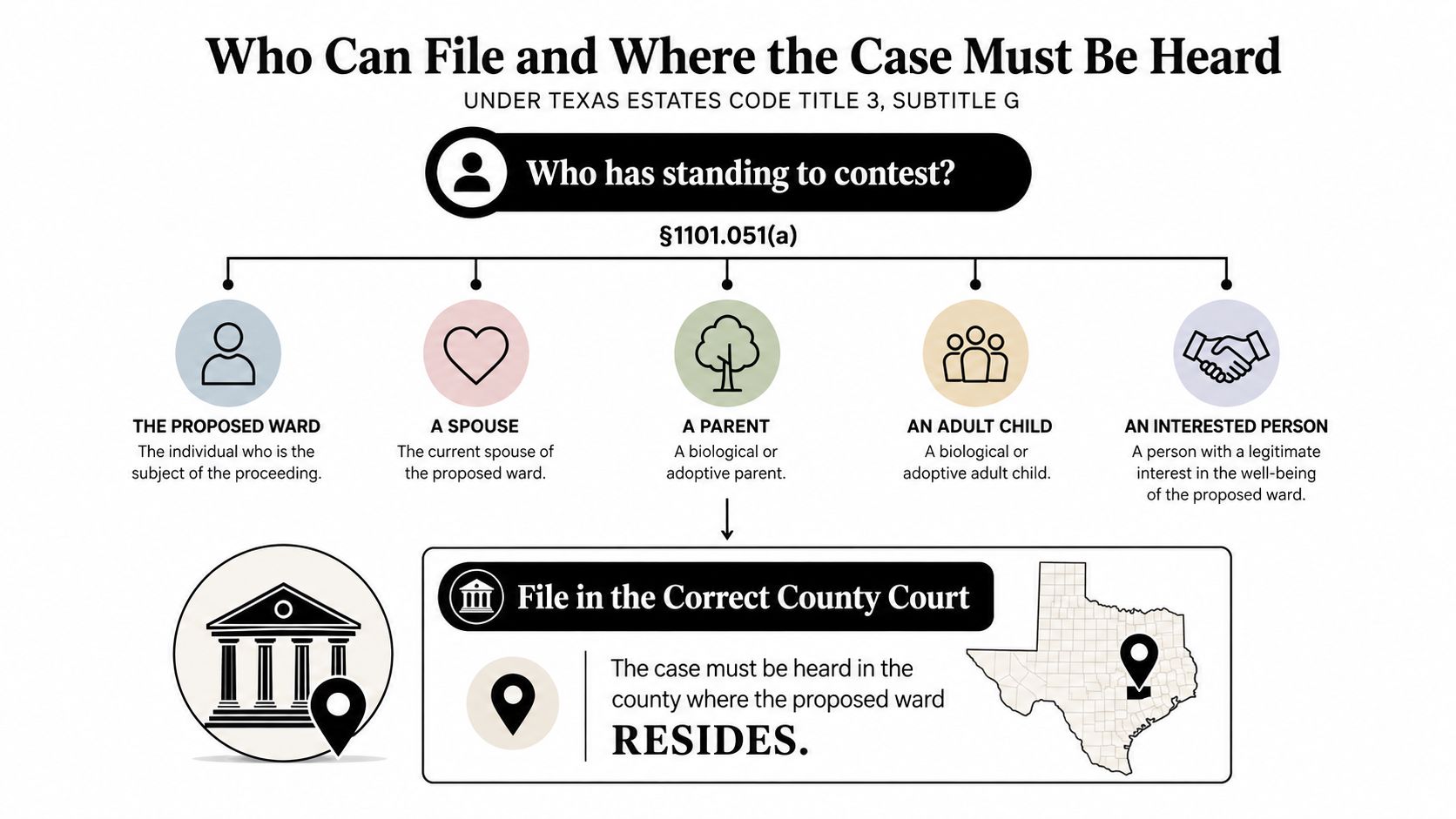
Texas law gives many people a path to appear, but having a relationship with the ward doesn't automatically guarantee success. Under Estates Code Section 1101.051(a), a guardianship proceeding may be initiated by the proposed ward, a spouse, a parent, an adult child, an adult sibling, or another person the court considers appropriate. The ward's attorney ad litem also has a role in protecting the ward's interests and may file objections under the applicable provisions of Section 1055.003.
A person contesting an original application should file a written contest or objection in the probate court handling the case. The document should identify the contestant's relationship or interest, explain the specific legal grounds, and state what relief is requested. Possible requests include denial of the application, appointment of another guardian, a limited order, or recognition of a less restrictive alternative.
A later dispute may require a different pleading. Sections 1150.101, 1151.001, and 1151.051 address post-appointment court authority, administration, and guardian conduct. A party seeking modification, removal, or termination should identify the statutory remedy rather than filing a general objection to the guardian's behavior.
Venue and hearing notice
Venue normally belongs in the county where the proposed ward resides under Estates Code Section 1023.001. If applications are filed in more than one county, the statute can determine which filing controls. A party seeking to move the case should examine the transfer procedures in Section 1023.052 instead of assuming that convenience alone permits a change.
That distinction matters in large counties and rural areas alike. A case involving a Houston resident may proceed through a Harris County Probate Court, while a ward living near San Antonio may be handled in Bexar County. The correct court depends on statutory venue and the ward's circumstances, not on where the contestant lives.
Filing and notice checklist
- Confirm standing: Determine whether the contestant has a permitted relationship or interest and whether an adverse interest could block the challenge.
- Use the existing case: File the contest in the guardianship proceeding when an application is already pending.
- Request clear relief: State whether you want denial, a different guardian, limited authority, modification, removal, or termination.
- Serve required parties: Follow the court's requirements for service on the applicant, proposed guardian, ward, and appointed representatives.
- Protect the hearing date: Texas law requires written notice of a hearing on whether a physician or psychologist examination is necessary at least four days before that hearing, under Estates Code Section 1101.103. The statutory examination procedure explains this safeguard.
- Review emergency venue: Temporary and emergency applications under Chapter 1251 may involve separate venue and notice rules.
You can review the filing process through this guide to a Texas guardianship application, but a contest often needs different requests and evidence than an uncontested application.
Building the Evidentiary Record on Capacity
Capacity evidence must answer a practical question: What decisions can the proposed ward make, and what decisions can they not make? A diagnosis alone doesn't answer that question. A stroke, dementia diagnosis, developmental disability, or mental illness may affect functioning, but the court needs evidence connecting the condition to specific decision-making limits.
The physician's certificate of medical examination, often called a PCME, is central. Estates Code Section 1101.103 addresses the examination process, including notice of the hearing on whether an examination is necessary. For restoration or modification, Section 1202.152 imposes the certificate timing and content requirements described above.
A contestant should compare the certificate with current records. Ask whether the physician examined the ward recently, whether the certificate explains functional limitations, whether medication effects were considered, and whether the prognosis addresses possible improvement. A certificate that uses broad conclusions without explaining how the condition affects daily decisions may provide a basis for challenge, although the judge will evaluate the record as a whole.
Evidence that gives the judge a usable picture
Medical records are only one part of the file. Useful evidence may include:
- Direct observation: Caregivers, relatives, nurses, and facility staff can describe how the ward handles appointments, communication, finances, medication, and personal choices.
- Functional records: Occupational therapy assessments, facility notes, care plans, and rehabilitation records may show retained abilities or specific limitations.
- Financial documentation: Bank statements, bills, account histories, and transaction records can show whether the ward manages money safely or needs targeted assistance.
- Existing planning documents: Powers of attorney, medical powers of attorney, supported decision-making agreements, trusts, and representative-payee arrangements can support a less restrictive plan.
- Professional testimony: The certifying physician or another qualified professional may explain whether incapacity is complete, partial, stable, or potentially reversible.
Requesting complete medical records often requires proper authorization, a court order, or coordination with counsel because HIPAA limits access. Depositions can test whether the physician reviewed relevant history and whether the opinion rests on a complete examination rather than a brief encounter.
| Evidence Element | Statutory Source | What the Court Expects | How a Contester Can Challenge |
|---|---|---|---|
| Medical examination | § 1101.103 | A legally sufficient examination and proper notice of the examination hearing | Attack notice, qualifications, examination quality, or missing analysis |
| Physician certificate | § 1202.152 | A timely certificate addressing incapacity, prognosis, medications, and decision-making | Identify an outdated date, unexplained conclusion, or failure to address improvement |
| Functional evidence | §§ 1101.003, 1101.101 | Proof linking the medical condition to actual limitations | Present recent records and witnesses showing retained abilities |
| Ward's preferences | § 1055.153 and related provisions | Consideration of the ward's wishes when legally relevant | Show that the proposed order ignores clear, consistent preferences |
| Less restrictive plan | Texas guardianship framework | A workable method that protects the ward without unnecessary loss of rights | Document who will perform each task and how accountability will work |
Hearsay objections, relevance objections, and disputes over outdated records can narrow the evidence. Strong preparation doesn't mean bringing every document. It means connecting each exhibit to a specific statutory question.
Temporary and Emergency Relief During the Contest
A full contest may take time, but a ward or estate may face immediate danger. Texas law provides temporary guardianship procedures under Chapter 1251 for situations requiring short-term protection. A request should identify the concrete risk, such as financial withdrawals, isolation, untreated medical needs, or an urgent inability to make essential decisions.
Temporary relief isn't a substitute for proving the permanent case. The court still must follow statutory requirements, provide notice when required, and decide whether the emergency conditions justify temporary authority. A contestant should explain why ordinary scheduling won't protect the ward and what limited authority is needed.
What to request in a temporary application
A focused request may ask the court to:
- Protect identified assets: Seek authority limited to preventing dissipation or securing records.
- Address immediate care: Identify the medical or living decision that cannot safely wait.
- Require accountability: Request a bond, reporting, or an accounting appropriate to the temporary authority.
- Limit the order: Ask for only the powers necessary to address the stated emergency.
- Set the next hearing: Make clear how the temporary order relates to the pending permanent contest.
Emergency hearings can be scheduled quickly, sometimes within days, so families should gather the key records immediately. Bring bank information, medical statements, facility communications, police or protective-services records when applicable, and any existing court orders.
A temporary guardian must file a final report when the appointment ends. If the ward is living, the report must explain why the temporary guardianship expired, including whether the ward regained capacity, alternatives were established, or a permanent guardian qualified. Under Estates Code Section 1251.153, after proof of delivery and court approval of the final report, the temporary guardian is discharged and bond sureties are released from future liability. The temporary guardian final-report rule gives families a concrete closing checkpoint.
Temporary relief can protect a vulnerable person, but it can also intensify family conflict. The order should be narrow, documented, and reviewed promptly.
Preparing for the Guardianship Hearing in Texas
A contested hearing rewards preparation that is organized around the legal elements. A family member who spends the hearing describing years of conflict may lose focus if the testimony doesn't show incapacity, necessity, conflict, procedural error, or a specific fiduciary failure.
Before court, prepare a binder or electronic exhibit set containing the pleadings, medical certificate, current medical records, financial documents, planning documents, proposed orders, and communications relevant to notice or care. Mark the documents clearly and confirm that the court and opposing parties receive them according to local practice.
Build the hearing around witnesses
The proposed ward may speak if able and willing. Their preferences can be important, but relatives shouldn't pressure the ward or rehearse answers. The ward's attorney ad litem represents the ward's interests, while the judge may also consider information from a court investigator or another appointed representative under the applicable Estates Code provisions.
Other witnesses should offer firsthand facts. A caregiver can describe medication management. A physician can explain the relationship between diagnosis and decision-making. A banker or fiduciary professional may explain unusual transactions if those records are properly presented. A sibling who only repeats what another person said may offer less useful testimony than a facility employee who personally observed the ward's functioning.
Hearing-day advice: Answer the judge's question directly, avoid arguing with relatives in the courtroom, and tie every important fact to the order you want entered.
Out-of-town physicians may need arrangements for live testimony or videoconference testimony, subject to the court's approval and local procedures. Ask counsel early about subpoenas, affidavits, deposition testimony, and exhibit authentication. Don't assume a letter from a doctor will receive the same weight as admissible testimony or a properly supported medical certificate.
Courtroom conduct and preservation
Arrive early, dress respectfully, silence your phone, and address the judge properly. If the proposed ward attends, allow them dignity and space. Family members should not interrupt, make faces, or exchange accusations during testimony.
If the judge rules against you, ask counsel about preserving objections, requesting findings of fact and conclusions of law when appropriate, and identifying the exact order being challenged. A respectful record matters more than a dramatic argument.
The timeline depends on the court, the number of parties, the evidence, and whether a jury is requested. A contested matter may require multiple settings and can extend well beyond the initial hearing. Treat every interim hearing as important because temporary orders, discovery rulings, and evidentiary decisions can shape the final record.
Outcomes, Appeals, and When to Talk to an Attorney
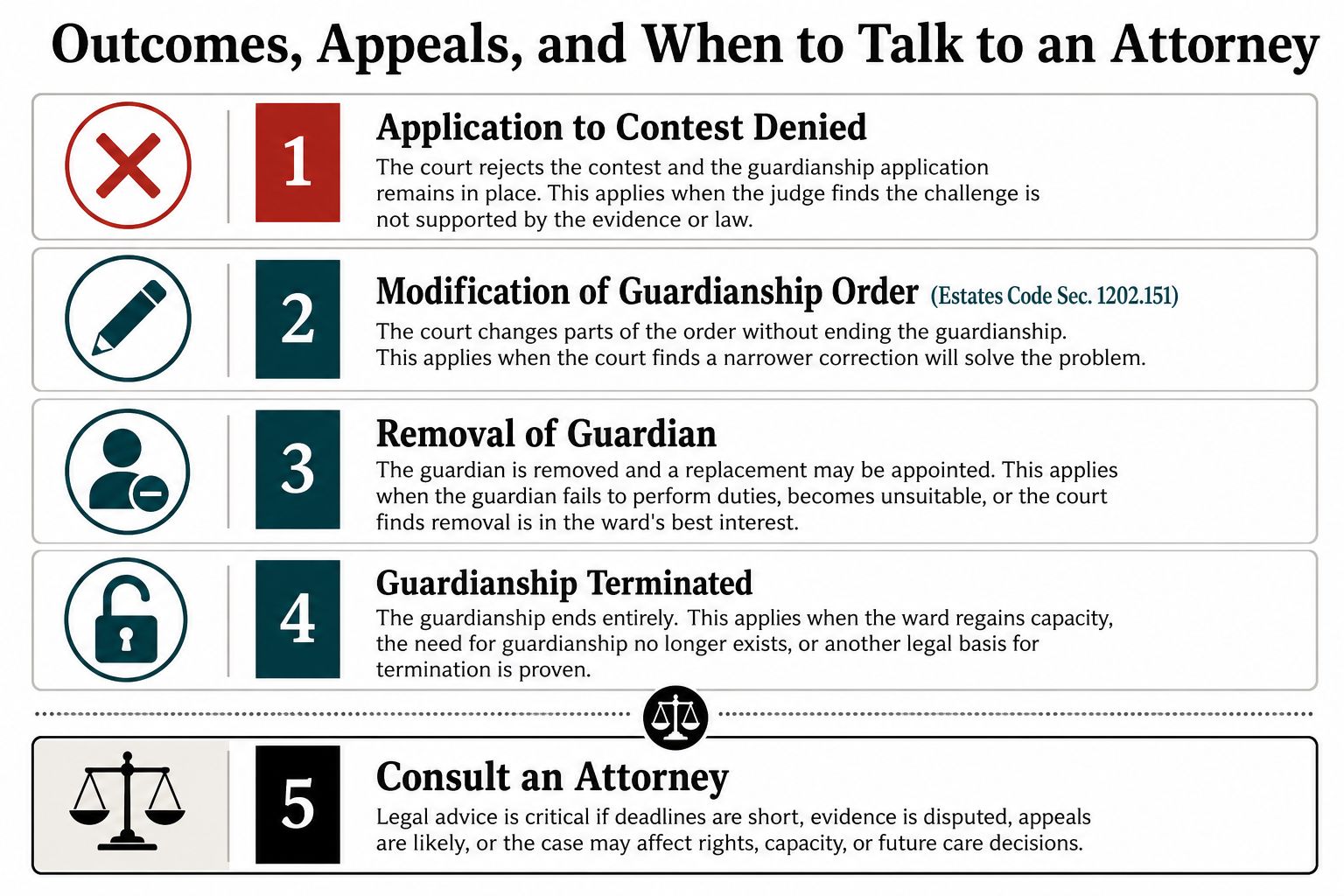
A guardianship contest can end in several ways. The court may deny the application, appoint another guardian, limit the guardian's authority, modify an existing order, remove the guardian, or terminate the guardianship. The remedy should address the problem proved by the evidence.
If the proposed ward can manage some matters but needs help with a specific task, modification may fit better than termination. If the guardian has neglected the ward, mishandled property, or developed a conflict, removal or appointment of a successor can preserve needed protection. If incapacity is not established, or protection is no longer necessary, restoration or termination may be appropriate.
Post-appointment disputes
Texas Estates Code Chapter 1202 governs restoration and modification proceedings. Section 1202.151 addresses modification procedures, while Section 1202.152 concerns medical proof related to restoration. A request should identify what changed and support that change with current evidence. The original hearing record may not answer the court's present question.
Removal is a separate remedy. Estates Code Section 1203.052 may apply when a guardian breaches duties or becomes unsuitable. Missing reports, unexplained transactions, inadequate protection of property, neglect of personal needs, and conduct involving an adverse interest can support a documented request. A family disagreement or unpopular decision, standing alone, usually does not establish statutory grounds.
Compliance records often decide whether a removal request gains traction. Examine whether the guardian filed the required inventory, annual report, or annual account, then connect each omission to a specific period, asset, care issue, or risk. The Texas judiciary's oversight materials provide broader context for reviewing guardianship compliance, but the cited document does not establish Fiscal Year 2025 statistics. The Texas judiciary's Fiscal Year 2025 report should not be treated as proof of current-year figures.
Texas law requires a guardian to file an inventory within 30 days after appointment. The timing can be checked against the statutory inventory deadline. Annual reports and annual accounts are also subject to filing deadlines tied to the guardian's qualification anniversary. A useful court filing identifies the missed document, explains what information it should have provided, and shows why the omission warrants an order, accounting, bond action, removal, or another remedy.
Appeals and closing duties
A final contested order may be appealable, but the deadline depends on the order and qualifying post-judgment filings. Texas appellate deadlines may range from 30 to 90 days in the circumstances described by the applicable rules. Calculate the deadline from the signed order and relevant filings, not from the day a relative hears the ruling.
An appeal is not a new hearing for every disputed fact. It generally focuses on legal error, insufficient evidence under the governing standard, abuse of discretion, or preserved procedural error. Counsel should review service, notice, jurisdiction, objections, and the reporter's record. A defect in the process may affect the order's validity, but an issue not preserved in the trial court may be difficult to raise later.
Settlement does not automatically end a guardian's duties. Depending on the order and the estate, the guardian may need to file a final accounting, return property, transfer records, and obtain an order closing the estate. Under the requirements identified in the contested matter, a final accounting may be due within 60 days under Section 1202.053. Review the actual order and governing statute promptly.
Families sometimes compare guardianship disputes with other probate conflicts involving property and heirs. A general discussion of inherited property disagreements Arizona can help explain why an inheritance dispute may proceed separately from a capacity or fiduciary-duty challenge. Arizona law does not govern a Texas guardianship, so Texas families should rely on Texas statutes, the assigned court, and the ward's circumstances.
The following video offers general context about guardianship issues. It does not replace advice about a Texas case or review of the court record.
Consult a Texas guardianship or probate attorney promptly when:
- Capacity is disputed: The medical certificate is incomplete, outdated, inconsistent with current records, or does not explain functional limits.
- Money is at risk: Bank activity, property transfers, missing records, or unexplained spending suggests possible financial exploitation.
- Standing is uncertain: The contestant is a beneficiary, caregiver, fiduciary, or relative whose interests may be adverse.
- Notice or jurisdiction is defective: The ward did not receive required notice, an examination hearing was missed, or the case appears filed in the wrong county.
- A child or public benefit is involved: Minor children, Medicaid planning, trusts, and spend-down issues may affect matters beyond the guardianship order.
- The guardian is not complying: Missing annual reports, annual accounts, inventories, or care information may require immediate court action.
The strongest contests usually combine current capacity evidence, a precise procedural objection, documented fiduciary failures, and a workable alternative. Emotional testimony may explain the family conflict, but it rarely answers the statutory questions by itself.
The Law Office of Bryan Fagan, PLLC helps Texas families establish, modify, terminate, and contest guardianships involving the person or estate, including disputes over incapacity, fiduciary conduct, medical evidence, and reporting compliance. Schedule a consultation by visiting the Law Office of Bryan Fagan, PLLC to discuss the court, deadlines, evidence, and relief that fit your family's situation.