A Texas parent may spend the week before a son or daughter's 18th birthday sorting school records, medical forms, and benefit paperwork, then realize that the legal relationship changes overnight. The child may still need help understanding medical choices, managing money, or recognizing unsafe situations, but a parent's automatic authority as the guardian of a minor ends when the child becomes an adult. Texas law presumes an adult has capacity at age 18 unless a court determines otherwise. Texas Estates Code
That can feel frightening, but guardianship isn't the only path. For some adults with Down syndrome, supported decision-making, powers of attorney, or carefully designed financial planning may provide protection without removing rights. For others, a limited or full guardianship may be necessary. The right question isn't, “Can I get guardianship for a Down syndrome adult in Texas?” It's, “What level of legal support protects this adult while preserving as much independence as possible?”
When Your Child With Down Syndrome Turns 18 in Texas
Maria sits at her kitchen table in Houston, looking at the calendar. Her son, Daniel, has Down syndrome and has always relied on her to organize doctor visits, explain complicated forms, and help with spending decisions. Until now, Maria has been able to speak with schools, doctors, and agencies because she's Daniel's parent. His 18th birthday changes that legal authority.
Daniel becomes an adult whether or not he has a disability. Maria won't automatically retain the right to consent to medical care, manage his money, or receive protected information. A doctor, bank, school, or benefits agency may ask Daniel to make the decision himself or to identify a legal tool that permits someone else to help.
The central question: An adult with Down syndrome doesn't automatically need a court-appointed guardian. The law requires an individualized assessment of capacity and available supports.
Texas law presumes capacity at adulthood. A Down syndrome diagnosis may explain why someone needs help, but the diagnosis alone doesn't establish legal incapacity. The court must look at the person's actual ability to care for personal needs, protect health, and manage financial affairs. Families can review the transition from childhood authority to adult decision-making in this guide about what happens to guardianship of a minor in Texas at age 18.

Start with the adult's abilities
Families should write down what the adult can do independently, what they can do with reminders, and what they can't safely manage even with assistance. A person may be able to choose clothing, communicate treatment preferences, use transportation, or manage a debit card while still needing help with contracts, complex medical decisions, or financial exploitation risks.
That mixed picture matters. Texas courts can appoint a guardian of the person for personal and medical needs, a guardian of the estate for financial matters, or separate guardians for each role. The court can also consider joint guardians when that serves the protected person's best interest. Texas Estates Code guidance on guardianship alternatives and appointments
Before filing, families should consider supported decision-making agreements and targeted powers of attorney. They should also gather medical, school, employment, and service-provider records that show how the adult functions in daily life. A thoughtful plan may avoid court intervention, or it may give the court a clearer basis for a limited guardianship instead of a broader one.
Understanding Texas Capacity Standards for Adults With Down Syndrome
A parent may see one adult who can choose clothing, explain treatment preferences, and use a debit card with reminders, yet still need help with contracts or complex medical decisions. Another adult with Down syndrome may be unable to recognize a medical emergency, understand where basic needs come from, or resist serious financial pressure. Texas courts examine those real-life differences rather than treating a diagnosis as the answer.
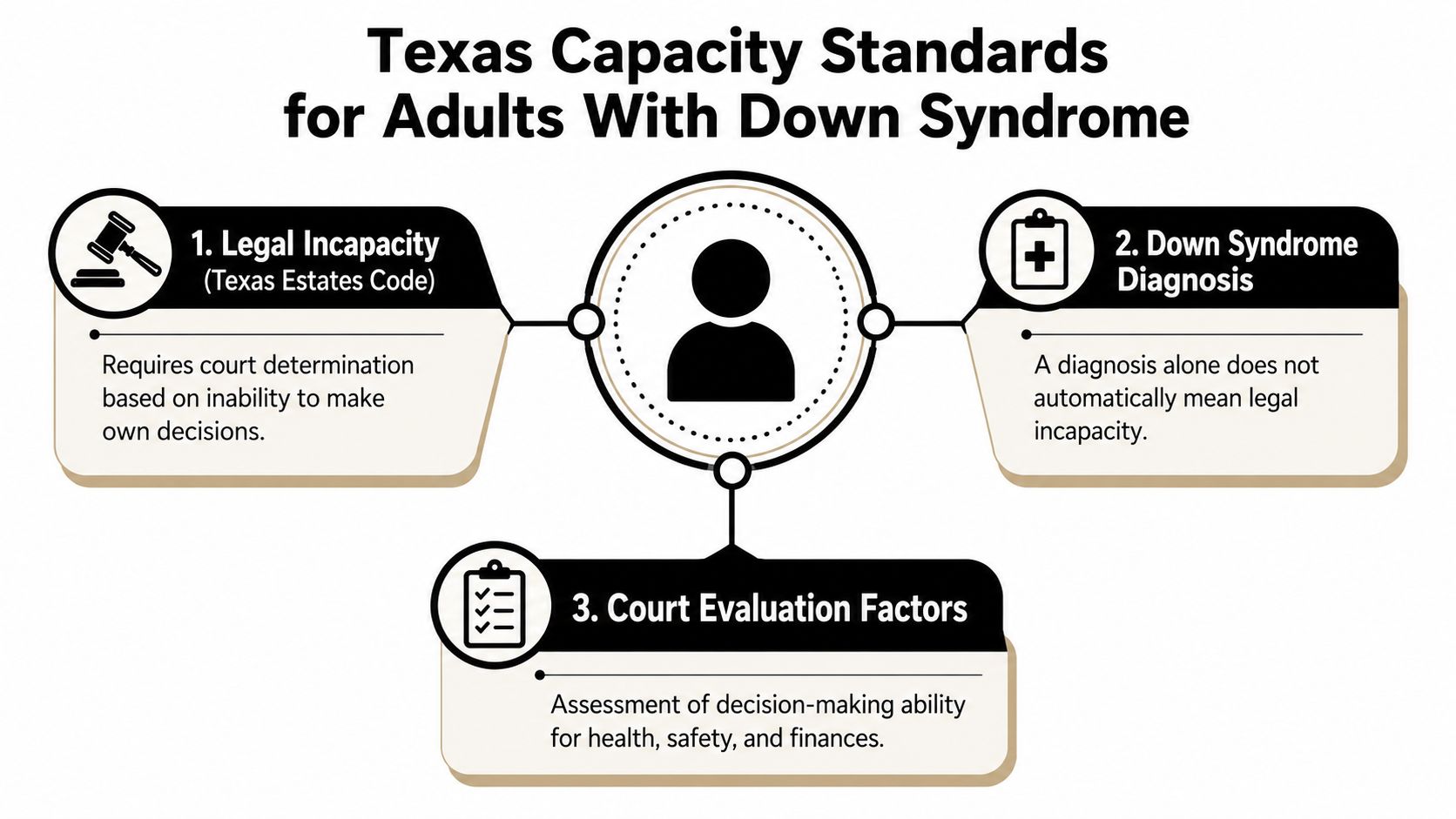
Texas uses a functional standard. In plain English, the court asks whether a physical or mental condition leaves an adult substantially unable to provide food, clothing, or shelter, care for personal health, or manage financial affairs. The governing framework appears in Texas Estates Code Title 3, including the incapacity provisions described in Texas law on determining incapacity. A guide to determining incapacity in a Texas court can help families understand how evidence connects to that legal test.
The three practical areas courts examine
The standard becomes clearer through ordinary questions:
- Basic needs: Can the adult obtain or arrange food, clothing, and shelter independently or with dependable support?
- Personal health: Can the adult recognize health concerns, seek care, follow treatment instructions, and communicate meaningful preferences?
- Financial affairs: Can the adult understand basic financial choices, use money safely, and avoid serious exploitation?
A person may need assistance in one area while making decisions independently in another. Texas can appoint a guardian of the person for personal and medical needs, a guardian of the estate for financial matters, or separate guardians for those roles. The court may also consider joint guardians when that arrangement serves the protected person's best interest.
Capacity isn't the same as intelligence
An IQ score does not answer every legal question. Judges focus on functional decision-making, communication, foreseeable risks, and the adult's ability to use available support. Extra time, plain-language explanations, visual aids, or a trusted supporter may help an adult decide without removing the adult's legal rights.
Before a guardianship application, families should document what the adult does independently, what requires reminders, and what remains unsafe even with assistance. Medical, school, employment, and service-provider records can show daily functioning more accurately than a diagnosis alone.
A physician or psychologist must provide a written certificate of examination before most adult guardianships can be created. Texas requires the examination to occur no earlier than 120 days before the application is filed, according to the Texas requirement for a Certificate of Medical Examination. When intellectual disability is involved, the court may also rely on an intellectual-disability determination made or updated within the preceding 24 months, as the statute describes. The Certificate of Medical Examination in Texas Guardianship explains why this document usually begins the court's review.
The least restrictive option controls
The threshold question is whether full guardianship is necessary. Texas courts must consider alternatives and available supports before appointing a guardian. If the adult needs help only with property management, a guardian of the estate may fit better than authority over personal decisions as well.
A limited order can preserve rights in areas where the adult remains capable. Protection should address documented risks while leaving the adult as much control as possible over personal, medical, and financial choices.
Alternatives to Full Guardianship That Preserve Independence
Guardianship places decision-making authority under a court order. Less restrictive tools can provide assistance while allowing the adult to retain legal rights. Texas recognizes supported decision-making as a formal alternative through Chapter 1357 of the Estates Code, and the state's adult-guardianship guidance emphasizes that a disability doesn't automatically mean a person needs a guardian. Texas Health and Human Services guardianship guide
Match the tool to the actual risk
A Supported Decision-Making Agreement, or SDMA, lets an adult choose trusted supporters. Those supporters can help the adult understand information, consider options, and communicate decisions. The adult keeps the legal right to decide.
A medical power of attorney can authorize another person to make health-care decisions when the adult can't make or communicate a decision under the document's terms. A durable power of attorney may address financial matters if the adult understands the document and signs it voluntarily. These tools require careful capacity analysis and drafting.
A representative payee arrangement can address Social Security benefit management without automatically controlling all other areas of the adult's life. A special needs trust can hold and manage resources for the adult while supporting continued eligibility for needs-based benefits, subject to the specific benefit rules and trust structure.
Families comparing trusts and wills may also benefit from a neutral explanation of which estate tool suits my family, especially when inheritance planning and public benefits overlap.
| Option | Rights Retained by Adult | Court Involvement | Typical Cost | Best For |
|---|---|---|---|---|
| Supported Decision-Making Agreement | Adult retains legal decision-making rights | Usually no guardianship case | Varies by drafting and advice | Adults who can decide with support |
| Medical or durable power of attorney | Adult retains rights outside the authority granted | Usually no guardianship case | Varies by document complexity | Specific health-care or financial authority |
| Representative payee | Adult retains rights outside benefit management | Benefits agency involvement | Varies by administration | Managing Social Security payments |
| Special needs trust | Adult retains personal rights; trustee manages trust assets | Trust administration, with court involvement depending on structure | Varies by trust design and administration | Protecting managed resources and benefit planning |
| Limited guardianship | Rights are removed only in areas ordered by the court | Probate court order and ongoing compliance | Court and professional costs vary | Significant vulnerability in defined areas |
| Full guardianship | Rights may be removed across personal, financial, or both areas | Probate court order and ongoing compliance | Court and professional costs vary | Profound functional impairment |
Practical rule: Start with the narrowest tool that addresses the real problem. Move toward limited guardianship when targeted support fails, and consider full guardianship only when the evidence shows broader protection is necessary.
Texas petitioners must explain why alternatives and available supports aren't sufficient. That comparison isn't just a family-planning preference. It's part of the legal analysis. Families can also review the state-law framework in this explanation of supported decision-making agreements in Texas.
Filing for Guardianship in Texas Courts Step by Step
A guardianship case should begin with a careful question: what decision-making problem needs protection, and can a less restrictive tool address it? A Down syndrome diagnosis alone does not answer that question. Texas families generally file in the probate court, or another court with probate jurisdiction, in the county where the adult lives. Harris County and Dallas County have dedicated probate courts. Other counties may use county courts at law or another probate court.
Prepare before filing
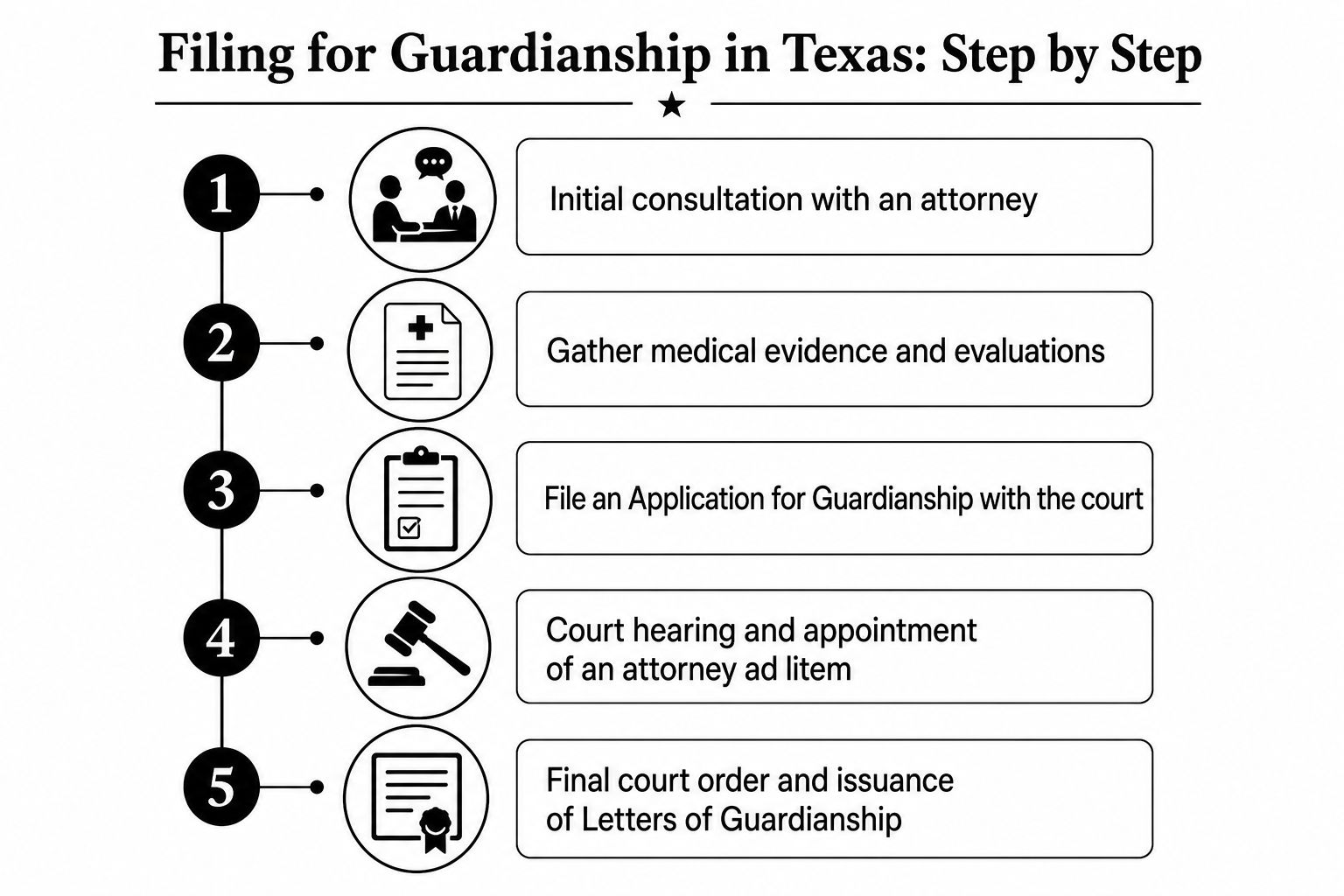
Before filing, consult a Texas guardianship attorney and gather records that show daily functioning. Examples may include information about health care, finances, safety, communication, housing, and the adult's ability to make particular decisions. A licensed physician must complete the Certificate of Medical Examination within the required 120-day period before filing. The certificate should explain functional limitations rather than just identify Down syndrome.
The application names the proposed ward, the requested type and scope of guardianship, the proposed guardian, relatives and other interested persons, and the facts supporting incapacity. It should also explain why supported decision-making, powers of attorney, representative payee status, or other services would not adequately protect the adult. The goal is to request the narrowest authority that addresses the actual problem, rather than removing rights across areas where support is still effective.
File, notify, and investigate
After filing, the court addresses notice to the proposed ward and required relatives or interested parties. The proposed ward receives an attorney ad litem to protect their interests. In counties that use court investigators, an investigator may interview the adult, family members, caregivers, and professionals, then provide findings to the court.
The proposed ward should be treated as a participant, not as paperwork being delivered to court. Explain who will attend and what questions may arise. The judge needs to hear the adult's own views. Bring communication aids, allow extra time, and avoid coaching answers.
At the hearing, the applicant presents evidence, the attorney ad litem speaks for the proposed ward, and the judge reviews the medical certificate, testimony, available alternatives, and requested scope. Under Texas Estates Code Chapter 1101, the court must make the findings required to establish incapacity and determine that guardianship is necessary and appropriate.
The judge may appoint a guardian of the person, a guardian of the estate, both, separate guardians, or joint guardians when legally appropriate. If the application is granted, the order defines the guardian's authority, and Letters of Guardianship provide evidence of the appointment.
Temporary guardianship serves a different purpose from permanent guardianship. Texas guidance describes it as an emergency remedy that expires after 60 calendar days unless extended, while permanent guardianship continues until death or court termination.
A temporary application should identify the emergency and the immediate harm that may occur without court action. It is not a shortcut for ordinary planning. The court must still follow applicable notice and due-process requirements.
Guardian Duties Reporting Requirements and Common Disputes
Appointment creates continuing legal duties. A guardian of the person handles personal needs such as residence, health care, and daily welfare within the authority granted by the court. A guardian of the estate manages property and finances, follows fiduciary duties, and handles required accounting and bond matters.
Texas requires a guardian of the person to file an annual report covering a 12-month period beginning on the qualification date. The report is due within 60 days after that reporting period ends and addresses the protected person's mental and physical condition, social and intellectual functioning, living conditions, and, when relevant, receipts and disbursements for support and care. Texas Estates Code Section 1163.102
A guardian of the estate must file an annual account with the county clerk. Texas law also says the clerk may not renew Letters of Guardianship until the court receives and approves the required report or account. Texas Estates Code Chapter 1163
| Responsibility Area | Guardian of the Person | Guardian of the Estate |
|---|---|---|
| Health care | Makes or coordinates decisions within the order | Usually limited unless the order includes related authority |
| Residence | Decides or approves living arrangements | May pay approved housing expenses |
| Daily welfare | Oversees care, services, and personal needs | May manage funds used for care |
| Property | Usually no broad control over assets | Collects, protects, and administers property |
| Reporting | Annual report about condition and living circumstances | Annual account of financial activity |
| Court oversight | Must follow the guardianship order | Must follow fiduciary duties and court requirements |
Disputes can arise when relatives disagree about who should serve, when co-guardians cannot make timely decisions, or when another family member claims the guardian is neglecting duties. A proposed ward may also oppose guardianship or ask the court to narrow the order.
Improvement matters. If Daniel learns to manage more of his money with structured support, the family should preserve records from caregivers, therapists, employers, and medical professionals. Those records may support a modification or partial restoration of rights rather than leaving an unnecessarily broad order in place.
Texas law allows guardianship to end when the ward dies, regains full capacity, regains enough capacity with supports and services to care for themselves and manage property, or no longer needs a guardian to receive government benefits. Texas Estates Code Chapter 1202
Timelines Costs and Next Steps for Texas Families
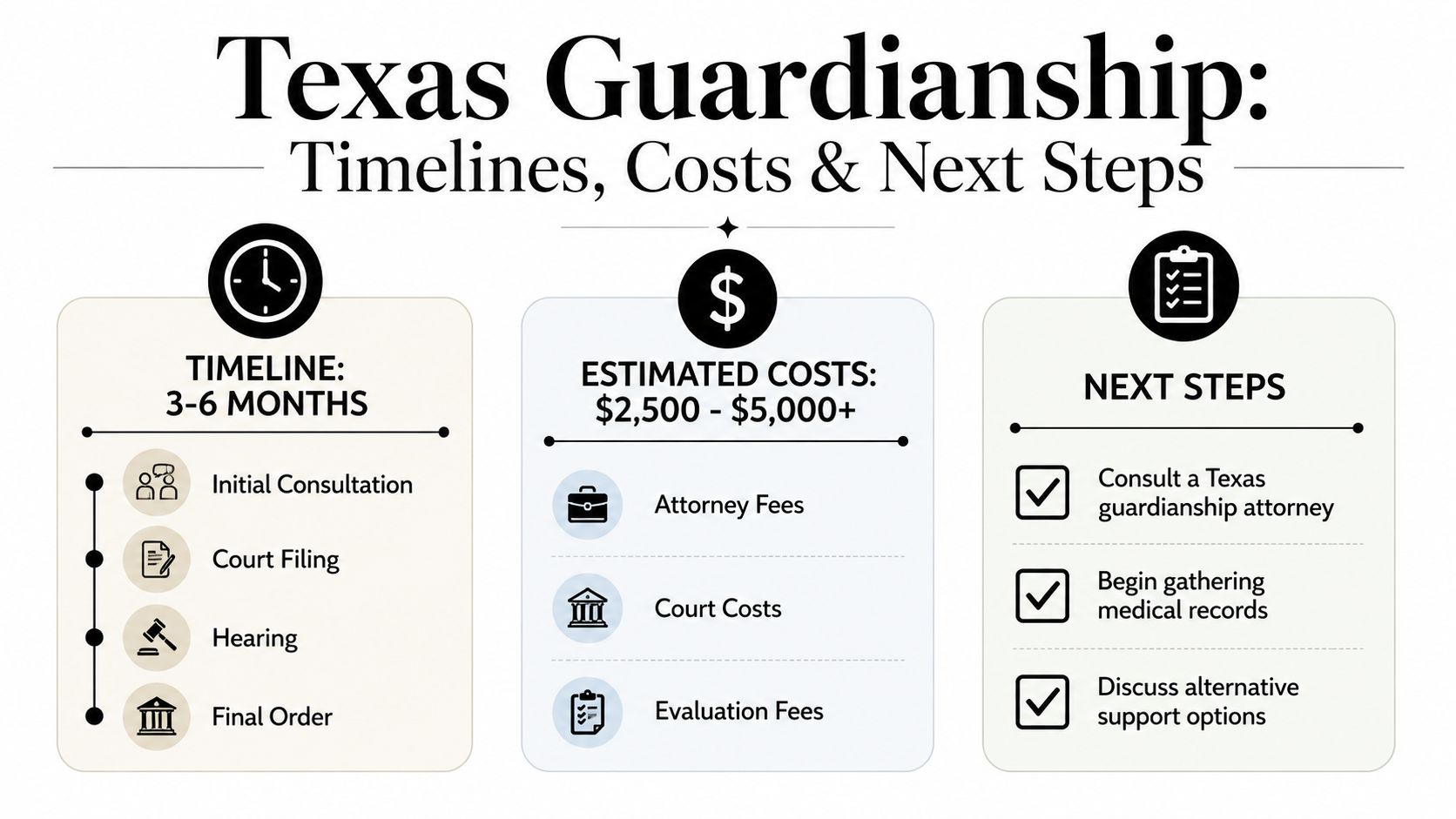
At the kitchen table, a family may be deciding whether to file now, gather more information, or try supported decision-making first. The court timeline begins only after the application is filed, and several months may pass before a final order. The county docket, the physician's availability, notice requirements, an investigation, objections, and disagreements about the requested authority can all affect the schedule.
Planning materials estimate a three-to-six-month timeline for Texas guardianship matters. They also list estimated uncontested attorney fees of $2,500 to $5,000, court filing fees of $300 to $400, attorney ad litem fees of $500 to $1,500, and separate physician examination costs. These are planning figures, not a quote for a particular family. Contested cases or estates requiring more work may exceed $10,000. Texas guardianship planning guidance
A focused checklist for this week
- Schedule an evaluation: Ask a developmental physician or another qualified professional to describe real-world functioning, decisions the adult can make, and support still needed.
- Gather records: Collect medical records, school documents, service plans, employment information, and caregiver notes that show strengths as well as risks.
- Compare tools: Discuss whether an SDMA, medical power of attorney, durable power of attorney, representative payee arrangement, or special needs trust could address the specific concern without full guardianship.
- Identify the court: Confirm the appropriate probate court or county court at law where the adult resides.
- Plan the conversation: Ask the adult what support feels comfortable, explain each option plainly, and include them in decisions as much as possible.
- Get legal advice early: A Texas guardianship attorney can assess the evidence, explain less restrictive choices, and prepare for a hearing if court intervention is needed.
Family planning point: Safety and independence can work together. A carefully limited plan may give the adult meaningful control while adding help only where risk is greatest.
Before your child's 18th birthday, schedule a free consultation with Law Office of Bryan Fagan, PLLC to review capacity evidence, supported decision-making, benefits planning, and whether a limited or full guardianship fits the family's needs. The firm assists Texas families with guardianship applications, temporary matters, disputes, modifications, termination, probate, and estate planning, including virtual consultations statewide.