Skip to content
When you learn a loved one can’t sign medical forms or pay their bills, the clock starts ticking. In Texas, securing an emergency guardianship can be the fast track to safeguarding someone’s health and finances when there’s no power of attorney in place.
What Happens In A Texas Guardianship Emergency

That still from the DeFord Law Firm’s video underscores a critical point: you need a doctor’s certification to prove incapacity. Courts aren’t driven by family opinions alone—they want solid medical evidence before they step in.
Sudden emergencies—think traumatic accidents or serious strokes—throw families into chaos. Without a durable or medical power of attorney, you can’t authorize treatments or tap into bank accounts. That’s exactly when emergency guardianship becomes not just an option, but a necessity.
Understanding The Temporary Nature
Emergency guardianship in Texas hands a court-appointed guardian the authority to make urgent decisions for someone who can’t act for themselves and has left no powers of attorney behind. You’ll most often see it in life-or-death medical scenarios—comas, severe head injuries or sudden mental collapses.
By law, this temporary fix runs for up to 60 days, though judges can extend it if more time is needed before a final guardianship hearing. For a deeper dive on preventing or preparing for this process, see the avoidance and application of this process.
This short-term order bridges the gap until a long-term plan is in place. For example, a judge in Harris County Probate Court can instantly empower someone to make choices that prevent immediate harm.
Emergency Guardianship At A Glance
Here’s a quick overview of the must-knows so you can move confidently when time is of the essence:
| Aspect | Details |
|---|---|
| Eligibility | Any interested party may petition, though courts favor spouses, adult children or close family. |
| Grounds | Must show evidence of immediate, substantial risk to the person’s health or estate. |
| Duration | A temporary order, generally for up to 60 days, with possible extensions. |
| Court Needs | A sworn application plus a physician’s letter certifying incapacity. |
This snapshot highlights the key requirements and timelines for securing an emergency guardianship in Texas. Use it as your quick reference guide when every minute counts.
Facing an urgent guardianship situation can feel overwhelming—but you don’t have to go it alone. Reach out to the Law Office of Bryan Fagan, PLLC for a free consultation and clear guidance on your next steps.
When a crisis hits, families often find themselves in a desperate scramble to protect a vulnerable loved one. Suddenly, you're faced with a situation that requires a court’s immediate intervention, and you need to know what steps to take—fast.
In Texas, the legal tool for this kind of emergency is found in Title 3, Subtitle G of the Estates Code. This is the part of the law that gives a judge the power to step in and act swiftly when someone is facing imminent danger.
The Legal Grounds for Urgent Action
The core idea behind an emergency guardianship comes from Chapter 1104 of the Estates Code. It’s designed to safeguard a person's health, safety, and financial assets when they've lost the ability to make decisions for themselves. A judge can even issue an ex parte order, meaning they can act on your petition without the other party being present, because the situation is just that critical.
Of course, a judge won't take this step lightly. They expect clear, hard evidence that this drastic measure is necessary. Typically, this starts with a physician's letter confirming that the person is incapacitated, as defined under Tex. Est. Code §1101.001. This temporary guardianship is a powerful but short-term fix, usually lasting up to 60 days.
What Counts as an "Imminent Threat"?
A vague sense of worry isn't enough to get a court's attention; you need concrete facts demonstrating a clear and present danger.
Imagine a relative in a Travis County hospital who has slipped into a sudden coma. They can't consent to medical procedures, and decisions need to be made immediately. That’s a textbook case for an emergency guardianship.
Or consider a situation in Harris County where an elderly parent with dementia suddenly has large, unexplained bank transfers showing up on their statements. This points to financial exploitation, another situation that meets the threshold for the court to step in and protect their estate from being drained.
These scenarios fall squarely under the grounds outlined in §1104.003, which is all about protecting a person and their property from immediate harm.
Here are some of the most common triggers we see:
- Sudden Medical Crisis: A doctor provides a statement confirming a life-threatening incapacity, like a severe stroke or an accident resulting in a coma.
- Rapid Financial Drain: You have evidence like bank statements showing suspicious withdrawals or checks being cashed by strangers.
- Unsafe Living Conditions: The person is in physical danger due to neglect, abuse, or an inability to provide for their own basic care at home.
How Emergency Authority Works
An emergency order grants very specific, limited authority. The temporary guardian is empowered to make crucial medical and financial decisions, but only until the court can hold a full hearing to determine if a permanent guardianship is needed.
The law also builds in protections. The temporary guardian must secure a bond and file an inventory and report with the court, as required by Tex. Est. Code §1151.101, to ensure they are held accountable for their actions.
Remember, these orders are temporary, lasting for a maximum of 60 days. This puts immense pressure on you to act quickly and get your paperwork and evidence in perfect order from the very beginning.
A Note from Experience: I can't stress this enough—judges are moved by proof, not just pleas. A detailed doctor's note, a printout of a bank statement, or photos of unsafe living conditions will always be more persuasive than a family member's emotional testimony alone.
Navigating the Texas Estates Code
Knowing the specific laws gives you a massive advantage when building your case. The foundation for emergency guardianship rests in Chapters 1104 and 1101 of the Texas Estates Code.
Here are the key statutes you need to know:
- Tex. Est. Code §1104.001: This is what gives the court the authority to appoint a guardian in an emergency, even on an ex parte basis.
- Tex. Est. Code §1104.003: This section lays out the standard of evidence needed to prove an imminent risk exists.
- Tex. Est. Code §1104.004: This statute limits the duration of temporary orders to 60 days.
In Texas, guardianship filings are overwhelmingly new cases. In fact, over 80% of guardianship and probate filings in 2023 were brand new matters, not renewals. You can find more data on these trends from legal analysts like Duffy Law. This shows just how often families find themselves navigating this process for the first time.
When you're facing a true crisis, every moment is critical. The Law Office of Bryan Fagan, PLLC, is here to guide you through the process, ensuring every step is handled with the urgency and precision it deserves.
- Visit our Guardianship page for a detailed walkthrough.
- See our Probate page for related legal guidelines.
- Explore our Estate Planning guide for information on protecting assets before a crisis hits.
Don't wait. Call us now for immediate help with an emergency guardianship.
Preparing Your Emergency Guardianship Petition
When you're facing a crisis that requires emergency guardianship, you don't have time for mistakes. Filing the petition in Texas is all about having a solid plan and the right documents ready to go. The last thing you want is a last-minute scramble at the Harris County Probate Court, so a checklist can be a lifesaver.
Your first move should be to get the official Application for Appointment of a Temporary Guardian directly from the county clerk's office. This isn't just any form; it's the key that unlocks the process empowered by the Texas Estates Code (Title 3, Subtitle G) under §1104.001. This statute is what allows you to act quickly when a loved one is in immediate peril.
Key Documents to Gather
The strength of your petition lies in its supporting evidence. You'll absolutely need a doctor's letter—sometimes called a physician's certificate—that clearly states the proposed ward is incapacitated, as defined by Tex. Est. Code §1101.001. Don't stop there. Gather hospital records, recent medical test results, and even sworn statements (affidavits) from family, friends, or caregivers who have witnessed the emergency firsthand.
Your document packet should include:
- The official Application for Appointment of Temporary Guardian, fully signed and notarized.
- A physician's certificate or letter that details the incapacity and explains why the situation is urgent.
- Hospital discharge summaries or emergency room notes.
- Written statements from family or facility staff that show a clear risk of harm.
"A detailed medical affidavit often makes or breaks an ex parte emergency petition,” says a Houston probate judge.
Before you head to the courthouse, double-check that you have a receipt for your bond and proof that you've paid the filing fee. If the proposed ward has a known cognitive issue, including a formal adult learning disability assessment can significantly strengthen your case by documenting their specific needs.
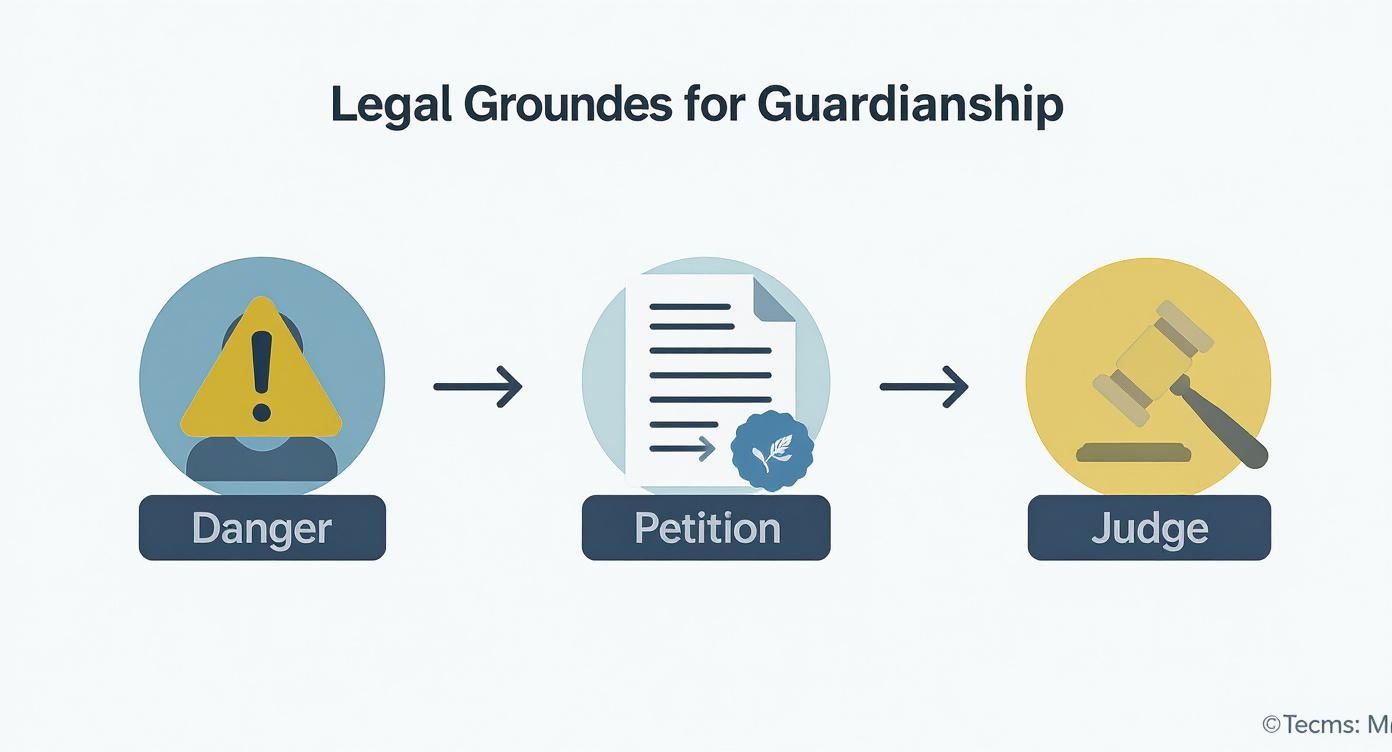
This infographic really simplifies the whirlwind process, showing how you move from identifying an imminent danger to filing your petition and hopefully getting a judge's ex parte order. It drives home the point that each step has to happen in quick succession.
The visual makes it clear: gathering your proof before you file is the key to avoiding delays and building a petition that a judge can act on immediately. Understanding this flow helps you put together paperwork that is not just accurate, but genuinely compelling.
Strengthening Your Evidence
In a place like Travis County Probate Court, the quality of your evidence can make all the difference. You need to go beyond general statements and highlight specific, concrete incidents. Think sudden falls, strange and unexplained bank withdrawals, or a dangerous refusal to eat. If you have photos, emails, or financial records that directly support the grounds for emergency relief under §1104.003, include them.
It helps to outline the critical events clearly:
- The date and time of the crisis, like a car accident or a sudden medical emergency.
- Specific risks you've observed, such as self-neglect or financial decisions that show vulnerability.
- Contact information for professionals who can back up your claims, like doctors or social workers.
Filing at Your Local County Clerk
While the core requirements are the same statewide, the filing logistics can vary a bit from county to county. For instance, in Harris County, you'll likely use the eFileTexas system to submit your documents electronically. But in Travis County, you might need to appear in person at Probate Court No. 1. Always, always check the local rules and deadlines for ex parte requests.
The basic steps are straightforward:
- Pay the filing fees to the county clerk and get a receipt.
- Serve notice to the required parties or, in an emergency, formally request an ex parte hearing under Tex. Est. Code §1104.004.
- Work with the court coordinator to get a hearing scheduled, which should happen very quickly after filing.
Once your petition is filed, move fast to schedule any court-ordered capacity evaluations. Any delay on your part could force the judge to extend the temporary orders or require you to come back for a second hearing. For a deeper dive, you can also read our detailed instructions on how to file for guardianship in Texas for more context.
Avoid These Common Pitfalls
We see the same simple mistakes trip people up time and time again. Be careful to avoid them:
- Missing notarization on your application is a surefire way to get your hearing delayed.
- Vague affidavits that don't include specific dates, times, and locations make your evidence much weaker.
- Forgetting to include contact info for your witnesses can lead to a continuance if the court can't reach them.
A final, thorough check before you file ensures your petition is both complete and compelling, giving you the best possible chance of success in any Texas court.
Imagine, for example, an adult child in Dallas County who has every form organized in a binder, a timely and detailed affidavit from their father's doctor, and printouts of recent suspicious bank activity. That level of preparation is what makes the process at the courthouse go smoothly, minimizing stress during an already difficult time.
Navigating the Emergency Guardianship Hearing
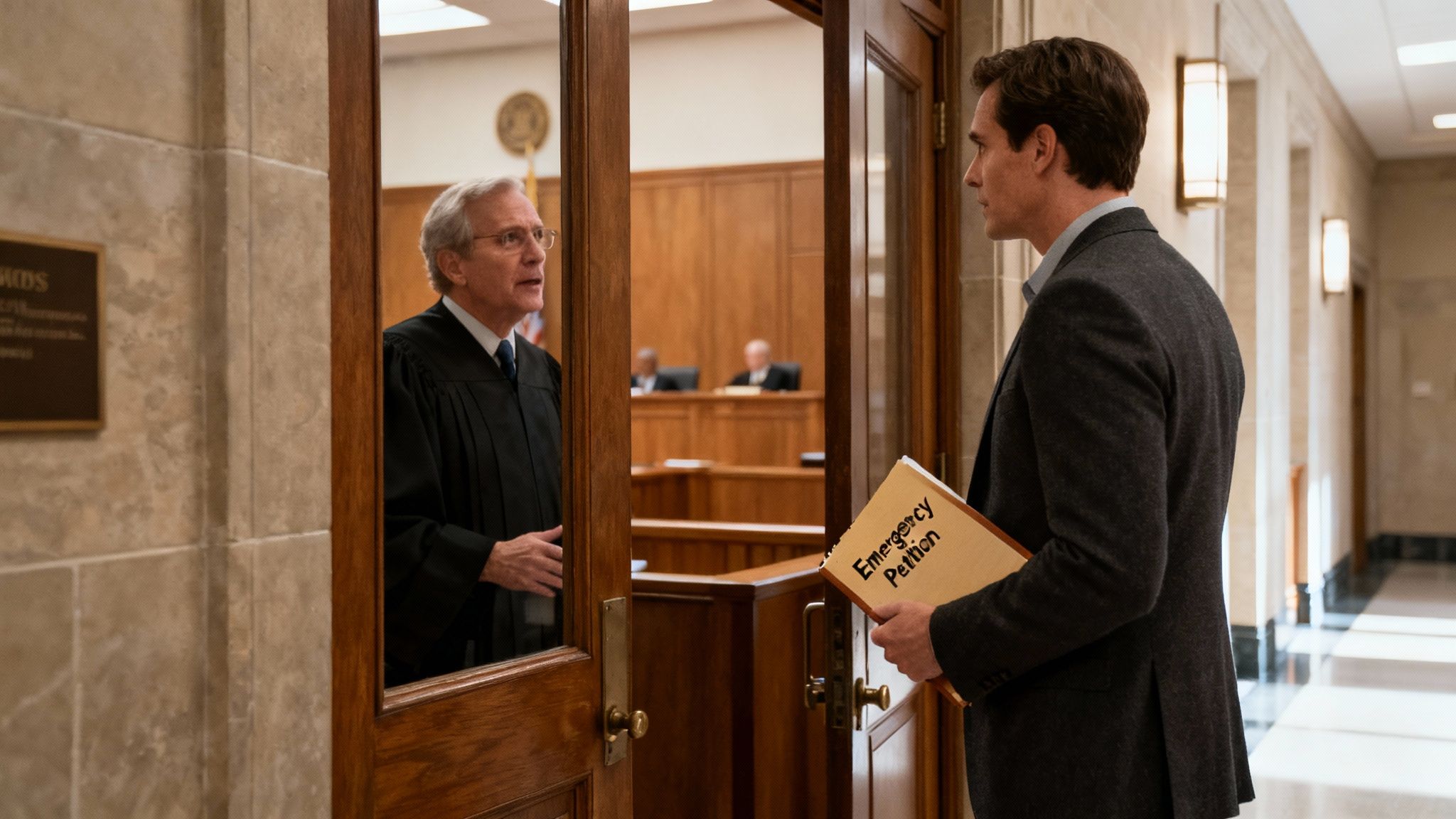
This hearing is where the rubber meets the road. It’s the moment your carefully prepared petition comes under a judge's microscope, and it all happens incredibly fast—often just a few days after you file. The whole point of these hearings is urgency, so they are focused, direct, and aimed at one single question: Is your loved one in immediate, substantial danger?
Unlike most court proceedings, an emergency hearing can be ex parte. This is a legal term that means the judge can grant the temporary order without the proposed ward or other family members even being there. The Texas Estates Code allows for this because the law understands some crises simply can't wait for formal notices to be sent out.
What the Judge Needs to See and Hear
When you walk into a Harris County Probate Court, or any probate court across Texas, the judge is going to cut right to the chase. Their questions will be pointed because they have to weigh the need for immediate action against a person's fundamental rights. Your mission is to provide clear, convincing proof that justifies this extraordinary legal measure.
Get ready to answer questions like:
- Why is this an emergency right now? Why can’t this wait for a standard hearing?
- What specific, immediate harm will happen to your loved one if a guardian isn't appointed today?
- Have you looked into less restrictive options, like a power of attorney? What happened?
- Why are you the right person to step in as the temporary guardian?
Your testimony needs to be anchored to the evidence you’ve already filed. Pointing directly to the doctor’s letter, the bank statements showing odd withdrawals, or photos of your loved one's unsafe living situation gives your words the legal weight they need to persuade the court.
A common mistake we see is families speaking in general terms. Don't just say, "Mom is confused." Give a concrete example: "Last Tuesday, Mom left the stove on for six hours and had no memory of it, which is confirmed in the sworn affidavit from her caregiver." That’s the kind of detail that convinces a judge there’s immediate danger.
Presenting Evidence of the Emergency
The heart of your case is proving "imminent danger," a standard set by Title 3, Subtitle G of the Texas Estates Code. You have to show not just a potential future problem, but a crisis that is unfolding as we speak.
For instance, say your brother was in a serious car accident in Dallas County and is now unconscious in the ICU. The hospital needs someone to consent to a critical surgery. Your evidence would be a sworn statement from his doctor confirming his condition and the urgent need for medical decisions. That paints a clear, undeniable picture for the judge.
Or maybe your elderly aunt in Travis County has dementia and you suspect a "new friend" is draining her bank accounts. Presenting bank records of large, uncharacteristic cash withdrawals from the past week, paired with a physician's letter about her cognitive decline, demonstrates an immediate threat to her financial well-being. This is the kind of powerful proof that supports an emergency order.
The Role of the Ad Litem
In many emergency cases, the court will appoint an attorney ad litem. This is an independent lawyer whose only job is to represent the best interests of the person you're trying to protect. They will likely visit your loved one, talk to doctors or caregivers, and review your entire application.
The ad litem's report to the judge is incredibly influential. Being open, cooperative, and organized when they reach out can make a huge difference in your case. They are not your opponent; they are an officer of the court focused on making sure the proposed ward is truly protected.
Discussing the Guardian's Bond
If the judge agrees to grant your petition, one of the last things they'll do is set the bond. Think of a bond as an insurance policy required by Texas law. It’s there to protect the ward’s assets from any potential mismanagement or misconduct by the guardian.
The bond amount is usually calculated based on the value of the ward's liquid assets—things like cash and stocks. You’ll need to be ready to discuss your loved one’s financial picture so the judge can set a fair amount. After the hearing, you'll have to purchase this bond from a surety company before the judge will sign the final order and you can officially get your Letters of Guardianship.
The hearing can feel overwhelming, but being prepared is your best defense. For a deeper dive, we cover this in our guide on what to expect at a Texas guardianship hearing, which can help you walk in with more confidence.
Standing before a judge during a family crisis is stressful. At The Law Office of Bryan Fagan, PLLC, we make sure our clients don't stand alone. We ensure your story is heard and your evidence is presented with the clarity and force it deserves. If you're facing an urgent guardianship crisis, schedule a free consultation with us today.
Your Responsibilities After Being Appointed
https://www.youtube.com/embed/jKzIOoqDs74
Getting the court's order and your official Letters of Guardianship is a huge step, but it’s really the beginning of your journey, not the end. The Texas Estates Code is crystal clear on this: being appointed a temporary guardian means you have immediate and serious legal duties.
Your role isn't just about making decisions. You are now a fiduciary—a person legally and ethically required to act only in the best interest of the person you're protecting, who is called the "ward." This means you are accountable to the court for every single action you take. A judge has placed incredible trust in you, and Texas law demands complete transparency to make sure that trust is well-placed.
Immediate Fiduciary Duties and Reporting
Your legal obligations kick in the second you're appointed. One of the first and most critical jobs is to file a detailed Inventory, Appraisement, and List of Claims. This document, which is required under Texas Estates Code §1154.051, serves as a complete financial snapshot of everything the ward owns and owes.
And this isn't some casual list you can just jot down. It has to be a sworn, meticulous accounting of all assets—from real estate and bank accounts right down to personal property. You typically have just 30 days from your appointment to get this filed with the court, although extensions are sometimes possible.
Think of it like this: if someone handed you the keys to their business, you wouldn't just start operating it without first taking a full inventory of everything on the shelves and all outstanding debts. The court demands that same level of diligence to protect your loved one’s financial health.
The Importance of Meticulous Record-Keeping
From day one, you absolutely must keep perfect records of every financial transaction involving the ward's estate. This means tracking:
- Every single dollar spent on their behalf, whether for medical bills or groceries.
- All income that comes in, like Social Security checks or pension payments.
- Any decisions you make that affect their property or assets.
These records aren't just for you. They are the foundation for the reports you'll have to submit to the court. Opening a separate bank account for the ward's funds isn't just a good idea—it's essential for maintaining clarity and accountability.
Failing to keep detailed records is one of the fastest ways to get into hot water with the court. A judge in Harris County Probate Court once remarked that a guardian's messy checkbook is a clear red flag that something might be wrong.
Unfortunately, this is a surprisingly common problem. In fiscal year 2024, audits by the Texas Guardianship Abuse, Fraud, and Exploitation Deterrence Program found that a staggering 30% of guardianship cases they reviewed were missing the required inventory. You can see the data for yourself in the official GAFEDP annual report. This just goes to show how critical it is to get this step right from the very beginning.
Transitioning from Temporary to Permanent Guardianship
An emergency guardianship is, by definition, a short-term fix. It typically only lasts for 60 days. If your loved one's condition is unlikely to improve, you'll need to start the process of seeking a permanent guardianship almost immediately.
This means filing a new application and navigating a more thorough court process, which includes a full hearing where all interested parties can be heard. All the evidence you gathered and the pristine records you kept during the temporary period will become vital in making your case for a permanent appointment. When you act responsibly as a temporary guardian, you're showing the court you have what it takes to handle this crucial role for the long haul.
Being appointed as a guardian is an act of love and protection, but it is also a demanding legal role. The Law Office of Bryan Fagan, PLLC is here to help you manage these responsibilities with confidence and care. Schedule a free consultation today to ensure you are meeting all your legal obligations while protecting your loved one.
Exploring Alternatives to Guardianship
Before you jump into the court system for an emergency guardianship in Texas, it's not just a good idea—it's a legal requirement—to see if there's a simpler way. A court-ordered guardianship is a heavy-handed tool that strips a person of their fundamental right to make their own choices. The Texas Estates Code is very clear on this: guardianship should always be the last resort, only used when there are absolutely no other viable options.
Often, the best alternatives are documents your loved one may have already put in place during their estate planning. These are the tools designed specifically for a crisis, meant to keep the courts out of your family's personal business.
Pre-Existing Planning Tools
The two most powerful documents that can help you avoid a guardianship battle are the Durable Power of Attorney and the Medical Power of Attorney.
- Durable Power of Attorney: This document lets your loved one (the "principal") pick a trusted person (the "agent") to manage their financial life. If a valid durable power of attorney exists, that agent can step in immediately to pay bills, handle bank accounts, and deal with property matters without ever needing a judge’s permission.
- Medical Power of Attorney: This is the healthcare equivalent. It appoints an agent to make medical decisions if the principal can't. In an emergency, this is often the most critical need—having someone who can legally talk to doctors, consent to treatment, and access medical records.
If your loved one has these documents in order, you probably don't need a guardianship. The person they chose already has the power to act.
When Alternatives Just Aren't Enough
But what happens when those documents exist, but the situation is still out of control? A power of attorney isn't a magic wand, and sometimes it's not enough.
An alternative might fall short if:
- The appointed agent is abusive, nowhere to be found, or simply not doing their job. If the person named in the Power of Attorney is harming your loved one or neglecting their duties, a judge may need to intervene.
- The documents themselves are flawed. An old or improperly executed power of attorney might not be legally valid when you need it most.
- The crisis demands more authority than the document provides. For instance, a power of attorney can’t force someone to move into a nursing home if they refuse. Only a guardian has that kind of authority.
The existence of a Power of Attorney creates a legal presumption that guardianship isn't necessary. To get around this, you have to show a judge with clear and convincing evidence why that document is failing to protect the person who needs help.
Thinking through these options can be confusing, especially when you're in the middle of a crisis. This table breaks down the key differences between the most common tools available.
Guardianship vs Powers of Attorney
| Option | Court Involvement | Key Features | Best For |
|---|---|---|---|
| Emergency Guardianship | Required. A judge grants authority after a hearing. | Court-supervised, temporary (up to 60 days), and used only in crises. | Immediate, severe risk where no valid alternatives exist. |
| Powers of Attorney | None. Activated by incapacity as defined in the document. | Pre-planned, grants specific authority (financial/medical) to a trusted agent. | Proactive planning to avoid court intervention during a future crisis. |
| Supported Decision-Making | None. Formal or informal agreements. | Allows the person to make their own choices with help from trusted advisors. | Individuals with some capacity who need guidance, not a substitute decision-maker. |
Taking the time to explore these avenues is a critical first step. For a much deeper dive into this topic, you can learn more about the many alternatives to guardianship in our comprehensive guide. Understanding all the tools at your disposal can save your family an incredible amount of time, money, and heartache.
If you're staring at an old power of attorney and wondering if it's enough, or if you're convinced an emergency guardianship is the only path forward, our team is here to help. Contact The Law Office of Bryan Fagan, PLLC, for a free consultation to talk through your specific situation and figure out the right next step.
Answering Your Urgent Questions About Emergency Guardianship
When a crisis hits, your mind is flooded with questions. It's completely normal. Let's walk through some of the most common concerns we hear from families who are suddenly facing the need for an emergency guardianship in Texas.
Who Can Ask to Be an Emergency Guardian in Texas?
In theory, almost any "interested person" can step up and petition the court. But in practice, judges give strong preference to those closest to the person in need—think spouses, adult children, or other immediate family members.
The court’s one and only goal, as laid out in the Texas Estates Code, is to find someone who will genuinely act in the best interest of the incapacitated person. A Harris County Probate Court judge is always going to put the well-being of the proposed ward first, period.
What Happens if Family Members Disagree?
Family disagreements are incredibly common, especially when stress levels are high. It’s a natural part of the process.
While an emergency order can be granted very quickly—sometimes even ex parte, meaning without other family members present—that isn't the final word. The court will always schedule a full hearing shortly after. This is when other relatives can show up, present their own arguments, or formally contest the guardianship. These situations can get complicated fast, and it's usually wise to have an experienced attorney help you navigate these sensitive family dynamics.
How Much Does Emergency Guardianship Cost?
This is a tough one to answer without knowing the details, as costs can vary dramatically. The final amount depends on the complexity of your situation, the specific court's filing fees, and your attorney's fees. The best way to get a realistic estimate for your family's circumstances is to discuss the specifics during a consultation.
Guardianship Disputes: Addressing Family Conflicts
Even after an emergency guardianship is granted, conflicts can arise. Siblings may disagree about who should serve as guardian, or an adult ward may later contest the appointment. Texas Estates Code Chapter 1106 governs contested guardianship hearings.
Common Triggers for Disputes
- Rival petitions by different family members.
- Claims that the temporary guardian mismanaged assets.
- The ward or a power-of-attorney agent objects to guardianship.
Resolving Conflicts
- Mediation and Alternative Dispute Resolution: Some courts encourage mediation before a full hearing.
- Contested Hearing: Each side presents evidence under Tex. Est. Code §1106.101. You’ll need to show why your appointment is in the ward’s best interest.
- Attorney Ad Litem and Guardian ad Litem Reports: Independent assessments help the judge decide.
Example: In Bexar County, two adult children filed competing petitions. Through court-ordered mediation, they agreed on a co-guardianship arrangement that balanced both perspectives and avoided a long, expensive trial.
If you’re facing a dispute, early legal advice can help you navigate the contested process and protect your loved one’s well-being.
Termination and Compliance: Ending the Guardianship
Guardianship isn’t always permanent. Ending it properly is just as important as creating it.
Grounds for Termination
- Restoration of Capacity: The ward regains decision-making ability. File a petition under Tex. Est. Code §1151.015.
- Death of the Ward: The guardianship ends automatically; final accounting is required.
- Age or Goal Achievement: For minor wards, guardianship ends when they turn 18.
Compliance and Final Reports
- Final Inventory and Accounts: Required under Tex. Est. Code §1154.101 within 60 days of termination.
- Court Hearing: The court reviews final reports and issues an order closing the case.
Example: A ward in Collin County recovered after surgery and regained capacity. The guardian filed a reinstatement petition, and the court ended the guardianship after an independent evaluation confirmed full recovery.
Failure to comply with termination procedures can lead to liability for the former guardian. The Law Office of Bryan Fagan, PLLC can guide you through every step, ensuring you meet all deadlines and obligations.
When an emergency strikes, you don't have time to waste. You need clear, straightforward answers from people who've been there before. The compassionate attorneys at The Law Office of Bryan Fagan, PLLC provide the guidance your family needs to protect a vulnerable loved one.
Schedule a free, no-obligation consultation today and let us help you find the best path forward.