Skip to content
A hospital calls late in the day. Your mother fell, she's confused, and the doctor says she may need urgent decisions made tonight. One nurse mentions a DNR. Another says DNAR. A sibling asks whether signing one means “giving up.” Someone else says you may need guardianship because your mother can't speak for herself.
That mix of fear, guilt, and pressure is common in Texas families. In Harris County, Dallas County, Bexar County, and across the state, families often face these questions in the middle of a medical crisis, not after months of calm planning. The problem is that medical language and legal authority don't always line up neatly in the moment.
If you're trying to understand DNR vs. DNAR while also asking who has the right to decide for an incapacitated loved one, you need straight answers. You also need to know where Texas guardianship law fits in, what a guardian can legally do, and what limits still apply.
Navigating a Medical Crisis with a Loved One
A common pattern looks like this. An older parent is admitted after a serious event. The hospital team asks whether she should be “full code.” The family knows she once said she never wanted to be kept alive by machines, but no one can find a signed directive. Her memory has been declining for some time, and now she can't explain what she wants.

In that moment, families often assume the question is broader than it is. They hear “DNR” and think it means no treatment, no oxygen, no antibiotics, and no effort at all. Then the guardianship question arrives. If no valid medical power of attorney exists, who speaks now? A spouse? An adult child? A court-appointed guardian?
Why this feels so overwhelming
Medical crises move fast. Guardianship cases do not. Texas courts can appoint a guardian of the person when an adult is incapacitated and needs someone to make personal and medical decisions, but that authority comes through a legal process under Texas Estates Code Title 3, Subtitle G, not by family agreement alone.
At the same time, doctors and nurses need clear instructions. They can't wait for relatives to sort out old disagreements in a hospital hallway.
Families usually don't need more jargon in a crisis. They need to know exactly what the order covers, who can consent, and what happens next.
What matters most right now
If you're in this situation, focus on three questions first:
- What order is the hospital discussing: Is the team talking only about CPR, or also about broader treatment goals?
- Who has legal authority: Is there a medical power of attorney, or has a court already appointed a guardian?
- What did your loved one say before incapacity: Prior statements, values, and religious beliefs often matter greatly in both medical and legal discussions.
Those answers often reduce conflict quickly. They also help families avoid a mistake I see often in these cases, treating DNR and DNAR as if they are separate end-of-life plans when, in practice, they usually are not.
What DNR and DNAR Mean in a Medical Context
A DNR means Do Not Resuscitate. A DNAR means Do Not Attempt Resuscitation. In medical practice, both terms refer to one narrow instruction: if the patient's breathing stops or heartbeat stops, clinicians should not attempt cardiopulmonary resuscitation, or CPR.
That narrow scope is the most important point for families to understand.

What these orders do and do not cover
A DNR or DNAR order applies only to CPR. It doesn't automatically stop pain medicine, IV fluids, antibiotics, oxygen, or nutrition. The University of Washington bioethics resource explains that DNR and DNAR are narrowly specific to CPR, and notes that the American Heart Association changed its terminology in 2005 from DNR to DNAR because CPR is an attempt, not a guaranteed result. That same resource reports out-of-hospital cardiac arrest survival of 7%–14% for adults and 3%–9% for infants and children in that context of explaining resuscitation decisions (University of Washington bioethics discussion of DNR and DNAR orders).
That wording change matters. It gives families a more accurate picture of what clinicians are being asked to do or not do.
Why this confusion matters in guardianship cases
When a loved one has lost capacity, families may start thinking about Guardianship of an Incapacitated Adult in Texas, which addresses how a court establishes guardianship for an adult who cannot manage their affairs. But even before a guardianship hearing, people often misunderstand the medical issue itself.
A son may say, “Dad would still want treatment.” A daughter may answer, “Then we can't agree to DNR.” Those two statements are not necessarily in conflict. A person can refuse CPR and still want active treatment for infection, breathing distress, pain, or dehydration.
Practical rule: A DNR or DNAR is about whether to attempt CPR after cardiac or respiratory arrest. It is not a blanket refusal of medical care.
A simple example
Suppose your aunt has advanced illness, cannot communicate, and develops pneumonia. A DNAR order would address what happens if her heart stops or she stops breathing. It would not, by itself, answer whether she should receive antibiotics, oxygen, suctioning, or comfort medication. Those are separate care decisions.
That distinction becomes critical when a guardian is involved, because the guardian may have authority to make broader medical choices, while the DNR or DNAR order itself remains focused on CPR only.
A Clear Comparison for Texas Families
Hospitals may use either term. Families may hear both in the same conversation. In major clinical guidance, DNR and DNAR are functionally equivalent, meaning both indicate that CPR should not be attempted. The American Heart Association moved from the older DNR shorthand to DNAR in 2005 to reduce the implication that resuscitation is likely and to improve communication around end-of-life decisions (clinical guidance discussing DNR and DNAR terminology).
| Aspect | DNR (Do Not Resuscitate) | DNAR (Do Not Attempt Resuscitation) |
|---|---|---|
| Full term | Do Not Resuscitate | Do Not Attempt Resuscitation |
| Core meaning | No CPR if breathing or heartbeat stops | No CPR if breathing or heartbeat stops |
| Scope | Limited to resuscitation | Limited to resuscitation |
| Practical effect | Same bedside instruction in most settings | Same bedside instruction in most settings |
| Why wording differs | Older, more familiar phrase | Newer, more precise phrase |
| Why families hear it | Common in older records and everyday conversation | Common in current clinical and ethics discussions |
Where families get tripped up
The core dnar vs dnr issue usually isn't substance. It's language.
DNR sounds blunt and final. Some families hear it as “do not treat.” DNAR is more precise because it reminds everyone that CPR is an attempted intervention, not a promise of recovery. That difference in wording often lowers tension during care conferences.
What works better in real discussions
In practice, the clearest family conversations separate two decisions:
Code status
This answers whether the patient should receive CPR if the heart or breathing stops.Treatment plan
This answers what care should continue before that happens, such as oxygen, antibiotics, fluids, or comfort-focused treatment.
When these issues are mixed together, conflict increases. A family member may fight a DNAR order because they believe it means the hospital will stop caring for their loved one. Once the doctor explains that treatment can continue while CPR is withheld, the discussion often becomes more productive.
The most useful question in a hospital meeting is often this one: “If we choose DNAR, what treatment will still continue?”
A Texas family example
Suppose three siblings meet with a physician in a Houston hospital. One sibling insists on “full treatment,” another says their father never wanted resuscitation, and the third has no idea what the terms mean. The practical answer may be DNAR with continued treatment otherwise.
That approach respects the narrow scope of the order and allows the family to discuss the larger care plan separately. It also gives a guardian, if one has been appointed, a clearer path for decision-making because the legal question becomes more precise.
The Guardian's Role and Texas Legal Requirements
Texas law draws a line between medical judgment and legal authority. A guardian does not become a doctor. But a guardian of the person may receive authority to make medical decisions for the ward, subject to the court's order and Texas law.
Under Texas Estates Code Title 3, Subtitle G, courts can appoint a guardian for an incapacitated person when the evidence supports that need and less restrictive options are not enough. In many counties, including Harris County Probate Court, judges look carefully at the proposed ward's capacity, available alternatives, and the exact powers requested. Not every guardianship is full, and not every guardian gets unrestricted authority.

Can a guardian decide about a DNR or DNAR order
Often, yes. But the answer depends on the court order, the patient's prior directives, and the medical setting.
If the ward signed valid advance directives while competent, those prior instructions should guide later decisions. A guardian generally should not treat the appointment as permission to ignore clearly expressed wishes. If no prior directive exists, the guardian usually must act in the ward's best interest and, where known, in line with the ward's values and past statements.
Texas families should also understand that the state distinguishes between in-hospital code status discussions and the formal Out-of-Hospital Do-Not-Resuscitate framework used outside the hospital. That can matter for EMS calls, nursing facilities, and home settings.
Guardianship authority is real, but not unlimited
Here are the practical limits that matter most:
- Court-ordered limits: A guardianship order may grant some powers and withhold others.
- Existing directives: A prior medical power of attorney, directive to physicians, or valid end-of-life instruction can affect what the guardian may do.
- Best-interest duties: A guardian is a fiduciary. The role requires care, honesty, and decisions centered on the ward, not on family convenience.
- Court oversight: Guardians remain accountable to the court through filings, compliance duties, and sometimes disputes over major decisions.
A related discussion appears in the role of guardians in planning end-of-life wishes under Texas law, especially where medical decision-making and incapacity overlap.
A Harris County example
Assume an adult daughter is appointed guardian of the person for her father after a Harris County proceeding. The hospital asks whether he should remain full code. He never signed a medical power of attorney, but he repeatedly told family he did not want CPR if recovery was unlikely.
The daughter should not guess. She should ask the physician for the current prognosis, review the guardianship order, gather any prior written statements, and communicate the father's known wishes. If disagreement persists among relatives or providers, legal guidance may be necessary.
Texas courts must also consider whether guardianship was the least restrictive answer in the first place. Families exploring that question should understand Less Restrictive Alternatives to Guardianship in Texas, which addresses why courts must examine options short of guardianship before granting it.
How Hospitals and EMS Respond to These Orders
Once a valid order is in place, medical staff do not read it as “stop caring for this patient.” In good practice, they read it as one part of a broader treatment plan.
AMA ethics guidance recommends documenting the patient's clinical status, prognosis, decision-making capacity, and resuscitation preferences, and revisiting the order as conditions change. That guidance also reflects the use of care pathways such as DNAR/full-care and DNAR/comfort-care, which can preserve non-CPR treatment like oxygen, fluids, vasoactive medications, and noninvasive ventilation depending on the care goal (AMA ethics opinion on DNAR orders and documentation).
What staff usually do in the hospital
In a hospital setting, the team typically separates the code-status order from the daily treatment orders. That means a patient may be listed as DNAR and still receive:
- Oxygen support: Depending on the care plan
- IV fluids: When clinically appropriate
- Medication: Including pain relief, antibiotics, or blood pressure support if consistent with goals
- Noninvasive ventilation: If the plan allows it
- Comfort care: Always a key part of dignified treatment
This is why families should ask for the care plan in writing or in plain spoken terms. “What will you still do?” is the right question.
What EMS needs outside the hospital
EMS works under practical constraints. Paramedics need a recognizable, valid order when they arrive at a home, facility, or accident scene. If no valid out-of-hospital order is available, emergency responders may proceed under standard emergency protocols until the legal status becomes clear.
That is one reason families should not assume a verbal understanding is enough. Outside the hospital, access to the proper paperwork can make all the difference.
A signed order hidden in a file drawer doesn't help the EMT standing in a front yard making a split-second decision.
When disputes interrupt care
Disputes usually arise when one relative believes the order means “no treatment” and another insists the patient would never have wanted CPR. Hospitals often try to resolve this through physician meetings, ethics consultation, and review of legal authority.
If a conflict turns into a consent dispute, guidance on guardianship and hospital disputes over final decision-making can help families understand who may legally speak for the patient.
Actionable Steps for Texas Families and Guardians
The best time to address end-of-life wishes is before a crisis. But even if the crisis has already started, families can still take clear, useful steps.
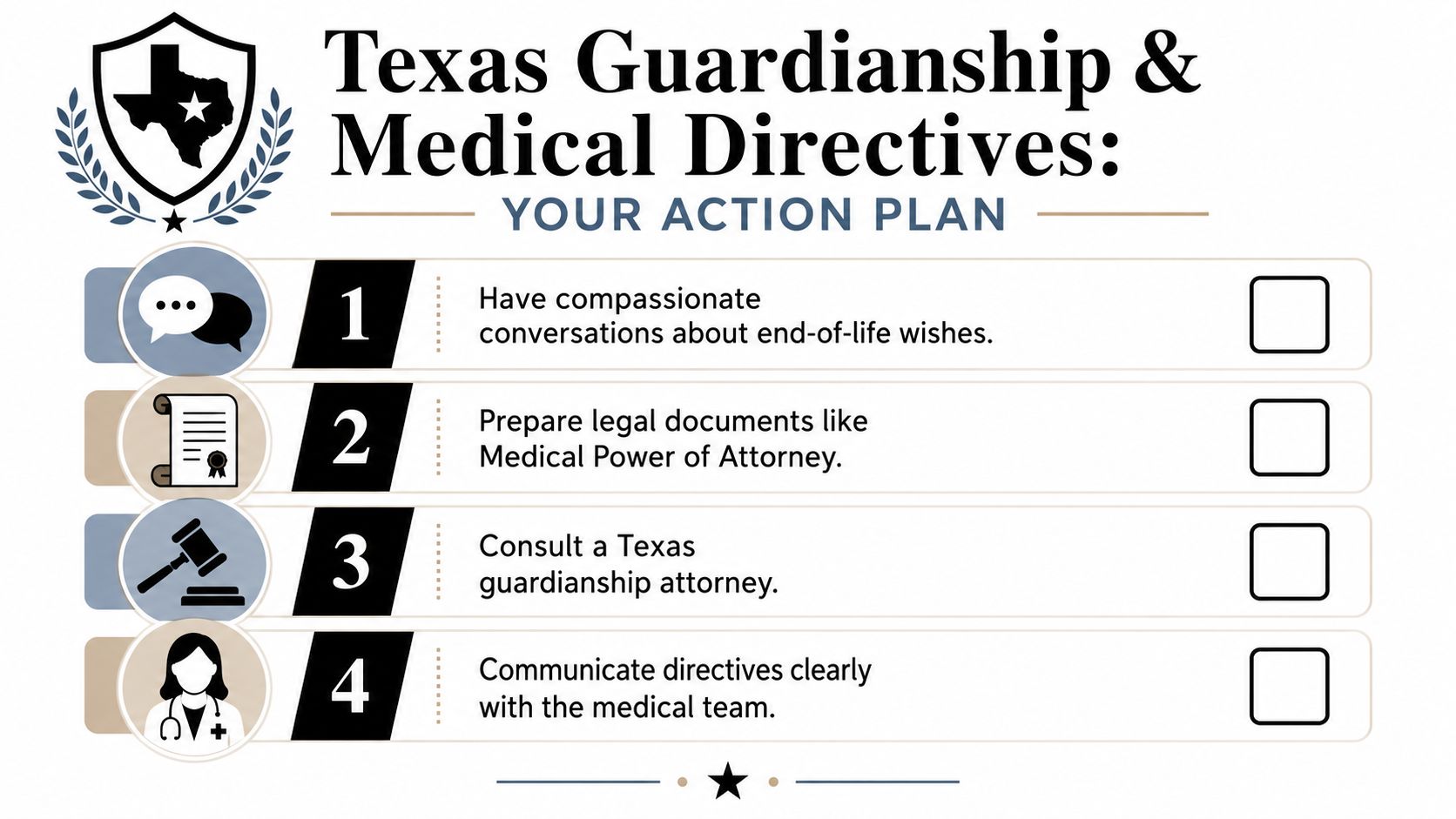
Start with the medical facts
Ask the attending physician direct questions. Is the patient able to make decisions now? Is the current discussion only about CPR, or are broader treatment choices also on the table? What outcomes does the doctor believe are realistic?
Write the answers down. Families often hear different things because each person remembers the conversation differently.
Match the medical issue to the legal document
Different documents do different jobs. A DNR or DNAR addresses CPR. A medical power of attorney names someone to make healthcare decisions if the principal loses capacity. If you're reviewing planning documents, Texas Medical Power of Attorney is often the first document to check because it may determine who can speak without needing a guardianship case.
If no valid authority exists and the person is incapacitated, a guardianship application may become necessary. In urgent situations, Texas law may also allow temporary guardianship relief, depending on the facts and court findings.
Use a practical checklist
- Talk early if possible: Ask your loved one what matters most to them. Some people prioritize survival at all costs. Others prioritize comfort, dignity, or avoiding CPR.
- Find existing documents: Look for a medical power of attorney, directive to physicians, prior guardianship orders, or out-of-hospital resuscitation paperwork.
- Confirm legal authority: Don't assume the closest relative automatically has final say.
- Ask the facility how the order is documented: Hospitals and care facilities may use specific code-status language in the chart.
- Keep records accessible: If an out-of-hospital order exists, store it where caregivers and EMS can find it quickly.
- Inform key people: Tell family, home health staff, nursing staff, and facility personnel what documents exist and where they are kept.
Prepare for the hearing if guardianship is needed
If the family must seek guardianship, practical preparation matters:
- Gather medical records and physician information showing incapacity.
- Be ready to explain why less restrictive options won't work.
- Identify whether you need guardianship of the person, the estate, or both.
- Bring any prior statements from the proposed ward about medical preferences.
- Expect the court to focus on the ward's rights, not only the family's convenience.
This is one area where the Law Office of Bryan Fagan, PLLC handles guardianship, probate, estate planning, and related issues for Texas families who need help with filings, hearings, and compliance.
Frequently Asked Questions About DNAR and DNR
Can a DNR or DNAR order be changed
Yes, but the proper method depends on the setting and the patient's legal decision-maker. Hospitals usually require the physician and care team to update the charted order. Families should never assume an informal verbal change is enough.
Is a DNAR the same as a living will
No. A DNAR or DNR applies to CPR. A living will or other advance directive can address broader treatment choices. That difference matters because people often confuse a narrow code-status order with a larger end-of-life plan.
Will a Texas order work in another state
You should never assume that it will be recognized in exactly the same way. If interstate care or travel is likely, ask the treating provider and an attorney what documents should be updated.
What if family members disagree with the guardian
Disagreement doesn't automatically cancel the guardian's authority, but it can create delay and conflict. A common point of confusion is the scope of the order itself. Authoritative sources emphasize that DNR and DNAR apply only to CPR and do not mean other treatment stops, which is one reason hospitals increasingly use detailed care plans such as DNAR/Full Care or DNAR/Comfort Care (Oxford discussion of confusion around DNR scope and care plans).
If your family is facing a dispute over incapacity, code status, or a guardian's medical authority, get legal advice early. These cases are emotional, but they also turn on specific Texas procedures and court orders.
If your family is weighing guardianship, medical decision-making, or end-of-life directives for a loved one in Texas, Law Office of Bryan Fagan, PLLC can help you understand your options and next steps. A free consultation can clarify whether you need guardianship, whether an existing directive controls, and how to protect your loved one's wishes while complying with Texas law.