Skip to content
DARS was dissolved in 2016, and its services are now handled through the Texas Workforce Commission and the Texas Health and Human Services Commission. Using "DARS State of Texas" is not outdated; it remains a term many families, doctors, schools, and even old court papers still employ.
That confusion often shows up at the worst time. A parent is trying to help an adult child with disabilities find job support. A guardian is reviewing an older order that mentions DARS. A family in Harris County is preparing for probate court and isn't sure whether old paperwork still works. When you're already carrying medical, emotional, and financial stress, a state agency name change can feel like one more barrier.
The good news is that the help didn't disappear. It moved. The harder part is knowing which agency now handles what, and how that affects a guardianship case under Texas Estates Code, Title 3, Subtitle G. If your family is trying to protect a loved one while also securing disability-related services, the legal and practical steps need to line up.
Navigating Disability Services in Texas After DARS
Many families type "DARS State of Texas" into a search bar because that is the name they were told years ago. Some heard it from a school counselor. Others saw it in medical records, benefit paperwork, or an older guardianship file. If that's where you are, you're looking in the right direction even if the agency name is outdated.
What matters now is matching your loved one's need to the current system. Employment-related disability services are no longer accessed through a standalone DARS agency. Guardians also need to think beyond agency names and ask a legal question: does the current court order give enough authority to apply for services, share records, and respond to agency requests?
Why the name change matters in real life
When families use an old agency name, they can run into delays. A doctor may write a recommendation for DARS. A school transition plan may mention DARS. A guardian may call an office that no longer manages the same function. None of that means your case is doomed. It usually means your paperwork and strategy need updating.
A guardianship case can also intersect with public benefits and community supports. Families often explore multiple paths at once, including waiver options. For a broader look at support systems that may fit alongside guardianship planning, see these Texas Medicaid waiver programs.
Practical rule: If an old document says DARS, don't panic. Treat it as a clue about the type of service your loved one needs, then confirm which current Texas agency now handles that function.
What families should focus on first
Instead of chasing the old name, focus on three questions:
- Daily needs: Does your loved one need help with health, supervision, housing, or long-term supports?
- Work needs: Do they need vocational rehabilitation, training, communication support, or help preparing for employment?
- Legal authority: Does the current guardian, agent, or caregiver have documents that let them apply, sign, and respond on the person's behalf?
Those questions usually point the family toward the correct agency and also help a probate court understand whether guardianship is necessary, or whether a less restrictive option may work.
What Was DARS and Why Does the Name Linger
For years, DARS was the state agency many Texans associated with disability services. Historically, DARS administered vocational rehabilitation and other disability-related programs intended to help people with physical or mental disabilities prepare for, find, or keep employment. It also served children with developmental delays and supported the larger goal that Texans with disabilities should have equal opportunities for independent and productive lives.
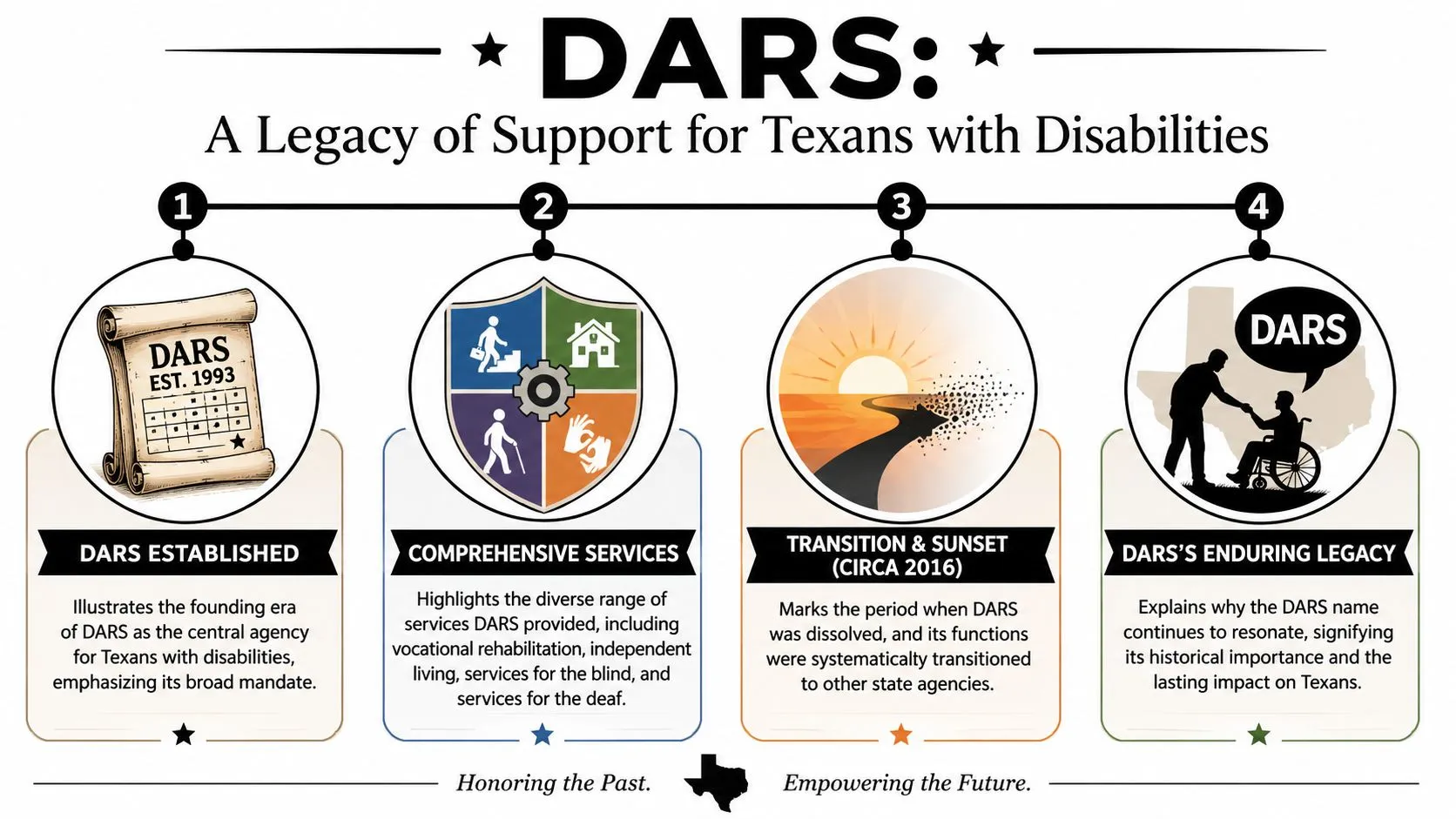
That old role explains why the DARS name still echoes through community conversations. Families remember it because they used it. Professionals remember it because they referred people there. Old files still mention it because, at one time, that was the right name.
The official change
Texas formally transitioned DARS from a standalone state agency to consolidated functions under the Texas Workforce Commission and the Texas Health and Human Services Commission effective September 1, 2016, as noted in the DARS agency history reference.
That change wasn't just cosmetic. It changed where families look for services and which state system now controls vocational rehabilitation decisions. It also changed the legal language that should appear in current guardianship practice when a family is dealing with disability employment support.
Why old references still show up
The name lingers for ordinary reasons:
- Old court papers remain in circulation: Guardianship orders, medical letters, and school records may still say DARS.
- Community memory is strong: Families and case workers often keep using the name they learned first.
- Web content ages badly: Some directories and older articles were never updated after the transition.
- Legal files may need cleanup: A current case may still contain agency references that no longer match the present system.
Old names create real confusion, but they don't erase a person's right to seek current services.
For guardians, this has a practical consequence. If your existing order, physician letter, or service plan keeps referring to DARS, your lawyer may need to review whether the language should be updated so the current agencies recognize the guardian's authority without unnecessary delay.
Where to Find Disability Services Today The Agencies That Replaced DARS
Families usually need a plain answer to a plain question: where do I go now? In most situations, the answer depends on whether the issue is work-related support or health and long-term support.

Texas Workforce Commission and vocational rehabilitation
The historical DARS vocational rehabilitation program provided free vocational rehabilitation services to physically or mentally disabled individuals who met basic eligibility requirements, or who were already receiving Social Security disability benefits, according to the Texas CJC DARS Region II overview. That same source explains that DARS also specifically served deaf and hard-of-hearing populations through hearing evaluations, communication assistance, academic training, and counseling.
For families trying to translate that into today's terms, think of the workforce side of the state system as the place to pursue support tied to employment and job readiness. If your adult child needs help preparing for work, staying employed, or getting disability-related workplace support, this is often the lane to investigate.
The same historical office guide also identified a structured network of local offices. In Dallas County, the Region II office in Dallas-Fort Worth was listed with phone number (972) 949-2400 and website www.dars.state.tx.us. That detail matters because many families still find those references in old paperwork and wonder if they should start there.
Texas Health and Human Services Commission and broader support needs
The other major successor is HHSC. In practical terms, families often look to this side of the system for services connected to health, daily care, intellectual or developmental disability supports, and related long-term needs. If your loved one needs more than job help, such as ongoing supervision, services tied to disability care, or coordination with healthcare and benefits, HHSC is usually part of the conversation.
A simple way to decide where to start
Here is a plain-language comparison:
| Need | Likely starting point |
|---|---|
| Job training, work readiness, employment support | Texas Workforce Commission vocational rehabilitation |
| Disability-related care, long-term supports, service coordination | Texas Health and Human Services Commission |
| Mixed needs involving both work and daily functioning | Both, with records coordinated carefully |
Why this matters for guardians
A guardian's role isn't only to sign forms. It's to make sure the right agency receives the right records under the right legal authority. If the person under guardianship can work with support, vocational rehabilitation may become part of the long-term care plan. If the person needs broad daily assistance, HHSC-related services may matter more.
Families who are planning ahead sometimes also watch legal talent market updates to understand how employment trends affect supported work opportunities, especially when a loved one is capable of some level of vocational participation with accommodations.
Key point: The agency structure changed, but the family task stayed the same. Identify the need first, then match the need to the correct state system.
Connecting State Services to Guardianship and Capacity Evaluations
Many families encounter a point of confusion. They understand that DARS became something else, but they don't see how that affects a guardianship case. In Texas, those two issues often overlap because a court deciding guardianship needs evidence about a person's abilities, limitations, and support needs.
Under Texas Estates Code, Title 3, Subtitle G, a court may appoint a guardian for a person deemed incapacitated, meaning a person who, because of a mental or physical condition, can't manage financial affairs or provide for personal needs such as food, clothing, and medical care. That determination requires a formal application supported by medical evidence, including a physician's affidavit and, in many cases, a court-appointed evaluator's report, as described in this overview of Texas guardianship law.
How agency records can help
A vocational rehabilitation record or service assessment doesn't replace medical proof. But it can help show the court how the person functions in daily life. For example, an employment-related evaluation may reflect whether the person can follow instructions, communicate effectively, travel safely, handle money, or make consistent choices.
That matters because Texas law favors the least restrictive alternative. A judge in Harris County Probate Court may ask whether the person needs a full guardian, or whether a more limited guardianship would protect the person while preserving as much independence as possible.
Families considering that issue often benefit from reading more about legal guardianship for adults with disabilities in Texas, especially when the case involves young adults transitioning from school services into adult systems.
A Harris County example
Consider a common situation. A mother in Harris County cares for her adult son, who has a disability that affects judgment and communication. He wants to work and may be able to do some tasks with support. He also struggles to understand contracts, medical forms, and transportation safety.
The family files for guardianship of the person. The doctor provides medical documentation. A vocational assessment from the current workforce system shows that he can participate in structured job training but needs substantial help with decision-making and communication. A judge could use that fuller picture to craft a narrower order, giving the mother authority over healthcare and service coordination while avoiding unnecessary control over areas where her son can still participate.
A strong guardianship case doesn't just show incapacity. It shows capacity where it still exists.
Why medical paperwork still leads the case
The foundation is still documented incapacity. The Certificate of Medical Examination in Texas Guardianship is relevant here because a guardianship case starts with documented incapacity. Agency reports can support the court's understanding, but medical evidence remains central.
If your loved one already receives disability services, gather those records early. They may help your attorney explain daily functioning, support needs, and practical limitations in a way that medical notes alone sometimes don't.
Practical Steps for Families Seeking Guardianship and Support
A father may spend one week calling offices about job training, Medicaid waivers, and medical appointments, then realize he also needs court authority to sign forms or protect his adult daughter from unsafe decisions. That is the point where the old DARS name stops being a history question and becomes a practical one. Families need a plan that connects state services to what a guardian can do.
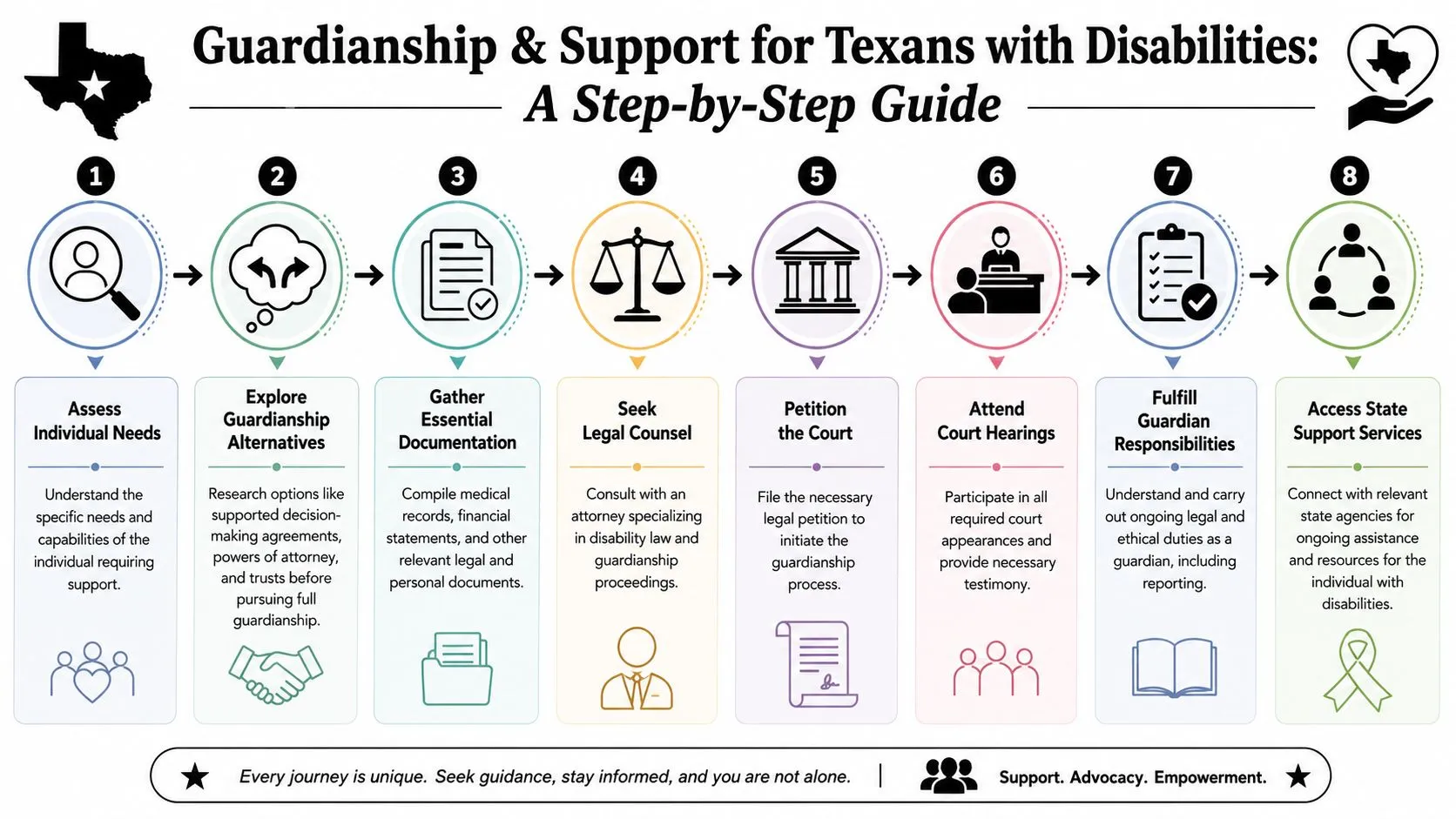
Start with the decision that needs to be made
Begin by listing the decisions your loved one cannot safely make alone right now. Focus on real-life categories such as medical consent, housing, benefits, school or vocational services, transportation, and money management. That list works like a map. It helps you see whether you need service referrals, legal documents, a guardianship case, or some combination of all three.
Texas courts also expect families to consider less restrictive options before asking for full guardianship. In plain terms, the court wants the smallest legal tool that will keep the person safe. Some families may do better with supported decision-making, powers of attorney, representative payee arrangements, or targeted planning for future care and benefits. Planning may also include special needs planning for a loved one with disabilities.
Build a file before you start calling agencies or filing in court
Families often lose time because the same records are requested by a doctor, a service coordinator, and the probate court in slightly different forms. Put them in one folder, paper or digital, before the process gets urgent.
A useful starter file includes:
- Identity records: Photo ID and Social Security card.
- Proof of address: A current bill, lease, or other document showing residence.
- Medical information: Diagnoses, medications, treating physicians, hospital records, and recent evaluations.
- Insurance and benefits records: Insurance cards, Medicaid or Medicare information, and benefit notices.
- School, work, or program records: ARD paperwork, vocational assessments, service plans, or case notes that show daily functioning.
- Legal papers: Existing powers of attorney, supported decision-making agreements, prior guardianship orders, or earlier court filings.
If safety at home is part of the concern, a guide for independent living can help you document practical risks such as falls, wandering, bathing hazards, or unsafe stove use. Those details often matter because guardianship cases are decided in human terms, not just diagnostic labels.
Read old court orders like instruction manuals
Many families have older orders, letters, or service records that still refer to DARS. Treat those documents the way you would treat an old insurance policy. The name on the front may be outdated, but the wording still matters.
If an existing guardianship order names DARS, read closely for the actual authority the court granted. Does the order let the guardian apply for services, sign program paperwork, manage benefits, or make educational or vocational decisions? If the order is narrow, an agency may ask for clarification. If the wording is broad enough, the order may still work even though the agency name has changed. The safest approach is to review the decree before a benefits deadline or intake appointment, not after a denial.
After you've reviewed the basics, this video offers a helpful overview of the broader guardianship process:
Match the service problem to the court problem
Many families get stuck at this point, so it helps to separate the questions.
If the problem is access to services, call the current agency, ask what documents they require, and confirm whether they will accept the existing order. Write down the employee's name, the date, and what was requested.
If the problem is legal authority, return to probate court. You may need to file for guardianship, seek a modification, request a successor guardian, or ask the court to clarify the guardian's powers. For example, if a parent has authority over medical decisions but not over property or contracting, that gap can affect housing forms, program enrollment, and benefit administration.
Know when delay becomes dangerous
Some situations cannot wait for the normal pace of a guardianship case. If a person is at immediate risk because of exploitation, medical neglect, unsafe living conditions, or inability to consent to necessary care, temporary relief may be needed.
Under Section 1110.001 of the Texas Estates Code, a temporary guardian may be appointed when there is an immediate threat to the person's health, safety, or welfare. The appointment lasts no more than 90 days unless extended by the court. Families in such emergencies may find Temporary and Emergency Guardianship in Texas useful because it explains how a court can act quickly when immediate harm is present.
Prepare for disagreement, and for the work that comes after appointment
Guardianship cases often involve more than paperwork. One sibling may believe no guardianship is needed. Another may believe the proposed guardian is controlling or financially careless. The court may appoint an attorney ad litem or, in some cases, look to a neutral decision-maker if conflict is severe.
Appointment is not the finish line.
A guardian must stay within the court's order, keep records, respond to reporting requirements, and watch for changes in capacity over time. Some guardianships should be narrowed later. Some should end. Under Section 1150.001, termination can be requested if incapacity no longer exists or the guardianship is no longer necessary.
Families handling service applications and court duties at the same time often work with doctors, school staff, caseworkers, and counsel in parallel. Law Office of Bryan Fagan, PLLC, handles guardianship, probate, and related planning matters in Texas.
Your Next Steps in Protecting Your Loved One
If you've been searching for "DARS State of Texas," the main thing to remember is simple. The name is old, but the need is current. Services tied to disability support still exist, yet families now have to access them through today's agency structure while also meeting the rules of Texas guardianship law.
That can feel heavy, especially when your family is already managing caregiving, medical appointments, work schedules, and disagreement among relatives. Some people are trying to establish guardianship for the first time. Others need to update an old order, respond to a service interruption, or decide whether guardianship should end because the person has regained function. Each of those choices carries legal and emotional weight.
If memory loss or cognitive decline is part of your family's story, these Velma memory support insights may help you think through support options and program quality as you gather information.
The right next step is often a careful legal review of the current court order, the loved one's capacity evidence, and the service system involved. That review can help you avoid delays, protect dignity, and make sure the paperwork matches the world as it exists today.
If you're unsure whether an old DARS reference affects your loved one's guardianship, or you need help starting, modifying, contesting, or terminating a case, schedule a free consultation with Law Office of Bryan Fagan, PLLC. A Texas guardianship attorney can review your family's situation, explain your options under the Texas Estates Code, and help you take the next step with clarity and care.