Skip to content
When a loved one names you as the executor of their will, it's a profound sign of trust. But the responsibilities that come with the role are often far more complex than people first realize. Your core duty is to see your loved one's final wishes through—locating the will, gathering their assets, paying off debts, and distributing what's left to the beneficiaries. This is a job that demands honesty, diligence, and a steady hand, often during a time of grief.
A Compassionate Guide to Your Executor Duties
Accepting the role of an executor means stepping into a position of significant legal and financial responsibility, often while you're grieving. It’s a final act of service to the person you've lost, and understanding your duties is the first step toward fulfilling that service with confidence. We recognize the emotional and financial challenges families face during this time, and our mission is to provide clear, empathetic guidance through Texas law.
Think of yourself as the temporary CEO of your loved one's final affairs. Your primary job is to manage everything transparently and exactly as they instructed. This is what's known as your fiduciary duty—a legal obligation to act with complete honesty and always put the estate's best interests first, as outlined in the Texas Estates Code.
Understanding the Scope of Your Responsibilities
Many people named as executors don't realize the legal weight of the position until they're in the thick of it. This lack of awareness can lead to unintentional mistakes and a great deal of stress. In fact, recent data highlights a significant gap in understanding these duties.
A 2025 survey revealed that 68% of people were unaware that an executor must secure the deceased's property right away. Another 47% did not know that calculating and paying taxes is a core responsibility. This just goes to show how easily an executor can underestimate the complexity of their role. You can read the full findings about executor responsibilities here.
These numbers underscore how important it is to get clarity from the very beginning. Your duties under the Texas Estates Code are comprehensive and include:
- Locating and filing the will: This must be done with the appropriate probate court, such as a Harris County Probate Court.
- Marshalling and inventorying assets: You are in charge of identifying, securing, and valuing everything the person owned.
- Notifying creditors and paying debts: All legitimate debts must be settled from the estate's funds before anyone receives their inheritance.
- Distributing assets to beneficiaries: After all debts and taxes are paid, you will transfer the remaining property to the people named in the will.
While the list of executor of will responsibilities might seem overwhelming, it’s a manageable process with the right support. You aren't expected to become an expert in Probate law overnight. Our team at The Law Office of Bryan Fagan is here to provide the guidance you need. We can help you understand each step, ensuring you honor your loved one’s legacy and protect yourself from liability.
To discuss your specific situation, schedule a free consultation for personalized guidance.
The First Critical Steps an Executor Must Take
In the emotional days after a loved one passes, the duties of an executor can feel crushing. Knowing where to even begin is half the battle. Having a clear, actionable plan is key to bringing a sense of control to a chaotic time and preventing early, costly mistakes. Your first tasks are all about securing the estate and gathering the foundational documents you'll need for the road ahead.
Imagine you're Maria, a teacher in Harris County, just named the executor of your father’s will. You're grieving, but you also know he trusted you completely to handle his final affairs. Your first move isn't about complex legal filings; it's about methodically working through the immediate priorities with care. This practical step is crucial before any guardianship or probate hearings.
Locate the Will and Secure Key Documents
Your entire authority as an executor flows from the will. That makes the original document your number one priority. Start looking in the obvious places: a home safe, a safe deposit box, or with the attorney who drafted it. This document is your roadmap, and you can't start the journey without it.
Next, you need to get official copies of the death certificate—and not just one. You'll need plenty of them. Banks, government agencies, insurance companies, and pension administrators will all demand a certified copy before they'll even speak with you. To get a better handle on this crucial document, it's worth reviewing this guide on understanding the Texas Death Certificate.
Secure and Protect Estate Property
One of your most urgent duties is to protect the deceased's assets from theft, loss, or damage. This isn't just a suggestion; it's a legal obligation under your fiduciary duty. You need to take immediate physical control of tangible property.
- Real Estate: Secure the deceased’s home. This means changing the locks, ensuring utilities stay on, and forwarding the mail to your address.
- Vehicles: Find the car keys and the title. Move the vehicle to a safe spot, like your own garage, and confirm that the insurance is up to date.
- Personal Items: Gather and safeguard valuable personal property. Things like jewelry, art, and irreplaceable family heirlooms need to be protected from being lost or taken.
This timeline gives you a bird's-eye view of the entire process, from the moment you're appointed to the final handshake when assets are distributed.
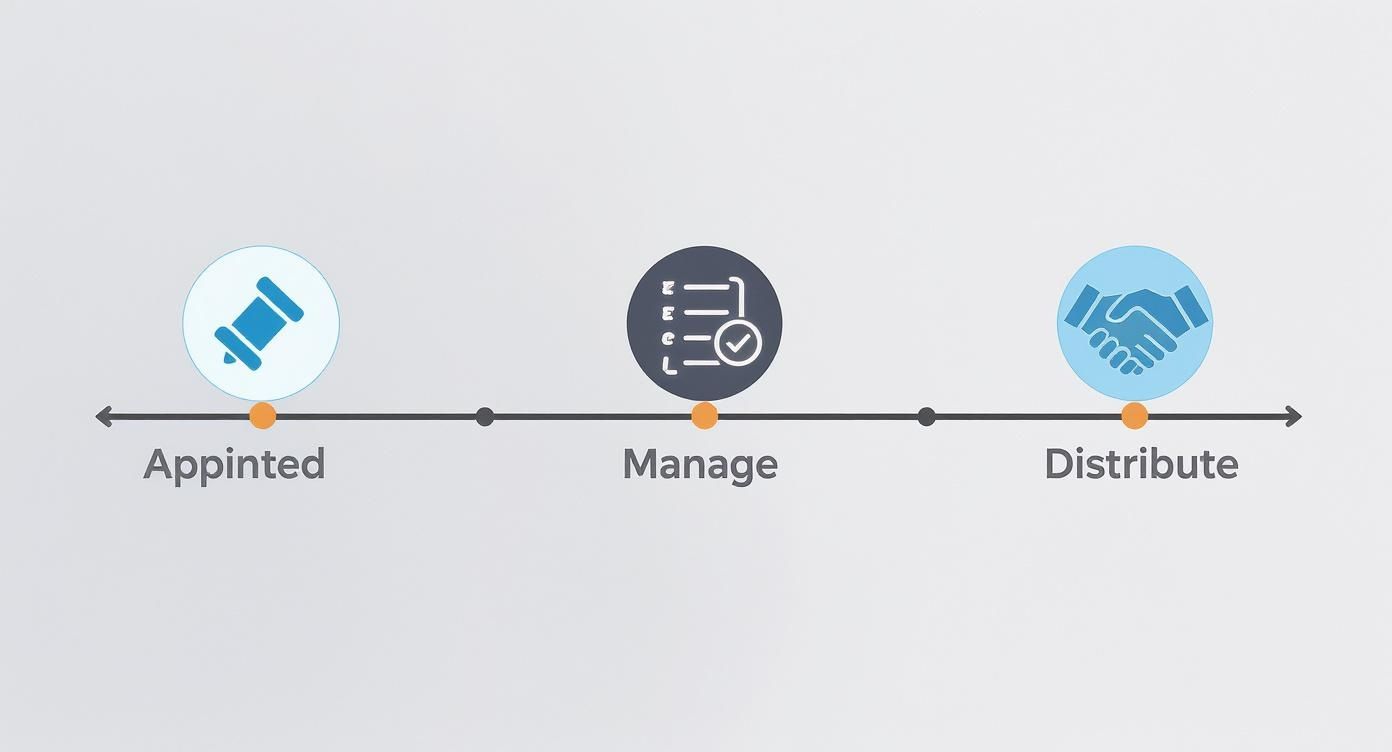
Each of these phases involves its own set of legal duties, but they all build upon these foundational first steps of securing the will and protecting the assets.
The following checklist boils down these immediate tasks into a simple action plan. Tackling these items first will put you on the right path.
Immediate Executor Action Checklist
| Task | Why It's Important | Where to Start |
|---|---|---|
| Obtain the Original Will | This document grants you authority and outlines the decedent's wishes. The probate process cannot begin without it. | Check home safes, safe deposit boxes, or contact the decedent's estate planning attorney. |
| Order Certified Death Certificates | You'll need 10-15 official copies to close accounts, claim benefits, and transfer assets. | The funeral home can typically order these for you, or you can contact the Texas Vital Statistics office directly. |
| Secure Tangible Property | Prevents theft, damage, or unauthorized access to the decedent's home, vehicles, and valuables. | Change locks on all real estate, locate vehicle keys and titles, and move valuable personal items to a secure location. |
| Notify Key Agencies | Stops automatic payments, prevents identity theft, and initiates survivor benefits. | Start with the Social Security Administration, then notify banks, credit card companies, and insurance providers. |
Once you've checked these boxes, you've successfully navigated the first—and often most stressful—part of the process.
Notify Essential Parties
With the physical assets secured, it's time to start notifying key individuals and organizations of the death. This is a critical step for shutting down financial accounts, preventing identity theft, and initiating the claims process for any benefits due to the estate or beneficiaries.
Make a list and start making phone calls. The most important parties to inform include:
- Social Security Administration: To stop benefit payments and ask about any potential survivor benefits for a spouse or minor children.
- Financial Institutions: Call all banks, credit unions, and brokerage firms to freeze accounts and stop any unauthorized withdrawals.
- Life Insurance Companies: Get the claims process started for any life insurance policies.
- Employers or Former Employers: You'll need to inquire about any final paychecks, retirement plans like a 401(k) or pension, and other death benefits.
Sometimes, a full, formal probate process isn't necessary, especially for smaller estates with minimal assets. In Texas, alternatives to a full administration exist that can save families time and money. Exploring these options is an important part of fulfilling your duty to act in the estate's best interest.
Taking these initial steps with care and diligence lays the groundwork for a smooth and orderly administration of the estate. By tackling them head-on, you honor the trust placed in you and start the process on solid ground.
Navigating the Texas Probate Court System
Once you've secured your loved one's will and made sure their property is safe, your next big step as executor is heading into the Texas court system. This part of the journey is called probate, a word that can sound intimidating. But really, it’s best to think of it as the official process for getting the will validated by a judge. It’s the legal step where a court confirms the will is legitimate and formally gives you the authority to start your duties.
https://www.youtube.com/embed/eIbPocpJh2E
The process kicks off when you file an "Application to Probate the Will" in the county where the person lived. So, if your loved one lived in Austin, you’d file the paperwork with the Travis County Probate Court. This application, along with the original will, is what officially gets the ball rolling on the estate administration.
Getting a handle on this legal roadmap is key. While it definitely involves specific steps and paperwork, the system is there to provide a supervised, clear path for settling an estate. It ensures everything is handled by the book and honors the final wishes of the person who passed away.
Your First Court Appearance and Letters Testamentary
After you file the application, the court will post a public notice, and a hearing will be scheduled. This hearing is usually short and pretty straightforward. Your main job here is to "prove up" the will. This typically just means you'll testify under oath that the will you’ve submitted is, to the best of your knowledge, the final and true will of the person who died. You'll also confirm their identity and that they have passed away.
Once the judge validates the will, you'll take an oath of office. It’s a formal promise to faithfully do your job according to the will and the law. At that point, the court issues a document that is absolutely essential for your role as executor.
This document is called Letters Testamentary. Think of it as your golden ticket—it's the official certificate of your authority. This is the legal proof you’ll show to banks, financial institutions, and government agencies to prove you have the power to act for the estate. Without it, you can't touch, manage, or transfer any of the estate’s assets.
With your Letters Testamentary in hand, you are officially empowered to start the core tasks of your executor of will responsibilities, like opening an estate bank account and gathering all the assets. For a more detailed walkthrough, our firm has a guide on how to probate a will in Texas that can provide more clarity.
The Advantage of Independent Administration in Texas
One of the best features of the Texas probate system is something called independent administration. If a well-drafted will includes this provision, it can make your job as executor dramatically simpler and is a major reason why probate in Texas can be far more efficient and less expensive than in other states.
So, what exactly is it? Independent administration lets an executor handle most of their duties—like paying debts, selling property, and distributing assets—without having to run to the court for permission every single time. This cuts down on court supervision, which saves the estate a significant amount of time and money in legal fees and court costs.
- No Court Approval for Sales: You can sell the decedent's house or car to pay off debts without needing a judge to sign off first.
- Freedom to Pay Debts: You're free to pay valid creditor claims as they come in, without having to file a motion with the court.
- Simplified Asset Distribution: When it’s time to distribute assets to the beneficiaries, you can do so directly, just as the will instructs.
If the will names you as the "Independent Executor," you've been given a huge amount of trust and autonomy. This doesn't mean you can forget about your fiduciary duty; you still have to act in the estate's best interest and give beneficiaries an inventory of the assets. But it removes layers of judicial red tape, allowing you to administer the estate much more efficiently. This unique Texas feature really does transform the probate process from a series of court hearings into a more manageable administrative task, letting you focus on fulfilling your loved one’s final wishes with confidence.
Managing Estate Assets and Settling Debts

Once the court has issued your Letters Testamentary, you officially have the green light to take control of the estate's finances. This is where your role as a fiduciary—a person entrusted with managing someone else's assets—really kicks into high gear. From this point forward, you are the financial steward of the estate, tasked with gathering every asset, identifying every debt, and handling it all according to Texas law.
Think of yourself as creating a complete financial snapshot of your loved one's life. This phase demands meticulous record-keeping and a firm grasp of legal priorities. Your job is to make sure every dollar is accounted for, every valid debt is settled, and the remaining assets are kept safe for the beneficiaries.
Creating a Detailed Inventory of Estate Assets
Your first major assignment is to find and secure everything the decedent owned. Lawyers often call this "marshaling the assets," and it can feel like a bit of detective work. You'll need to create an exhaustive inventory, listing each asset and its value on the date of death.
This inventory isn't just a formality for the probate court; it’s a crucial document that provides total transparency for the beneficiaries. As you put this list together, you'll need to differentiate between various types of property, since some assets may pass to heirs outside of the will. For a closer look at this distinction, check out our guide on probate and non-probate assets.
Your inventory will likely cover a wide range of items:
- Financial Accounts: Track down every checking account, savings account, certificate of deposit (CD), and money market account.
- Real Estate: You'll need the deeds to any homes, land, or other properties. You may also need an official appraisal to pin down the fair market value.
- Investments: Gather all the statements for stocks, bonds, mutual funds, and any brokerage accounts.
- Personal Property: This is the catch-all for everything else—vehicles, jewelry, furniture, art, and cherished family heirlooms. Particularly valuable items might need a professional appraisal.
- Life Insurance and Retirement Accounts: Take note of any policies or accounts that name the estate as the beneficiary, rather than a specific person.
Notifying Creditors and Handling Claims
After you have a solid handle on the assets, your next legal duty is to formally notify potential creditors about the death. A key part of your executor of will responsibilities under the Texas Estates Code (Title 3, Subtitle G) is to publish a "Notice to Creditors" in a local newspaper. This notice serves as a public announcement, giving anyone owed money by the decedent a set amount of time to file a formal claim against the estate.
You also have to send a certified notice directly to any secured creditors you're aware of, like a mortgage lender or a company that financed a car loan. This is a mandatory step that protects both you and the estate.
Once the notice period is up, you must review each claim that comes in. Your job is to figure out which claims are legitimate and should be paid, and which ones should be rejected. This isn't a task to take lightly—paying debts in the wrong order can create some serious problems.
The Correct Order for Paying Estate Debts
Texas law is very specific about the pecking order for paying claims against an estate. You can't just pay bills as they show up in the mail. For instance, paying off a credit card bill before settling a federal tax lien could make you personally liable for the shortfall if the estate runs out of money.
Here is the general order of payment you must follow:
- Funeral expenses and the costs of the last illness, up to a certain limit.
- Expenses of administering the estate, which includes court costs and your own executor compensation.
- Secured debts, like mortgages, but only up to the value of the property securing the debt.
- Claims for unpaid child support.
- Taxes owed to the State of Texas.
- Certain claims from the state prison system, if applicable.
- All other claims, which is where things like credit cards and personal loans fall.
This hierarchy ensures the most critical obligations are handled first. Failing to follow this order, distributing assets incorrectly, or not sticking to the will's instructions can expose an executor to personal liability. This whole process takes about a year on average but can stretch out much longer for more complex estates.
Dealing with estate assets and debts is a detailed process that requires diligence and a solid understanding of Texas law. If you're navigating these complex duties in Harris County, Montgomery County, or anywhere in Texas, our team can provide the guidance you need. Schedule a free consultation with The Law Office of Bryan Fagan to make sure you’re protecting the estate—and yourself.
Distributing Assets and Closing the Estate

You’ve done the hard work of gathering assets, notifying creditors, and settling all the estate’s debts and taxes. Now, you’ve reached the final—and often most rewarding—phase of the journey. This is the moment you get to honor your loved one's final wishes by distributing their property to the beneficiaries named in the will.
It’s a meaningful step, but it demands the same precision you’ve applied all along. You aren’t just handing over items or money; you are legally transferring ownership. Nailing this final part of your executor of will responsibilities is the key to preventing future disputes and bringing the process to a smooth, respectful close.
The Mechanics of Asset Distribution
Passing out assets is more than just writing a few checks. Every type of property has its own legal process for transferring ownership from the estate to the beneficiary. Your job is to make sure each transfer happens by the book and is documented perfectly.
Here's what that often looks like:
- Financial Assets: This means moving funds from the estate’s bank account to the beneficiaries. For investment accounts, you’ll work with financial advisors to get them properly retitled in the beneficiaries' names.
- Real Estate: To transfer a house or piece of land, you'll need to prepare and file a new deed, often called a "Distribution Deed," with the county clerk's office (like the Harris County Clerk). This is what makes the transfer official.
- Personal Property: When it comes to tangible things like jewelry, art, or family heirlooms, it is absolutely critical to get a signed receipt from every beneficiary. This simple piece of paper confirms they received their specific items and can prevent a world of headaches later.
Addressing Complicated Beneficiary Scenarios
Sometimes, the plan in the will collides with the messiness of real life. As an executor, you have to know how to handle these curveballs according to Texas law, because a mistake here can have serious personal consequences.
A critical part of an executor’s duty is to handle distribution with precision. Distributing an asset to the wrong person, or in the wrong amount, can make the executor personally liable for the financial loss to the rightful beneficiary.
What happens if a beneficiary can't just receive their inheritance? You might run into a few common snags:
- Minor Beneficiaries: You generally can't just hand an inheritance over to a minor. The will might direct you to set up a trust for them. If not, you may need to ask the court to appoint a guardian or establish an account under the Texas Uniform Transfers to Minors Act (UTMA). This is where guardianship law intersects with your duties.
- A Deceased Beneficiary: If a beneficiary passed away before the decedent, check the will immediately for an alternate. If there isn't one, Texas's "anti-lapse" laws might come into play, which typically pass the inheritance down to the deceased beneficiary's children.
- A Beneficiary Who Cannot Be Found: You have to make a real, documented effort to find a missing beneficiary. This might even mean hiring a professional genealogist or an heir search firm. If, after all that, they're still missing, you’ll likely need to go back to the court for guidance on what to do next.
Final Accounting and Closing the Estate
When it comes to wrapping things up, transparency is your best friend. Before you make those final distributions, it's a smart move to give all beneficiaries a final accounting. Think of this as a complete financial summary of your time as executor.
This document should clearly lay out:
- Every asset you collected and its value.
- Any income the estate earned while you were managing it.
- All the debts, taxes, and administrative costs you paid.
- The final proposed distribution for each beneficiary.
Giving everyone this report provides a clear picture of your work and lets them ask questions before the money goes out the door. This one step can dramatically lower the risk of future arguments or guardianship disputes. Once everyone is satisfied and has received their inheritance, you can formally petition the probate court to close the estate, officially ending your duties and compliance requirements.
Navigating these final steps can feel complex, especially when unexpected problems pop up. The Law Office of Bryan Fagan is here to help you complete your duties correctly and compassionately. Schedule a free consultation with us to get personalized guidance for your family’s situation.
Getting Paid as an Executor and Knowing When to Call a Probate Attorney
Let's be clear: serving as an executor is a real job. It’s a demanding role that takes up a significant amount of your time and mental energy, often while you're also grieving. Texas law recognizes this commitment, and you are absolutely entitled to be compensated for your work. Think of it this way—you're stepping into a professional role, and you deserve to be paid for handling your fiduciary duties properly.
Under Texas Estates Code § 352.002, an executor can typically take a commission of five percent (5%) on all cash that comes into the estate and another five percent (5%) on all cash they pay out. It’s calculated on the money flowing both in and out. For example, if you collect a $100,000 life insurance policy for the estate and then pay out $50,000 in estate debts, your commission would be based on that total cash flow of $150,000.
Knowing When to Ask for Legal Help
While getting paid is fair, the smartest move you can make as an executor is recognizing when you’re in over your head. Trying to navigate all the responsibilities of an executor alone can be a minefield, especially when things get complicated. Hiring a probate attorney isn't an admission of defeat; it's a strategic decision to protect both yourself and the estate from potentially disastrous mistakes.
Just consider the scale of what's at stake. Projections show that American retirees will transfer an astounding $124 trillion by 2048. At the same time, studies reveal that only about 24% of Americans even have a will. This huge gap underscores just how crucial it is for executors to be competent and to know when it's time to bring in a professional. Learn more about these estate planning statistics here.
Some situations should be immediate red flags, telling you it's time to find an experienced probate attorney in Texas.
An executor can be held personally liable for mistakes, such as distributing assets incorrectly or failing to pay debts in the proper legal order. An attorney’s guidance provides a crucial layer of protection against these personal financial risks.
You should seriously consider hiring a lawyer if you run into any of these common hurdles:
- A Contested Will: If a family member even hints at challenging the will’s validity, you need legal representation on your side immediately. This can quickly become a guardianship dispute. Don't wait.
- Complex Assets: If the estate includes a business, multiple real estate properties, or tricky investments, you'll need specialized knowledge to manage them correctly.
- Significant Estate Debt: An estate that owes more than it owns (or has a tangled web of creditor claims) can quickly become insolvent. An attorney can help you navigate this complex process properly.
- Conflict Among Beneficiaries: Simple disagreements between heirs can spiral into full-blown legal battles. You do not want to be caught in the middle of that without your own counsel.
If your duties involve dealing with disputes in places like the Harris County Probate Court, having legal support isn't just a good idea—it's essential. The attorneys at The Law Office of Bryan Fagan are here to offer the clarity and support you need. Schedule a free consultation to discuss your duties and protect the estate you've been entrusted to manage.
Common Questions About an Executor's Role in Texas
When you’re named an executor for the first time, it’s only natural to have a lot of questions. Below are some straightforward answers to the most common uncertainties people face in this role, giving you a clearer picture of what to expect as you navigate the estate administration process.
How Long Does an Executor Have to Settle an Estate in Texas?
This is probably the number one question I get, and the honest answer is: it depends. While there isn't a strict, universal deadline mandated by law, most Texas estates are fully settled and closed within 9 to 18 months.
The timeline really hinges on how complex the estate is. Things like selling a house in a slow real estate market, dealing with complicated claims from creditors, or trying to resolve disagreements between beneficiaries can definitely stretch things out. The key thing the Texas Estates Code requires is that you act diligently. Your main job is to keep the process moving forward without any unnecessary delays.
Can an Executor Sell Property Without Beneficiary Consent?
This is a frequent point of confusion, and the answer comes down to two things: what the will says and what type of administration you're operating under.
If the will specifically gives the executor the "power of sale" and the estate is under an independent administration, then yes, you can generally sell property without needing to get a thumbs-up from the beneficiaries for every single transaction. But remember, every move you make must still be in the best interest of the estate as a whole.
On the other hand, a dependent administration involves much more court supervision. In that scenario, you’ll need a judge’s approval for almost every major action, including selling property. This is a key procedural step that protects all parties involved.
An executor’s fiduciary duty always comes first. Even if you have the power of sale, selling a home to your friend for way below market value is a clear breach of that duty. That kind of action could land you in hot water and make you personally liable for the financial loss.
What Happens if an Executor Fails to Fulfill Their Duties?
Stepping into the executor role means you're held to a strict fiduciary duty to act with honesty and good judgment. If an executor mismanages assets, doesn't pay debts in the proper legal order, or fails to distribute property according to the will, the beneficiaries have legal options.
A Texas probate court, like the one in Harris County, can take several actions against a negligent or dishonest executor. The court might order you to comply with your duties, hold you personally liable for any money the estate lost because of your actions, or in serious cases, remove you as executor entirely. This is exactly why getting a firm grasp on your executor of will responsibilities is so critical from the very beginning. Guardianship termination and compliance rules also emphasize the importance of following court orders precisely.
Navigating these challenges requires a clear understanding of Texas law. At The Law Office of Bryan Fagan, PLLC, we guide executors through every step of the probate process, ensuring you fulfill your duties correctly and compassionately. Schedule a free, no-obligation consultation today to get personalized legal advice by visiting us at https://texasguardianshiplawyer.net.