Skip to content
When a loved one passes away, the last thing your family wants to deal with is a confusing and drawn-out legal process. We understand that this is an emotional and challenging time. The secret to a smoother transition often comes down to one key concept: understanding the difference between probate and non-probate assets.
Simply put, some assets require a judge's approval to be transferred (probate), while others can pass directly to your loved ones without ever seeing the inside of a courtroom (non-probate). Knowing this distinction is the first step toward creating an estate plan that protects your family and your legacy.
A Clear Guide to Probate and Non-Probate Assets in Texas
Navigating the loss of a family member is emotionally draining. During such a tough time, legal jargon like "probate" can feel overwhelming. Here at The Law Office of Bryan Fagan, our mission is to empower Texas families with clear, compassionate guidance. Getting a handle on this core distinction is the first step in creating an estate plan that truly protects your legacy and lightens the load for those you leave behind.
This simple flowchart can help you quickly figure out if an asset is likely headed for the Texas probate court system.
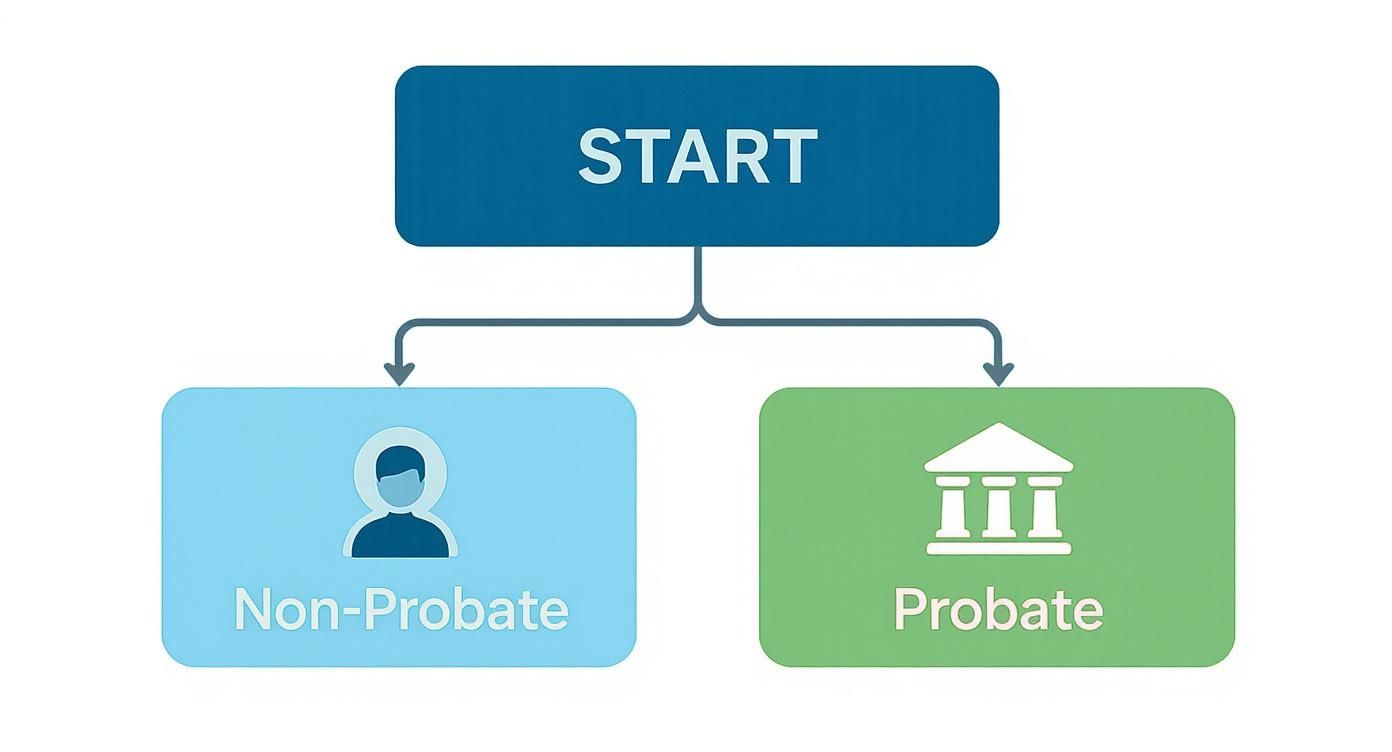
As you can see, it really boils down to one question: does the asset have a legally designated beneficiary or a co-owner with survivorship rights? That's the main fork in the road separating non-probate assets from those that must be managed by a court.
What Are Probate Assets?
Think of probate assets as anything titled only in the deceased person's name, with no automatic "backup plan" for transfer. These assets are essentially frozen until a Texas probate court, like the Harris County Probate Court, gives legal permission for them to be distributed.
This court-supervised process, which is outlined in the Texas Estates Code, makes sure that any outstanding debts are settled and the remaining property gets to the right heirs, either according to the will or state law if there isn't one.
Common examples of probate assets include:
- A house or piece of land that was owned solely by the person who passed away.
- A personal checking or savings account that doesn't have a "Payable on Death" (POD) designation.
- A car, truck, or boat titled exclusively to the deceased.
- Personal belongings like furniture, art, collectibles, and jewelry.
Probate is the official legal pathway for a court to validate a will, pay off estate debts, and ensure the remaining assets reach their rightful owners. It brings structure and finality to settling an estate, providing peace of mind that everything has been handled correctly.
What Are Non-Probate Assets?
On the other hand, non-probate assets are specifically set up to bypass the court system entirely. They come with pre-arranged instructions for transfer that kick in automatically upon death. This is usually done through beneficiary designations or certain types of legal titling.
The big advantages here are speed and privacy. These assets can get to your loved ones much faster, and since the transfer happens outside of court, the details don't become part of the public record. This can be a great comfort to grieving families.
Classic examples of non-probate assets are:
- Life Insurance Policies: The death benefit is paid directly to the person you named as the beneficiary.
- Retirement Accounts: Funds in accounts like 401(k)s, IRAs, and 403(b)s go straight to the designated beneficiaries.
- Bank Accounts with a POD Designation: The money in the account is automatically payable to whoever you named.
- Assets Held in a Living Trust: Property inside a trust is managed and distributed by your chosen successor trustee according to the rules you set—no probate needed.
- Jointly Owned Property with Right of Survivorship: This is common for real estate. The surviving co-owner automatically inherits the entire property without court involvement.
To make this even clearer, here is a quick reference table to help you classify common assets.
Quick Guide to Asset Classification
| Asset Type | Typical Classification | How It Transfers |
|---|---|---|
| House (Sole Ownership) | Probate | Through a will or Texas intestacy laws, supervised by a court. |
| Joint Bank Account (with Survivorship) | Non-Probate | Automatically to the surviving joint owner upon death. |
| Life Insurance Policy | Non-Probate | Directly to the named beneficiary listed on the policy. |
| 401(k) or IRA Account | Non-Probate | Directly to the designated beneficiary on the account. |
| Personal Belongings (Jewelry, Art) | Probate | Distributed according to the terms of the will. |
| Car (Sole Ownership) | Probate | Transferred via the probate process to an heir. |
| Property in a Living Trust | Non-Probate | Distributed by the successor trustee according to trust rules. |
This table should give you a good starting point, but we know every family's situation is unique.
Knowing these differences is absolutely critical for effective Estate Planning and can even affect related issues like Guardianship proceedings down the road. If you're not sure how your assets are classified or want to build a plan that protects your family from unnecessary court intervention, our team is here to help. Schedule a free consultation for personalized guidance.
A Deeper Look Into Probate Assets

To truly understand the difference between probate and non-probate assets, let's focus on what lands an asset in the probate pile. At its core, a probate asset is any piece of property titled solely in the deceased person's name, with no automatic instructions for who gets it next.
Think of these assets as being legally "stuck." There’s no pre-arranged beneficiary form or co-owner on the title telling the bank or the county clerk where the property should go. That’s where the Texas legal system steps in with a formal process—probate—to get these assets unstuck, pay off any debts, and make sure everything is transferred correctly and legally.
Why the Court Gets Involved with Probate Assets
Picture a family in Harris County whose father just passed away. He owned his house, a car, and a personal savings account, and every single one was in his name alone. Without a co-owner or a designated beneficiary, who has the legal right to take control?
This is precisely why the probate court exists.
Under the Texas Estates Code, specifically Title 2, the probate process provides a supervised, transparent roadmap for these situations. The court's job boils down to a few key functions:
- Validate the Will: The court first confirms that the will is legally sound.
- Appoint an Executor: It officially grants authority to the person named in the will to manage the estate.
- Oversee Debt Payment: It makes sure all legitimate debts and taxes are settled from the estate's assets before anyone gets their inheritance.
- Authorize Asset Transfer: Finally, it gives the legal green light to transfer titles for things like homes and cars to the rightful heirs.
This court oversight is there to protect everyone—the beneficiaries, any creditors, and the final wishes of the person who passed. It’s a system designed to prevent family disputes and bring an orderly close to someone's financial life.
A Texas Family's Story: The Garcias
Let's look at a hypothetical scenario. Mr. Garcia passed away, leaving a will that said his daughter, Maria, should inherit his San Antonio house and his beloved classic car. But the deed to the house and the title to the car were in his name only. That makes them probate assets.
Maria can't just take the keys and move in. She has to start by submitting her father's will to the Bexar County Probate Court. The court will then officially appoint her as the executor, giving her the legal power to manage the estate. It's only after the probate process wraps up that the titles will be legally transferred into her name. The same goes for his bank account, which didn't have a "payable-on-death" beneficiary named.
This story highlights a crucial point: having a will doesn't let you skip probate. A will is really just your set of instructions for the probate court. And when you're dealing with assets tied up in the system, it's smart to understand the legal steps and options for selling a house during probate if that becomes part of the plan.
The probate process is the formal system for settling debts and making sure your property reaches the right hands. The executor is the person responsible for guiding the estate through this process, and you can learn more about what an executor does in our detailed guide.
How Non-Probate Assets Bypass the Courts
While probate assets need a judge's green light, non-probate assets are built with an express lane to your loved ones, skipping the court system entirely. Think of them as having a pre-programmed set of instructions that activate the moment you pass away. This built-in transfer mechanism is precisely what makes them so efficient.
These direct instructions are just legally binding contracts you set up with banks, insurance companies, and other financial institutions. When you name a beneficiary on a life insurance policy or set up a bank account as "Payable on Death" (POD), you're creating a crystal-clear, legally recognized path for that money to follow. This simple step can turn what could be a drawn-out court process into a straightforward administrative task for your family.
Common Types of Non-Probate Assets in Texas
For Texas families, just knowing which of your assets can avoid probate is a huge step toward giving your heirs a more secure future. The great news is that many of the financial tools you're already using are designed to work this way.
Here’s a look at the most common types of non-probate assets:
- Life Insurance Policies: The death benefit is paid directly to the beneficiaries you've named on the policy. The insurance company simply follows your directions without waiting for a court order.
- Retirement Accounts: Funds sitting in your 401(k)s, IRAs, and pensions will pass straight to your designated beneficiaries. For many people, this is one of their most significant non-probate assets.
- Payable on Death (POD) Bank Accounts: You can easily add a POD designation to your checking or savings accounts. It simply means the money becomes immediately payable to your named person upon your death.
- Transfer on Death (TOD) Securities: This works just like a POD account, but for your stocks, bonds, and brokerage accounts. You name a beneficiary, and they inherit the securities directly.
Joint Ownership and Living Trusts
Beyond just naming beneficiaries, the way you title your property can also dictate its path after you're gone. Two of the most powerful ways to keep assets out of probate involve co-ownership and trusts.
Joint Tenancy with Right of Survivorship (JTWROS): When you own property—like a house or even a bank account—with someone else as "joint tenants with right of survivorship," the surviving owner automatically gets the whole thing. The asset transitions seamlessly without any court involvement.
A Practical Example: Imagine a mother and daughter in Travis County own a home together as JTWROS. When the mother passes away, her daughter instantly becomes the sole owner of the property by operation of law. No probate is needed for the house to be hers.
Living Trusts: Putting your assets into a living trust is one of the most effective strategies for avoiding probate. You're essentially transferring ownership of your property from your individual name to the name of the trust. When you die, your chosen successor trustee steps in to distribute the assets according to the rules you laid out in the trust document.
For anyone serious about bypassing the probate courts, looking into trusts is essential. It's important to understand all sides of tools like revocable living trusts, including their potential drawbacks. You can also get more specific information on whether you should put your house in a trust in our detailed guide.
By using these estate planning tools, you give your loved ones the gift of accessing their inheritance faster and with far less stress.
How Asset Types Impact Guardianship Cases

Most people think the difference between probate and non-probate assets only matters after someone dies. But in reality, this distinction is critically important long before then—especially when a person can no longer manage their own financial affairs. This is where guardianship often enters the picture, and knowing how assets are titled is key to protecting your loved one.
When a Texas court finds that an adult is incapacitated, it can appoint a guardian of the estate to handle their finances. This legal process, laid out in Title 3, Subtitle G of the Texas Estates Code, gives the guardian authority over the property of the individual, now known as the "ward."
But here’s the crucial part: the guardian's power and day-to-day duties are completely different depending on whether the assets are probate or non-probate. This one detail can dramatically alter the cost, complexity, and stress of the entire guardianship process.
Managing Different Assets in a Guardianship
At its core, a guardian's job is to responsibly manage the ward's property for their benefit. How they do this is a matter of control and court oversight, which is directly tied to the asset type.
Let's imagine your aging parent, who lives in a Dallas-area nursing home, has a checking account just in their name. That account is a classic probate asset. If you are appointed guardian of the estate, you’ll need to:
- Take your court-issued Letters of Guardianship to the bank to get access.
- Use the funds strictly for your parent's care, like paying medical bills and living expenses.
- File detailed annual accountings with the probate court, documenting every single dollar that comes in or goes out.
This intense level of court supervision is there to protect the ward, but it also creates a mountain of administrative work for the guardian. Every move you make must be carefully documented and approved.
Under Texas law, a guardian of the estate is a fiduciary who must act in the best interest of the ward. This includes managing, investing, and protecting the ward's assets under strict court supervision, as outlined in the Texas Estates Code.
How Non-Probate Assets Change the Equation
Now, let's flip the script. What if, years ago, your parent wisely put most of their assets into a revocable living trust? A living trust is a non-probate tool, and it completely changes the game.
In this scenario, the assets belong to the trust, not your parent as an individual. The trust document names a successor trustee—perhaps you or another family member—to step in and manage things if your parent becomes incapacitated.
This creates a much better situation for several reasons:
- No Guardianship May Be Needed: If all the major assets are held by the trust, there might not be an "estate" for the court to oversee. This could help you avoid a court-appointed guardianship altogether, which is a powerful alternative to guardianship.
- Less Court Involvement: As the successor trustee, you can manage the trust's assets according to the rules your parent already set. You don't need a judge's permission for routine transactions.
- Greater Privacy and Flexibility: Trust administration is a private family matter, unlike a guardianship, which is part of the public court record. This lets you handle things more efficiently and discreetly.
Smart Estate Planning is one of the most powerful shields against the future complexities of a Guardianship. By using non-probate tools like trusts and beneficiary designations now, you create a clear roadmap for what should happen if incapacity strikes later. This foresight not only makes the process smoother but also helps preserve the estate for your loved one’s care by cutting down on legal fees and court costs.
If you are worried about a family member's ability to manage their affairs, the first step is to understand how their assets are structured. For clear, personalized advice on how these issues affect your family, schedule a free consultation with The Law Office of Bryan Fagan.
Strategic Planning to Minimize Probate in Texas
Knowing the difference between probate and non-probate assets is the first step. But true peace of mind comes from putting that knowledge into action. With strategic planning, you can set up your estate to keep the courts out of your family’s business as much as possible. This makes transferring your legacy faster, more private, and significantly less expensive for your loved ones. It’s about being proactive and taking control now, so they don’t have to deal with the fallout later.
The main goal here is straightforward: legally transform potential probate assets into non-probate assets. It sounds technical, but it just means using legal tools designed to create a direct path for your property to get to your heirs, without needing a judge’s approval. For Texas families, this means cutting through red tape and reducing the emotional strain during an already difficult time.
Powerful Tools to Keep Your Estate Out of Court
The good news? Texas law offers several highly effective ways to sidestep the probate process. These aren't obscure legal loopholes; they are accessible tools that can be customized to fit your family’s unique situation. The trick is to set them up correctly and, just as importantly, keep them updated as your life changes.
Here are some of the most common and powerful strategies we see Texas families use every day:
- Establish a Revocable Living Trust: This is the heavyweight champion of probate avoidance. When you transfer ownership of your major assets—think your house, investment portfolios, and significant bank accounts—into a trust, they technically no longer belong to you. You still control them, but they aren't part of your personal estate. After you pass, the successor trustee you named steps in to distribute everything according to your instructions, completely outside of court.
- Utilize Beneficiary Designations: For many financial accounts, this is the simplest and quickest fix. Take an afternoon to review and update the beneficiaries on all your life insurance policies, IRAs, 401(k)s, and pension plans. This simple action instantly converts these accounts into non-probate assets that pass directly to the people you’ve chosen.
- Use Payable on Death (POD) and Transfer on Death (TOD) Designations: Think of these as beneficiary designations for your other assets. You can add a POD designation to your bank accounts and a TOD designation to brokerage accounts and even vehicle titles here in Texas. It works the same way, allowing the asset to transfer automatically upon your death.
The Importance of Proper Asset Titling
How you legally own your property can be just as crucial as having a will or a trust. The right ownership structure can ensure an asset bypasses probate entirely, while the wrong one can send it straight to the courthouse steps.
Key Takeaway: Titling an asset as Joint Tenants with Right of Survivorship (JTWROS) is a powerful non-probate tool. When one owner dies, the property automatically belongs to the surviving owner by operation of law. This is a common and effective strategy for married couples owning a home or sharing a bank account.
The trusts and estates industry, which helps people manage both probate and non-probate assets, is growing rapidly. It reached an estimated $290.1 billion in revenue in a recent year, largely because more people are looking for smart ways to handle wealth transfers. Trusts are especially popular because they offer privacy and control over non-probate assets. To get a better sense of these financial shifts, you can discover more insights about these economic trends.
This growth highlights that more and more families understand the value of planning ahead. For smaller estates, other options might be on the table. In some cases, your heirs may be able to use a simpler court process; you can learn more in our guide on the Small Estate Affidavit in Texas.
Probate vs. Non-Probate Planning Tools
Choosing the right estate planning tools can feel overwhelming. To help clarify your options, the table below compares some of the most common planning tools and explains how they affect whether your assets will go through probate in Texas.
| Planning Tool | Effect on Assets | Best For | Key Consideration |
|---|---|---|---|
| Last Will & Testament | Directs probate assets. Does not avoid probate. | Anyone with assets or minor children. | All assets titled in your name alone still go through probate. |
| Revocable Living Trust | Converts probate assets into non-probate trust assets. | Individuals with significant assets (like real estate) seeking to avoid probate and maintain privacy. | Requires you to retitle your assets into the trust's name to be effective. |
| Beneficiary Designations | Turns accounts (IRAs, 401ks, life insurance) into non-probate assets. | Anyone with retirement accounts or life insurance policies. | Beneficiary forms override your will, so they must be kept up-to-date. |
| Joint Tenancy (JTWROS) | Creates a non-probate asset that passes to the surviving owner. | Married couples or partners co-owning property like a house or bank account. | The surviving owner gets 100% ownership, which may not be ideal in blended families. |
Ultimately, there is no one-size-fits-all solution. The best strategy is a personalized one that reflects your wishes and protects your family from getting tangled in unnecessary legal hurdles.
Answers to Your Top Questions About Texas Assets
When it comes to estate planning, the details matter. Texas families often have very practical questions about how everything works on the ground. We’ve put together some straightforward answers to the questions we hear most often about probate and non-probate assets to give you the clarity you need.
Does Having a Will Mean I Can Avoid Probate?
This is probably the biggest misconception we see in estate planning. The short answer is no. A will doesn’t sidestep probate; it’s actually a roadmap for the probate court.
Think of it this way: your will contains your instructions, but it has no legal power on its own. It must be submitted to a Texas probate court, like the one in Tarrant County, to be officially validated. Only then can the court legally authorize your executor to start distributing your probate assets according to your wishes. A will is absolutely essential, but it’s the probate process that brings it to life.
What Happens If Someone Dies Without a Will in Texas?
When a person passes away without a will, the law says they died "intestate." In these cases, Texas steps in with a rigid, one-size-fits-all formula to divide up their probate assets. The rules are laid out in the Texas Estates Code, which dictates who gets what based on a strict family hierarchy—spouse, children, parents, and so on.
The problem is, the state’s formula probably won’t match what you would have wanted. For example, a surviving spouse might be forced to share property with children from the deceased’s prior marriage. This is exactly why a will is so powerful: it lets you call the shots, not the state legislature.
Can I Just Add My Child to My Bank Account to Avoid Probate?
It’s a common strategy, and yes, adding a child as a joint owner with right of survivorship can make that account a non-probate asset. When you pass on, the money automatically becomes theirs without any court involvement.
But this shortcut comes with some serious risks you need to think about.
- Creditor Access: While you’re alive, that account is now fair game for your child’s creditors or any legal judgments against them.
- Loss of Control: The moment you add their name, your child has equal access and control over every penny in that account.
- Family Friction: This move can create unintended conflict if you have other children. It may look like favoritism, even if you intended for the money to be shared.
A much safer route is often a Payable on Death (POD) designation. It names your child as the beneficiary, but they have zero access to the funds until after you’re gone, neatly avoiding all these potential headaches.
Are Life Insurance Proceeds Always Non-Probate Assets?
In most cases, yes. Life insurance is a classic non-probate asset because the payout goes directly to the beneficiary named in the policy. It’s a contract between you and the insurance company, so the will and the probate court aren’t involved.
However, things can go wrong. A major issue arises if your named beneficiary dies before you do and you never named a backup (contingent) beneficiary. If that happens, the insurance company may have no choice but to pay the proceeds to your estate. The moment that happens, the money becomes a probate asset, subject to court delays and your creditors.
Crucial Tip: Make it a habit to regularly review and update the beneficiary designations on all your insurance policies, retirement accounts, and annuities. This simple act is one of the most effective things you can do to keep your assets out of probate and in the hands of your loved ones.
How Does Real Estate Factor into Probate?
Real estate is one of the biggest assets that gets stuck in probate, but it doesn't have to be. If a house is titled only in the deceased's name, it's a probate asset, plain and simple. Thankfully, Texas law offers a few excellent ways to avoid this.
A popular method for married couples is titling the property as Joint Tenants with Right of Survivorship (JTWROS). When one spouse passes away, the other automatically becomes the sole owner of the property—no court required.
Another powerful option is the Transfer on Death Deed (TODD). This is a simple legal document you file with the county clerk that names a beneficiary to inherit your property the moment you die. It’s a clean, direct transfer that completely bypasses the probate process.
Understanding these tools is the first step toward building an estate plan that truly protects your family from the cost and hassle of probate.
Trying to figure out the world of probate and non-probate assets can feel like a heavy burden, but you don't have to carry it alone. The experienced attorneys at The Law Office of Bryan Fagan, PLLC are here to offer the clear, compassionate guidance your family deserves. Whether you're just starting an estate plan, dealing with a guardianship matter, or settling a loved one's estate, we can help you move forward with confidence. Schedule a free consultation today to talk about your family's needs and see how we can help protect your future.