Skip to content
A lot of Texas families reach this problem before they realize they’re in it. One daughter says Mom is forgetting bills, missing medication, and getting pressured by a new boyfriend. A son says she’s still stubborn, still sharp enough, and doesn’t need anyone taking over her life. A stepfather says the children are interfering. An out-of-state sibling suddenly starts asking for bank records. By the time someone mentions guardianship, the family argument has usually been building for months.
A family dispute over guardianship texas case is never just paperwork. It’s usually grief, fear, old resentments, and genuine concern mixed together. In many families, each person thinks they’re protecting the same loved one. They just disagree about what protection looks like.
Texas law gives courts a process for sorting that out. Under Texas Estates Code Title 3, Subtitle G, guardianship can be created when a person lacks capacity and needs a court-appointed decision-maker for personal care, finances, or both. But courts don’t hand that power out lightly. A guardianship takes rights away from the proposed ward, so judges expect evidence, notice, and close scrutiny.
That’s where families often get overwhelmed. They know something is wrong, but they don’t know whether they should seek guardianship, fight it, narrow it, or avoid it through another legal tool. The good news is that a clear roadmap helps. So does understanding what Texas probate courts care about.
When Families Disagree on Guardianship
The hardest calls usually start at a kitchen table, not in a courtroom.
One common example is an aging mother in Harris County who has started repeating herself, missing rent payments, and accusing one child of stealing when she misplaced a checkbook. One sibling wants immediate guardianship. Another wants to try a doctor visit and in-home help first. A third hasn’t visited much but suddenly objects to everyone else’s plan.
That’s how many cases begin. Not with bad people. With scared people.
In Texas, a guardianship is a court-created relationship where one person is appointed to make decisions for another person who can’t manage some or all personal or financial matters. Depending on the facts, the court may appoint a guardian of the person, a guardian of the estate, or both. The legal standard matters, but so does the family story behind it.
What families are usually fighting about
Some disputes focus on capacity. Is Dad unable to handle finances, or is he just making decisions his children dislike?
Others focus on control. Who should serve if a guardian is needed? A spouse? An adult child? A professional guardian? In blended families, that question can get especially tense.
A third category involves money and access. One relative may suspect another of isolating the loved one, redirecting income, or steering medical choices for personal benefit.
Families often come to court asking, “Who’s right?” The court’s real question is different: “What protects the proposed ward’s best interests with the least restriction on their rights?”
That shift matters. Probate judges don’t reward the loudest family member. They want evidence, a workable plan, and compliance with the Estates Code.
If your family is already in this kind of conflict, it helps to see that you’re not the only one dealing with it. This discussion of a battle for control when siblings fight over who gets to be guardian reflects a pattern many Texas families recognize right away.
What usually helps early
Before anyone files, families often benefit from doing three things:
- Get current medical information: Old assumptions won’t carry much weight.
- Pull existing legal documents: Powers of attorney, trusts, designations, and prior planning can change the entire case.
- Separate hurt feelings from legal issues: A judge can address incapacity and suitability. A judge can’t repair decades of sibling resentment.
When people understand that difference early, they make better decisions.
Legal Grounds for a Guardianship Dispute in Texas

A Texas court won’t treat every family disagreement as a valid legal objection. To contest a guardianship, you need a recognized basis under the Texas Estates Code, especially the guardianship provisions in Title 3, Subtitle G, including the chapters dealing with incapacity, appointment, qualifications, and alternatives.
Disputing incapacity
The first major ground is simple in concept and difficult in practice. You argue that the proposed ward is not incapacitated to the degree claimed.
Texas courts require clear and convincing evidence of incapacity in guardianship cases, which is why a medical letter alone may not settle the matter when the family sharply disagrees. Capacity also isn’t always all-or-nothing. A person may be able to choose where to live but not manage a complex estate. Or they may need help with medical consent but still understand everyday spending.
That’s why limited guardianship often deserves serious attention. If a person only needs support in one area, a full guardianship may be too broad.
Challenging the proposed guardian
The second common ground is unsuitability.
A relative may be legally disqualified or practically inappropriate because of conflict, past financial misconduct, estrangement, or inability to carry out fiduciary duties. In many families, the primary fight isn’t over whether help is needed. It’s over who should have authority.
A judge will look closely at whether the proposed guardian can act in the ward’s best interests. In real life, warning signs include:
- Financial conflict: The proposed guardian benefits from controlling accounts, property, or litigation decisions.
- Isolation concerns: One person has cut off the ward from other family members or medical providers.
- History of poor judgment: A pattern of dishonesty, instability, or misuse of funds can become central.
- Relationship breakdown: A technically eligible person may still be a poor choice if trust has completely collapsed.
Arguing for a less restrictive alternative
This is the issue many families miss. Texas courts must consider whether a less restrictive alternative can protect the person without imposing a full guardianship.
That may include a durable power of attorney, a medical power of attorney, supported decision-making, or another arrangement recognized by law. If those tools are already in place and functioning, a guardianship application may face serious resistance.
Practical rule: If you walk into court asking for full control without first addressing narrower alternatives, you’re making the judge’s job easier for the wrong side.
A blended family dispute shows how these legal grounds overlap. A wife may insist her husband needs protection from adult children who want access to assets. The children may respond that the husband’s existing planning documents should remain in force and that the wife is the one exerting pressure. The legal issues become capacity, suitability, and least restrictive option, all at once.
The Texas Supreme Court’s 2025 ruling in In the Matter of the Marriage of Carlos Y. Benavides, Jr. and Leticia R. Benavides shows how deep these cases can run. The dispute spanned over a decade and involved dementia, divorce, estate issues, and conflict between a fourth wife and children from a prior marriage. The case included multiple divorce filings by different guardians and a final divorce granted on grounds of living apart for more than three years, as discussed in this analysis of the Benavides guardianship and divorce dispute.
Families often need a plain-English overview before they can evaluate those legal grounds in their own situation.
Temporary and emergency concerns
Sometimes the dispute can’t wait for a long merits fight. If a vulnerable adult is at immediate risk, temporary or emergency relief may be necessary.
That usually comes up when someone alleges active financial exploitation, unsafe living conditions, refusal of necessary care, or rapid cognitive decline. In those situations, the court may need to stabilize the situation first and sort out the long-term arrangement later.
The trade-off is important. Emergency action can protect a loved one quickly, but it also raises the emotional temperature in the family. If you seek immediate orders, be prepared to support them with specific facts, not conclusions.
The Court Process for a Contested Guardianship
Most contested cases feel intimidating because families don’t know the sequence. Once you see the steps, the process becomes more manageable.
In Texas, guardianship matters are often heard in probate courts or statutory probate courts, including courts in places like Harris County Probate Court, Dallas County, Travis County, and other Texas counties with guardianship dockets. The exact local practice varies, but the main path is consistent under the Estates Code.
Step one through step three
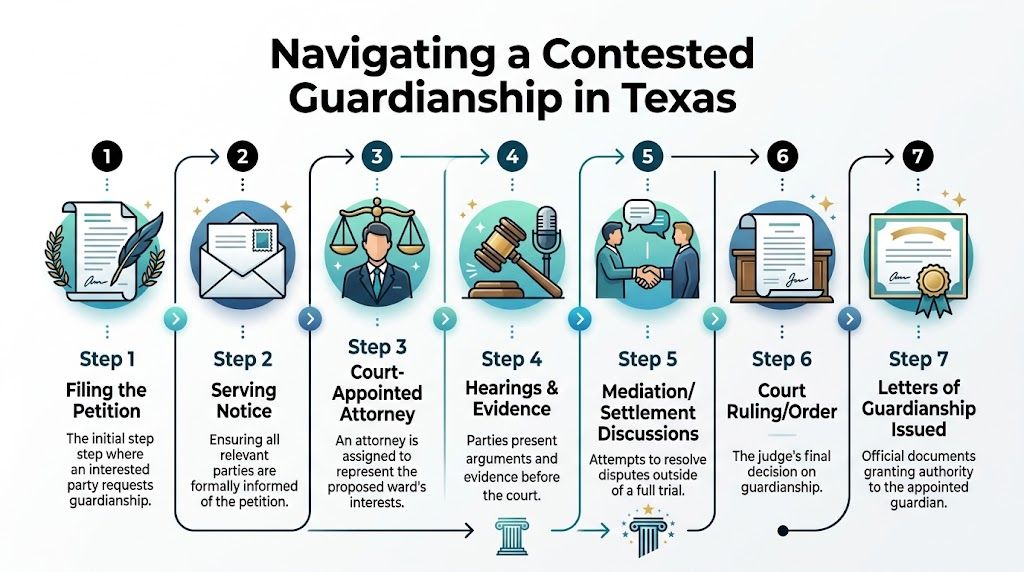
The opening phase usually includes three essential acts.
An application gets filed
The person seeking guardianship files the application in the proper court. In a standard case, that filing needs supporting information about the proposed ward, the nature of the incapacity, and the requested scope of authority.A physician’s letter is gathered and submitted
Texas courts expect medical support for the incapacity claim. Without that, many cases stall before they really begin.Notice goes out to interested parties
Family members and other required persons receive legal notice. At this stage, hidden conflict often surfaces. A case that looked routine can become contested the moment someone formally objects.
Texas guardianship disputes require clear and convincing evidence of incapacity, and the process involves filing an application with a physician’s letter, serving notice, and appointing an attorney ad litem. In practice, uncontested cases may finalize in weeks, while contested matters can extend from 3 to over 6 months, as described in this discussion of Texas guardianship litigation procedure.
The attorney ad litem and the proposed ward
Once the case is active, the court appoints an attorney ad litem for the proposed ward. That lawyer does not represent the family members. The ad litem’s job is to represent the proposed ward’s interests in the case.
This changes the tone of the proceeding. Families often assume the case is solely one relative versus another. It isn’t. The court treats the proposed ward as a person with rights, not as the subject of a family management dispute.
The ad litem may interview the proposed ward, review records, and test whether guardianship is necessary or whether a narrower option will work.
The proposed ward’s voice still matters, even when family members are convinced the outcome is obvious.
What happens when someone contests
A formal contest usually means written objections, competing evidence, and more preparation.
That can include:
- Medical disputes: One side says the person can’t make informed decisions. The other says the impairment is overstated.
- Guardian fitness disputes: Relatives accuse one another of self-interest, bad judgment, or prior misconduct.
- Alternative planning disputes: Someone points to an existing power of attorney or supported decision-making arrangement.
In many counties, judges also encourage practical problem-solving before a full evidentiary hearing. Some disputes narrow after records are exchanged and family members see the strengths and weaknesses of their positions.
A fuller explanation of the litigation side appears in this guide on contesting guardianship in Texas.
Hearing, ruling, and next steps
At the hearing, the judge reviews testimony, documents, medical input, and arguments about the least restrictive solution. In some cases, a jury may be requested. In others, the judge decides everything.
The court may:
- appoint a guardian of the person,
- appoint a guardian of the estate,
- appoint both,
- create a more limited arrangement than requested, or
- deny the application.
If the court appoints a guardian, the work doesn’t end there. The guardian must qualify, follow court orders, and stay current on ongoing duties. A guardianship is not a one-time victory. It’s a court-supervised role with continuing obligations.
What families should do during the process
The most effective families usually take a disciplined approach.
- Keep communication in writing when possible: Clear timelines and records matter.
- Follow local court requirements carefully: Probate judges notice sloppy filings.
- Stay focused on the ward, not family score-settling: Judges can tell when a case has drifted into punishment or revenge.
- Prepare for timing issues: Even when the family feels urgency, court procedure still controls the path.
That structure won’t erase the stress, but it does reduce avoidable mistakes.
Gathering Evidence to Build Your Case
Strong guardianship cases are built, not announced. Telling the court that a sibling is manipulative or that a parent is declining isn’t enough by itself. In a contested matter, proof carries the case.
The practical question is always the same. What evidence helps the judge decide capacity, suitability, and best interests?
Medical proof comes first
If capacity is disputed, medical evidence is usually the anchor.
That may include a physician’s letter, clinical records, cognitive evaluations, medication history, or testimony from a treating professional. The strongest medical evidence usually connects diagnosis to decision-making limits in plain terms. A chart note that says “memory issues” is less helpful than a professional opinion that explains what the person can and cannot understand or manage.
If the family strongly disagrees with an existing medical opinion, counsel may explore whether an updated or independent evaluation makes sense. That should be done carefully and with court procedure in mind.
Financial records often tell the real story
Many cases that sound like “Mom is confused” are really cases about money, access, and control.
If someone alleges exploitation or fiduciary abuse, documents matter more than family accusations. Bank statements, transfer records, account changes, credit activity, unusual withdrawals, and property records can show whether a concern is real or exaggerated.
Texas practitioners often see families rely too heavily on affidavits. That’s risky. To successfully contest a guardianship, parties need evidence beyond simple affidavits, including bank records proving fiduciary breaches or witness statements from medical professionals. Weak evidence is a common pitfall, and courts often dismiss cases that lack substantive medical or financial proof, as explained in this review of evidence needed in contesting guardianship.
Witnesses should be credible, not just loyal
A useful witness is someone with firsthand knowledge and a calm presentation.
That may be:
- A treating physician or nurse who can describe functioning and limitations
- A caregiver who sees daily routines, medication compliance, and safety issues
- A neighbor or close friend who has observed confusion, vulnerability, or isolation
- A financial professional who can explain unusual transactions or account access
A witness who repeats family grievances rarely helps much. Judges tend to value detail over outrage.
Bring witnesses who observed facts. Leave the family historian at home unless they actually saw something that matters.
Sample Evidence Checklist for a Guardianship Dispute
| Evidence Category | Specific Examples | Purpose |
|---|---|---|
| Medical records | Physician’s letter, diagnosis records, medication list, mental status exam, treatment notes | Show the nature and extent of incapacity |
| Financial documents | Bank statements, withdrawal records, online transfer history, property records, billing records | Support or refute claims of mismanagement, exploitation, or need for estate control |
| Existing legal documents | Durable power of attorney, medical power of attorney, supported decision-making paperwork, trusts | Show whether less restrictive alternatives already exist |
| Witness materials | Statements or expected testimony from caregivers, neighbors, medical staff, family members with direct knowledge | Corroborate daily functioning, safety risks, and relationship history |
| Communication records | Emails, text messages, appointment logs, care notes | Establish timeline, notice, access issues, or family interference |
| Court compliance records | Prior reports, accountings, orders, letters of guardianship if a guardian is already serving | Evaluate whether an existing guardian has met legal duties |
A practical way to organize the file
Families handle this better when they stop collecting random papers and start building categories.
Create one folder for medical records, one for finances, one for legal documents, one for witness contact information, and one for a timeline. A simple chronology often reveals patterns that no single document shows by itself.
If expert testimony may be needed, this overview of expert testimony in a Texas guardianship hearing is a helpful companion topic.
In some disputes, families also work with counsel, physicians, or forensic professionals to test whether concerns are provable before investing in a full hearing. That’s often a smart trade-off. It’s better to know early whether the evidence supports your theory than to discover that weakness in court.
Hearings Mediation and Finding a Resolution
Not every guardianship fight needs a winner and a loser. Some do. Many don’t.
A contested hearing is sometimes necessary, especially when someone is in danger or one side won’t cooperate. But many Texas families are better served by a structured settlement that protects the ward and reduces damage to the family.
What happens at a contested hearing

At a hearing, each side presents testimony and exhibits. The judge evaluates capacity, the need for guardianship, the scope of any appointment, and who is qualified to serve.
The process can be emotionally draining. Family members may be cross-examined about private issues, finances, caregiving history, and their motives. That’s one reason families should be realistic about the cost of full litigation, not just in money but in relationships.
Family disputes over guardianship can cost tens of thousands of dollars in legal fees, and a 2015 Texas study found that nearly 50 percent of guardianship appointments were to a “mother” or “parents,” which reflects how often these matters stay inside the family and why the emotional fallout is so deep, according to the Texas guardianship study from the Office of Court Administration.
When temporary relief makes sense
Sometimes the court must act before the larger dispute is fully resolved.
Examples include:
- Unsafe spending or transfers: Funds are disappearing, and delay could cause real harm.
- Medical instability: A vulnerable person needs immediate decisions about care or placement.
- Isolation or access problems: One relative blocks information, visits, or treatment coordination.
Temporary orders can create breathing room. They can also intensify distrust. Families should treat emergency requests as a serious legal step, not as a means of gaining an advantage.
Why mediation often works better
Mediation doesn’t mean the concerns were exaggerated. It means the family recognizes that a court order can solve only part of the problem.
A good mediation can produce solutions a trial often can’t, such as a limited guardianship, agreed reporting rules, a neutral third party for finances, scheduled access, or a transition plan that preserves the ward’s routine.
Here’s the key trade-off:
| Path | Strength | Cost |
|---|---|---|
| Hearing | A judge decides disputed facts and authority | More conflict, more exposure, less control over outcome |
| Mediation | The family can shape a practical resolution | Requires compromise and enough trust to negotiate |
Mediation is especially valuable when people must keep dealing with each other after the order is signed. Siblings still need to share updates. A spouse and adult children still need to coordinate care. A courtroom ruling may settle authority while making day-to-day cooperation worse.
Some families need a judge. Others need a structure that lets everyone stop fighting long enough to care for the person at the center of the case.
The emotional side matters too. Families in these disputes are often carrying grief, caregiver exhaustion, and old wounds that legal process alone won’t solve. Outside legal counsel, some people also benefit from mental health support during the dispute. For readers looking for a non-legal example of that kind of resource, support through counselling can help families think about the role emotional support may play while a legal matter unfolds.
Resolution can still involve accountability
Settlement doesn’t require blind trust.
An agreement may include inventory requirements, restricted spending, care reporting, supervised transitions, or review by the court. The point isn’t to “keep the peace” at any price. The point is to protect the ward with a plan people can follow.
That’s where experienced counsel can help weigh options. Some firms, including the Law Office of Bryan Fagan, PLLC, assist families with capacity evaluations, probate filings, mediation strategy, and hearings when settlement isn’t possible.
Common Pitfalls in Guardianship Disputes
Families lose ground in these cases long before a judge rules. The damage usually comes from avoidable mistakes.
Waiting until the crisis is already here
Many people delay action because they hope the conflict will calm down on its own. Usually it doesn’t.
By the time a family files, accounts may already be drained, medical decisions may already be disputed, or the proposed ward may be much harder to evaluate clearly. Early legal review doesn’t always mean filing quickly. It often means preserving options before they disappear.
Treating suspicion as evidence
A daughter may be completely right that her brother is taking advantage of their father. But if she has no records, no doctor support, and no witnesses with firsthand knowledge, her concern may remain just that. A concern.
Start documenting early. Keep dates, names, account activity, medication issues, hospital visits, and communication records.
Using guardianship as a family power struggle
Courts see this problem often. One person wants guardianship not because it’s necessary, but because they want to “win” a larger family conflict.
That approach usually backfires. Judges respond better when the requested relief is narrow, supported, and tied directly to the ward’s needs. They respond poorly when the case feels like punishment for a difficult sibling or spouse.
The fastest way to weaken a guardianship case is to make the hearing about yourself instead of the proposed ward.
Ignoring alternatives
Some families assume guardianship is the default answer once there’s a diagnosis. It isn’t.
If a valid planning document or less restrictive support system can solve the problem, the court will want to know why that isn’t enough. Families who fail to address alternatives can look unprepared or overreaching.
Underestimating compliance after appointment
Winning the appointment is only the first part. A guardian has ongoing duties, reporting obligations, and fiduciary responsibilities.
People sometimes fight hard to get appointed, then struggle with the paperwork, deadlines, and court oversight that follow. That creates a new set of problems and may expose the guardian to removal or challenge later.
Letting every conversation become a battle
Not every disagreement needs a written accusation. Some do. Many don’t.
A practical approach is to save formal legal energy for issues that affect safety, money, capacity, or court compliance. If the argument is really about old family grievances, don’t disguise it as a legal emergency.
Protecting Your Loved One with Clarity and Care
A guardianship dispute in Texas asks families to do two hard things at once. Protect a vulnerable person, and make careful legal decisions while emotions are high.
That’s why these cases need more than urgency. They need a plan. The strongest approach usually starts with a candid review of capacity, existing planning documents, family dynamics, and immediate risks. From there, the right path may be a guardianship application, a contest, a limited order, temporary relief, mediation, or a less restrictive alternative.
Texas courts take these cases seriously because the stakes are serious. A guardianship can protect someone from exploitation, unsafe decisions, or neglect. It can also remove important personal rights. Under Texas Estates Code Title 3, Subtitle G, the court’s job is to balance protection with dignity. Families should approach the case with that same balance.
If you’re dealing with sibling conflict, a blended family fight, concerns about incapacity, or questions about an existing guardian’s conduct, don’t assume that waiting will make things easier. Usually it makes the facts harder to prove and the conflict harder to contain.
Clear legal guidance can help you sort out what’s urgent, what’s provable, and what resolution would serve your loved one. That matters whether your case is in Harris County, Dallas, Austin, San Antonio, or another Texas court.
You don’t have to figure this out alone. The right next step is often a focused legal consultation that turns a chaotic family conflict into a workable legal strategy.
If your family is facing a guardianship dispute, the Law Office of Bryan Fagan, PLLC can help you evaluate your options, understand the Texas Estates Code, and build a practical plan for protecting your loved one. We handle guardianship, probate, and estate planning matters for families across Texas. Schedule a free consultation to discuss your situation and the next best step.