Skip to content
You may be there already.
Your mother forgot to pay the light bill twice, even though the money is in the account. Your brother found stacks of unopened mail. A neighbor says she signed a repair contract she clearly didn’t understand. Then, on a better day, she tells you she’s fine and gets angry that anyone is asking questions.
That’s where many Texas families get stuck. You can see something is wrong. But you also know this is still your loved one, with rights, preferences, pride, and a voice that matters.
A guardianship hearing isn’t about taking control because a family is worried. It’s about asking a court to step in only when the law allows it, and only to the extent necessary to protect someone who can’t protect themselves. In Texas, that decision turns on evidence, not fear, frustration, or family history.
The hardest part for many families is this: the judge doesn’t know your parent the way you do. The court needs a reliable, professional explanation of what your loved one can still do, what they can’t do safely, and why. That’s where expert testimony becomes so powerful. It gives the judge a careful, objective picture that goes beyond, “We’re concerned.”
A Difficult Crossroads Navigating Guardianship for a Loved One
A daughter in Harris County may notice her father wandering from home after dark. A son in Dallas County may realize his mother is giving away money to strangers on the phone. An aunt in Bexar County may start missing medications and accusing family members of stealing.
These moments feel personal because they are. Families often arrive at guardianship after months of trying easier solutions first.
When concern turns into a legal question
Texas courts treat adults as capable unless someone proves otherwise. So even if the family is certain a loved one needs help, the court won’t act just because the situation feels urgent or painful.
That can surprise people. They assume the hearing is about whether the judge believes the family. It isn’t. The hearing asks a narrower question: is there reliable proof that a guardianship is necessary, and if so, how limited or broad should it be?
A simple example helps.
If your loved one can still choose where to live and understand basic medical choices, but can’t handle banking or spot financial scams, the court may look at a more customized solution. If the evidence shows much broader incapacity, the court may consider broader authority. The point is fit, not punishment.
Why families often feel overwhelmed
Guardianship mixes emotion with procedure. You may be grieving a change that hasn’t been spoken out loud yet. At the same time, you’re hearing terms like “proposed ward,” “capacity,” “ad litem,” and “evidentiary hearing.”
Guardianship cases are often less about winning an argument and more about helping the court see a full, accurate picture of a vulnerable person’s daily reality.
That’s why expert testimony matters so much in an expert testimony guardianship hearing texas case. It helps translate private struggle into courtroom proof.
What families can do first
Before anyone files anything, it helps to slow down and gather facts.
- Write down specific incidents. Note missed medications, unpaid bills, unsafe driving, wandering, confusion, or repeated scams.
- Collect records carefully. Medical records, discharge summaries, financial notices, and caregiver notes often tell a clearer story than memory alone.
- Look at alternatives too. Powers of attorney, supported decision-making, trusts, or informal help may work in some families and may avoid a full guardianship.
- Talk with relatives early. Quiet disagreements become loud disputes once a case reaches probate court.
If the situation involves immediate danger, temporary or emergency relief may need to be considered. If not, thoughtful preparation usually leads to a stronger and more respectful case.
Why Expert Testimony is Important in Texas Guardianship Hearings
A hearing can turn on one hard question. Is your loved one making risky choices they still have the legal right to make, or has their condition reached the point where the court must step in?
Texas courts start with a strong presumption. Every adult is presumed to have capacity. That rule protects independence and keeps guardianship from being granted just because a family is worried, frustrated, or in disagreement.
To overcome that presumption, the court must hear clear and convincing evidence. In plain English, the judge must form a firm belief that a guardianship is needed and that less restrictive options will not do the job. That is why expert testimony matters so much. It translates confusion, unsafe decisions, memory loss, or psychiatric symptoms into professional opinions the court can test and rely on.
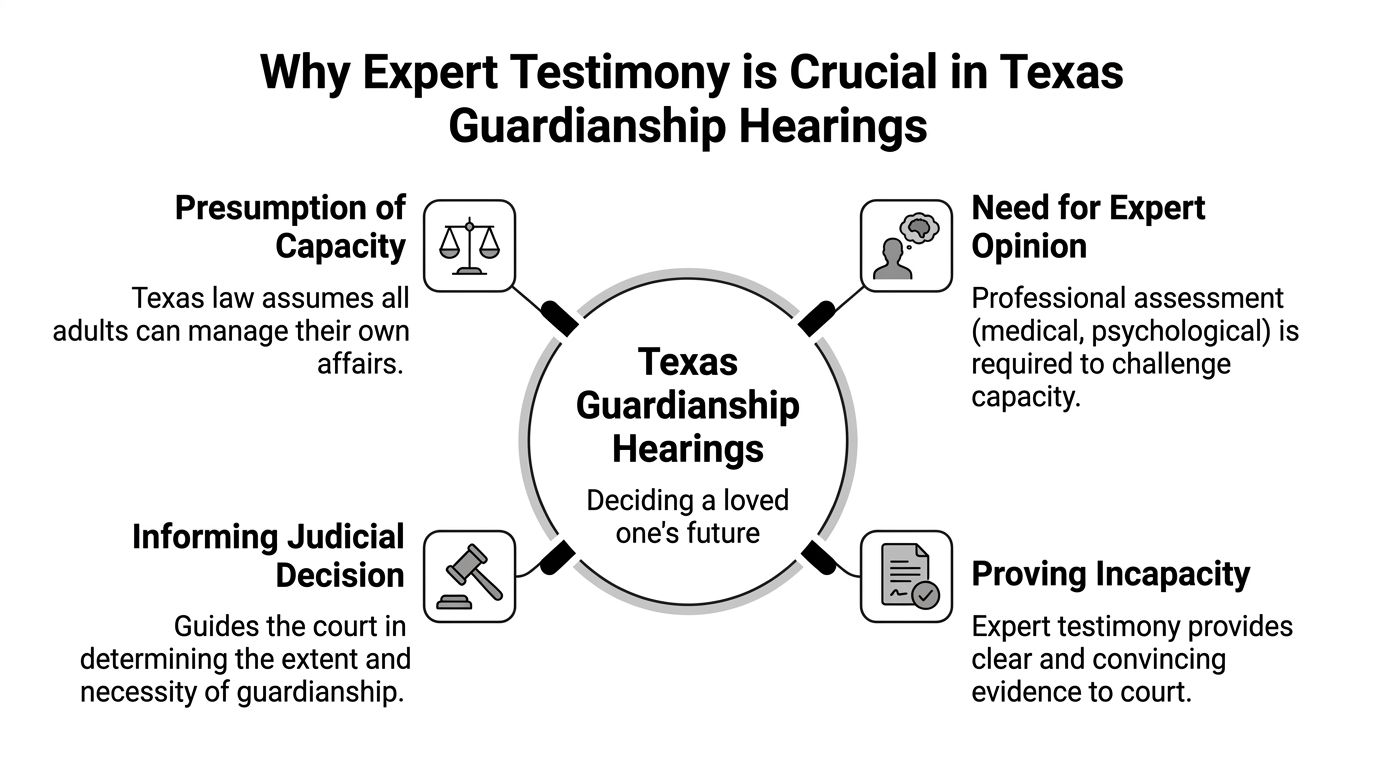
Family concern starts the story. Expert proof helps finish it.
Families usually see the warning signs first. They notice unpaid bills, repeated falls, wandering, medication mistakes, or sudden distrust of people who are trying to help. That information matters. It often explains why the case was filed in the first place.
But a judge still needs more than understandable concern.
A guardianship hearing works a lot like a medical consult after a serious symptom appears. The family describes what has been happening at home. The expert explains what those events mean, whether they reflect impaired judgment, and whether the problem affects only one area of life or many. That distinction can shape the whole case, especially if the court is considering a limited guardianship instead of removing broad rights.
The court is not looking for a diagnosis alone
One of the biggest points of confusion for families is this: a diagnosis does not automatically equal incapacity.
A person can have dementia, bipolar disorder, schizophrenia, depression, or a brain injury and still retain legal capacity in some areas. The judge needs testimony that connects the condition to daily function. Can the person understand a medical recommendation? Can they manage money without being exploited? Can they recognize danger and respond appropriately?
That is why a psychological evaluation for guardianship in Texas can carry so much weight. It helps the court move from labels to abilities. For families, that means preparation should focus on real-world examples that match the expert's findings.
Why this evidence often carries more force than family testimony alone
Expert testimony gives the court three things family testimony usually cannot provide on its own.
- A clinical explanation. The expert can explain whether the problem is memory loss, psychosis, poor executive function, impaired judgment, or something else.
- A link between condition and risk. The court needs to know how the condition affects finances, personal safety, medical decisions, or vulnerability to exploitation.
- A measured recommendation. A good expert often helps the court see whether the right answer is full guardianship, limited guardianship, or another option.
This is also where the human side matters. If your loved one has symptoms that may call for psychiatric care, families often benefit from learning more about when to see a psychiatrist before the hearing process becomes more urgent. Early treatment does not solve every guardianship issue, but it can clarify what is temporary, what is treatable, and what risks remain.
Subtitle G is designed to slow the process down for a reason
Texas Estates Code Title 3, Subtitle G sets out the rules for guardianship proceedings. Those rules are there to protect the proposed ward from losing rights without careful proof.
Expert testimony helps the court answer practical legal questions, including:
- Can the person manage finances safely
- Can the person understand and communicate medical choices
- Can the person meet basic personal needs
- Is the condition temporary, improving, or likely ongoing
- Can the court protect the person with fewer restrictions
Families sometimes feel discouraged by this level of scrutiny. I usually explain it this way. Guardianship is not a general statement that someone is struggling. It is a legal transfer of decision-making power. Courts should require careful proof before taking that step.
What families should do with this information
Focus on patterns. Judges and experts are trying to see the difference between a bad week and a sustained loss of capacity.
Keep notes with dates. Save records. Match each concern to a daily task such as paying bills, taking medication, keeping appointments, avoiding scams, or understanding treatment choices. If an expert later evaluates your loved one, those specifics can help the opinion become more accurate and more useful in court.
The strongest guardianship cases usually do one thing well. They show, with professional support, how a medical or mental condition affects actual decision-making in everyday life.
The Key Players Who Can Provide Expert Testimony
In many cases, families think “the expert” means one doctor. In reality, the court often sees a fuller picture when several professionals contribute different pieces.
One person may explain memory loss. Another may explain psychiatric symptoms. Someone else may explain missing money or unusual transfers. Each role answers a different question for the judge.
Common expert witnesses in Texas guardianship cases
| Expert Witness | Primary Role and Focus | When They Are Most Important |
|---|---|---|
| Primary care physician | Gives an overall medical picture and often identifies how health conditions affect daily functioning | When the family needs a broad medical foundation for the case |
| Neurologist | Evaluates disorders affecting the brain, memory, reasoning, or cognition | When dementia, stroke effects, or other neurological decline is central |
| Psychiatrist | Assesses mental illness, thought process, judgment, and the effect of psychiatric symptoms on capacity | When delusions, severe mood symptoms, or questions about diagnosis and treatment are involved |
| Psychologist or neuropsychologist | Measures cognition and functional limits through structured testing and evaluation | When the case needs detailed analysis of memory, reasoning, or executive function |
| Court-appointed evaluator or investigator | Provides the court with an independent view of circumstances and concerns | When the judge wants a neutral perspective beyond family testimony |
| Financial expert or forensic accountant | Reviews records for exploitation, misuse, or inability to manage an estate | When the case involves suspicious spending, missing assets, or estate management concerns |
How these experts fit together
A primary physician often starts the process because that doctor already knows the patient’s medical history. But if the case involves dementia symptoms, unusual behavior, paranoia, or a long history of mental illness, a specialist may be more persuasive.
For some families, it helps to understand the difference between stress, grief, memory decline, and a psychiatric condition. If you're unsure when mental health symptoms call for specialist care, this plain-language resource on when to see a psychiatrist can help you think through the signs before a legal case develops.
A judge may also rely on a court-appointed investigator or attorney ad litem to test what everyone else is saying. That independent review can matter a great deal in a contested hearing.
The financial side of expert proof
Guardianship of the estate raises its own issues. If a loved one signed confusing contracts, gave away large sums, or stopped keeping track of accounts, a medical expert may explain diminished capacity, but a financial expert can show how that problem played out in real life.
That doesn’t mean every case needs a forensic accountant. Many don’t. But when money management is a central issue, a financial expert can tie records and transactions to the question the judge must answer.
What families can do when choosing professionals
Not every professional who treats a person is prepared to testify well in court. Families should think about both expertise and clarity.
- Ask about experience with evaluations. A treating doctor may be excellent in clinic but less comfortable writing a detailed legal report.
- Look for specificity. Courts need examples of how the condition affects daily abilities.
- Keep roles separate in your mind. A doctor treats. An expert explains. Sometimes the same person can do both, and sometimes a specialist is needed.
- Share the right records. Hospital notes, medication lists, bank notices, caregiver logs, and prior diagnoses can help the expert form a grounded opinion.
If you want a better sense of how mental and cognitive assessments are used in these cases, this guide to a psychological evaluation for guardianship in Texas gives useful background.
A good expert witness doesn’t replace the family’s story. They make the story legible to the court.
The Physician's Report The Cornerstone of Evidence
The most important document in many guardianship cases is the Physician’s Certificate of Medical Examination, often called the CME.
Under Texas Estates Code Sections 1101 and 1102, the CME must be completed within 120 days of the filing of the application, and it plays a central role in helping the court meet the clear and convincing standard, as described in this overview of the Texas guardianship evaluation process.
What the CME should answer
A strong CME does more than check a box. It should give the judge a usable picture of the person’s condition and functioning.
The report commonly addresses:
- The nature of the condition. What diagnosis or medical issue is affecting the person.
- The severity. Whether the limits are mild, moderate, or serious in practical terms.
- Functional impact. Whether the person can handle finances, personal care, or medical choices.
- Expected duration. Whether the condition appears temporary, improving, stable, or likely permanent.
- Need for support. Whether a guardianship appears necessary, and in what areas.
Vague reports create problems
Take two versions of the same idea.
A weak report might say, “Patient has memory issues and needs help.” That leaves the judge with too many unanswered questions.
A stronger report might say the person cannot understand account balances, repeatedly forgets medication instructions, cannot describe the risks and benefits of proposed treatment, and cannot recognize common financial scams. That kind of detail gives the court something concrete to work with.
A simple checklist for families
When a family is trying to help a physician prepare a useful evaluation, these points can help.
- Confirm the date. If the CME is stale, the court may not give it the weight the family expects.
- Provide current examples. Share recent incidents that show daily limitations, not just general concern.
- Ask for functional detail. The court needs practical effects on living, health, and money.
- Avoid coaching. Families should provide facts, not script the conclusion.
- Review for completeness with counsel. Missing details can weaken a case even when everyone knows help is needed.
A physician who has enough information to describe real-life limits often gives the court far more help than one who offers only a diagnosis.
Why this report matters so much
The CME is often the anchor around which the rest of the evidence is organized. Family witnesses may explain what they’ve seen. Caregivers may fill in daily realities. But the physician’s report often gives the court the neutral medical framework for understanding the whole case.
If you need more detail on what this document includes and how courts use it, this guide to the physician certificate for guardianship in Texas is a useful next step.
Meeting Legal Standards The Daubert Rule in Texas
Even a professional opinion can be kept out of evidence if it isn’t reliable enough. That’s where the Daubert standard comes in.
Under Texas Rules of Evidence Sections 702 through 706, expert testimony in guardianship hearings must be reliable and relevant. In contested proceedings, this standard can lead to the exclusion of 20 to 30 percent of proffered expert opinions when the methods or connection to incapacity are not strong enough, as discussed in this article on expert witness testimony and Texas family law cases.

Think of Daubert as quality control
A chef can’t serve a dish in a competition just by saying, “Trust me, I’m experienced.” The judges want to know whether the recipe is sound, whether the ingredients make sense, and whether the method produces the result claimed.
Courts apply a similar filter to experts. The judge asks whether the expert used dependable methods and whether those methods help answer the legal question in the case.
What makes testimony more reliable
A reliable expert usually shows three things.
- Relevant training and experience. The expert works in the area they are testifying about.
- Sound method. The opinion comes from accepted medical, psychological, or financial evaluation methods.
- A clear link to incapacity. The testimony connects findings to specific limits in decision-making.
For example, a doctor who says someone “seems confused” may not be very persuasive if there is no clear examination, no records reviewed, and no explanation of how that confusion affects legal capacity.
What often gets challenged
Families sometimes assume any doctor’s note will carry the day. But problems can arise when:
- The expert goes beyond their field. A professional may be qualified in one area but not another.
- The opinion is too general. Labels without functional explanation often draw objections.
- The data is thin. If the expert barely examined the person or ignored important records, the court may question the opinion.
- The method looks shaky. Outdated, unsupported, or poorly explained methods may reduce admissibility or weight.
Courtroom reality: The question isn’t only whether the expert is sincere. It’s whether the expert’s process gives the judge something dependable to rely on.
Why this matters to families
If you’re seeking guardianship, Daubert means preparation matters. Your attorney may need to make sure the expert has reviewed the right records, stayed within their specialty, and explained conclusions in plain, defensible terms.
If you’re opposing guardianship, Daubert can be a shield. A weak expert report can be challenged before or during the hearing. Sometimes the issue isn’t that your loved one has no problems. It’s that the other side hasn’t proven those problems support the guardianship they want.
That’s a major reason expert testimony guardianship hearing texas cases often turn on quality, not volume. One careful, well-supported expert may matter more than several vague opinions.
Presenting and Challenging Expert Testimony at the Hearing
The hearing is where all the preparation becomes a live record. Witnesses testify under oath. Documents are offered into evidence. The judge decides what is credible, what is admissible, and what relief, if any, is necessary.
For most families, this is the most intimidating part. It helps to know what usually happens.
If you are seeking guardianship
When an applicant presents expert testimony, the goal is to give the judge a clear path from facts to conclusion.
That usually means the attorney will:
- Establish the expert’s qualifications. The court needs to know why this person is competent to offer an opinion.
- Lay the factual foundation. What records were reviewed, what exam was performed, and what observations were made.
- Tie findings to function. The expert explains how the condition affects money, safety, health care, or daily living.
- Address scope. The testimony should help the court decide whether guardianship should be full, limited, temporary, or denied.
A direct examination may sound like this in plain terms:
Doctor, after examining Ms. Rios and reviewing her records, were you able to form an opinion about her ability to manage finances safely?
Then the next questions would narrow the focus. Can she understand account balances? Can she recognize exploitation? Can she make informed medical decisions?
If you are contesting guardianship
Challenging expert testimony doesn’t always mean denying a loved one has struggles. Often it means testing whether the requested guardianship goes too far.
An attorney might ask:
- Did you review recent records or only old ones
- How long did your evaluation last
- Did you consider good days as well as bad days
- Are there areas where the person still makes informed choices
- Did you explore alternatives short of guardianship
This kind of questioning can narrow the case. A judge may reject a full guardianship even if some support is clearly needed.
What evidence supports or weakens the expert
Expert testimony rarely stands alone. The surrounding proof can either reinforce it or expose gaps.
Helpful supporting evidence may include caregiver notes, medication records, account statements, photographs of unsafe conditions, or testimony from relatives who observed a consistent pattern over time.
Weakening evidence may include family conflict, inconsistent stories, missing records, or signs that the expert relied too heavily on one side’s version of events.
A practical hearing checklist
Families often feel calmer when they know what they can control.
- Bring organized records. Chronological folders are better than a loose stack of papers.
- Use examples, not speeches. “She forgot insulin three times in one week” is stronger than “She’s declining.”
- Stay respectful in court. Anger toward siblings or a proposed ward can distract from the actual legal issue.
- Prepare for alternatives. The judge may ask why a power of attorney, trust, supported decision-making, or limited guardianship wouldn’t work.
- Understand local practice. Probate courts in places like Harris County and Tarrant County may have their own expectations for hearing preparation and presentation.
If you want a closer look at how these hearings work in practice, this explanation of an evidentiary hearing for guardianship in Texas is helpful.
Don’t overlook related legal planning
Sometimes a guardianship case reveals bigger issues. A loved one may need probate guidance after a spouse’s death, or the family may realize earlier estate planning could have prevented the current crisis.
That’s why families often review broader topics such as Guardianship, Probate, and Estate Planning alongside the hearing itself. These areas often overlap in real life, even if they are handled through different legal steps.
Timelines Costs and Preparing Your Family
Families usually ask three practical questions right away. How long will this take, what will it cost, and what should we do first?
The honest answer is that every county and every case is different. A straightforward, uncontested matter usually moves faster than a case involving conflict, missing records, or disputed medical opinions. Temporary or emergency guardianship requests can move on a different track when immediate harm is at issue.
What affects timing
A guardianship case often slows down for ordinary reasons, not dramatic ones. Doctors need time to evaluate. Records have to be requested. Family members may disagree about who should serve. Court investigators and attorney ad litems may need to complete their work before the judge is ready to hear the matter.
Contested cases usually take longer because both sides may present witnesses and challenge experts. If the issue is urgent, families should tell their attorney quickly so the right relief can be considered at the beginning rather than after avoidable delay.
What affects cost
There isn’t one standard price for a guardianship matter. Costs vary based on the level of conflict, the number of hearings, the need for specialists, and the volume of records involved.
Common cost categories include:
- Attorney’s fees. These usually increase when the case becomes contested or document-heavy.
- Court costs and filing fees. Each county has its own fee structure and procedural requirements.
- Medical evaluation costs. Physicians and specialists may charge for exams, reports, or testimony.
- Additional expert costs. Financial experts or other specialists may be needed in estate-focused or disputed cases.
- Ongoing compliance expenses. After appointment, guardians may have continuing reporting and administrative duties.
How to prepare without making things harder
Preparation isn’t about building a dramatic case. It’s about building an accurate one.
Start with a single folder, paper or digital. Put medical records, medication lists, contact information for doctors, examples of concerning incidents, financial notices, and key legal papers in one place. If your family is scattered across Houston, Austin, San Antonio, or out of state, make sure one person is responsible for keeping the file current.
Families who prepare early usually communicate better with doctors, lawyers, and the court because they aren’t trying to reconstruct six months of events the night before a hearing.
Related planning can reduce future crises
Some guardianship cases happen because no one planned ahead. That’s common, and it doesn’t mean anyone failed. But once a family sees how much strain a crisis creates, many decide to update powers of attorney, beneficiary designations, trusts, and other planning documents for the rest of the family.
That broader Estate Planning work often reduces later conflict and helps preserve more personal choice.
Your Next Steps in Protecting Your Loved One
If you’re facing a possible guardianship, you don’t need to become a doctor or a judge overnight. You do need to understand one central truth. Courts act on proof.
That’s why expert testimony carries so much weight in a Texas guardianship case. It turns concern into evidence. It helps the court decide whether a loved one needs protection, how much protection is necessary, and whether a less restrictive option may still work.
A strong case usually rests on a few basics:
- A detailed medical evaluation
- An expert who stays within their field and explains function clearly
- Records and witness testimony that support the professional opinion
- Careful attention to scope, so the request fits the actual need
- A plan for what happens after the hearing, including compliance and ongoing review
Guardianship also isn’t the end of the legal story. Families may need help with reporting duties, disputes, modification, termination, or probate issues connected to a loved one’s estate. Support staff can make a real difference in document-heavy matters, and families who are trying to understand that side of legal workflow may find resources like Hire Paralegals helpful for general background on how legal support roles function.
The decision to seek or contest guardianship is rarely easy. But clear information helps. So does early legal guidance.
If your family is dealing with questions about incapacity, emergency protection, contested guardianship, or ongoing compliance, the Law Office of Bryan Fagan, PLLC offers free consultations to help you understand your options under Texas law. A personalized review can help you decide whether guardianship is appropriate, what expert evidence may be needed, and how to protect your loved one with dignity and care.