Skip to content
Your mother has always paid her bills on time. Then you notice unopened mail on the counter, duplicate checks written to the same company, and a missed doctor’s appointment she insists never existed.
Or maybe your adult son with a disability is turning eighteen, and you’re being told he now has full legal rights, even though he still can’t safely manage medication, money, or basic daily choices without help.
These are the moments when families start asking hard questions about determining incapacity in texas court. The question usually doesn’t begin in a courtroom. It begins at home, in a kitchen, at a hospital bedside, or during a worried phone call between siblings.
This is also where many people feel torn. You want to protect someone you love, but you don’t want to take away rights unnecessarily. That tension is normal. Texas law takes it seriously too.
In many families, the signs show up slowly. Memory loss. Poor judgment. Repeated scams. Unsafe driving. Confusion about medication. In others, the change is sudden after a stroke, injury, or mental health crisis. Either way, the legal process can feel intimidating when you’re already under stress.
If you’re also juggling day-to-day care, practical support matters. Families who are handling memory-related decline often look for safety tools and routines used in caregiving for dementia patients, especially when wandering, nighttime confusion, or fall risk has become part of daily life.
Guardianship can be a protective step, but it’s not automatic and it shouldn’t be. Texas courts require real proof. A judge won’t appoint a guardian just because a person is elderly, forgetful, physically frail, or difficult. The court wants evidence that the person can no longer safely make certain decisions.
When a Loved One Can No Longer Make Decisions
A lot of families come in with one question: “How bad does it have to be before the court will help?”
The answer is more specific than many people expect. Texas courts don’t look only at diagnosis labels. A diagnosis may matter, but the judge is focused on how the person functions in real life.
What families usually notice first
Often, the first warning signs are practical:
- Bills go unpaid: Utilities lapse, rent is missed, or credit cards are used in ways that don’t make sense.
- Health decisions slip: Medications are skipped, doubled, or mixed up.
- Basic safety changes: Food spoils in the refrigerator, the stove is left on, or the person can’t explain how they’ll get groceries.
- Communication breaks down: The loved one can’t understand choices well enough to give an informed answer, or can’t express a consistent decision.
A family may see all of this and still hesitate. That hesitation makes sense because guardianship affects legal rights, independence, and dignity.
Families often wait too long because they fear “taking over.” The court process works best when concerns are documented early and handled carefully.
Why this process feels so personal
Guardianship cases often involve grief before there has even been a loss. You may be watching someone physically present, but no longer able to manage life the way they once did.
That emotional weight matters. It also affects how families gather evidence. Some relatives minimize the problem out of love. Others feel urgency because they’re the ones taking emergency calls, replacing lost debit cards, or driving across Harris County to deal with another crisis.
When a court gets involved, the goal isn’t to punish a loved one for declining ability. The goal is to determine whether legal protection is necessary, and if so, how much.
What Incapacity Legally Means in a Texas Court
A Texas court is not asking a broad question like, “Is your loved one sick?” It is asking a narrower and more demanding one: can this person still make and carry out decisions about daily life and property in a way that is safe, informed, and reasonably consistent?
That difference matters more than families expect. Many people live with serious medical conditions, memory problems, or physical limitations and still retain the ability to decide where they want to live, how they want to spend money, or what treatment they want. Guardianship is about decision-making ability, not a diagnosis by itself.
The legal definition in plain English
Under Texas guardianship law in Texas Estates Code Title 3, Subtitle G, an incapacitated adult is someone who, because of a physical or mental condition, is substantially unable to provide food, clothing, or shelter for themselves, care for their own physical health, or manage their own financial affairs.
The phrase “substantially unable” does a lot of work here. The court is not looking for occasional mistakes, stubborn choices, or habits the family dislikes. The court is looking for a real loss of functional decision-making.
A simple example helps. An older adult who chooses to spend money unwisely may still have capacity if she understands her bills, knows her income, and can explain her choice. A different adult with the same bank balance may lack capacity if he cannot recognize bills, forgets what money is for, or gives away funds because he cannot understand the consequences.
The court focuses on function, not labels
Families often bring the court a diagnosis and expect that to settle the issue. Judges usually need more.
A diagnosis such as dementia, schizophrenia, brain injury, or stroke explains possible causes. It does not automatically prove what the person can or cannot do on a given week. The court wants the practical effect of the condition. Can the person understand information, weigh options, communicate a choice, and follow through?
That is why two people with the same diagnosis can have very different cases. One may need reminders and support. Another may be unable to handle medication, resist scams, or understand a consent form. The legal question turns on function.
Why the proof standard is so demanding
Texas requires clear and convincing evidence in guardianship cases. If you want a fuller explanation of that burden, this guide on the clear and convincing burden of proof in Texas guardianship cases lays it out well.
In practical terms, the judge needs a firm basis for restricting someone’s rights. Guardianship can transfer control over money, medical decisions, living arrangements, or other major parts of life. Courts treat that seriously, as they should.
A single doctor’s note rarely answers every legal question. It may identify a condition, but it often does not show the day-to-day effect of that condition. Families usually need a fuller picture that shows repeated problems with judgment, understanding, memory, communication, or self-care.
It's comparable to proving a roof leak. One water stain raises concern. Several stains, photos after rain, a roofer’s report, and records of repeated damage show the problem clearly. Incapacity cases work much the same way.
What a judge is actually trying to decide
The court usually breaks the issue into practical areas of life. The judge may ask questions such as:
- Does the person understand important choices? For example, can they understand what a surgery is for, what a power of attorney does, or why rent must be paid?
- Can the person communicate a stable decision? A person does not have to speak perfectly, but the court looks for a meaningful and reasonably consistent way to express choices.
- Can the person meet basic personal needs? Food, shelter, hygiene, medication management, and medical follow-through matter.
- Can the person handle financial matters? The court considers whether they can identify assets, pay routine expenses, avoid exploitation, and understand ordinary transactions.
This is why a short conversation can be misleading. A loved one may sound polished for five minutes, then be unable to explain where their money went, whether they ate that day, or why they stopped taking insulin.
Capacity is not all-or-nothing
Another point that causes confusion is that incapacity can be limited. A person may be able to choose what clothes to wear and who they want to visit, yet be unable to manage investments or consent to complex treatment. Texas courts are supposed to use the least restrictive option that fits the evidence.
The primary question is often not, “Can this person do everything alone?” It is, “What decisions can this person still make, and where is legal protection needed?”
That approach protects dignity. It also shapes how families should think about proof. The strongest cases do not rely on broad statements like “Mom can’t handle anything anymore.” They show, with specific examples, which decisions have broken down and why the problem is serious enough for court involvement.
Good moments do not erase a larger pattern
Many families worry because their loved one has periods of clarity. That concern is understandable. A person may answer questions correctly at lunch and still be unable to manage medication, recognize danger, or resist financial pressure later that day.
Judges know capacity can fluctuate. For that reason, they often look for patterns over time rather than one good office visit or one bad afternoon. The legal standard asks whether the person can manage important decisions in real life, not whether they can appear composed for a brief conversation.
Gathering the Evidence Needed to Prove Incapacity
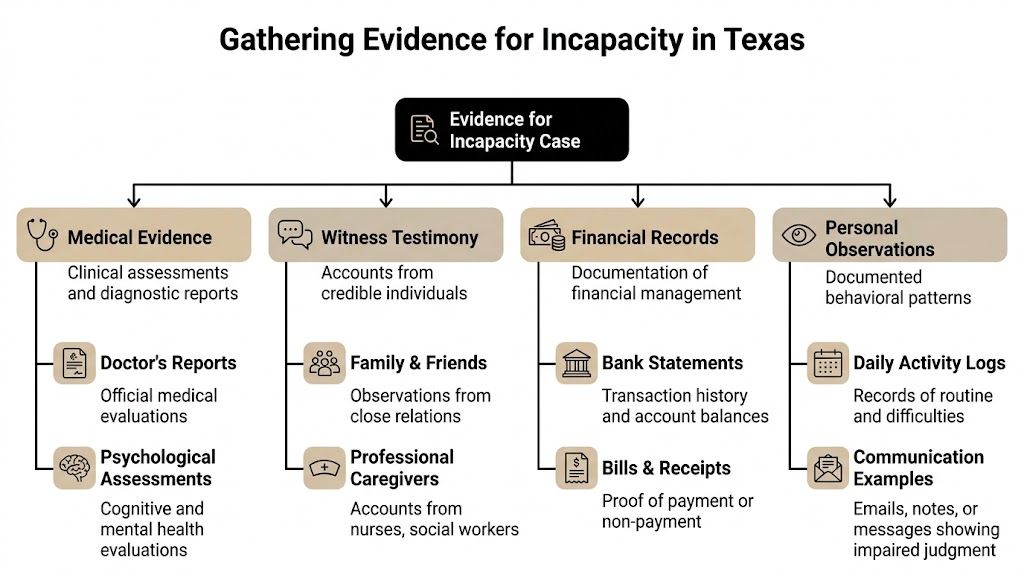
At this stage, many cases either strengthen or weaken. Texas requires a functional assessment and clear and convincing evidence, but there is no single standardized, clinically validated assessment protocol mandated statewide, as discussed in this review of determination of incapacity in Texas. That means families usually need to build a full picture from several types of proof.
Start with medical evidence, but don’t stop there
Most families think the case begins and ends with a doctor’s letter. It doesn’t.
A medical evaluation is important, especially the Physician’s Certificate of Medical Examination in Texas guardianship matters, but the court usually needs context. A form may say a person has dementia, cognitive impairment, or another condition. The judge still needs to understand how that condition affects daily decisions.
Helpful medical records often include:
- Recent clinical notes: Notes that describe memory problems, impaired judgment, confusion, or inability to perform tasks safely.
- Hospital discharge papers: These may show repeated crises, falls, medication problems, or safety concerns.
- Specialist evaluations: Neurology, psychiatry, psychology, or rehabilitation records can help show functional limits.
- Medication history: Changes in prescriptions, missed doses, or misuse may support the larger picture.
Real-life proof often persuades the court
Medical evidence tells the court what may be happening. Daily-life evidence shows what is happening.
Keep a clean, factual log. Dates matter. Specific examples matter. Emotional conclusions matter less.
Instead of writing “Mom is totally incapable,” write things like:
- March 3: She paid the water bill three times and told me strangers were “holding” her mail.
- March 8: Found spoiled food in the pantry and refrigerator. She said she had gone shopping that morning but had not left the house.
- March 12: Missed insulin dose and insisted she had already taken it. Pillbox still full.
That kind of record helps the court understand function, not just diagnosis.
The strongest cases usually combine professional records with simple, organized observations from the people who see the loved one every day.
Financial records can show impaired judgment
A guardianship of the estate case often rises or falls on documentation. If your loved one can no longer manage money, gather records that show a pattern.
Consider collecting:
- Bank statements: Look for unusual withdrawals, repeated overdrafts, or large transfers the person can’t explain.
- Unpaid bills: Utility shutoff notices, rent demands, tax notices, and collection letters may be relevant.
- Scam evidence: Gift card purchases, suspicious checks, or repeated donations to strangers can matter.
- Missed insurance payments: Lapses can show inability to manage essential obligations.
A short summary spreadsheet can help your attorney and the court see trends. Keep copies of originals and avoid writing all over the documents.
Witnesses matter more than many families expect
The court may hear from relatives, but neutral or professional witnesses can be especially useful. A caregiver, social worker, case manager, home health provider, or neighbor with direct observations may help confirm what the family has seen.
Not every witness needs legal jargon. They need credibility, firsthand knowledge, and specific examples.
A useful witness statement usually answers:
- What did you personally observe?
- When did you observe it?
- How often has it happened?
- Why did it create a safety or decision-making concern?
Build a timeline, not a pile
Judges don’t want a shoebox of paper. They want a coherent story.
A practical way to organize the evidence is to sort it into four folders:
| Folder | What goes in it | Why it helps |
|---|---|---|
| Medical | Exam records, diagnoses, medication lists | Shows clinical basis for concerns |
| Daily functioning | Care logs, missed appointments, unsafe incidents | Shows how the condition affects life |
| Financial | Statements, unpaid bills, fraud concerns | Shows inability to manage money |
| Communication | Texts, notes, voicemails, letters showing confusion | Shows impaired understanding or judgment |
If a family in Bexar County tells the court only that Dad “isn’t himself,” the case may feel vague. If they show six months of records, recurring medication errors, unpaid mortgage notices, and witness accounts from a home health aide, the judge can evaluate the issue much more clearly.
Navigating the Guardianship Hearing Process in Texas
Your hearing date is set. Your mother insists she is fine. You have a folder full of records, notes about missed medications, and bank statements that worry you, but no single document that seems to settle the question. That is a common place for families to be in a Texas guardianship case.

The hearing is where those pieces are put together into a legal picture the judge can trust. Texas courts do not rely on a single standardized incapacity test the way a school might rely on one final exam. The judge looks at the whole record. Medical evidence matters, but so do the day-to-day facts showing whether the proposed ward can make and carry out safe decisions.
How the case gets to the courtroom
A guardianship case usually starts with an application asking the court to appoint a guardian of the person, a guardian of the estate, or both. These cases are often heard in probate courts or county courts with probate jurisdiction.
By the time the hearing arrives, the court is not deciding whether a family disagreement exists or whether the proposed ward is difficult, private, or stubborn. The court is deciding whether the applicant has proven incapacity under Texas law by clear and convincing evidence. That is a high standard. It means the judge needs more than suspicion and more than a bare doctor’s note.
Who the judge expects to hear from
Several people may have a role before and during the hearing.
The proposed ward is usually represented by an attorney ad litem. That lawyer’s job is to represent the proposed ward, not the applicant or the family. The court may also involve an investigator or another court-connected professional, depending on the county and the facts.
The applicant must also be ready to show why the proposed guardian is appropriate and why the requested guardianship fits the person’s actual limitations. Courts often look closely at whether a limited guardianship would address the problem without taking away more rights than necessary.
What usually happens before hearing day
Preparation before the hearing often shapes the outcome more than families expect. Deadlines, service, medical paperwork, and witness coordination all matter because the court wants a record that is orderly and usable.
A family should be ready to address:
- Notice and service requirements: The right people must receive formal notice.
- Medical evidence: The court usually expects current medical support in the form required by Texas procedure.
- Guardian qualifications: The proposed guardian may need to provide background information and other required disclosures.
- Scope of relief requested: The application should match the actual problems shown by the evidence.
- Urgency, if any: If there is immediate danger to health, safety, or property, temporary guardianship may be requested, but the court will still expect specific proof of that emergency.
What the hearing is actually like
A guardianship hearing is an evidentiary hearing. The judge listens, compares, and tests the proof. If you want a clearer picture of what an evidentiary hearing in a Texas guardianship case often involves, it helps to know that the court is looking for a reliable connection between a medical condition and real-world inability.
That connection is where many cases are won or lost.
For example, a physician may diagnose dementia, stroke-related impairment, or another condition. The diagnosis alone does not answer every legal question. The judge still wants to know what the condition prevents the person from doing. Can she understand a medication schedule? Can he recognize a scam call? Can he pay basic bills without repeated serious mistakes? Can she explain a choice and appreciate its consequences?
That is why testimony often comes from more than one source. The judge may hear from:
- The applicant
- Doctors or evaluators
- Family members with firsthand knowledge
- Caregivers or service providers
- The attorney ad litem
- The proposed ward, when appropriate
A doctor may explain the condition. A caregiver may explain what happens at 8:00 p.m. when the pills are taken twice. A daughter may explain the pattern of utility shutoff notices and confused phone calls. Together, those details can meet the legal standard in a way no single document can.
Some families find it helpful to see a general overview before attending court. This video can help you picture the process.
What judges often focus on
Judges usually want practical, grounded answers. They often focus on questions like these:
- What decisions can the proposed ward still make safely?
- Which decisions create a real risk of harm?
- Is the problem personal care, financial management, or both?
- Do the examples show a continuing pattern rather than one bad day?
- Would a limited guardianship solve the problem?
- Is there a less restrictive option that would work just as well?
A good hearing presentation works like assembling a mosaic. One tile by itself may not prove much. A completed pattern can be very persuasive.
Calm testimony helps. Specificity helps more.
A statement like “Dad cannot manage money” is too broad. A statement like “Dad paid the same roofing contractor three times in one month, could not explain why, and then forgot the mortgage was overdue” gives the judge something concrete to evaluate.
If the judge grants guardianship
If the court grants guardianship, the appointment is usually not complete the moment the ruling is announced. The guardian may still need to qualify, take an oath, post bond if required, and meet later reporting duties imposed by the court and the Estates Code.
That ongoing supervision is part of why courts examine these cases carefully. Guardianship can protect a vulnerable adult, but it also transfers important rights. The hearing is where the court decides whether the evidence justifies that step.
What Happens When Guardianship Is Disputed
Disputed guardianship cases are often the hardest ones emotionally. One sibling believes Mom is unsafe alone in Austin. Another says she’s just eccentric. The proposed ward may insist nothing is wrong at all.
These disagreements don’t automatically mean someone is acting in bad faith. They often mean family members are seeing different parts of the same situation.
When a needed guardianship is challenged
Sometimes the applicant has a legitimate concern and still faces resistance. A brother may live nearby and see unpaid bills, wandering, and medication mistakes. A sister who visits less often may think he’s exaggerating.
In that situation, the answer isn’t louder accusations. The answer is better proof.
A strong response usually includes:
- A clean timeline of incidents
- Medical records tied to function
- Neutral witnesses
- A focused explanation of why lesser options won’t solve the problem
If the dispute centers on who should serve as guardian, the court may separate that issue from the question of incapacity itself. One person may prove incapacity, while a different person ends up appointed as guardian.
When the proposed ward wants to fight the case
Texas law gives the proposed ward important rights. The attorney ad litem has a key role here. That lawyer should not rubber-stamp the petition.
A contested case may involve arguments such as:
- The person still has capacity.
- The evidence is outdated or incomplete.
- The requested guardianship is broader than necessary.
- A less restrictive alternative would work.
- The applicant has a conflict of interest or poor judgment.
For example, if a daughter files after a minor stroke, but the parent still understands finances, keeps appointments, and has valid estate planning documents in place, the court may question whether guardianship is necessary at all.
How courts sort through family conflict
Judges know that guardianship disputes can hide old family tensions. They also know that some concerns are real.
That’s why the most persuasive position is usually the one tied to facts instead of emotion. If you’re defending the petition, stay grounded in safety, decision-making failures, and documented decline. If you’re opposing it, show what the proposed ward can still do and why less restrictive support is enough.
A disputed case may also require narrower thinking. Instead of asking for total control, a family may need to ask only for authority over a specific area, such as finances.
The court is not looking for the most upset relative. The court is looking for the most reliable evidence.
In contested cases, careful preparation matters even more because every weakness in the record is likely to be challenged.
Exploring Alternatives to a Formal Guardianship
A common turning point looks like this. Your mother is missing bill payments and needs help at medical appointments, but she still knows who her doctors are, recognizes her bank account, and can clearly say what she wants. In that situation, a Texas court may ask a practical question before granting guardianship. Is there a narrower tool that solves the problem without taking away more rights than necessary?
That question matters because guardianship is the most restrictive option on the table. It gives someone else court-approved authority over areas of life the proposed ward can no longer manage. If a less restrictive arrangement will protect the person just as well, the judge may expect the family to use it instead.
This also connects back to proof. Because there is no single medical test that automatically establishes incapacity, families often strengthen or weaken their case by how well they explain alternatives. A bare doctor’s note is rarely enough by itself. The court wants to see whether the person can still make some decisions with support, even if they cannot handle everything alone.
Alternatives families should examine first
Several tools may address the underlying problem without a full guardianship petition:
- Durable Power of Attorney: Lets a chosen agent handle financial tasks such as banking, bills, insurance, and contracts, but only if the person had enough understanding when signing it.
- Medical Power of Attorney: Authorizes a trusted person to make healthcare decisions under the document’s terms.
- Directive to Physicians: Records treatment preferences for serious illness and end-of-life care.
- Supported Decision-Making Agreement: Allows the person to keep legal rights while choosing people who can help gather information, explain options, and communicate decisions.
- Representative payee or direct bill assistance: Offers limited help with income or recurring expenses when the concern is narrower than full decision-making failure.
If your family is also sorting through related household, caregiving, or legal planning concerns, useful family law resources can help you identify where guardi…com/resource/family-law/) can help you identify where guardianship fits within the larger picture.
How to compare these options realistically
A good way to evaluate alternatives is to match the tool to the actual failure in decision-making.
| Tool | Level of Court Involvement | When It's Effective | Key Limitation |
|---|---|---|---|
| Guardianship | High | When the person cannot safely manage major personal or financial decisions and court oversight is needed | Removes rights and creates ongoing reporting duties |
| Durable Power of Attorney | Low | When the person still understands the document and trusts the chosen agent | Usually fails if capacity was already too impaired at signing |
| Medical Power of Attorney | Low | When healthcare choices may need to be delegated | Covers medical decisions only |
| Directive to Physicians | Low | When treatment wishes should be stated in advance | Does not address finances or daily management |
| Supported Decision-Making Agreement | Low | When the person can still participate in choices but needs help understanding information | May not be enough if decisions cannot be made or communicated reliably |
A simple comparison helps. A power of attorney works like handing a trusted person a limited set of keys. Guardianship is closer to asking the court to reassign control over part of the house. Judges want the smallest set of keys that will keep the person safe.
Three questions that often clarify the right path
Start with capacity to sign. Can your loved one still understand what a document does, who will act for them, and what authority they are giving away?
Next, identify the scope of the problem. Some people need help only with money management. Others can no longer handle medical decisions, living arrangements, personal safety, or all three.
Then look at risk in real life. Occasional forgetfulness is different from repeated scams, untreated illness, wandering, or inability to explain basic choices.
For example, a father in Fort Bend County may forget online passwords but still review his monthly expenses, recognize his property, and tell doctors what treatment he wants. That fact pattern may support a durable power of attorney, appointment reminders, and help with banking. A mother who repeatedly sends money to strangers, cannot follow a discussion about surgery, and cannot explain where she lives presents a very different picture. In that situation, alternatives may be too narrow because the problem is broader than paperwork.
Why this matters if you still expect to file for guardianship
Families sometimes assume that discussing alternatives weakens a guardianship case. Often, it does the opposite.
If you can show that you considered supported decision-making, powers of attorney, bill-paying help, or other limited options, and you can explain why each one failed or could not be used, your evidence becomes more credible. It shows the court that the request is based on function, safety, and specific decision-making limits, not family frustration.
That is especially important in Texas incapacity cases, where clear and convincing proof usually comes from the full picture. Medical records matter. A physician’s certificate matters. But so do the practical facts showing why lesser tools cannot protect the person anymore.
Working with Attorneys and Evaluators Effectively
A common problem shows up in the first meeting. A daughter says, "Mom is declining fast," but she cannot yet explain what that means in concrete terms. An attorney or evaluator cannot build a clear and convincing case from that sentence alone. They need the pieces that show how the condition affects real decisions, real safety, and real daily function.
That is why preparation matters so much in a Texas incapacity case. There is no single test score or one-page note that settles the issue for the court. Your job is to help the professionals see the pattern clearly, the same way a puzzle only makes sense once enough pieces are on the table.
What to gather before the first meeting
Bring copies if you can, and organize them in a way that lets someone else follow the story quickly.
- Basic identifying information: Full names, addresses, dates of birth, and family relationships.
- Medical information: Recent evaluations, medication lists, discharge papers, provider names, and any diagnosis that may affect memory, judgment, or communication.
- Financial records: Unpaid bills, unusual withdrawals, wire transfers, repeated donations, account changes, or other signs that the person cannot protect money or property.
- A timeline of events: Dated examples are often more useful than general descriptions. Include missed medications, falls, wandering, scams, confusion at appointments, or repeated inability to explain choices.
- Existing legal documents: Powers of attorney, trusts, wills, advance directives, supported decision-making agreements, or prior court orders.
A short example helps. "Dad has dementia" is a conclusion. "Dad paid the same roofing contractor three times, forgot he had surgery scheduled, and could not explain why his electricity was shut off" is evidence. Courts and evaluators usually need the second kind of information.
If you need guidance with guardianship, probate, or planning documents, one option families use is the Law Office of Bryan Fagan, PLLC, which handles guardianship applications, hearings, probate matters, and estate planning for Texas families. You can also review related information about their Probate and Estate Planning services.
How to work with professionals without hurting the case
Start with facts. Give examples you personally observed, identify who else saw the same problems, and separate what you know from what you suspect.
That distinction matters.
Evaluators, court investigators, and attorneys are trying to answer a legal question, not just a family one. If a relative overstates the problem, hides good days, or coaches the proposed ward on what to say, it can damage credibility. A case built on pressure is much weaker than a case built on records, dates, and consistent examples from multiple sources.
It also helps to ask focused questions. Ask the attorney what legal gaps still need proof. Ask the evaluator what records would make the picture clearer. Ask whether the evidence points to a limited guardianship, a full guardianship, or a less restrictive option. Those questions help families use their energy where it counts.
A good working approach is simple. Be candid. Be organized. Let the professionals test the facts and form their own opinions. That gives the court what it needs most in these cases: a clear, believable record showing why help is needed and why lesser measures may no longer be enough.
Common Questions About Texas Incapacity Hearings
Does the proposed ward have rights during the case
Yes. The proposed ward still has rights. In many cases, that includes the right to notice, the right to legal representation through an attorney ad litem, and the right to be heard by the court.
Is a doctor’s note enough by itself
Usually, no. Courts often need a broader picture of how the condition affects daily life, decision-making, safety, and finances.
What happens right after a judge finds incapacity
If the court grants guardianship, the proposed guardian may need to qualify before acting. That can involve an oath, bond if required, and follow-up filings under the Texas Estates Code.
Can guardianship be limited instead of total
Yes. In some cases, the court may tailor the guardianship to only the areas where help is needed, such as finances or medical decisions.
What if the situation is urgent
A temporary or emergency guardianship may be available in some situations involving immediate risk. Courts still expect prompt, specific evidence showing why urgent relief is necessary.
Can guardianship end later
It can. If circumstances change, a court can review whether the guardianship should be modified or terminated. Guardians also have ongoing compliance duties, and failure to follow them can create separate problems.
Is this process expensive
Costs vary by county, complexity, and whether the case is contested. A disputed case usually requires more time, more evidence, and more court involvement than an uncontested matter.
If you’re facing questions about a parent, adult child, or other loved one, legal advice early can prevent costly mistakes later. The Law Office of Bryan Fagan, PLLC helps Texas families evaluate whether guardianship is necessary, prepare evidence, respond to disputes, and pursue the least restrictive option that protects a vulnerable person’s dignity and safety. Schedule a free consultation to get guidance specific to your family’s situation.