Skip to content
When you entrust a guardian to look after a vulnerable loved one, you are placing an enormous amount of trust in their hands. You expect them to act with integrity and put your family member’s needs first. But what happens when that trust is broken? In Texas, guardian misconduct is a serious legal issue that arises when a court-appointed guardian violates their duties, often leading to financial abuse, neglect, or emotional harm.
This isn't just about a guardian making a poor decision; it’s a breach of their fundamental legal obligations to the person they swore to protect. We understand how devastating this realization can be, and our goal is to provide clear, practical steps for Texas families facing this challenge.
Recognizing Guardian Misconduct in Texas

The entire concept of guardianship rests on a powerful legal principle: fiduciary duty. This is the highest standard of care under Texas law. In simple terms, it means the guardian must act exclusively in the best interest of the "ward"—the person under their care. Every decision must be prudent, loyal, and completely transparent.
When a guardian fails to uphold this duty, misconduct has occurred. This isn't about small disagreements over daily schedules. We’re talking about serious violations that jeopardize the ward's health, safety, or financial stability. These responsibilities are clearly laid out in Title 3, Subtitle G of the Texas Estates Code, along with the penalties for failing to meet them.
What Does Misconduct Actually Look Like?
From the outside, it can be tough to distinguish between an honest mistake and a deliberate pattern of abuse. Family members often get a gut feeling that something is wrong long before they have concrete proof. Recognizing the signs is the first step toward protecting your loved one.
Here are some real-world examples of what guardian misconduct can look like in Texas:
- Financial Exploitation: This is unfortunately one of the most common forms of guardian abuse. It includes using the ward's money for the guardian's personal benefit—paying their own bills, taking vacations, or making "loans" to themselves that are never paid back. A guardian in Harris County might use the ward’s pension check to cover their own car payment, for example.
- Neglect of Personal Needs: A guardian of the person is directly responsible for the ward’s physical well-being. Neglect can be as blatant as failing to provide enough food and clean clothes or as subtle as consistently missing doctor's appointments or failing to fill vital prescriptions.
- Self-Dealing: This occurs when a guardian leverages their position for personal profit. A hypothetical scenario is a guardian selling the ward’s home to a friend for far less than its market value or renting out the ward's property to themselves at a steep discount, both of which are serious conflicts of interest.
- Isolation and Alienation: Some guardians intentionally cut the ward off from friends and family. This is a major red flag, as it can be a tactic to hide other forms of misconduct or to exert total control over the ward’s life and assets.
A guardian's job is to protect, not to profit. Any action that puts the guardian's interests ahead of the ward's is a fundamental breach of their legal and ethical duties.
Knowing what to look for can help you spot these issues before they cause irreparable harm.
Red Flags of Potential Guardian Misconduct
This table highlights common warning signs that should prompt you to take a closer look.
| Area of Concern | Potential Red Flags |
|---|---|
| Financial Matters | – Sudden, unexplained drops in bank account balances. – Unpaid bills or eviction notices when funds should be available. – Guardian is secretive about finances or refuses to show records. – New, unauthorized names added to the ward's bank accounts. – The guardian's lifestyle suddenly improves without a known reason. |
| Personal Care & Well-being | – Poor hygiene, signs of malnutrition, or unsanitary living conditions. – Untreated medical issues, bedsores, or missed appointments. – The ward seems fearful, anxious, or depressed, especially around the guardian. – The ward is not dressed appropriately for the weather. |
| Communication & Access | – The guardian prevents or limits calls and visits from family and friends. – The guardian makes excuses for why the ward cannot come to the phone. – The ward is suddenly moved to a new location without explanation. – The guardian speaks for the ward and doesn't let them answer questions. |
| Property & Assets | – The ward’s personal belongings, jewelry, or art go missing. – The guardian sells the ward's property without court permission. – Changes are made to the ward's will, trust, or other estate documents. – The guardian uses the ward’s car or home for their own benefit. |
If you notice any of these signs, it doesn’t automatically mean misconduct is happening, but it’s a clear signal that you need to investigate further.
A Hypothetical Scenario
Let's put this into perspective with a hypothetical example. Imagine Maria is the guardian of the estate for her father, David, who lives in Dallas. Her role is to manage his finances. David’s other children start to notice that his savings account has dwindled by a large amount over the past year.
When they ask Maria for an accounting, she becomes evasive and defensive. A little digging reveals she used $20,000 of David’s money to pay off her own credit card debt. This is a textbook case of financial misconduct and a breach of her fiduciary duty. Under Texas law, David’s other children have every right to file a petition in the Dallas County probate court to have her removed and held accountable.
Facing a situation like this is heartbreaking and stressful. At The Law Office of Bryan Fagan, we understand the sensitivity of these family disputes. If you suspect a guardian is not fulfilling their duties, we can help you understand the next steps and fight to protect your loved one.
The Hidden Red Flag: Failure to File Court Reports
When families worry that a guardianship has gone wrong, their first instinct is often to look for obvious signs—missing money, a loved one looking neglected, or sudden changes in behavior. But one of the most telling red flags is far more subtle: the guardian’s failure to file required court reports.
This isn't just about missing a deadline. In Texas, a guardian's duties are strictly defined by the court. When they fail to submit these mandatory reports, it's a serious breach of their legal responsibilities. It's like a pilot going silent with air traffic control; you have to wonder what they're trying to hide.
Why These Reports Are So Important
Think of these court-mandated reports as the guardianship's built-in safety system. Each one is designed to create a transparent, official record of the guardian's actions, giving the court—and you—a clear view of what’s happening. The three most critical reports are:
- The Initial Inventory, Appraisement, and Claim: Filed at the beginning of the guardianship, this is a complete list of every asset the ward owns. Without this baseline inventory, it's almost impossible to prove later if a car, a bank account, or family heirlooms have vanished.
- The Annual Account: This is a detailed, yearly financial statement. It must account for every dollar that came in and every dollar that went out of the ward’s estate, complete with bank statements and receipts. A missing Annual Account is a massive warning sign for guardian misconduct in Texas, because it’s the perfect cover for financial abuse.
- The Annual Report on the Well-being of the Ward: This report focuses on the person. It details their physical and mental health, where they're living, and any significant changes. A vague or unfiled report can easily mask signs of isolation, poor care, or neglect.
These aren't just bureaucratic hoops to jump through. They are legal requirements under Title 3, Subtitle G of the Texas Estates Code. A guardian’s failure to file is a direct violation of their duties and gives you solid legal ground to challenge them.
Connecting the Dots: From Missing Paperwork to Misconduct
Let's imagine a scenario that could happen in places like the Tarrant County Probate Courts. A guardian is appointed for an elderly man with dementia. The first Annual Account is never filed. The family feels uneasy, but without the report, they have no concrete proof something is wrong.
A year goes by, and now the second Annual Account is also missing. The family finally decides to hire an attorney, who files a motion to force the guardian to produce the reports. When the records are finally turned over, they reveal a pattern of theft: the guardian has been using the ward’s debit card for personal shopping sprees. The reporting failure wasn't just a symptom; it was the strategy that allowed the abuse to happen.
A missing or incomplete report is never just a minor slip-up. It's a fundamental breakdown of the guardian's most important job: their fiduciary duty. It blocks the court from doing its oversight job and robs your family of the peace of mind that comes from knowing your loved one is safe. If you’re seeing this pattern, you have every right to demand answers. You can learn more about how to report guardianship abuse in our detailed guide.
Don't dismiss reporting failures as just late paperwork. They are often the first warning that a guardian is failing in their duties or actively causing harm. Recognizing this gives you the leverage you need to take action. If you suspect a guardian isn't meeting their reporting obligations, it's time to get legal advice. The Law Office of Bryan Fagan offers a free consultation to help you understand your options and protect your loved one.
Building a Case to Prove Guardian Misconduct
When you suspect a guardian is failing your loved one, that gut feeling is often just the beginning. The real challenge is turning those suspicions into a solid case. In Texas probate courts, whether in Bexar County or Travis County, a judge needs more than just your word—they need hard proof.
This is where the real work begins. You have to systematically gather the facts and documents that paint a clear picture of the guardian's misconduct. It might feel like a daunting task, but building this foundation is the only way to hold a bad guardian accountable under the Texas Estates Code and protect your family member.
Start with a Detailed Timeline
The first practical step is to start a log. Grab a notebook or open a new document on your computer and start writing down everything. Don’t dismiss anything as too small or insignificant; it all matters.
For every incident, note the date, the time, and exactly what happened. This detailed record helps you and your attorney spot the troubling patterns of neglect or exploitation that are easy to miss when you only look at isolated events.
What should you be logging?
- Missed Appointments: Every single time a doctor’s visit or therapy session gets canceled or missed without a solid explanation.
- Unanswered Calls: Document the dates and times you tried to reach your loved one, only to be blocked or given flimsy excuses by the guardian.
- Concerning Interactions: Write down conversations where the guardian was hostile, evasive, or made comments that just didn’t sit right.
- Financial Red Flags: Note any strange transactions you catch wind of, like big, unexplained cash withdrawals or bills suddenly going unpaid.
This timeline becomes the backbone of your case. It organizes the evidence and makes the story of misconduct undeniable.
Preserve Every Piece of Communication
In today's world, crucial evidence is often digital. That’s why you should not delete a single text message or email from the guardian. These communications can be goldmines of evidence.
Take screenshots of your text conversations—make sure the date and time stamp are clearly visible. Save every email to a dedicated, secure folder. We even recommend printing them out for a physical backup. You would be surprised how often a guardian might directly admit to wrongdoing in a moment of frustration or carelessness.
We often see cases where a single text message—like a guardian admitting "I had to borrow from Mom's account to pay my rent"—becomes the key piece of evidence that cracks a case of financial exploitation wide open.
Document the Ward’s Condition and Environment
Evidence isn’t just about paper trails and digital messages. The physical state of your loved one and their home can speak volumes, providing powerful and often indisputable proof of neglect.
If you get a chance to visit, use your phone to discreetly take photos or videos of anything that seems off.
Look for things like:
- Unsafe or unsanitary living conditions, such as filth, clutter, or an empty refrigerator.
- Signs of poor personal hygiene, like unwashed clothes, dirty bedding, or even bedsores.
- Any unexplained injuries, like bruises or cuts, that the guardian can't properly account for.
- Missing personal belongings, especially items that have significant financial or sentimental value.
This kind of visual evidence is incredibly compelling in a courtroom. It shows a judge the reality of the situation in a way that words alone simply can't. Many of a guardian's duties mirror those of an executor, and understanding what's required can help you spot failures. An executor duties checklist, for instance, can highlight the types of responsibilities that, if mishandled, signal misconduct.
The graphic below shows the core reports a guardian is legally required to file. These documents are often the first place to find official, documented proof of their failures.
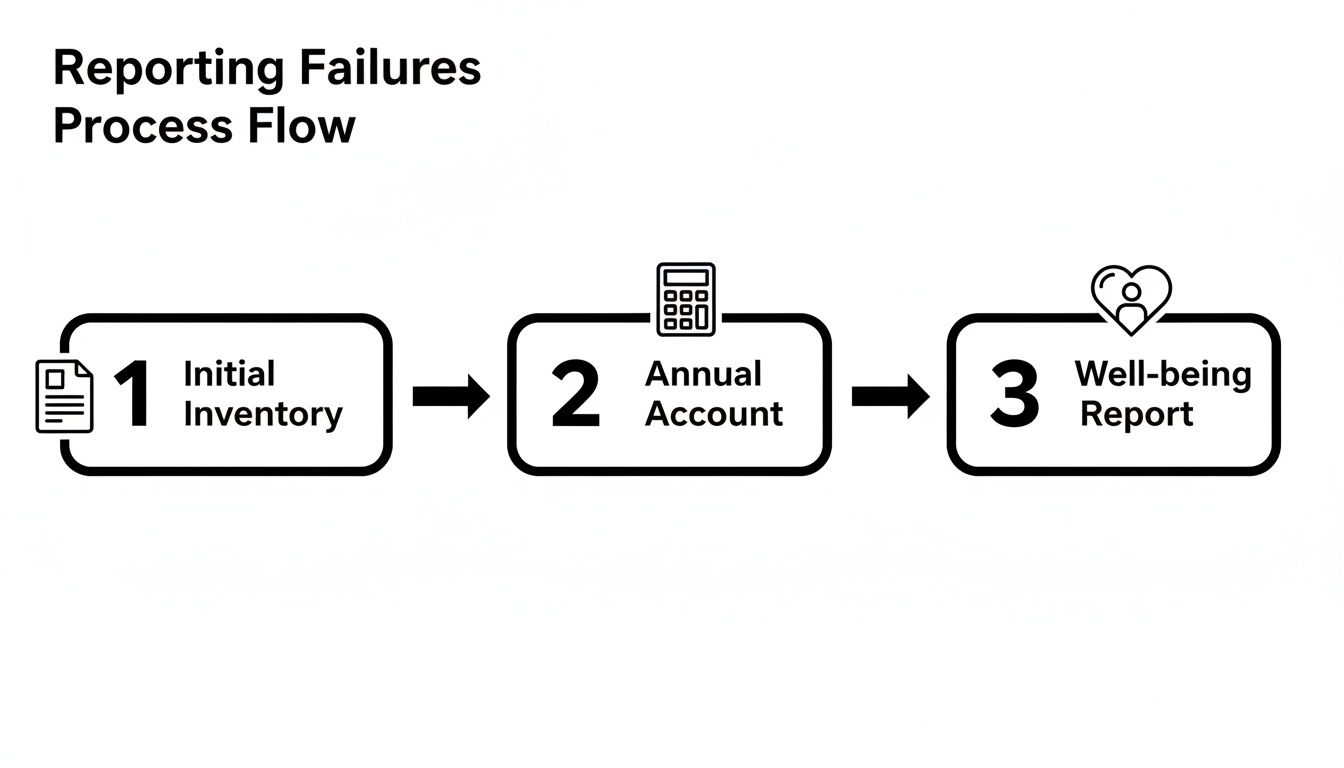
As you can see, a guardian's failure to file these reports correctly—or at all—creates a clear paper trail for the court to follow, starting from day one.
Putting a case together takes real effort, but you don't have to do it by yourself. Once you've started collecting this evidence, your next step should be to talk with an experienced guardianship attorney. At The Law Office of Bryan Fagan, we offer a free consultation where we can look over what you've found and help you figure out what to do next.
How to Challenge a Guardian in a Texas Court
Taking legal action against a court-appointed guardian is a daunting prospect. The idea of going to court, particularly when it involves a family member, is not just intimidating but also emotionally draining. But when you have real evidence of guardian misconduct in Texas, the law gives you a direct path to protect your loved one. You don't have to face this difficult process by yourself.
Challenging a guardian means formally asking a judge to step in. This is much more than a simple disagreement; it's a legal process where you present the evidence you’ve gathered to a Texas probate court—whether in Harris County, Dallas County, or elsewhere—and demand a change. With an experienced guardianship attorney on your side, you can take back control and ensure the ward is protected.
Hiring an Attorney and Filing a Petition
Your first and most important move is to partner with a guardianship lawyer. They will meticulously review your evidence—your timeline of events, communication records, and other documentation—to give you a straightforward assessment of your case's strength. An attorney does more than just represent you; they translate your valid concerns into the specific legal arguments the court needs to hear.
Once you have legal counsel, the process begins by filing a formal petition with the probate court overseeing the guardianship. This document officially notifies the court, the guardian, and any other interested parties that you are challenging the guardian's authority and lays out exactly why.
This petition is based on the Texas Estates Code, which grants any "interested person" the legal standing to ask for a guardian's removal if they fail to perform their duties.
Key Legal Actions You Can Take
Depending on the nature of the misconduct, your attorney will likely recommend one or several legal actions. Think of these as the tools the law provides to demand accountability and protect the person under guardianship.
- Motion to Remove the Guardian: This is the most direct approach. You are formally asking the judge to strip the guardian of their legal power because of clear proof of misconduct, like neglect, self-dealing, or a failure to file required court reports.
- Petition to Compel an Accounting: If a guardian has been secretive about the finances or has missed filing their Annual Account, this motion forces them to produce a detailed financial record for the court to review. This is often the first step in uncovering financial abuse.
- Surcharge Action: This is about financial justice. If you can prove the guardian mismanaged, wasted, or outright stole assets, a surcharge action aims to hold them personally liable to repay the estate for every dollar they lost or took.
These actions can often be filed at the same time, creating a multi-pronged legal strategy that shows the court you are serious. You can read more about removing a guardian in Texas in our in-depth guide.
What to Expect in Court: A Hypothetical Scenario
Let's walk through a common and heartbreaking situation. Imagine a man named John in San Antonio who is growing concerned about his father in Houston, who is under a guardianship. John’s sister, Sarah, is the guardian of their father's estate, giving her sole control over his pension and retirement savings. John starts getting calls from his father's nursing home about late payments, which makes no sense because their father has more than enough money to cover his care.
John’s first move is to hire a guardianship attorney. The attorney immediately files a petition in the Harris County Probate Court, which includes a motion to remove Sarah as guardian and a motion to compel an accounting.
This kicks off the legal process of "discovery." John’s attorney formally requests all of Sarah's financial records for the guardianship, including every bank statement and receipt. Sarah is legally obligated to hand them over.
Sure enough, the bank statements tell a story. They reveal that Sarah has been using her father’s debit card for her own personal expenses—groceries, car repairs, and even a family vacation. This isn't just a mistake; it's concrete proof of financial exploitation and a breach of fiduciary duty.
The case goes before the judge. John’s attorney presents the bank statements and the evidence of Sarah’s failure to pay the nursing home as undeniable proof of her misconduct. Sarah gets a chance to explain her actions, but the numbers don't lie.
The judge signs an order immediately removing Sarah as guardian. The court also opens a surcharge action against her, forcing her to repay the $15,000 she misappropriated from her father's accounts. A new, independent guardian is appointed to take over and protect the father's estate from that day forward.
This scenario shows that while the process is detailed, it is built to deliver justice. The courts have the power to stop misconduct in its tracks and make things right.
We know that facing this journey is a huge emotional and financial challenge. At The Law Office of Bryan Fagan, we guide Texas families through these situations with clarity and compassion. If you are worried about a loved one, schedule a free consultation with us today. We can help you understand your options and take the right steps to protect them.
Taking Emergency Action to Protect a Loved One

When you realize a guardian’s actions are causing immediate harm to your loved one, it feels like the world is crashing down. In these situations, you simply can't afford to wait for a full, lengthy hearing to remove the guardian. You have to act now.
The good news is, Texas law doesn't leave you powerless. The Texas Estates Code gives probate courts the authority to step in with immediate, emergency relief to stop the harm while you build your case for a permanent solution. This isn't just about asking nicely; it's about using the force of law to put a stop to the misconduct.
Seeking a Temporary Restraining Order (TRO)
One of the fastest legal tools at our disposal is a Temporary Restraining Order (TRO). A TRO is a powerful court order that a judge can issue very quickly, sometimes even the same day the request is filed. Its entire purpose is to freeze the situation and prevent any further damage.
A judge can, for example, issue a TRO that:
- Freezes the ward’s bank accounts, preventing the guardian from making another withdrawal.
- Blocks the sale of property, like a family home or a car that the guardian is trying to sell without court approval.
- Prohibits the guardian from moving the ward to a new facility or city against their will or best interests.
A TRO is a temporary fix, usually lasting about 14 days, but it’s a crucial first step. It buys you precious time to halt the guardian misconduct in Texas before the damage becomes irreversible.
Suspending the Guardian and Appointing a Successor
When the evidence of immediate danger is overwhelming, the Texas Estates Code allows a judge to take an even more aggressive step: temporarily suspending the guardian’s powers. Under Section 1203.001, the court can issue an order that instantly strips the guardian of their authority if there's clear and convincing evidence they have misapplied, embezzled, or are about to mismanage the ward’s property.
This is a critical move. You're not just limiting the guardian's actions—you're asking the court to sideline them completely while the allegations are fully investigated. At the same time, the court can appoint a temporary successor guardian to take over.
This temporary guardian, often a qualified professional or another trusted family member, can immediately step in to manage finances, pay bills, and ensure your loved one’s personal and medical needs are met. It provides instant stability and safety when it’s needed most.
It's important to know that judges in counties like Bexar or Travis don’t grant these emergency requests lightly. You must come to court with compelling, well-organized evidence that proves a clear and present danger to the ward. This is where all the documentation you’ve gathered becomes absolutely vital. You can get more details by reading our guide on the requirements for an emergency guardianship hearing in Texas.
Navigating this high-stakes process requires speed, precision, and a deep understanding of probate law. Because every second counts, working with an experienced guardianship attorney isn't just helpful—it’s essential to make sure your request is filed correctly and presented persuasively to the judge.
Frequently Asked Questions About Guardian Misconduct
When you suspect a guardian is failing your loved one, your mind is probably racing with urgent, and often emotional, questions. The fear and uncertainty can be overwhelming. Below, we’ve answered some of the most common questions we hear from families facing potential guardian misconduct in Texas, providing clear, straightforward answers to help you move forward.
What’s the difference between removing a guardian and a surcharge action?
This is a common point of confusion, but the distinction is crucial. Think of it this way: one action stops the immediate threat, while the other repairs the financial damage.
- Removing a guardian is exactly what it sounds like. You file a motion asking the court to legally strip them of their authority over the ward. To succeed, you must prove they’ve been negligent, abusive, or simply failed to follow court orders. The goal here is to protect the ward from any more harm.
- A surcharge action is purely financial. It’s a legal claim filed to recover assets the guardian stole, wasted, or mismanaged. The court can order the guardian to repay the ward's estate out of their own pocket.
For instance, if a guardian in Montgomery County took the ward’s money for a personal vacation, you would file to remove them for their misconduct. At the same time, you’d pursue a surcharge action to force them to pay back every dollar they took. Tackling both at once is often the most powerful strategy.
Can I report a bad guardian without a lawyer?
While anyone can—and should—report suspected abuse or neglect to Adult Protective Services (APS), taking legal action in a Texas probate court is a different matter. Trying to remove a court-appointed guardian is a formal legal process governed by the strict procedures of the Texas Estates Code.
Technically, you can file a motion yourself. But navigating the court’s rules, evidence requirements, and filing deadlines without a legal background is incredibly challenging. The guardian has a right to defend themselves, and they will likely have their own attorney.
An experienced guardianship attorney is your best ally for ensuring your case is filed correctly, the evidence is presented persuasively, and your loved one's rights are protected. A free consultation can help you understand your options before making any decisions.
How much does it cost to fight guardian misconduct?
The cost of challenging a guardian varies widely. The final expense depends on how complex the case is, how much evidence is needed, and whether the guardian decides to fight back. Your main expenses will be attorney's fees, court filing fees, and potentially fees for expert witnesses.
However, money should never be the reason a vulnerable person is left in a dangerous situation. The Texas Estates Code, specifically Section 1155.054, offers a powerful solution. This law allows the court to order that the concerned person's attorney's fees be paid directly from the ward's estate, provided the lawsuit was filed in good faith to protect the ward. This provision ensures that a lack of personal funds doesn't stop a necessary fight.
What happens after a guardian is removed for misconduct?
Once a judge orders the guardian removed, the court’s top priority is ensuring the ward has continuous, uninterrupted protection. The first step is the appointment of a successor guardian. This could be another qualified family member, a trusted friend, or a neutral professional guardian, depending on what the court feels is in the ward's best interest.
The story isn't over for the removed guardian, either. They are legally required to submit a final accounting to the court, detailing every financial transaction right up to the moment they were removed. Any other legal actions, like a surcharge to recover stolen money, will continue until the ward's estate has been made whole. The court stays involved until a new, responsible guardian is securely in place and the ward is safe.
At The Law Office of Bryan Fagan, PLLC, we know that confronting guardian misconduct is one of the toughest challenges a family can face. If you are worried about a loved one in a Texas guardianship, you don’t have to figure it all out on your own. Schedule a free, confidential consultation with our experienced team to get personalized guidance and take the first step toward protecting what matters most. Visit us at https://texasguardianshiplawyer.net to learn more.