Skip to content
When a loved one suddenly can't make their own decisions due to a medical crisis, a serious accident, or financial exploitation, the situation can feel terrifying and helpless. You are in a crisis, and time is not on your side. We understand the fear and urgency you're facing.
This is precisely where an emergency guardianship hearing in Texas becomes a legal lifeline. It is an urgent court process designed for rapid intervention to protect someone from immediate and serious harm to their health, safety, or finances. At The Law Office of Bryan Fagan, we are committed to guiding Texas families through this difficult process with clarity and care.

Unlike a standard guardianship, which can take weeks or months, an emergency action is all about speed. It allows a concerned family member to go before a judge and present clear evidence that a person—the "proposed ward"—is facing an imminent threat.
Think of it as a legal first-aid kit. It’s not the long-term solution, but it’s what you need to stop the bleeding right now and provide immediate protection.
The Legal Standard: Proving "Imminent Danger"
To convince a judge to grant a temporary guardianship, you must prove there is "probable cause" to believe the person is incapacitated and in imminent danger. This is a lower standard of proof than what’s required for a permanent guardianship, but it’s far from automatic. You need solid, credible evidence.
Under the Texas Estates Code, "imminent danger" isn't a vague feeling of worry. It means a specific, immediate threat is happening right now. The law requires you to show a direct link between the person's inability to make decisions and the danger they face.
A judge, for instance in a Harris County Probate Court, will want to see clear proof of situations like these:
- A person is unconscious and unable to give consent for urgent medical treatment.
- An individual's physical safety is at risk due to severe self-neglect or an unsafe living situation.
- Their financial assets are actively being stolen or squandered due to their vulnerability.
This entire process is laid out in the Texas Estates Code, Title 3, Subtitle G. The goal isn't to make a final, permanent decision. It’s about putting a protective shield in place while everyone figures out the next steps. We know that trying to read legal codes during a family crisis is overwhelming. To help, you can learn more about what to expect at a Texas guardianship hearing in our detailed guide.
What Happens at the Hearing?
The hearing itself is fast-tracked. A judge will review the application and the evidence you provide. This typically includes a signed certificate from a doctor, sworn statements from witnesses, or financial records showing exploitation.
If your evidence is compelling, the court can appoint a temporary guardian with very specific, limited powers designed only to address the immediate emergency. This appointment is usually limited to 60 days.
This crucial 60-day window gives your family the breathing room to stabilize the situation and determine if a permanent guardianship is needed.
Emergency Guardianship vs. Permanent Guardianship
This table highlights the key differences between an immediate emergency action and the more comprehensive permanent guardianship process.
| Feature | Emergency Guardianship | Permanent Guardianship |
|---|---|---|
| Purpose | Address an immediate, urgent crisis. | Provide long-term care and decision-making. |
| Timeline | Extremely fast, often within days. | Slower, can take weeks or months. |
| Duration | Temporary, typically limited to 60 days. | Indefinite, lasts as long as the ward is incapacitated. |
| Legal Standard | "Probable cause" of incapacity and "imminent danger." | "Clear and convincing evidence" of incapacity. |
| Guardian's Powers | Limited to addressing the specific emergency. | Broad powers over personal and/or financial affairs. |
| Notice Requirements | Can be waived or shortened due to urgency. | Strict notice requirements must be met for all interested parties. |
Ultimately, an emergency guardianship is a critical tool for intervention, while a permanent guardianship is a long-term solution for ongoing care.
Recognizing When Urgent Action Is Legally Justified
When a loved one is in crisis, your first instinct is to protect them. But how do you know when the situation has escalated from a serious family problem to a legal emergency? It’s one thing to worry, but it’s another thing entirely to meet the court’s strict standard of “imminent danger.”
Let’s cut through the legalese. The Texas Estates Code gives judges the power to act swiftly when an incapacitated person faces immediate and substantial harm, either physically or financially. This isn't for tough situations or family disagreements. It’s for true emergencies where waiting for the normal guardianship process would lead to a preventable disaster.
Medical Crises That Demand Immediate Decisions
Sudden, severe health problems are one of the most common triggers for an emergency guardianship. In these moments, every second counts, and the inability to get consent for medical care can have devastating consequences.
Hypothetical Scenario: Your elderly mother has a massive stroke in her Harris County home and is rushed to the hospital. She’s unconscious and the doctors say she needs emergency surgery to survive, but she has no Medical Power of Attorney. The hospital’s hands are legally tied.
This is a textbook example of "imminent danger." The harm—the lack of critical medical care—is happening at that very moment. An emergency guardianship empowers a judge to quickly appoint someone who can legally consent to the surgery, protecting your mother's life.
Another all-too-common scenario is when a caregiver is suddenly taken out of the picture. Imagine a husband who provides round-the-clock care for his wife with advanced Alzheimer's. If he suffers a heart attack and is hospitalized, who ensures his wife gets her medication, stays safe, and is properly cared for? An emergency guardianship hearing in Texas can appoint another family member to step in immediately, preventing a life-threatening gap in care.
When Financial Exploitation Becomes an Emergency
Financial threats can be just as urgent and destructive as any medical crisis. While a permanent guardianship is often the right tool for long-term financial protection, an emergency order is absolutely critical when someone is actively stealing from your loved one.
These are the kinds of financial fires that justify an emergency hearing:
- Rapidly Draining Accounts: You learn that a new "friend" has been driving your vulnerable aunt in Dallas to the bank for large, daily cash withdrawals. Her life savings are disappearing before your eyes.
- Fraudulent Property Sales: A predatory cousin is pressuring your father in Bexar County, who has dementia, to sign over the deed to his house. You discover the sale is set to close in just a few days.
- Sudden Isolation and Control: A new caregiver has completely cut off your grandfather from the family. At the same time, you see suspicious, high-dollar online purchases appearing on his credit card statements.
In every one of these cases, the financial harm isn’t just a future risk—it’s happening now. The Texas Estates Code provides the court with the authority to issue emergency orders to freeze bank accounts, block a fraudulent property sale, and authorize an investigation into the abuse. The immediate goal is to stop the bleeding while you and your attorney prepare a more permanent solution, like a full Guardianship or looking into other Probate court protections.
If you recognize your loved one’s situation in these examples, the law provides a pathway for you to take decisive action. Understanding that you can seek rapid intervention is the first step to protecting your family member from harm. For personalized advice on your specific circumstances, schedule a free consultation with our team.
The Step-by-Step Process for Filing an Emergency Guardianship
When a loved one is in immediate danger, the last thing you want to do is navigate a confusing court system. We get it. You need a clear, straightforward roadmap, not a pile of legal documents filled with jargon. This guide breaks down the filing process for an emergency guardianship in Texas into practical steps you can follow during what is an incredibly stressful time.
The entire process is built for speed, but that doesn't mean you can cut corners. Every single step is critical. If you miss a document or a deadline, you risk delays that your loved one simply can't afford. The goal here is to give the judge a clear, urgent, and well-supported reason to intervene immediately.
Step 1: Gather Your Essential Evidence
Before you even think about heading to the courthouse, you have to build your case with compelling evidence. Your word, no matter how sincere, isn't enough. A judge needs to see proof that meets the legal standard of “probable cause.”
The cornerstone of your evidence is the Physician's Certificate of Medical Examination (CME). This isn't just any doctor's note; it's a specific court form that must be completed by a physician. It details the proposed ward’s condition and confirms they are incapacitated. Crucially, it must have been completed within the last 120 days.
Beyond the CME, you'll want to pull together as much supporting documentation as you can:
- Affidavits: These are sworn written statements from people who have seen the danger firsthand. Think family members, neighbors, or even other caregivers who can attest to what's happening.
- Financial Records: If financial exploitation is the issue, gather bank statements, unusual credit card bills, or property records that show money is being mismanaged or disappearing.
- Medical Records: Hospital admission forms, recent diagnoses, or other reports can help confirm a medical crisis is unfolding.
Step 2: Draft and File the Application
Once your evidence is organized, the next move is to file an Application for Appointment of Temporary Guardian. This is the formal legal document that kicks off the process and asks the court to step in. It must clearly explain why an emergency guardianship is necessary and list the specific powers you need to handle the crisis.
You'll file this application in the probate court of the county where the proposed ward lives—for example, the Harris County Probate Court or the Bexar County Probate Court. Every detail matters. A simple mistake on the application could get it rejected, forcing you to start all over. This is one of the main reasons having an experienced attorney is so vital; they make sure it’s done right the first time.
Step 3: The Judge's Initial Review and Hearing Date
After the application is filed, a judge will review it and the evidence you submitted. If they agree there’s probable cause to believe imminent danger exists, they will do two things right away:
- Appoint an Attorney Ad Litem: The court appoints an independent attorney whose only job is to represent the proposed ward's best interests. This attorney will meet with your loved one, review the facts, and report their own findings back to the judge.
- Set a Hearing Date: The court will schedule an emergency guardianship hearing in Texas, often within just a few days. The speed is a defining feature of the Texas emergency guardianship process.
The infographic below highlights some of the crisis situations that demand this kind of fast action.
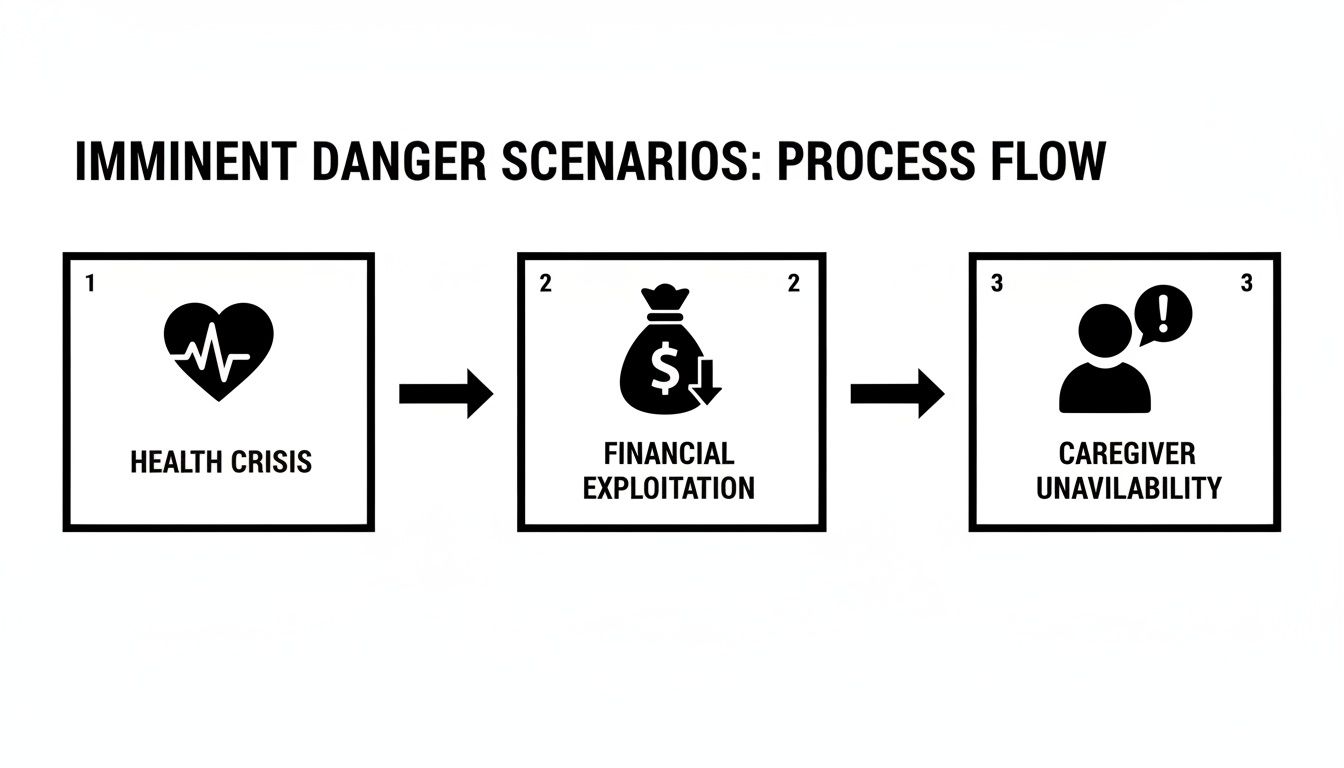
These are exactly the kinds of crises where a swift legal response is the only way to prevent irreversible harm.
Step 4: Serving Notice to All Parties
Even in a crisis, Texas law is designed to protect everyone’s rights. This means you have to make sure the proposed ward and their close relatives are legally “served” with a copy of the application and a notice of the hearing date. This gives everyone a fair chance to appear in court and have their voice heard.
While a judge can issue an order without prior notice in the most extreme cases, a full hearing must always follow very quickly.
This balance between speed and due process is a lifeline. For instance, if a parent in Houston has a sudden stroke and can't consent to life-saving surgery, an emergency order can often be granted in 24 to 48 hours. This allows for immediate action while ensuring a full hearing with legal representation for the ward follows right behind.
While the emergency process is streamlined, it shares many foundational steps with a standard guardianship. To get a better sense of the overall procedure, you can read our comprehensive guide on how to file for guardianship.
The Powers and Limits of a Temporary Guardian
Once a Texas court grants an emergency guardianship, a temporary guardian is appointed. It's a role with significant legal authority, but it’s critical for families to understand this is not a blank check. The position is one of immense trust, with powers carefully defined by the court and serious legal responsibilities attached.
The authority of a temporary guardian is never one-size-fits-all. Instead, the judge will tailor the guardian’s powers specifically to the crisis at hand. The court order itself will spell out exactly what the guardian can and cannot do.
For example, if the emergency is a sudden medical event, the order might give the guardian the power to:
- Consent to a specific, necessary medical procedure or course of treatment.
- Make decisions about hospital care and post-operative rehabilitation.
- Access medical records to coordinate care with doctors and specialists.
If the emergency involves financial exploitation, the court could authorize the guardian to:
- Secure the proposed ward’s bank accounts to stop unauthorized withdrawals.
- Pay urgent bills like rent, utilities, or medical copays.
- Gather financial records to start investigating potential fraud.
Understanding Your Fiduciary Duty
No matter what specific powers are granted, every temporary guardian has a fiduciary duty to the person they are protecting. This is a legal term, but it has a very simple, human meaning: you must always act in the ward's best interest, with complete loyalty and good faith. You absolutely cannot use your position for personal gain or make decisions that benefit anyone other than the person you were appointed to protect.
This duty demands total transparency and accountability to the court. A judge in Harris County, for instance, will expect a temporary guardian to meticulously track every decision made and every single dollar spent. This isn't just a friendly suggestion; it's a legal requirement that shields the vulnerable person from any misuse of power.
A temporary guardian acts as a shield, not a sword. Their role is to protect the ward from an immediate threat, not to take over their life permanently or manage affairs beyond the scope of the emergency.
The 60-Day Clock and Strict Court Oversight
A temporary guardianship is, by its very design, a short-term fix. The Texas Estates Code is crystal clear on this point. An emergency guardianship in Texas is strictly limited to a maximum of 60 days. This statutory cap, found in Tex. Est. Code § 1104.004, forces a quick stabilization of the crisis before everyone moves toward a more permanent solution.
This isn't an arbitrary deadline. It’s designed to address true, urgent situations—like an adult child’s sudden incapacity after an accident—while preventing these powerful temporary orders from dragging on. During those 60 days, the guardian has to file inventories and accountings to prove they are following the court's orders. For a closer look at this short-term role, you can find helpful details in our discussion of what temporary guardianship entails.
This 60-day window creates a real sense of urgency. It's a critical period to get the crisis under control while simultaneously preparing for what comes next. Extensions are rare and only granted if the imminent danger continues and less restrictive options, like a power of attorney, still aren't viable.
Missing reporting deadlines or failing to act in the ward’s best interest can lead to the court removing the guardian, so precision and diligence are absolutely essential during this high-stakes 60-day sprint. This strict timeline ensures the guardianship serves its purpose: resolving a crisis without infringing on a person’s rights any longer than absolutely necessary.
Moving from an Emergency Order to a Permanent Solution
An emergency guardianship order is a powerful tool for immediate, life-saving stability, but it’s important to remember that it is not a permanent fix. Texas law specifically designs these orders as a temporary bridge. They give families a crucial window to manage a crisis while figuring out what long-term support will look like.
The moment a judge signs that emergency order, a clock starts ticking. You have a maximum of 60 days before it expires. This 60-day period is your opportunity to assess the situation and determine the right path forward.
Using the 60-Day Window to Prepare
If it becomes clear that your loved one's condition is long-term, you'll need to use this temporary guardianship period to build a comprehensive case for a permanent guardianship. The legal bar is much higher this time around.
While an emergency order only requires "probable cause," a permanent guardianship demands a much higher level of proof: "clear and convincing evidence." This means you can't just show that a guardianship is likely needed; you must prove it’s highly probable.
During these 60 days, you and your attorney will be hard at work to:
- Gather Extensive Medical Evidence: This involves getting detailed evaluations from doctors and specialists. The reports must clearly spell out the nature, severity, and likely duration of your loved one's incapacity.
- Compile Financial Documentation: If the guardianship involves managing finances, you’ll need to pull together comprehensive records like bank statements, property deeds, and investment information.
- Prepare a Full Application: You'll need to draft and file the Application for Appointment of Permanent Guardian, a far more detailed document than the emergency application.
Taking these practical steps proactively ensures that you are fully prepared for the final hearing before the temporary order runs out, creating a smooth transition of authority.
Protecting the Rights of the Proposed Ward
Even when moving toward a permanent guardianship, the Texas Estates Code provides strong protections for the proposed ward. They do not simply lose their voice in this process. Throughout the entire proceeding, they have fundamental rights that the court is legally bound to uphold.
The court-appointed attorney ad litem, who was assigned during the emergency phase, continues to play a critical role. It’s their job to meet with your loved one, explain what's happening in a way they can understand, and advocate for their wishes and best interests directly to the judge.
The proposed ward has the absolute right to be present at the hearing, to have their own lawyer, and to fight the guardianship. They can bring their own evidence and witnesses to argue that a guardianship isn't necessary. The court's primary duty is to protect the ward, not just to grant the family's request.
This system ensures that a guardianship—a legal action that significantly limits a person's civil liberties—is only put in place when it is absolutely necessary and is the least restrictive option available. For a deeper dive into the various protective measures, our comprehensive Guardianship resources are a great place to start.
What if a Permanent Guardianship Is Not Needed?
Sometimes, the crisis that triggered the emergency order resolves. A person might recover from a major surgery, or a temporary situation that caused their incapacity could come to an end. If your loved one regains the ability to make their own decisions within the 60-day period, a permanent guardianship is no longer needed.
This is the best-case scenario. In this situation, the temporary guardian’s duties simply end when the order expires. The final step is to file a report with the court that details all the actions taken during the guardianship. This officially closes the case, and your loved one’s rights are fully restored. After all, the goal of any guardianship is to provide protection only for as long as it is truly needed.
Navigating this transition can be complex, whether you are moving toward a permanent solution or bringing the guardianship to a close. For personalized guidance on your family's next steps, we invite you to schedule a free consultation with our team.
How We Can Help You Through This Crisis
Facing an emergency guardianship is one of the most stressful situations a family can endure. When a loved one is in immediate danger, the last thing you need is the added weight of confusing paperwork, looming court deadlines, and the emotional turmoil that comes with it all. At the Law Office of Bryan Fagan, we step in to provide the clarity and strength you need during this incredibly difficult time.

We know Texas guardianship law inside and out, which allows us to move with the speed and precision these cases demand. Our attorneys have been in the trenches, guiding families just like yours through emergency hearings in probate courts all across Texas, from Harris and Dallas to Bexar and Travis counties.
What We Do for Your Family
From the moment you hire us, we get to work taking the burden off your shoulders. This lets you step back from the legal chaos and focus on what truly matters: your loved one.
- We Handle the Coordination: We become the central point of contact, working directly with doctors to get the crucial medical evidence and witness statements needed to prove your case.
- We Manage the Paperwork: Our team meticulously prepares and files every necessary court document. We know that even a small error can cause a devastating delay, and we don’t let that happen.
- We Represent You in Court: At the emergency guardianship hearing in Texas, we will be by your side, presenting a clear and compelling case to the judge with the care and authority your family deserves.
Our goal is simple: to protect your loved one while empowering your family with clear direction and confidence. We make this challenging legal process as supportive and understandable as possible.
An emergency guardianship is often the first, urgent step in a longer journey. It may lead to further proceedings in Probate court or bring up important long-term Estate Planning discussions. We can provide the experienced guidance you need right now and for the road ahead.
You don't have to face this crisis alone. Schedule a free, no-obligation consultation with our team today. We'll listen to your story and give you immediate, personalized guidance for your family’s unique situation.
Frequently Asked Questions About Emergency Guardianship
When you’re in the middle of a family crisis, a million questions can race through your mind. The legal process for an emergency guardianship can feel like a maze, especially when every second counts. Here are some clear, direct answers to the questions we hear most often from families seeking to protect a loved one in Texas.
Can I Get an Emergency Guardianship Without the Person Knowing?
Initially, yes. In a true crisis, the Texas Estates Code allows a judge to issue a temporary guardianship order ex parte. This legal term simply means the order can be granted without first notifying the person who needs protection (the proposed ward).
This is a serious step, and it’s only taken when there's solid evidence that waiting to give notice would lead to immediate and severe harm. But this lack of notice is short-lived. The law is very clear: the person must be notified right after the judge signs the order. A full hearing, where they can be present and object, has to happen within a few days to protect their rights.
What if Family Members Disagree with the Guardianship?
It’s completely normal for family members to have different viewpoints during such a high-stress time. Texas law ensures that anyone with a legitimate interest in the proposed ward's well-being has a voice in the matter.
Any interested person, including other family members, can appear at the emergency guardianship hearing in Texas. They have the right to present their own evidence, argue against the guardianship, or even suggest someone else for the role of guardian. Ultimately, the judge in a court like the Harris County Probate Court will hear all sides and make a decision based on one thing only: what is in the best interest of the incapacitated person.
Are There Alternatives to Emergency Guardianship?
Absolutely, and Texas courts will always look to these less restrictive options first. An emergency guardianship is a powerful tool, but it's meant to be a last resort.
If your loved one was proactive and already has legal documents in place, those should always be the first line of defense. These alternatives can include:
- Durable Power of Attorney: This appoints an agent to manage financial affairs.
- Medical Power of Attorney: This appoints an agent to make healthcare decisions.
- Living Will (Directive to Physicians): This document details a person's wishes for end-of-life care.
A guardianship is only pursued if these documents don't exist, don't cover the specific crisis at hand, or if the person they appointed is unable or unwilling to act.
How Much Does an Emergency Guardianship Cost?
The total cost can vary quite a bit. It really depends on how complex the case is, which county you're in (filing fees in Travis County can differ from Dallas County, for example), and the attorney's fees.
Typical expenses include court filing costs, the fee for the attorney ad litem who is appointed to represent the ward, and the legal fees for an attorney to prepare your case and represent you at the hearing.
At The Law Office of Bryan Fagan, PLLC, we provide a clear and compassionate path forward. We offer a free consultation to discuss your specific situation and give you a transparent understanding of the potential costs involved in protecting your loved one. Don’t navigate this alone—get personalized guidance by contacting us at https://texasguardianshiplawyer.net.