Skip to content
A lot of families reach this point privately. An aging parent starts missing medications. Bills pile up unopened. A bank account looks wrong. A disabled adult child turns 18, and suddenly a parent who has always helped can't sign medical or financial paperwork anymore. The concern is personal, but the next step is legal.
That's why so many people start searching for Guardianship Forms Texas and immediately feel buried in court language, deadlines, and medical paperwork. The forms matter, but the underlying issue is bigger than paperwork. Each document tells the court why protection is needed, why a particular person should serve, and why a less restrictive option won't solve the problem.
Texas guardianship law, especially under Texas Estates Code Title 3, Subtitle G, is designed to protect vulnerable people without taking away rights unnecessarily. That means courts look closely at what you file, what you attach, how notice is handled, and what happens after appointment. A good filing does more than fill blanks. It answers the judge's practical questions before anyone asks them.
Families in Harris County Probate Court, Tarrant County probate courts, and courts across Texas often make the same costly mistakes. They file too early, use weak medical support, leave out required information, or assume family agreement means the court process will be simple. It usually isn't simple, but it is manageable when you understand why each form exists and how the pieces fit together.
Your Compassionate Start to a Complex Legal Journey
If you're here, there's a good chance this isn't just a legal problem. It's a family problem wrapped inside a legal one. You may be worried about a parent with dementia, a relative recovering from a serious injury, or an adult child with disabilities who needs help making decisions safely.
Most families don't begin this process because they want control. They begin because they're scared something bad will happen if nobody has authority to act. A hospital wants consent. A facility needs admission paperwork. A bank freezes access. A landlord threatens eviction. In that moment, legal forms stop feeling abstract.
Practical rule: The court doesn't grant guardianship because a family is loving or concerned. The court grants it when the filings show necessity, suitability, and legal compliance.
That's why the forms deserve careful attention. In Texas, guardianship isn't supposed to be the first option. It's supposed to be the option that remains after the court considers whether a more limited solution could work. The “why” behind the forms is simple. The judge needs a reliable record before limiting someone's rights.
What families are really asking
Often, those who search for guardianship forms in Texas are really asking questions like these:
- Can I protect my loved one quickly: without making a filing mistake that causes delay?
- What proof does the court need: to take the case seriously?
- Is guardianship even the right path: or would a less restrictive alternative work better?
- What happens after the hearing: if the judge appoints me?
Those are the right questions. In many cases, the forms are where the case is won or lost.
The real trade-off
Guardianship can provide needed authority over medical care, living arrangements, finances, or all three. But it also places the ward and the guardian under court supervision. That's the trade-off. Protection comes with oversight, ongoing reporting, and fiduciary duties that can't be treated casually.
A careful approach at the beginning often prevents conflict, delay, and avoidable expense later.
The Core Application Packet Starting the Guardianship
The heart of most cases is the Application for Appointment of Guardian. For an adult guardianship in Texas, that application must be signed, notarized, and filed with the appropriate court, and it must state the proposed ward's name, date of birth, degree of alleged incapacity, and whether alternatives to guardianship were considered, as required by Texas Estates Code §1101.001(b), as explained in Guardianship of an Incapacitated Adult in Texas.
That sounds straightforward. It often isn't. Families usually struggle because they treat the application like a checklist instead of a legal argument.
What the court wants from the application
The judge needs enough detail to decide three basic things:
- Who needs help
- What kind of help is needed
- Why guardianship is necessary instead of a narrower option
The application typically needs to identify whether you're asking for a guardian of the person, guardian of the estate, or both. A guardian of the person handles issues like residence, care, and medical decision-making. A guardian of the estate handles property and finances. Asking for both when only one is necessary can create unnecessary resistance.
Texas Guardianship Forms at a Glance
| Form Name | Purpose | When It's Required |
|---|---|---|
| Application for Appointment of Guardian | Starts the case and tells the court what authority is requested | At the beginning of every guardianship case |
| Physician's Certificate of Medical Examination | Provides medical evidence about incapacity | Usually filed at the start of an adult guardianship case |
| Waiver of Citation and Consent | Shows that a family member does not object and may streamline uncontested matters | When a person entitled to notice agrees |
| Oath of Guardian | Confirms the guardian will faithfully perform duties | After appointment |
| Bond | Protects the ward's estate when required by the court | After appointment, if ordered |
| Letters of Guardianship | Official proof of authority | Issued after qualification is complete |
Why the alternatives section matters
Texas law requires the applicant to address whether alternatives to guardianship and available supports or services were considered, and whether they are feasible. This is one of the most overlooked parts of the packet. Families often write something vague such as “none available” or skip meaningful detail.
That's risky. If the person can function with support, tools like supported decision-making, powers of attorney, or limited assistance may matter. Courts want to know whether the requested guardianship is the least restrictive approach.
For families weighing that issue, How to Get Guardianship in Texas: The Process provides a factual overview of the step-by-step court process for establishing a guardianship.
A short application is not always a strong application. Clear facts usually work better than conclusions.
A simple example
Suppose an adult daughter is applying for her father, who has progressive dementia. Weak language says: “He can't handle things anymore.”
Better language is more specific: he forgets to take medication, can't understand bank transactions, has become vulnerable to scams, and cannot consistently communicate informed medical decisions. That gives the court functional facts.
Common mistakes in the initial packet
- Asking for too much authority: Courts are more receptive when the requested powers match the actual problem.
- Ignoring alternatives: If you don't explain why a less restrictive option won't work, the court may question necessity.
- Using conclusions instead of examples: Judges want facts they can rely on.
- Filing in the wrong court: Venue issues can slow everything down.
Families should also remember that minor guardianships, temporary guardianships, and contested guardianship disputes may require different filings or added evidence. In emergency or temporary guardianship situations, urgency doesn't erase the need for a coherent record. It usually increases the need for one.
Essential Attachments The Evidence for Your Case
The application opens the door. The attachments prove the case.
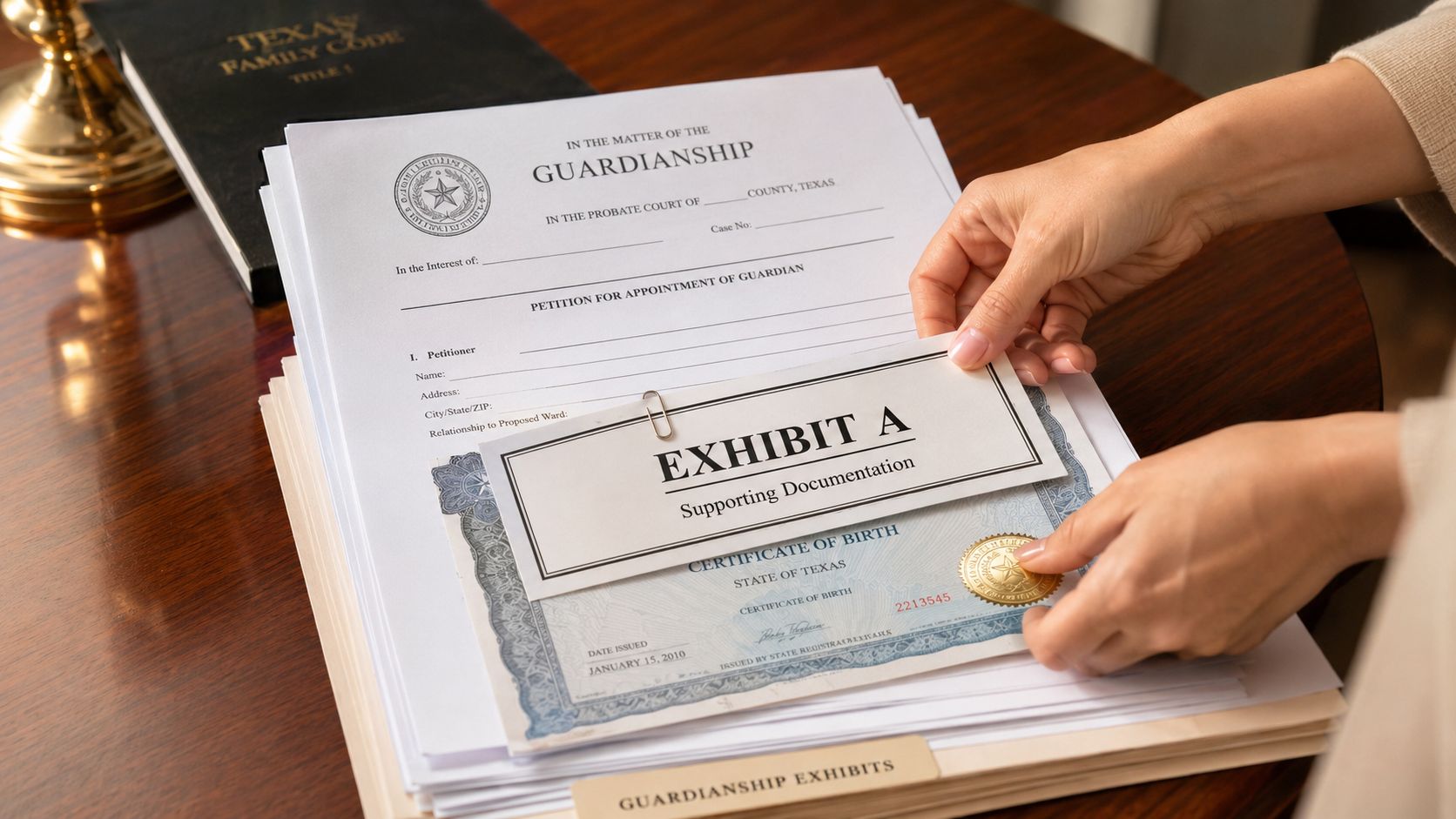
The most important attachment in many adult cases is the Physician's Certificate of Medical Examination, often called the PCME. It is the primary medical document required at the start of a Texas guardianship case to certify incapacity, and courts may order additional evaluations later to determine whether a guardianship should be modified or continued, as noted in this explanation of the Texas step-by-step guardianship process.
Why the medical form carries so much weight
Families sometimes think the doctor's form is just backup for what they already know. The court sees it differently. The PCME is part of the evidentiary foundation for taking rights away or limiting them. A weak, vague, or stale medical statement can damage a case even when the family's concerns are real.
The stronger filings usually connect diagnosis to daily function. The court needs more than a label. It needs to understand how the condition affects decision-making, safety, communication, finances, residence, and medical care.
If you need more detail on that document, the page on the Physician's Certificate for guardianship in Texas is a useful reference point.
What else belongs in the packet
Other attachments can matter just as much, depending on the case.
- Waivers and consents: If family members don't object, signed waivers of citation and consent forms may simplify the process.
- Background information about the proposed guardian: Courts often want enough information to evaluate suitability.
- Supporting records: Depending on the issue, that may include care records, financial concerns, or documents showing why immediate oversight is needed.
What works and what doesn't
A common mistake is sending the physician a blank form with no context. Doctors are busy. If they don't understand the legal issue, they may complete the form in a way that is medically accurate but legally unhelpful.
A better approach is to explain the practical decisions the court is evaluating. Can the person understand treatment choices? Can they manage property? Can they choose a safe residence? The doctor should answer from clinical knowledge, but families and counsel can frame the questions clearly.
Bring the doctor concrete examples. “He has dementia” is less helpful than “He repeatedly authorizes conflicting financial transactions and cannot explain them.”
Another problem is inconsistency. If the application asks for broad powers but the medical evidence supports only a narrow need, the mismatch raises doubt. The forms should tell one coherent story.
In guardianship disputes, attachments become even more important. If another relative objects, the case often turns on documentation, not family opinion. Courts are looking for reliable evidence, not the loudest voice in the room.
Filing Serving and Preparing for Your Day in Court
After the packet is assembled, the case becomes procedural, and families often lose momentum. The papers may be ready, but the court process has its own sequence, and skipping one step can stall everything.
A typical case starts with filing in the proper probate or county court, such as Harris County Probate Court, depending on where the proposed ward resides and the type of case involved. Once filed, the matter moves from private family concern to supervised court proceeding.
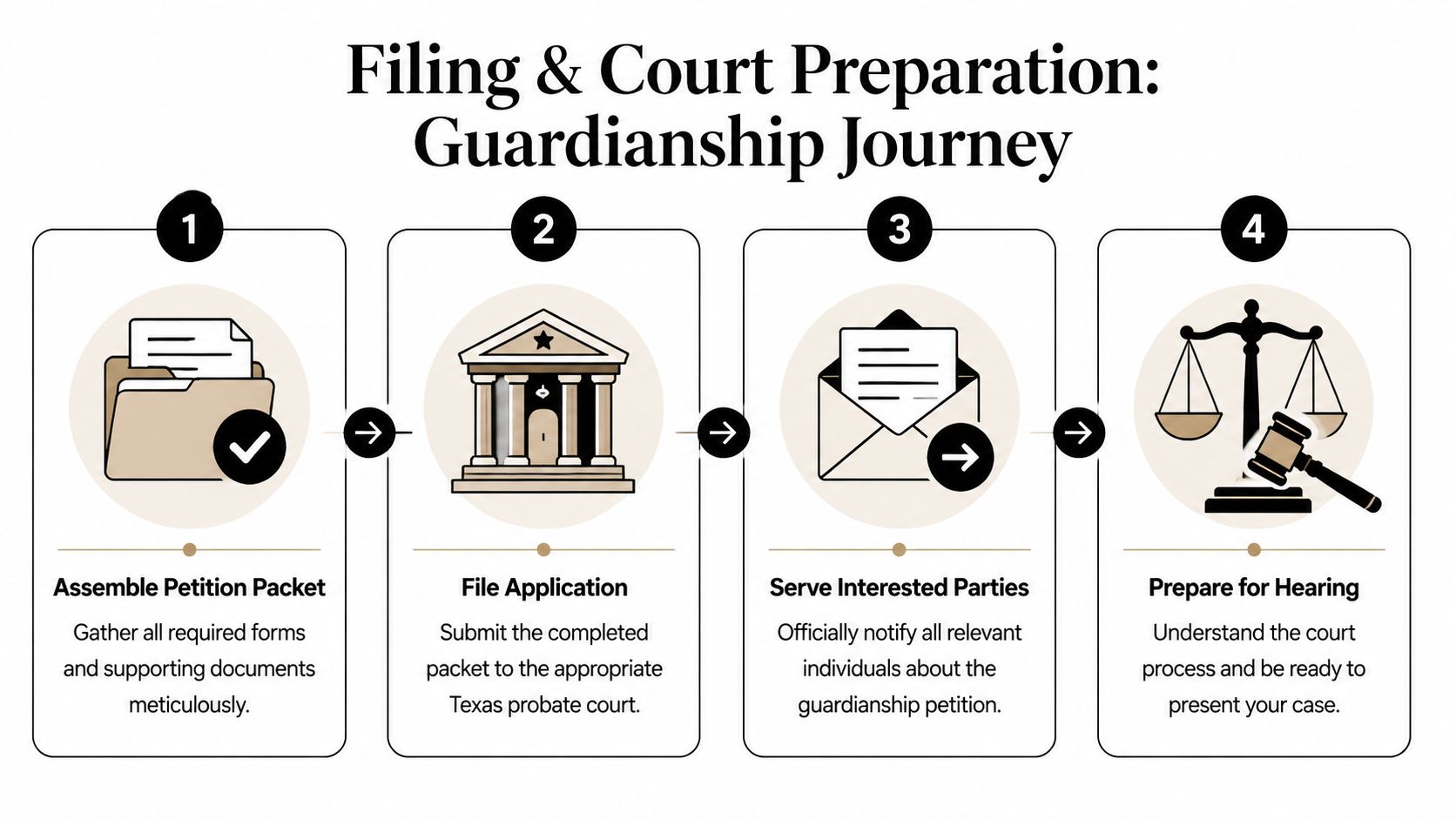
Here is the broad path most families follow.
What happens after filing
The Texas guardianship process involves filing the application and the medical certificate. After that, the court appoints an Investigator and an Attorney Ad Litem to represent the proposed ward's interests. The hearing proceeds only after both submit reports, and one of the most common pitfalls is failing to properly serve notice on all interested parties, as summarized in this guide to service of citation in Texas guardianship matters.
That sequence matters because families often expect a fast hearing. Instead, the court inserts safeguards. The investigator looks into necessity and suitability. The attorney ad litem represents the proposed ward, not the applicant. That can feel uncomfortable for families, but it protects the integrity of the process.
Service is not a technicality
Service means formal notice. It's one of the most frequent sources of delay because families assume informal communication is enough. It isn't. Telling your siblings about the case in a group text doesn't satisfy the legal requirement.
If the proposed ward or interested relatives are not properly served, the court may delay the hearing or require corrective steps. In some cases, defective notice can undermine the validity of the proceeding.
Courts expect proof that the right people were notified the right way. Family agreement doesn't replace proper service.
What the interviews are like
The investigator and attorney ad litem usually want specifics. Families should be ready to discuss:
- Daily functioning: Can the person handle medications, meals, transportation, hygiene, or appointments safely?
- Decision-making ability: Do they understand choices about finances, residence, and treatment?
- Existing supports: Is anyone already helping informally, and if so, why isn't that enough?
- Family dynamics: Are there disputes, concerns about misuse of money, or competing applicants?
The hearing itself is usually less dramatic than people fear, but preparation matters. Your paperwork, your testimony, and the supporting reports should all point in the same direction.
A short visual overview can also help families see the process in order.
Temporary and contested cases
Emergency or temporary guardianship can move more quickly, but the court still wants evidence and a legally sound filing. Contested cases move more slowly and require more discipline. In disputes, judges often pay close attention to whether the applicant appears organized, credible, and focused on the ward rather than on family conflict.
That's one reason sloppy forms can be expensive. Weak filings don't just create clerical problems. They can change how the court sees the entire case.
After the Hearing Your First Steps as a Guardian
A lot of families walk out of the courtroom believing the hard part is over, then run into trouble within days. A bank refuses to talk to them. A care facility asks for paperwork they do not have. Someone tries to help with bills before the guardian has legally qualified. Those early mistakes can create delays, extra fees, and sometimes court problems that were avoidable.
The judge's signature gives you an appointment. It does not give you full authority to act until you complete the next required steps. A new guardian must file the oath and, if the court requires it, post the bond. After that, the clerk can issue Letters of Guardianship. Those letters are the document third parties usually rely on, and they do not stay valid forever.
The three documents that matter first, and why they matter
The Oath of Guardian is more than a form to sign on the way out. It puts your duties in writing and under oath. If a guardian later mishandles funds, ignores court limits, or fails to report, the oath becomes part of the record showing the guardian accepted those obligations knowingly.
The bond often causes frustration, especially in families that have been caring for a loved one for years. The court is not making a personal accusation. The bond exists to protect the ward if money is misused, property is lost, or a guardian fails to carry out financial duties properly. In estate cases, skipping or delaying the bond can stop the entire appointment from becoming effective in practice.
The Letters of Guardianship are your working credential. Doctors, banks, insurance companies, and residential facilities usually want current letters, not just a signed order. Families often discover that distinction only after they are standing at a front desk trying to solve an urgent problem.
Mistakes that cost families time and credibility
The first common mistake is acting too soon. If you start moving money, signing admission papers, or giving legal consent before qualification is complete, you may be acting without authority.
The second is relying on the wrong document. A certified copy of the order may be helpful, but many institutions specifically ask for letters because they show the guardianship is active and current.
The third is poor setup in the first week. Guardians of the estate, in particular, get into preventable trouble when they mix the ward's funds with their own, fail to save receipts, or cannot explain why money was spent. That problem often surfaces later during an annual accounting for a Texas guardianship estate, but the damage usually starts right after appointment.
A practical first-week checklist
Once you qualify, slow down and get organized.
- Obtain certified copies of the Letters of Guardianship.
- Read the court's order line by line so you understand any limits on your authority.
- Make a list of every bank, doctor, facility, insurer, and agency that needs updated proof of authority.
- Open the proper account structure and keep the ward's money completely separate from your own.
- Start a simple recordkeeping system for receipts, deposits, bills, medical notes, and major decisions.
- Calendar the expiration date for the letters and any near-term court deadlines.
One habit matters more than families expect. Keep records from day one.
Good guardianship practice starts with documentation, not improvisation. If you are unsure whether a step is allowed, stop and check the order or get legal advice before acting. That is especially important in cases involving estate assets, restricted funds, family conflict, or narrow court-imposed limits.
Ongoing Duties Annual and Final Guardianship Forms
A lot of families feel relief once the court signs the order. Then the first annual deadline arrives, and that is when the stress usually returns.
The ongoing forms are where good guardianship cases stay healthy or start to unravel. The court is no longer deciding whether you should serve. The court is checking whether you are doing the job carefully, consistently, and in the ward's best interest.
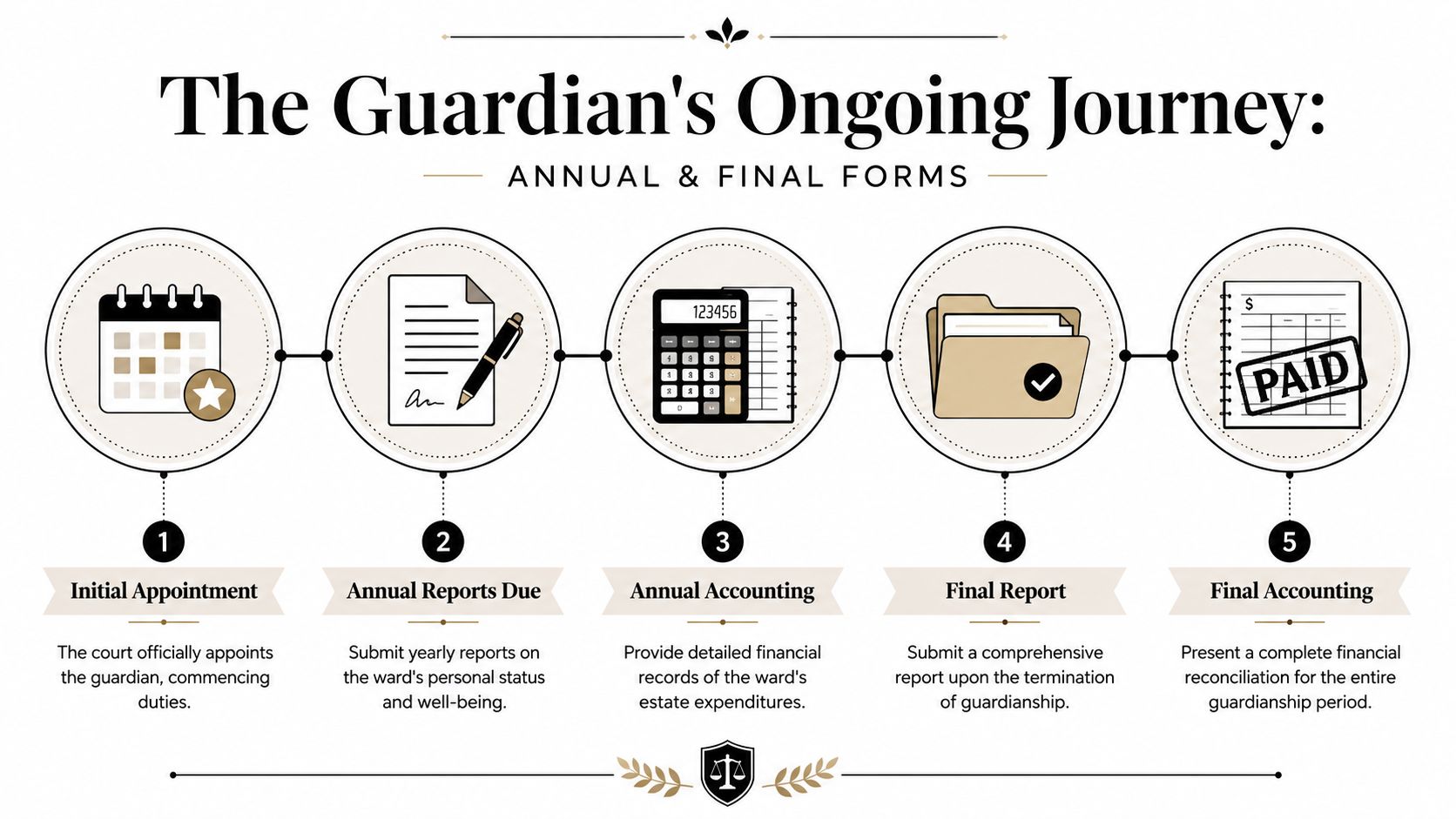
Why these forms matter more than families expect
Texas guardianship stays under court supervision for a reason. A guardian of the person must keep the court informed about the ward's living situation, condition, and care. A guardian of the estate must show, with records, what money came in, what was spent, and why those transactions were proper.
That second part is where many preventable problems begin.
Families often assume honest intent is enough. It is not. Courts want documentation. If a judge or clerk cannot follow your report, cannot match expenses to records, or sees gaps that suggest poor oversight, the case can become expensive very quickly.
The forms are not just paperwork
Annual reports and accountings serve different purposes.
An annual report tells the court how the ward is doing. It explains where the ward lives, what medical or care changes occurred, and whether the current guardianship still fits the ward's needs.
An accounting tells the court whether the ward's money was protected. If you are handling estate assets, review what goes into a proper annual accounting for a Texas guardianship estate well before the deadline. Waiting until the last week usually leads to missing bank statements, unexplained withdrawals, and avoidable corrections.
Common mistakes that cost guardians time and credibility
The mistake I see most often is delay. A guardian waits until the notice arrives, then tries to rebuild a year of care decisions or financial activity from memory.
The next mistake is incomplete support. A ledger without statements, receipts, or other backup usually creates follow-up questions. So does a report that says the ward is "doing fine" but gives no meaningful update about residence, health, services, or changes in condition.
Another expensive error is treating small transactions as too minor to document. Small cash withdrawals, transfers between accounts, shared family purchases, and reimbursements to the guardian are exactly the items courts examine closely. If the paper trail is weak, the transaction starts to look improper even when the money was spent for the ward.
What to track throughout the year
Good annual filings are built month by month, not the night before filing.
Keep one organized file, digital or paper, with:
- medical appointments, diagnoses, medication changes, and provider notes
- current address, facility transfers, hospital stays, and discharge paperwork
- monthly bank statements, deposits, bills paid, and receipts
- notes explaining major decisions, especially moves, high-cost purchases, and unusual expenses
- copies of any court orders that changed your authority or imposed new limits
This recordkeeping has a practical purpose. It protects the ward, and it protects you.
Final forms matter too
Guardianship does not cease merely because the ward dies, regains capacity, or circumstances change. The court usually requires closing paperwork, and in estate cases that may include a final accounting. Families are often caught off guard by that requirement and assume the file closes automatically once the crisis has passed.
It does not.
A final report tells the court how the guardianship ended and whether any remaining duties were completed. A final accounting closes the financial side of the case and gives the court a last chance to confirm that assets were handled properly before discharge.
The practical trade-off
Detailed records take time. Cleaning up missing records after a court notice, an audit question, or a family dispute takes much more time and usually more money.
If you treat the annual and final forms as part of the job from the start, the process stays manageable. If you treat them as an afterthought, they often become the reason a straightforward guardianship turns into a contested one.
Common Questions About Texas Guardianship Forms
Families usually reach this point after weeks of stress. A hospital wants a decision, a facility needs paperwork, or relatives are arguing about what should happen next. The forms can feel endless, but the better question is usually simpler. What is the court trying to learn from each document, and what mistakes will hurt the case?
Do all guardians have to complete training
Yes. Texas requires proposed guardians to complete training and register through the Judicial Branch Certification Commission before the court can approve the appointment. The rule catches many families by surprise, especially when they are already dealing with a medical crisis.
The mistake I see is delay. Relatives spend time gathering records, preparing the application, and arranging service, then learn they cannot move the case to the finish line because the training was left undone. Finish that step early.
Can guardianship be avoided
Sometimes. Texas courts want to know whether a less restrictive option would work, and that question matters for more than legal formality. Guardianship removes rights, so the court expects a clear reason why narrower tools are not enough.
That is where families often make an expensive error. They treat alternatives as a box to check instead of a serious part of the case. If supported decision-making, a power of attorney, a representative payee, or another arrangement can handle the problem, the court may expect you to explain why you are still asking for guardianship. If those options failed, say how and why.
What if family members disagree
Disagreement changes the value of every form you file. In a contested case, vague statements and incomplete attachments become real problems.
Judges look for proof, consistency, and compliance with procedure. A relative who files clean paperwork, provides medical support, fully discloses limitations, and shows a practical care plan usually stands on firmer ground than a relative who has strong opinions but weak documentation. In other words, the forms are often where credibility is won or lost.
Are emergency cases different
Yes, but families should not assume that "emergency" means relaxed standards. Temporary relief can move faster when someone faces immediate risk, but the court still needs specific facts and competent evidence.
A common mistake is filing in a panic with conclusions instead of details. "She is unsafe" is not enough by itself. Dates, incidents, provider concerns, financial exposure, missed medications, or unsafe living conditions give the court something it can act on.
Can one lawyer help with related probate or planning issues
Often, yes. Guardianship cases regularly overlap with title problems, old estate plans, beneficiary issues, and probate after a death. Handling those issues in isolation can create avoidable conflict or duplicate work.
Some families prefer one firm that can coordinate Probate and Estate Planning with the guardianship case so the strategy stays consistent. That can be especially helpful when the same set of records and family facts affects more than one legal matter.
If you are sorting through guardianship forms in Texas right now, keep this in mind. Each form answers a specific concern for the court. Capacity, risk, notice, suitability, and accountability. When families understand that purpose, they make fewer mistakes and spend less time fixing preventable ones later.
If your family is facing a possible guardianship, a temporary emergency, a dispute between relatives, or questions about ongoing compliance, the Law Office of Bryan Fagan, PLLC provides guidance on guardianship applications, hearings, modifications, and reporting duties. A free consultation can help you understand which forms matter, what evidence the court will expect, and whether guardianship is the right path for your loved one.