Skip to content
When a child’s parents are unable to provide care, guardianship of a minor in Texas offers a vital legal safety net. We understand that this is often a difficult and emotional time for a family. This guide is designed to walk you through the process with clarity and compassion, explaining a formal court procedure that appoints a responsible adult to protect a child's well-being, safety, and financial future.
Defining Guardianship for a Texas Child

Stepping up to care for a child is a profound act of love, but navigating the legal system can feel overwhelming. A guardianship provides a clear, court-approved framework giving an adult the legal authority to make critical life decisions for a minor when their parents cannot.
Think of a guardian not as a replacement parent, but as a trusted protector. A judge appoints them to guide a child’s journey when the child's parents are no longer able to. This entire process is outlined in the Texas Estates Code, Title 3, Subtitle G, which sets the legal standards for all parties. Whether in Harris County or El Paso County, the court’s primary and unwavering focus is always the best interest of the child.
Two Fundamental Types of Guardianship
It's important to understand the two main types of guardianship. A child might need one or both, depending on their specific needs.
- Guardian of the Person: This guardian is responsible for the child's daily life and personal well-being. They make crucial decisions about where the child lives, the school they attend, and the medical care they receive.
- Guardian of the Estate: This guardian is appointed specifically to manage the child's finances and property. This becomes necessary when a minor inherits money, receives a legal settlement, or owns valuable assets that require careful management to protect their future.
When Is Guardianship Necessary?
A Texas court, such as a Harris County Probate Court, will consider appointing a guardian if a minor's parents have passed away, had their parental rights legally terminated, or are otherwise unable to provide care due to serious illness, incarceration, or other challenging circumstances.
The purpose of guardianship is to create a stable and protective environment for a child. The court intervenes to ensure someone has the legal authority to make decisions that safeguard their health, education, and financial security during a vulnerable time.
This is a significant legal step, and Texas courts treat these cases with the seriousness they deserve. The need for this process is very real for many families. According to the Texas Judiciary's Annual Statistical Report, there were 688 guardianship cases for minors filed in Texas during Fiscal Year 2023 alone. This statistic, which you can explore further on the official Texas Courts website, shows just how many children and families rely on this legal protection each year.
To help you get a clearer picture, here’s a quick overview of the key concepts involved.
Guardianship of a Minor at a Glance
| Concept | Description | Governing Law (Texas Estates Code) |
|---|---|---|
| Ward | The minor child who is the subject of the guardianship. | Chapter 1002 |
| Guardian | The adult appointed by the court to care for the ward's person, estate, or both. | Chapter 1104 |
| Best Interest of the Child | The guiding principle for all court decisions in a guardianship case. | Family Code § 153.002 |
| Guardian of the Person | Makes decisions about the child's daily care, education, and health. | Chapter 1151 |
| Guardian of the Estate | Manages the child's property, finances, and assets. | Chapter 1151 |
| Court Supervision | The legal process is overseen by a probate court to ensure the guardian acts responsibly. | Chapter 1051 |
Ultimately, initiating a guardianship proceeding is a recognition that a child needs the dedicated supervision that only a court-appointed guardian can legally provide. If you are considering this path, understanding these fundamentals is the first critical step. Our team at The Law Office of Bryan Fagan is here to walk you through every stage with compassion and clarity. Schedule a free consultation to discuss your family's specific needs and find out how we can help.
Who Can Be Appointed as a Child's Guardian in Texas?
When a Texas court must decide who will become a guardian for a child, one question guides every decision: what is in the child's best interest? This isn't just a suggestion; it is the unwavering legal standard. The judge’s role is to find a competent, caring adult who can provide a safe, stable, and loving home.
The law is clear on what it looks for in a potential guardian. As defined in the Texas Estates Code, a potential guardian must be a "suitable and qualified" person. In plain English, this means they must be a responsible adult with a sound mind, free from serious conflicts of interest, and without a past that could put the child at risk. The court's review is meticulous because this role comes with profound responsibilities.
The Court's Preferred Order of Appointment
To guide this crucial decision, Texas law establishes a priority list for who the court should consider first. This hierarchy is designed to place the child with the person most likely to have their best interests at heart, often starting with those closest to the family.
The court typically looks at candidates in this order:
- Person Named in a Parent's Will: If a parent designated a guardian in a valid will, the court gives that choice immense respect.
- Nearest Ascendant: This legal term refers to the closest living ancestor, which almost always means a grandparent.
- Next of Kin: If grandparents are not available or suitable, the court will then consider other close relatives, such as aunts, uncles, or adult siblings.
While the law prefers family, a non-relative is not out of the running. The final decision always comes back to the child’s best interest. You can learn more in our detailed guide on how a non-relative can become a legal guardian in Texas.
Hypothetical Scenario: Imagine a judge in a Travis County Probate Court is considering two petitions for a 10-year-old boy. One is from his grandmother, who loves him but is in poor health. The other is from a dedicated family friend who has been a constant, stable presence in the boy's life. The judge will carefully weigh each person's ability to provide for the child’s emotional, physical, and financial needs, paying close attention to the existing relationship each person has with the child to determine the best outcome.
Factors That Can Disqualify a Potential Guardian
Just as there are qualifications to meet, there are also red flags that can immediately disqualify someone from serving as a guardian. The court's primary duty is to protect the child, which means screening out anyone who could pose a risk.
A person is generally considered unsuitable if they:
- Have a conflict of interest with the child (for example, they owe the child money).
- Lack the experience or education to prudently manage the child's estate.
- Have a criminal history involving sexual offenses, physical abuse, or other serious crimes.
- Are not a Texas resident and have failed to appoint a resident agent to accept legal notices.
These are not punitive measures; they are safeguards written into the Texas Estates Code (Title 3, Subtitle G) to ensure the appointed person is trustworthy. The process involves background checks and a thorough investigation to confirm the applicant is truly fit for the role.
The Step-by-Step Guardianship Process in Texas
When you need to step in for a child, the legal path ahead can feel overwhelming. But the process for establishing a guardianship of a minor in Texas is a series of deliberate, well-defined steps designed to ensure every decision serves the child’s best interests.
Let’s walk through that roadmap together.
Filing the Initial Application
The journey begins by formally asking a Texas court to establish a guardianship. This is done by filing an Application for Appointment of Permanent Guardian. This document explains to the judge why a guardianship is needed and why you are the right person for this critical role.
The application must be filed in the probate court of the county where the child lives, such as the Harris County Probate Court. It requires specific details about the child—name, age, address—and a clear explanation of the circumstances, such as the parents' passing or inability to provide care.
Serving Notice to Family Members
Once your application is filed, the law requires that key family members be formally notified. This is a fundamental part of the process that ensures transparency and gives close relatives a chance to be heard.
Under the Texas Estates Code, you must serve notice to the child’s parents (if living), grandparents, and anyone who has had primary custody in the last six months. This formal legal notice is typically delivered by a sheriff or private process server, informing them of the guardianship hearing.
The Role of the Attorney Ad Litem
Shortly after the application is filed, the court will appoint an attorney ad litem—an independent lawyer whose only client is the child. Their sole job is to represent the child's best interests, separate from you, the judge, or any other family member.
The attorney ad litem conducts their own investigation, which typically involves:
- Meeting with the child to understand their feelings and wishes.
- Interviewing you, other relatives, teachers, and anyone significant in the child’s life.
- Reviewing all documents filed with the court.
After this investigation, the ad litem provides a detailed report to the judge with their professional recommendation on whether the guardianship is in the child’s best interest and if you are a suitable guardian. This recommendation carries significant weight.
A common question is, "Do I have to pay for the attorney ad litem?" Typically, yes. The cost of the ad litem is considered part of the court costs, and the applicant is usually responsible for this fee.
Court Investigation and Background Checks
The court's primary duty is to protect the child. To do this, the judge will order a thorough investigation into you as the proposed guardian. This always includes a comprehensive criminal background check on you and any other adults living in your home.
This step is a critical safeguard. The court must be certain it is placing the child in a safe, stable environment. Any history of criminal activity, especially involving violence or child endangerment, can be a major obstacle.
The court has a preferred order for who it considers, usually starting with people the parents designated or the child’s closest relatives.
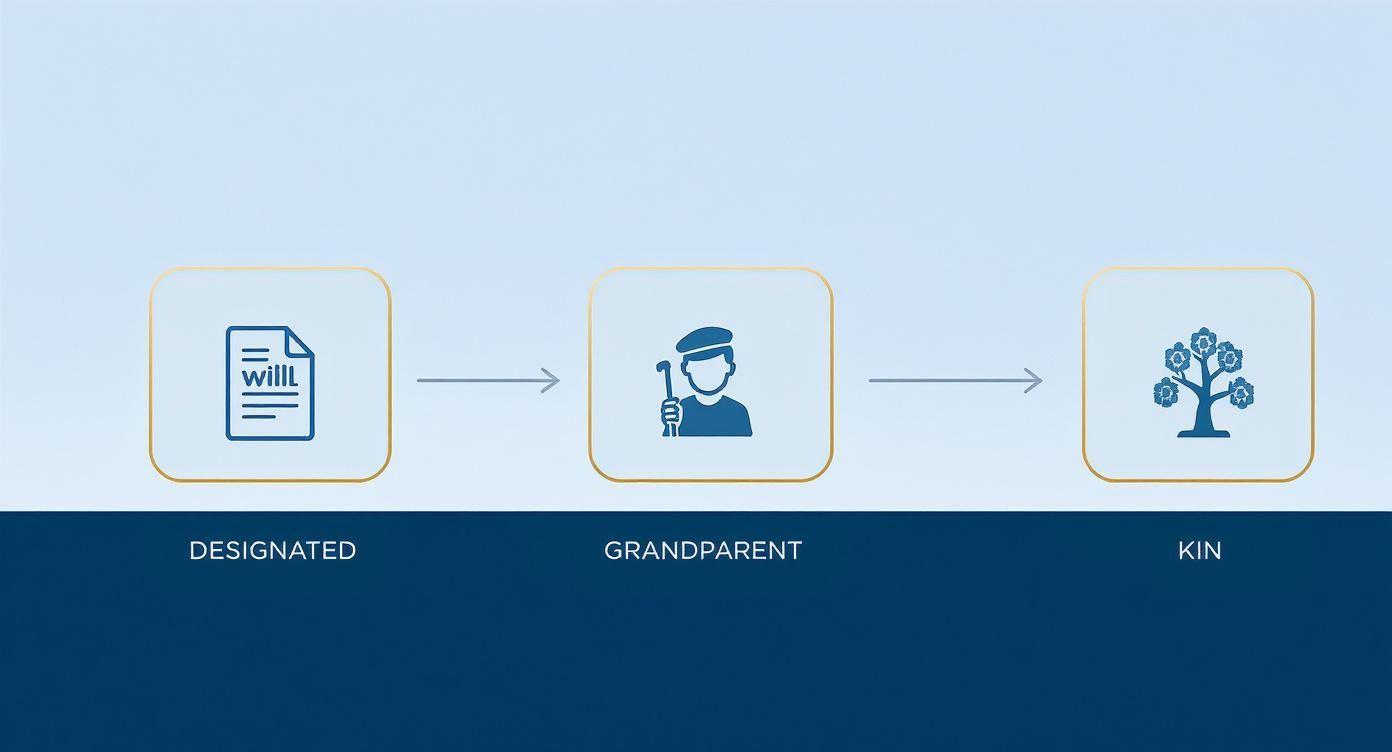
This visual helps clarify the court's priority system, which focuses on individuals who already have a strong, existing bond with the child.
Navigating the phases of the guardianship process can be easier when you have a clear picture of the timeline.
Guardianship Process Timeline and Key Actions
| Phase | Key Actions | Estimated Timeline |
|---|---|---|
| Phase 1: Preparation & Filing | Gather documents (birth certificates, etc.). File the Application for Appointment of Permanent Guardian. Pay the court filing fee. | 1-2 Weeks |
| Phase 2: Notices & Appointments | Arrange for formal notice to be served to all required family members. Court appoints an Attorney Ad Litem for the child. | 2-4 Weeks |
| Phase 3: Investigation | Cooperate fully with the Attorney Ad Litem's investigation. Complete and pass all required background checks. | 4-6 Weeks |
| Phase 4: Court Hearing | Prepare testimony and gather evidence with your attorney. Attend the final court hearing. | 6-12 Weeks from Filing |
| Phase 5: Finalization | If granted, sign the Order, take the oath of guardianship, and post the required bond. Receive official Letters of Guardianship. | 1-2 Weeks Post-Hearing |
These timelines are estimates and can vary based on your case and the court's schedule.
The Guardianship Court Hearing
The final step is the court hearing, where you will present your case to the judge. You'll need to provide testimony and evidence to prove that a guardianship is necessary and that you are the best person for the job.
Your attorney will guide you through your testimony. The judge will likely ask about your relationship with the child, your ability to meet their needs, and your understanding of a guardian's duties. The attorney ad litem will also be present.
It is crucial to come prepared with all important documents, such as:
- The child’s birth certificate.
- Parents' death certificates (if applicable).
- Proof of your financial stability.
- Letters of support from family or teachers.
If the guardianship is granted, the judge signs an Order Appointing Guardian. You will then take an oath and post a bond before receiving your Letters of Guardianship—the legal documents proving your authority.
Navigating this process can be complex, but you don't have to do it alone. The compassionate team at The Law Office of Bryan Fagan is here to guide you. For personalized advice, schedule a free consultation with us today.
A Guardian's Legal Rights and Responsibilities

When a Texas court appoints you as a guardian, you are entrusted with a profound legal and ethical commitment to protect and care for a child. Your duties are typically split into two roles: guardianship of the person and guardianship of the estate. You might be appointed to one or both.
Guardian of the Person Core Duties
As the Guardian of the Person, you become the central decision-maker for the child's daily life, stepping into a parental role to shape their health, safety, and future.
Your main responsibilities include:
- Providing Physical Care: You have the legal right to decide where the child lives.
- Ensuring Safety and Protection: It is your duty to provide the care, supervision, and protection a child needs.
- Managing Medical Care: You are in charge of all healthcare decisions, from check-ups to consenting for major treatments.
- Overseeing Education: You will handle school enrollment and guide the child's academic journey.
For example, if Maria is appointed guardian of 14-year-old Alex's person in Fort Bend County, she will enroll him in high school, take him to the doctor, and consent to his getting braces. Her entire focus is on his personal well-being.
Guardian of the Estate Core Duties
If the child has assets—such as an inheritance or property—the court will appoint a Guardian of the Estate. This role is about managing finances with sharp attention to detail.
This guardian is a fiduciary, meaning you must manage the child's money with absolute loyalty and in their best interest—not your own.
Key responsibilities include:
- Managing Assets: You take legal control of the child’s property and financial accounts.
- Financial Prudence: You must invest and manage the estate's money responsibly, pay the child's debts, and collect any money owed.
- Court Reporting: You must file meticulous reports with the court, starting with an initial inventory of all assets and followed by annual accountings that track every dollar.
For example, if Alex also inherited his parents' house, Maria could be named guardian of his estate. She would then be responsible for managing the property, paying taxes, and filing a detailed annual accounting with the court. You can learn more about these duties in our guide on the legal duties and responsibilities of guardians.
The Importance of Court Reporting and Compliance
Texas courts take their oversight role very seriously to prevent mismanagement or neglect. The reporting requirements in the Texas Estates Code are strict legal mandates. Failing to file reports on time or accurately can lead to removal as guardian and other legal consequences.
A guardian's duty is to be transparent and accountable to the court, which acts as the ultimate supervisor to safeguard the child’s future.
This accountability is actively monitored. The Texas Guardianship Abuse, Fraud, and Exploitation Detection Program (GAFEDP) audits cases to ensure compliance. In Fiscal Year 2024, their audits across 247 Texas counties revealed that 29% of audited cases were missing annual accounts and 30% were missing inventories. These numbers, found in the GAFEDP's annual report on the Texas Courts website, highlight how easy it is to fall out of compliance.
These responsibilities are significant, but they all serve to protect the child. If you have questions about these duties, schedule a free consultation with The Law Office of Bryan Fagan today.
Protecting a Child's Rights in Guardianship Cases
While guardianship appoints a responsible adult, Texas law never loses sight of the most important person: the child. The legal framework is built to protect their rights and ensure their voice is heard, providing a sense of security and agency during an emotionally charged time.
A common myth is that children have no input. In reality, especially for older children, their perspective is a critical piece of the puzzle for any judge making a decision.
Giving a Child a Voice in Their Future
Many people mistakenly believe children are silent participants. In Texas, that is not true, especially for older children.
Texas Estates Code, Section 1104.054, is a powerful law that gives a minor 12 years of age or older the right to choose their own guardian by filing a written preference with the court. This gives teenagers a direct line to the judge to state who they trust to care for them.
The child's choice is not automatic; a judge must still determine if the person is qualified and if the appointment is in the child's best interest. But it guarantees an older child's wishes are given serious weight. You can learn more by exploring insights on a minor's ability to select their own guardian.
The Attorney Ad Litem: The Child's Personal Lawyer
To ensure a child's rights are protected, the court appoints an independent Attorney Ad Litem. This attorney has only one client: the child. Their sole mission is to advocate for what is best for the child.
The Ad Litem's role is crucial. They will:
- Meet with the Child: They talk with the child privately to understand their feelings and wishes.
- Investigate the Situation: They act as a detective for the child's best interests, interviewing potential guardians, relatives, and teachers.
- Make a Recommendation to the Court: The Ad Litem provides a detailed report to the judge with their professional opinion on the best outcome for the child.
Sometimes, complex family dynamics make a guardianship case tougher. Guardians can find helpful strategies for co-parenting with a narcissist to navigate these challenges. These legal and personal supports work together to create a protective shield around the child.
Ultimately, these safeguards ensure that a guardianship of a minor in Texas is a process done for the child, not just to them. If you have questions about protecting a child's rights, our compassionate team is here to help. Schedule a free consultation at The Law Office of Bryan Fagan for personalized guidance.
Emergency Guardianships and Other Alternatives
Sometimes, a child faces a crisis that demands immediate legal protection. In these urgent moments, a Temporary or Emergency Guardianship is essential. When there is clear evidence that a child faces immediate physical or financial danger, a court can grant this type of guardianship in a matter of days.
The standard for this is intentionally high. You must show the judge proof of imminent harm if a guardian isn't appointed right away. This is reserved for true emergencies, like a child being abandoned or needing urgent medical care with no parent available to give consent. To learn more, read about emergency guardianships in Texas and how they are used.
Exploring Less Restrictive Alternatives
Because full guardianship transfers a parent’s fundamental rights, Texas courts are legally required to first consider less intrusive ways to protect a child. This approach meets a child's needs while preserving family rights as much as possible.
Full guardianship is always the last resort. The court's goal is to find the most effective solution that interferes the least with the rights of the child and parents.
Before appointing a guardian, a judge in Bexar County or Harris County Probate Court will explore other avenues, such as:
- Custody Orders: If the main issue is where the child lives and who makes daily decisions, a custody order through family court might be a better solution.
- Trusts: When a child inherits money, a trust can be a fantastic alternative to a guardianship of the estate. A trustee manages the assets with more flexibility and less court supervision.
- Powers of Attorney: For parents who are temporarily unable to care for their child due to military deployment or illness, a power of attorney can grant a trusted relative the authority to make key decisions without terminating parental rights.
Choosing the right path depends on your family's unique situation. These alternatives are often less expensive, less complicated, and better preserve family autonomy. We can help you explore every option to find the one that best protects the child you love.
Your Top Questions About Texas Child Guardianship, Answered
When you're considering guardianship, it's normal to have many questions. Getting clear, straightforward answers can reduce stress and help you move forward with confidence. Here are answers to some of the most common questions we hear from Texas families.
What’s the Bottom Line? How Much Does Guardianship Cost?
The total cost to establish a guardianship of a minor in Texas varies. It is a combination of court filing fees, the fee for the court-appointed attorney for the child (the ad litem), and your own attorney’s fees.
If the case is uncontested and all family members agree, the costs will be more predictable. However, if family members dispute the guardianship, the legal fees can increase as the case becomes more complex and time-consuming.
How Long Will This Whole Process Take?
For a straightforward, uncontested guardianship, you can typically expect the process to take between one and three months from start to finish.
However, delays can happen. Busy courts, like the Dallas County Probate Court, may have backlogs. Other common issues include difficulties notifying all required relatives or disagreements among family members. On the other hand, an emergency guardianship can often be established in just a few days when a child is in immediate danger.
When Does a Minor's Guardianship End?
A guardianship for a minor automatically ends when the child turns 18 years old, as they are then legally an adult.
A court can also terminate the guardianship earlier if the child is legally emancipated, gets married, or if the circumstances that required the guardianship in the first place are resolved (for example, a parent recovers from a serious illness). These situations represent a guardianship dispute or termination and require court approval.
Understanding the details of guardianship is the first step toward securing a child’s future. But every family's situation is unique, and you deserve advice that’s specifically for you.
To get clear answers and compassionate support, contact the experienced team at The Law Office of Bryan Fagan, PLLC. Schedule your free, no-obligation consultation and let us help you protect the child you care about.