Skip to content
When your family is considering guardianship for a loved one, the legal process can feel overwhelming and emotionally challenging. It all starts with one critical document: the physician certificate for guardianship in Texas.
This isn't just a piece of paper; it's the official medical evidence required by the Texas Estates Code to even begin a guardianship case. A Texas-licensed doctor completes this form, giving the court a clear, professional opinion on a person's physical and mental capacity to care for themselves. Understanding this document is the first step toward protecting someone you love.
Understanding The Cornerstone Of A Guardianship Case

The journey toward guardianship is filled with legal steps and difficult emotional decisions. We know this is a tough time for your family. But everything hinges on the Physician's Certificate of Medical Examination (CME). This is the foundational document that probate courts across Texas, from the Harris County Probate Court to courts in smaller counties, depend on to assess a person's ability to care for themselves.
Think of the CME as a doctor's expert testimony, submitted to the court in a very specific format. It provides the judge with an unbiased, medical perspective on your loved one’s condition, which directly influences the final decision. Simply put, without a correctly filled-out certificate, a guardianship application stops before it even starts.
Why The Certificate Is A Legal Must-Have
The Texas Estates Code (Title 3, Subtitle G) has strict rules for establishing guardianship, all designed to protect the rights of the person who might need help (the "proposed ward"). The law demands clear, objective medical proof of incapacity before a court can take away someone's right to make their own choices. The physician certificate is that proof.
This medical evidence is required at two key moments. First, a CME must be filed along with the initial application for guardianship. Second, if someone already under guardianship wants to have their rights restored, a new CME is needed to show their current medical status.
Crucially, the law requires the exam to have been performed by a Texas-licensed physician within the last 120 days of the filing date. This ensures the court is making its decision based on up-to-date information, which is a vital protection for your loved one.
To help you understand this vital document, here is a breakdown of its core components and why each one matters to the court.
Core Components of a Texas Physician Certificate
| Component | Purpose in the Guardianship Case | Why It's Critical |
|---|---|---|
| Proposed Ward's Information | Clearly identifies the person being evaluated. | Ensures there is no ambiguity about who the medical opinion applies to. |
| Physician’s Credentials | Establishes the doctor's authority and license to practice in Texas. | The court will only accept evaluations from a qualified, state-licensed physician. |
| Date and Location of Exam | Confirms the exam was recent (within 120 days) and conducted properly. | Outdated information is legally invalid and will cause the case to be rejected. |
| Diagnosis and Prognosis | States the specific medical conditions causing incapacity. | Gives the judge a clear understanding of the underlying medical issues. |
| Description of Incapacity | Details the ward's specific functional limitations. | This helps the court decide if a full or limited guardianship is appropriate. |
| Physician’s Opinion | The doctor’s professional conclusion on the ward’s ability to self-care. | This is the expert medical "testimony" that the entire case is built upon. |
This table shows just how much weight the court places on the details. A missing date or an unclear diagnosis can bring the entire process to a halt, adding to your family's stress and financial burden.
The Certificate’s Role In The Courtroom
In a guardianship hearing, the judge has one primary job: to determine if the proposed ward is legally "incapacitated" and if guardianship is the least restrictive option to keep them safe.
The physician's certificate directly answers the court's biggest questions:
- It clarifies the nature and severity of the incapacity. Is it a cognitive issue like dementia, a severe physical disability, or something else?
- It lists the person's specific limitations. Can they manage their own finances? Can they consent to medical treatment? Can they handle daily tasks like cooking or hygiene?
- It provides a trusted medical opinion. The doctor's professional assessment adds critical weight to the family's concerns, turning personal observations into medical facts.
Getting this document right is the first and most crucial step toward a successful guardianship application. It sets the tone for everything that comes next and helps you prepare for what to expect at a Texas guardianship hearing.
What A Judge Needs To See On The Doctor's Certificate
The Physician's Certificate of Medical Examination (CME) is far more than a simple doctor's note. Think of it as the single most important piece of medical evidence in your guardianship case. This detailed, legal report paints a clear picture of your loved one's condition for the court, and the Texas Estates Code is very specific about what it must include.
A vague or incomplete certificate will get you nowhere fast. A judge in any Texas probate court, from Bexar County to Fort Bend County, will reject it without a second thought. The court needs specific, concrete details to understand not just that your loved one needs help, but precisely what kind of help they need and why.
The Nature and Severity of Incapacity
First things first, the certificate must state a clear medical diagnosis. It’s simply not enough for a doctor to write "memory problems" or "confusion." The physician must identify the specific medical condition causing the incapacity, such as "Alzheimer's disease," "severe traumatic brain injury," or "schizophrenia."
Right after the diagnosis, the doctor needs to describe the severity of the condition. This gives the court crucial context. A diagnosis of "early-stage dementia," for instance, presents a very different legal situation than "late-stage dementia with significant cognitive and physical decline."
Detailing Specific Functional Limitations
This is arguably the most critical part of the entire form. The physician has to connect the diagnosis to real-world consequences. How does the medical condition actually prevent your loved one from safely managing their own life?
For example, imagine your father has dementia and you're worried about his safety. A strong certificate would provide clear, practical examples of his struggles:
- Managing Financial Affairs: Instead of saying "he's bad with money," a doctor might note, "Due to cognitive decline associated with dementia, the patient is unable to perform simple calculations, has paid the same bill multiple times in one month, and cannot recognize the value of currency, making him vulnerable to financial scams."
- Making Medical Decisions: The certificate might state, "The patient cannot retain information about his medical conditions or understand the risks and benefits of proposed treatments, rendering him unable to give informed consent."
- Providing Self-Care: This could be detailed as, "The patient frequently forgets to take essential heart medication, neglects personal hygiene, and has left the stove on unattended on several occasions, posing a significant safety risk."
By clearly outlining these functional problems, the physician gives the judge the exact evidence needed to determine if a guardianship of the person, a guardianship of the estate, or both, is the right path forward. Our firm has a detailed guide that explains more about proving incapacity in Texas courts.
The Prognosis and A Look At Less Restrictive Alternatives
The court also needs to understand what the future likely holds. The doctor must provide a prognosis—is the condition expected to improve, get worse, or stay about the same? This information helps the judge determine the potential length and scope of the guardianship.
Crucially, Texas law requires the physician to state whether less restrictive alternatives to guardianship were considered and why they are not sufficient. This shows the court that taking away a person's rights is a last resort.
For example, the doctor might state that a Power of Attorney is no longer a viable option because the proposed ward can't understand what the document means. Or they might explain that a supported decision-making agreement is inadequate due to severe cognitive decline. This specific opinion, coming from a medical professional, carries immense weight in the courtroom.
When all these pieces come together, a properly completed physician's certificate gives the court the confidence it needs to make a life-altering decision that is genuinely in your loved one's best interest.
Navigating The Strict Timeline And Physician Requirements
When you're pursuing a guardianship in Texas, two simple mistakes can completely derail your case: getting the timing wrong or having the wrong doctor sign the paperwork. These aren't just minor details; they're deal-breakers that can get your application delayed or even dismissed right out of the gate.
Getting these rules right is absolutely critical for a smooth process. Texas law is very specific here, and for good reason—the court needs to make its decision based on a recent and accurate picture of your loved one’s health, not on old information that might be completely out of date.
The 120-Day Rule Explained
Here's the first hard-and-fast deadline you need to know: the physician's certificate must be based on an exam that happened within 120 days of filing the guardianship application. Not 121 days. 120 days.
If you file on day 121, the court will automatically reject the certificate, and you’ll have to go back to square one.
Think of it this way: the court needs a fresh snapshot of your loved one's condition, not an old photograph. A person's capacity can change dramatically in a few months, especially with progressive illnesses. The 120-day window ensures the medical evidence is both relevant and current.
Who Is Qualified To Complete The Certificate
The certificate is a formal legal document, which means only certain professionals have the authority to sign it. The evaluation must be performed by a physician licensed to practice medicine in Texas.
A certificate signed by a nurse practitioner, a physician’s assistant, or even a doctor licensed in another state simply won't cut it for a Texas probate court.
This requirement ensures the person making the medical judgment meets Texas’s professional standards and understands their important role in the legal process. When sending medical records back and forth, it's crucial to use secure methods like HIPAA compliant document sharing to protect your loved one’s privacy.
Choosing The Right Doctor For The Examination
While any Texas-licensed physician can fill out the form, making a strategic choice can make your application much stronger. You really have two great options:
- The Primary Care Physician (PCP): A family doctor who has treated your loved one for years can offer invaluable insight. They can speak to the long-term decline and provide the court with crucial context.
- A Specialist: If the incapacity is due to a specific condition like Alzheimer's, Parkinson's, or a brain injury, a report from a neurologist or geriatrician often carries more weight. Their specialized expertise is highly respected by the court.
Whichever doctor you choose, clear communication is everything. You need to explain that the appointment is for a capacity evaluation for a potential guardianship. Give them the court-required form ahead of time so they know exactly what information the judge needs to see.
A Cautionary Tale From Travis County
Imagine a family in Austin caring for their father, whose dementia is getting worse. They get a physician's certificate in January but wait until June to file for guardianship while they get everyone on the same page. When they finally file, the Travis County Probate Court immediately rejects their application. Why? The certificate was well over 120 days old. This one mistake cost them precious time and money, forcing them to get another doctor's visit and start the legal process all over again—all while their father’s safety was still at risk. This shows just how a simple timing error can have huge consequences.
How To Work With Your Doctor For The Guardianship Certificate
Getting a solid, legally sound physician's certificate isn't something that just happens. It takes real teamwork between your family, your attorney, and the doctor. You can't just show up and expect the perfect document.
Think of the doctor's appointment as the most important meeting in your guardianship case. Your job is to arm the doctor with the information they need to paint a clear, accurate picture for the court. A well-prepared appointment is the key to avoiding frustrating delays and making your application stronger from the get-go.
Preparing For The Medical Appointment
Your first move should always be to talk with a guardianship attorney. A lawyer will make sure you have the right form—the one the court actually wants to see—and will help you time the exam so it falls within the crucial 120-day legal window.
Once that appointment is on the calendar, it’s time to get your information together. This is where your preparation can make or break the outcome.
To help you get ready, we've put together a checklist. Gathering these items isn't just about being organized; it's about guiding the conversation and making sure the doctor has everything they need to make an accurate assessment.
Physician Appointment Preparation Checklist
| Preparation Step | What to Bring or Discuss | Goal |
|---|---|---|
| Get the Correct Form | Provide the doctor with the official court-required certificate form. | Ensures the doctor knows exactly what information the court is asking for. |
| Summarize Medical History | Create a one-page summary of relevant diagnoses, medications, and recent hospital visits. | Gives the doctor a quick, focused overview of the medical background. |
| Log Specific Examples | Write down a list of real-world incidents showing your loved one's challenges. | Provides concrete evidence instead of just general statements. |
| Define the Goal | Clearly state that the exam is for a potential guardianship proceeding. | Helps the doctor understand the legal context of their evaluation. |
Using a checklist like this ensures you walk into the appointment prepared to give the doctor the specific, detailed information they need to help your case.
This flowchart lays out the essential steps: you start with the doctor's exam, make sure it’s within the 120-day timeframe, and only then do you file your case with the court.
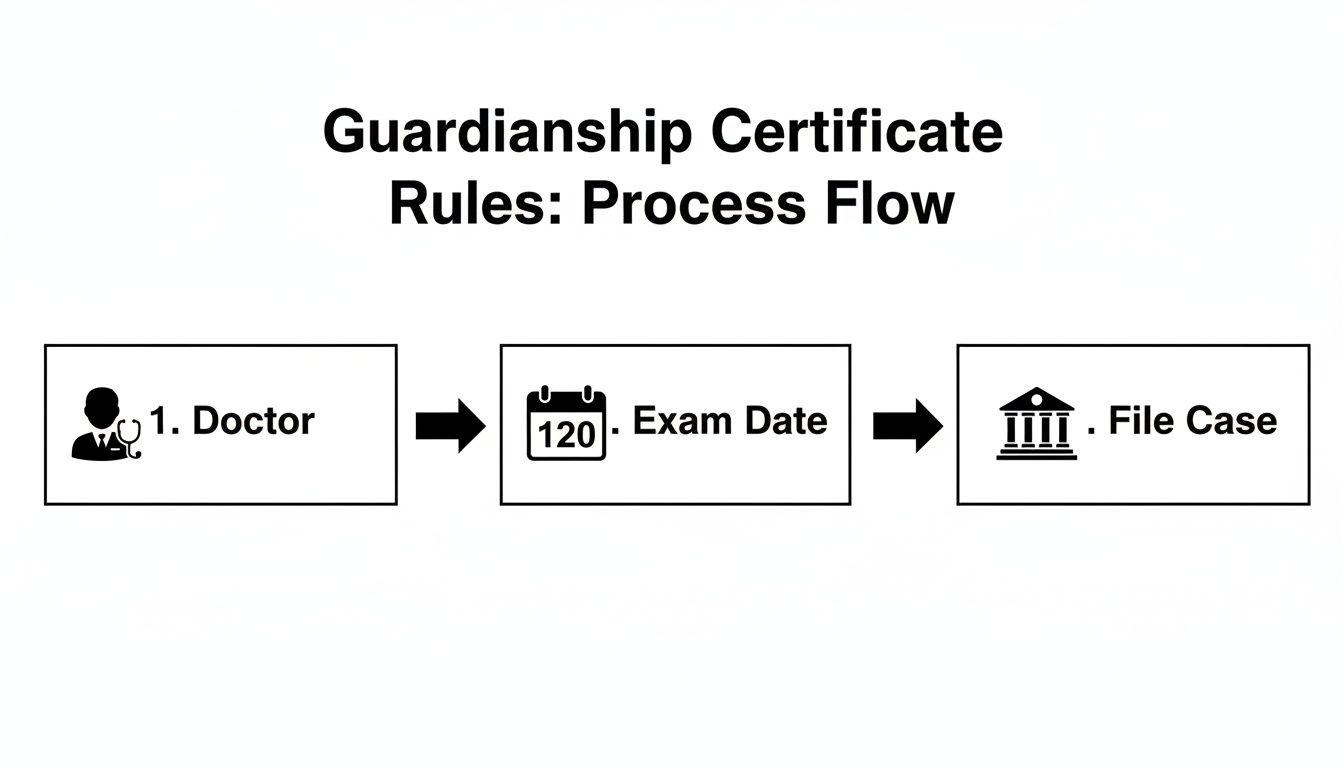
Following this sequence isn't just a good idea; it's a legal requirement. Sticking to the timeline is what keeps your case from being thrown out on a technicality before it even gets started.
Guiding The Conversation With The Physician
At the appointment, be direct. Explain that the exam's purpose is to evaluate your loved one's capacity for a guardianship case. Most doctors are medical experts, not legal ones, so they need you to clarify the goal.
This is where your log of examples comes in. Instead of saying "Mom is forgetful," you can say, "On Tuesday, Mom left the stove on for three hours," or "Last week, she tried to pay the water bill with a grocery store coupon." These real-life stories are far more powerful and give the doctor the concrete evidence needed to assess your loved one’s ability to manage their own life.
Remember, doctors take documentation very seriously. To capture the fine details of an examination accurately and securely, they might use tools like HIPAA-compliant transcription software. This is just one part of their professional duty to handle sensitive health information with care.
The best certificates are always the result of a team effort. Your firsthand knowledge of your loved one's daily struggles, combined with the doctor's medical expertise, creates the compelling evidence a judge needs to see.
When you treat the physician's appointment as a collaborative effort, you empower the doctor to write a detailed, defensible, and legally sound certificate that will stand up to judicial scrutiny. This teamwork is fundamental to building a strong case for guardianship.
Common Mistakes On The Physician Certificate And How To Avoid Them
The physician’s certificate is the single most important piece of evidence in your guardianship case. Think of it as the engine that drives the entire legal process forward. Even a small error on this form can cause the whole thing to grind to a halt.
A seemingly minor mistake can lead to frustrating delays, drive up legal costs, or even cause a judge to dismiss your case entirely. Understanding the common pitfalls before you start is the best way to make sure the document you submit is perfect and powerful.
By being proactive, you can work with your attorney and the doctor to create a certificate that gives the court the clear, legally-required evidence it needs to act.
Vague Descriptions of Incapacity
One of the most frequent and damaging mistakes we see is when a doctor uses vague, general language to describe a loved one’s condition. Phrases like "patient is confused" or "has memory problems" just won’t cut it for a Texas probate court judge.
The court doesn’t need jargon; it needs specific, concrete details that connect a medical diagnosis to real-world limitations.
- The Mistake: Using subjective terms without hard examples.
- The Solution: Before the exam, jot down a simple log of your loved one’s recent challenges. Note specific incidents, like forgetting to take vital medications, leaving the stove on, or giving money to a phone scammer. Sharing this list with the physician gives them the exact ammunition they need to write a specific and compelling certificate.
For instance, instead of "struggles with finances," the doctor can state, "Patient is unable to perform simple calculations required to pay bills and does not recognize the value of currency, making them highly susceptible to financial exploitation." This is the kind of detail a judge in Harris County or Dallas County needs to see.
Ignoring Less Restrictive Alternatives
Texas law is crystal clear: guardianship is a last resort. Because it involves removing a person's civil rights, the court has to be absolutely convinced that no less restrictive alternative will work. A physician's certificate that skips over this critical point is incomplete and will be rejected.
A physician must explicitly state on the certificate why alternatives like a Power of Attorney, a supported decision-making agreement, or a trust are insufficient to protect the proposed ward. This is not optional; it is a direct requirement under the Texas Estates Code.
To get this right, you need to discuss these alternatives with the doctor. Explain why a Power of Attorney isn't enough—maybe your loved one no longer has the capacity to sign one, or they are now revoking it due to paranoia. This conversation arms the doctor with the information needed to include a professional opinion that guardianship is the only viable option left to ensure safety.
Using an Outdated or Incorrect Form
Courts update their required forms all the time, and using an old version is an unforced error that causes immediate delays. Many probate courts have their own preferred format, and submitting the wrong one just signals to the judge that you're unprepared.
The fix for this is simple. Your first step should always be to consult with a guardianship attorney. An experienced lawyer will give you the most current, court-approved physician certificate for guardianship Texas form, ensuring the doctor starts with the right document from day one.
By tackling these potential mistakes head-on, you can streamline the legal process, reduce your family’s stress, and build a much stronger case for protecting your loved one.
Why An Experienced Guardianship Attorney Is Essential
While the physician's certificate is the core piece of medical evidence, guardianship is a legal process, not a medical one. A doctor can diagnose incapacity, but it takes a skilled attorney to translate that medical opinion into a successful legal outcome within the strict framework of Texas law.
Trying to navigate this process on your own can be incredibly overwhelming, especially when your family is already under the emotional strain of a loved one’s declining health. Think of an experienced guardianship lawyer as your guide, making sure every single step—from working with the doctor to representing you in court—is handled correctly.
When Legal Guidance Is Non-Negotiable
In some situations, having an attorney isn’t just a good idea; it’s absolutely critical. Attempting to handle these complex scenarios by yourself could easily jeopardize the entire case and, most importantly, your loved one's well-being.
Hiring legal counsel is essential when:
- Family Members Disagree: If siblings, children, or other relatives can't get on the same page about the need for a guardianship, a simple filing can quickly spiral into a bitter and contested legal fight. This is a common guardianship dispute that requires careful legal navigation.
- The Proposed Ward Contests It: Your loved one has every legal right to oppose the guardianship. When this happens, you will need an attorney to present clear and convincing evidence to the judge.
- The Estate Involves Complex Assets: Managing real estate, investments, or a family business requires specific legal authority and a deep understanding of fiduciary duties. A guardianship of the estate must be structured perfectly to avoid legal and financial mistakes.
A good attorney makes sure the physician certificate for guardianship in Texas is flawless and that every other requirement under the Texas Estates Code is met. They will be your advocate in the Harris County Probate Court or any other Texas court, building a strong case for why guardianship is the least restrictive—and most necessary—option available.
A doctor's note proves a medical need, but a lawyer's guidance is what secures legal protection. Their role is to translate medical facts into a compelling legal argument that persuades a judge to act in your loved one's best interest.
We understand that you are facing a difficult and emotional journey. You don’t have to walk this path alone. The compassionate attorneys at The Law Office of Bryan Fagan are here to provide the clarity and direction your family needs. We can help you explore all your options, from initiating a Guardianship to understanding related matters like Probate and Estate Planning.
Schedule a free consultation with our team today. Let us help you protect the person who matters most.
Frequently Asked Questions About The Physician Certificate
It's completely normal to have a lot of questions when you're dealing with the physician certificate for guardianship in Texas. This is a critical piece of the puzzle, and getting it right can feel overwhelming. Families often run into the same practical concerns, so we've put together some straightforward answers to help you prepare for what’s ahead.
We hope this clears things up as you take these important steps to protect someone you love.
What If Our Family Doctor Refuses To Complete The Certificate?
It’s definitely a setback when a trusted family doctor is unwilling to complete the certificate. This happens more often than you might think. Some doctors just aren't comfortable stepping into a legal arena, or they may not have experience with the specific language the court needs to see.
If this happens, don't panic. You have other excellent options. Your guardianship attorney will have a network of physicians, like geriatricians or neurologists, who are very experienced with these specific capacity evaluations. They know exactly what the court is looking for and how to document it properly. This is one of the many practical steps an attorney can help you with.
Can The Physician Certificate Be Challenged In Court?
Yes, it absolutely can be. The proposed ward has every right to contest the guardianship, and that includes challenging the medical evidence presented in the certificate. Other family members or interested parties can also voice their objections to the court. This is a common form of guardianship dispute.
When the certificate is challenged, the opposing side will likely hire their own medical expert to perform an independent evaluation. If the probate court in Harris County or Bexar County is presented with two conflicting medical opinions, the judge will often appoint a neutral, third-party physician to conduct an examination and break the tie.
How Much Does It Cost To Get The Certificate?
The cost for the medical exam and the doctor's time to fill out the form is a separate expense from your attorney's fees. The price can vary quite a bit, depending on the doctor's specialty, their location, and the complexity of the evaluation.
Be prepared for this to be an out-of-pocket cost. While health insurance might cover the medical examination itself, it almost never pays for the administrative time a doctor spends on legal paperwork. We understand the financial challenges families face, and it's best to think of this as a foundational investment in the process of protecting your loved one.
Must The Proposed Ward Go To The Court Hearing?
Legally, the proposed ward has a fundamental right to be at their own guardianship hearing. In fact, judges strongly prefer to see them in person. This gives the judge a chance to speak with them directly and make their own observations about their condition.
However, the court also understands this isn't always possible or safe. If the physician certificate for guardianship in Texas states that appearing in court would be medically harmful or pointless because of their condition, their attendance can be waived. Your attorney will file a formal motion with the court, using the doctor's signed opinion as the key piece of evidence to excuse their appearance.
Navigating the complexities of guardianship requires not just medical evidence but skilled legal guidance. The experienced team at The Law Office of Bryan Fagan, PLLC is dedicated to helping Texas families protect their loved ones with compassion and clarity. If you are feeling overwhelmed or unsure of the next steps, we are here to help. Schedule a free, no-obligation consultation today by visiting us at https://texasguardianshiplawyer.net.