Skip to content
When you see a loved one, like an aging parent, struggling to make safe and sound decisions, it’s a deeply concerning experience. An incapacity hearing in Texas is the formal court process for determining if that person can no longer manage their own affairs. This legal step, often part of a guardianship case, is designed to see if a guardian needs to be appointed to handle their personal or financial matters because they are found to be legally incapacitated.

What Is the Purpose of an Incapacity Hearing?
While the idea of a court hearing can be intimidating, we understand the emotional challenges families face. The core purpose of an incapacity hearing is to protect someone who can no longer protect themselves. Think of it less as a trial and more as a formal safety assessment led by a judge, ensuring your loved one has the support they need to navigate life's challenges.
This is a significant step, and the court's job is to carefully balance a person’s safety against their individual freedom and dignity. A judge does not take the responsibility of removing someone's rights lightly. The goal is always to provide necessary protection while preserving as much of their independence as possible, a principle guided by the Texas Estates Code.
The People Involved in the Hearing
When you step into a Texas courtroom, such as a Harris County Probate Court, for an incapacity hearing, you'll see a few key players. Knowing who’s who can demystify the process and help you feel more prepared. This table breaks down the essential roles you'll encounter.
Key Roles in a Texas Incapacity Hearing
| Role or Concept | Who They Are or What It Means | Primary Responsibility |
|---|---|---|
| Proposed Ward | The person the hearing is about—your parent, spouse, or loved one. | To have their rights and best interests represented. They can attend the hearing and object to the guardianship. |
| Applicant | The person who started the guardianship process by filing the application. | To present evidence showing why a guardianship is necessary for the proposed ward's protection. |
| Attorney Ad Litem | An independent attorney appointed by the court. | To advocate for the proposed ward's wishes and best interests, acting as their personal lawyer in the case. |
| Court Investigator | An impartial individual who works for the court. | To investigate the facts, interview the people involved, and provide an unbiased report to the judge. |
This cast of characters is designed to ensure a fair and thorough review of your loved one's situation. Facing this process can be difficult, but you are not alone. Texas has seen a steady rise in guardianship filings as our population ages, and courts are well-versed in these sensitive matters. You can learn more about national trends and legal precedents on the Department of Justice website.
Defining Legal Incapacity in Texas
The entire hearing revolves around one central question: is the proposed ward legally "incapacitated"? Under the Texas Estates Code, this term has a very specific definition. It goes far beyond occasional forgetfulness or making a few questionable choices.
A person is legally incapacitated if, because of a physical or mental condition, they are substantially unable to provide food, clothing, or shelter for themselves, to care for their own physical health, or to manage their own financial affairs.
— Texas Estates Code, Title 3, Subtitle G.
Meeting this high standard requires "clear and convincing evidence," which is why a physician’s sworn statement is a mandatory part of the process. This isn't just a family disagreement; it's a serious legal proceeding with life-altering consequences, and it's a decision the court approaches with utmost care.
At The Law Office of Bryan Fagan, we understand the immense emotional weight of this decision. If you're considering a Guardianship for a loved one, our team is here to provide clarity and compassionate support. Schedule a free consultation with us today to talk through your family’s unique situation.
Understanding the Legal Standard for Incapacity
How does a Texas court actually decide if a loved one is legally incapacitated? This is the core question at any incapacity hearing in Texas, and the answer isn't as simple as you might think. A judge can't strip away someone's rights because a family member is worried or because of a few instances of bad judgment. The law demands a much higher level of proof.
The decision must be grounded in "clear and convincing evidence." This standard is much higher than in other civil cases. It means the proof must be so strong that it produces a firm belief or conviction in the judge's mind that the claims are true.
What Incapacity Means in a Texas Court
Under the Texas Estates Code, "incapacity" isn't about making a few questionable choices. We all do that. Instead, it’s about a consistent, substantial inability to handle personal care or financial matters because of a specific physical or mental condition.
Here’s a practical example to simplify this complex issue: Misplacing your car keys is a common frustration. Forgetting what car keys are for, or how to operate a car entirely, points to a much more fundamental problem. The court is looking for the latter—a significant breakdown in the ability to manage essential life tasks.
The Texas Estates Code (Title 3, Subtitle G) defines an incapacitated person as an adult who, because of a physical or mental condition, is substantially unable to:
- Provide food, clothing, or shelter for themselves.
- Care for their own physical health.
- Manage their own financial affairs.
This legal definition is very precise. It's designed to protect a person's individual rights and ensure that guardianship is only ever used as a last resort when it is absolutely necessary. The court's focus is on specific, functional limitations, not just a medical diagnosis.
Partial vs. Total Guardianship: A Tailored Approach
Texas law understands that every person's situation is different. That's why it strongly favors the “least restrictive alternative.” This means a court will only grant the specific powers a guardian needs to protect the proposed ward, and nothing more. This philosophy often leads to a partial guardianship instead of a total one.
Partial Guardianship: The court pinpoints the exact areas where the person needs help—like managing a bank account or consenting to medical procedures—while leaving all their other rights untouched. For example, a person might have a guardian for their finances but still retain the right to vote and decide where they live.
Total Guardianship: This is reserved for the most serious cases where a person is completely unable to care for themselves or their property. It's a profound legal step, as it removes nearly all of the person's civil and legal rights.
A probate judge in a Harris County or Bexar County court will meticulously review the evidence to determine the exact level of support needed. The Physician's Certificate of Medical Examination (CME), for example, will detail which specific tasks the proposed ward can and cannot handle. This allows the judge to tailor a guardianship order that preserves as much of your loved one’s independence and dignity as possible. The process of proving incapacity in Texas courts is detailed and requires careful preparation.
This compassionate approach recognizes that needing help in one part of your life doesn't mean you've lost the ability to make choices in all the others. At The Law Office of Bryan Fagan, we can help you understand these important distinctions and advocate for a solution that genuinely serves your loved one's best interests. Schedule a free consultation to discuss the specifics of your situation.
Navigating the Incapacity Hearing Process Step by Step
When a loved one can no longer make safe decisions, the Texas legal system provides a structured process to protect them. This journey, involving an incapacity or guardianship hearing, can feel overwhelming. But understanding the practical steps can empower you. Let's walk through the timeline, step by step.
It all starts when someone, called the applicant, files an Application for Appointment of Guardian. This formal document is submitted to the local probate court—like the ones in Harris County or Dallas County—that handles these sensitive cases. The application explains to the court why you believe a person (the "proposed ward") is incapacitated and needs the protection of a guardian.
Key Milestones in the Guardianship Timeline
Once that application is on file, the court sets several things in motion, all designed to protect the rights of the person at the center of the case. First, the judge will appoint an attorney ad litem. This is an independent lawyer whose only client is the proposed ward. Their job is to represent the ward's best interests and personal wishes, whatever those may be.
At the same time, a court investigator is assigned to the case. Think of them as the court's neutral eyes and ears. They will interview the proposed ward, the applicant, and other family members or caregivers. Their findings are then compiled into a report for the judge, offering an unbiased look at the situation.
This process helps the court distinguish between a simple mistake—like misplacing car keys—and true legal incapacity, which might involve not understanding what a key is for.
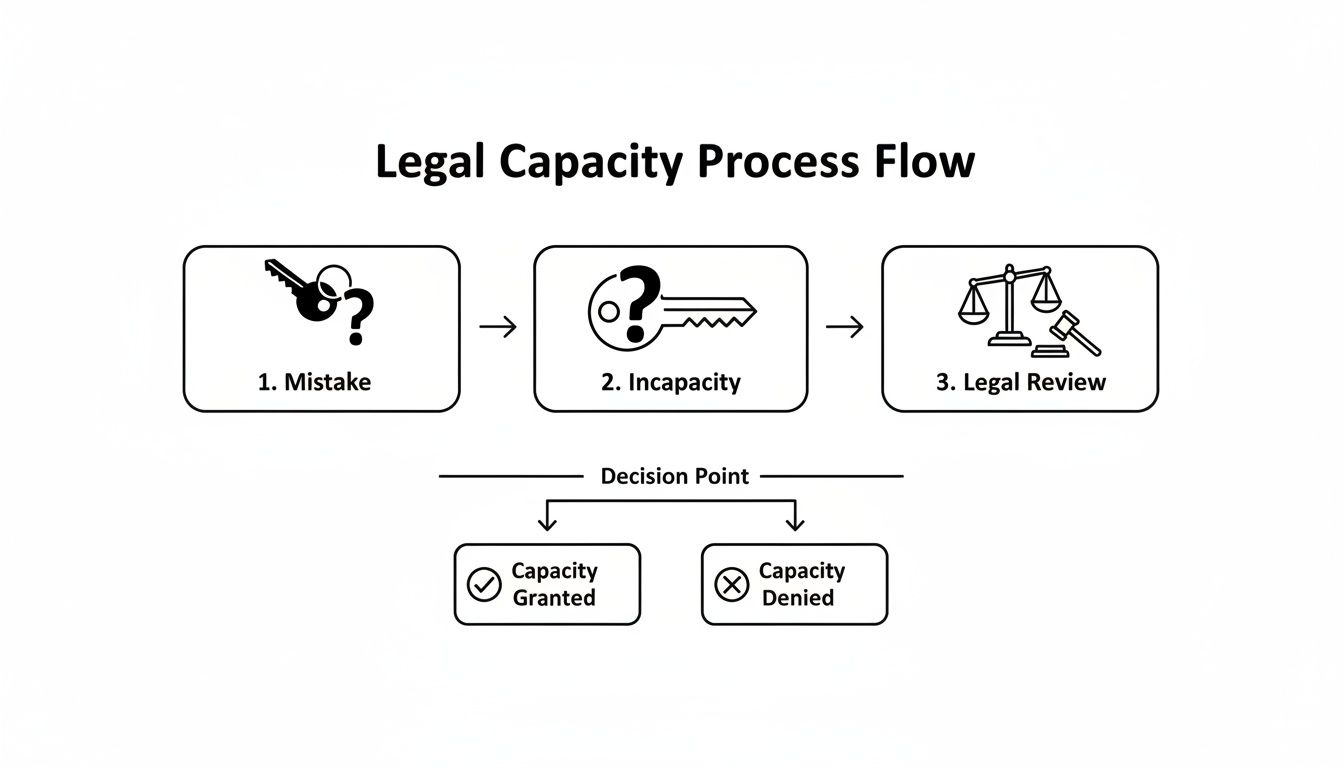
As the flowchart shows, an isolated mistake is just that. A pattern of being unable to care for oneself, however, triggers a legal review that leads to a formal court decision.
The Critical Role of Medical Evidence
In a Texas incapacity hearing, one piece of evidence stands above almost all others: the Physician's Certificate of Medical Examination (CME). This isn't just any doctor's note. It's a specific, sworn legal form required by state law.
A doctor must physically examine the proposed ward and fill out this detailed certificate, giving their medical opinion on the person's condition and how it limits their ability to function.
The CME is the sworn testimony of a physician, outlining the nature, degree, and severity of the person's incapacity. Critically, the exam must have been performed within 120 days of filing the application. An old or incomplete CME can bring your case to a halt, causing major delays or even dismissal.
This document truly is the cornerstone of the case. Judges lean heavily on this expert medical assessment when deciding if the high legal bar for declaring someone incapacitated has been met.
The Final Steps Leading to the Hearing
Before the court date, formal notice must be sent to all legally required parties, including close family members. This is a fundamental right—it ensures everyone has a chance to participate and be heard by the court.
As the hearing gets closer, you and your attorney will be in high gear, pulling together all the evidence. This includes financial records, preparing witnesses to testify, and, of course, making sure that critical CME is in order. For more in-depth tips, you can check out our guide on how to prepare for a guardianship hearing in Texas.
These hearings are more common than you might think. Texas courts in major hubs like Travis County (Austin), Bexar County (San Antonio), and Tarrant County (Fort Worth) are particularly busy. While an uncontested case may proceed smoothly, a contested one can easily see its timeline double. You can find more of these statewide judicial statistics on the Texas Judicial Branch website.
The hearing is the final step, where the judge considers all the evidence and listens to live testimony before making a decision. At The Law Office of Bryan Fagan, we guide families through every one of these steps with compassion and clarity. If this is a journey you’re facing, schedule a free consultation with us to make sure you're prepared.
Presenting Persuasive Evidence to the Court
At an incapacity hearing in Texas, the judge’s decision hinges entirely on the evidence you present. The standard is high—you must prove your case with "clear and convincing evidence." Your job is to paint a vivid, factual picture for the court, demonstrating why your loved one needs this protection.
Think of it less like a legal argument and more like telling a story with empathy. It’s not enough to simply state that a loved one is confused. You have to show it.
For example, saying "Mom gets confused with her finances" is too vague. A far more powerful approach is providing a specific, hypothetical scenario: "Last Tuesday, my mother tried to pay her electricity bill with a grocery store coupon and became extremely distressed when it was rejected." This concrete detail helps the judge grasp the real-world challenges your loved one is facing.
The Foundation of Your Case: Medical Evidence
The absolute cornerstone of any guardianship case is solid medical documentation. Without it, your case has little chance of succeeding. While several documents are important, the Physician's Certificate of Medical Examination (CME) is the most critical piece of the puzzle.
A key step is gathering a full medical history; understanding how to properly use a medical records request form is invaluable here. These records create a timeline of your loved one’s declining health and back up the doctor's formal opinion in the CME.
Your attorney will help you collect several types of medical evidence to build a comprehensive case for probate courts in counties like Travis, Bexar, or Tarrant.
- Physician’s Certificate of Medical Examination (CME): This is the mandatory, foundational document. In it, a doctor gives a sworn opinion on the proposed ward's physical and mental condition.
- Medical Records: This includes notes from doctor visits, hospital discharge papers, and reports from specialists like neurologists or psychiatrists. These documents show the history of the underlying condition causing the incapacity.
- Medication Lists: A current list of all prescribed medications can show the complexity of their health problems and highlight side effects that might impact their cognitive function.
Beyond Medical Reports: Personal Testimony and Financials
While medical evidence is the foundation, it doesn't tell the whole story. The court also needs to see how your loved one's condition impacts their ability to function day-to-day. This is where personal testimony and other documents become incredibly important.
An experienced attorney from The Law Office of Bryan Fagan can guide you on how to present your testimony in a way that is both compassionate and fact-based. The key is to focus on objective observations, not subjective opinions.
The judge is looking for a pattern of behavior that clearly shows an inability to self-manage. This pattern is often established through a combination of different evidence.
Types of Supporting Evidence:
| Evidence Category | Examples | Why It's Important |
|---|---|---|
| Witness Testimony | Family, caregivers, or friends describe specific incidents of confusion, unsafe actions, or difficulty with daily tasks. | Provides real-world context and personalizes the medical reports for the judge, showing the human impact. |
| Financial Records | Unpaid bills, bank statements showing strange withdrawals, or collection letters from creditors. | Demonstrates an inability to manage financial affairs, a key component of incapacity under the Texas Estates Code, Title 3, Subtitle G. |
| Photographs or Videos | Images showing unsafe living conditions, like extreme hoarding, broken appliances, or a lack of food in the home. | Offers powerful, visual proof of an inability to provide for one's own basic needs for shelter and well-being. |
| Court-Appointed Reports | The official findings from the Court Investigator and the Attorney Ad Litem assigned to the case. | These give the judge objective, third-party assessments of the proposed ward’s situation. |
Building a strong case for an incapacity hearing in Texas requires a thoughtful and organized approach to gathering all these pieces. It’s about weaving together medical facts, financial realities, and personal stories to show the court exactly why a guardianship is not just helpful, but necessary.
Facing this process can be an emotional marathon. The compassionate attorneys at The Law Office of Bryan Fagan are here to help you navigate every step. Contact us today for a free consultation to discuss how to build the strongest possible case for your loved one.
How to Handle Contested Hearings and Family Disputes
While many guardianship proceedings are straightforward, family disagreements can quickly turn an incapacity hearing in Texas into a contested legal battle. These disputes are deeply personal and emotionally draining, often flaring up when loved ones simply can't agree on what’s best for a parent or relative.
When this happens, the process is no longer just about presenting evidence to a judge. It becomes a complex negotiation of family dynamics, all playing out under the court's watchful eye.
Common guardianship disputes can arise from several sources. Siblings might disagree on whether a parent is truly incapacitated, or they may argue over which one of them is best suited to serve as guardian. Sometimes, the proposed ward themselves—exercising their full legal rights—will object to the guardianship entirely, insisting they are perfectly capable of managing their own life.
When Family Disagreements Go to Court
Once a hearing becomes contested, the entire dynamic shifts. The timeline almost always gets longer, the financial and emotional costs rise significantly, and the toll on the family can be immense. What should have been a collaborative effort to protect a loved one can start to feel like a full-blown trial with opposing sides.
A contested hearing demands a more rigorous legal strategy. Your attorney will need to gather far more extensive evidence, potentially hire expert witnesses, and prepare for cross-examination. This is where having an experienced guardianship lawyer becomes absolutely essential.
A contested hearing requires a lawyer who is not only a skilled litigator but also a compassionate guide. Their job is to fiercely advocate for your position while also looking for opportunities to de-escalate conflict—always keeping the proposed ward’s best interests front and center.
Many of these cases are rooted in mental health crises. Understanding the intersection of mental health and the legal system can provide important context for these disputes. You can read the full research about mental health and the justice system to get a better handle on these national trends.
Common Pitfalls and How to Prepare
In a contested guardianship, emotions run high, and that's when mistakes happen. It is vital to stay focused on the legal standard of incapacity and the best interests of your loved one, rather than getting sidetracked by old family grievances.
Here are some practical steps and strategies for navigating these difficult situations:
- Focus on Facts, Not Feelings: Center your arguments on concrete, provable evidence. Instead of saying, "My brother is just irresponsible," provide factual proof like, "My brother has four creditor judgments against him." Facts win cases.
- The Proposed Ward’s Rights: Remember, the proposed ward has a powerful voice. The court will appoint an attorney ad litem to represent their wishes, and the judge will give those wishes serious consideration, as required by the Texas Estates Code, Title 3, Subtitle G.
- Mediation as an Option: Before you dig in for a court battle, mediation can be a powerful tool. A neutral third-party mediator helps families find a solution everyone can live with, which can save an incredible amount of time, money, and heartache.
- Choose the Right Guardian: If multiple people want to be the guardian, the court will decide based on who is most qualified and best suited. The judge looks at factors like physical proximity, financial stability, and the nature of their relationship with the proposed ward.
Handling a contested incapacity hearing in Texas is a delicate balancing act. At The Law Office of Bryan Fagan, we have guided countless families through these difficult disputes. If you see a conflict on the horizon or are already in the middle of one, schedule a free consultation with us today.
Life After the Hearing: Your Responsibilities as Guardian
The judge's decision in an incapacity hearing in Texas isn't the final chapter; it’s the beginning of a new one. Once the court appoints you as guardian, you’re stepping into a role of profound trust to protect your loved one, who is now known as the "ward." This new role comes with specific legal duties you must fulfill, starting immediately and continuing for the entire duration of the guardianship.

Your first tasks begin the moment the hearing concludes. You'll need to formally qualify to serve as guardian, which involves taking a sworn oath before the court. In this oath, you promise to faithfully carry out your duties with the ward's best interests at heart.
Taking Control and Establishing Your Role
After you take the oath, the probate court will issue "Letters of Guardianship." Think of this document as your official proof of authority, empowering you to act on the ward's behalf. Depending on the situation, especially if you're managing your loved one’s finances, the court will also likely require you to post a bond.
A bond is essentially an insurance policy that protects the ward’s assets from any potential mismanagement. Once the bond is secured and the Letters are issued, you must begin the vital task of identifying and taking control of all the ward’s property.
Within 60 days of your appointment, you must file a detailed Inventory, Appraisement, and List of Claims with the court. This document serves as a complete financial snapshot of everything the ward owns and owes—from bank accounts and real estate to personal belongings and outstanding debts.
Ongoing Duties and Your Fiduciary Responsibility
Your job doesn't stop after these initial steps. As a guardian, you have a fiduciary duty to your ward. This is the highest standard of care the law recognizes, legally binding you to act with absolute loyalty and solely in the best interest of the person you're protecting.
This duty is a continuous obligation that the court monitors to prevent any neglect or exploitation. The Texas Estates Code requires you to submit regular reports to ensure transparency and accountability, part of guardianship compliance.
As a guardian, you are not just a helper; you are a fiduciary. Every decision you make—from medical choices to financial transactions—must be guided by what is best for your ward, free from any personal self-interest. This is the ethical and legal core of guardianship.
To prove you're upholding this standard, you'll need to file annual reports with the court.
- Annual Report on the Condition and Well-Being of the Ward: This yearly filing updates the court on the ward's living situation, health status, and overall care. It's how the court verifies their personal needs are being met.
- Annual Account: If you are the guardian of the estate, you must also file a detailed financial report each year. This accounting lists every dollar that came into and went out of the ward's estate, complete with receipts and supporting documents.
Getting a handle on these ongoing tasks is critical. To help you prepare, you might be interested in our guide on the responsibilities of a legal guardian, which provides a more detailed breakdown. These duties often intersect with other legal areas, such as Estate Planning and Probate, underscoring the need for a comprehensive approach to fully protect your loved one.
The path of a guardian is demanding, but it is also incredibly meaningful. If you have questions about what your duties will look like after an incapacity hearing, The Law Office of Bryan Fagan is here to provide the clarity and support you need. Schedule a free consultation with our compassionate team to discuss your family’s unique situation.
Frequently Asked Questions About Incapacity Hearings
The road to a Texas guardianship is often paved with questions. We’ve put together straightforward answers to the most pressing concerns families have when they’re facing an incapacity hearing in Texas.
How Much Does a Texas Incapacity Hearing Cost?
The final bill for a guardianship can vary wildly, depending on the case’s complexity and the financial challenges involved. The basic expenses include your attorney’s fees, court filing costs (which differ in every county), the fee for the court-appointed attorney ad litem, and the court investigator’s fees. The most affordable path is always an uncontested case where everyone is in agreement.
Things get more expensive quickly if the guardianship is contested. A guardianship dispute—where family members can’t agree, or the proposed ward objects—demands much more from your legal team. Expect more time in court, extensive legal work, and even the need to bring in expert witnesses, all of which drive up the costs.
Are There Alternatives to Guardianship?
Absolutely, and Texas courts actually prefer them whenever they are a viable option. A guardianship is a serious step that removes a person's fundamental rights, which is why it’s always treated as a last resort. Before filing, it's critical to check if less restrictive tools are already in place.
A well-drafted Estate Planning portfolio can often prevent the need for a court-supervised guardianship altogether, saving families time, money, and emotional stress.
Here are some of the most effective alternatives to guardianship to explore:
- Durable Power of Attorney: This document lets a trusted person (your "agent") handle your financial matters if you become unable to do so yourself.
- Medical Power of Attorney: This appoints an agent to make crucial healthcare decisions for you if you lose the capacity to make them on your own.
- Supported Decision-Making Agreement: This is a fantastic tool that formalizes a support network of trusted advisors who can help an individual with a disability make their own choices, keeping their legal rights intact.
What if There Is an Emergency?
If a loved one is facing immediate, serious physical danger or is at risk of being financially exploited, you can ask the court for an emergency or temporary guardianship. The process is designed to be much faster than a full guardianship, and you can often get a hearing within just a few days.
Under the Texas Estates Code, Title 3, Subtitle G, a judge can grant a temporary guardianship when there's substantial evidence of imminent danger. It's a short-term fix, typically lasting no more than 60 days, designed to stabilize a crisis while you work toward a more permanent solution, such as establishing a full guardianship or terminating the guardianship if the emergency passes.
At The Law Office of Bryan Fagan, we know these questions are just the tip of the iceberg. Our experienced attorneys can offer personalized advice tailored to your family’s unique circumstances, helping you navigate every step with clarity and compassion. To get a better handle on your options, schedule a free, no-obligation consultation with our team today by visiting us at https://texasguardianshiplawyer.net.