Skip to content
When you start to worry that a loved one can no longer take care of themselves, the idea of a mental incapacity guardianship in Texas is often where your mind goes first. It's a serious legal step—a court-supervised process designed to protect adults who have become unable to manage their personal or financial lives because of an illness, injury, or other disability. Think of it as a last resort, a powerful legal tool used only when less restrictive options just aren't enough to keep your loved one safe.
When Guardianship Becomes a Necessary Step
Coming to terms with the fact that a parent, spouse, or even an adult child might need a guardian is an incredibly emotional process. Families often struggle with sadness and a sense of guilt, worried they are taking away a person's independence. It's important, however, to reframe this legal step. It isn't about loss; it's about creating a protective shield for someone you love who has become vulnerable.
In Texas, a guardianship isn't automatically granted just because someone has a diagnosis like dementia or recently suffered a stroke. The court must first find that the person is legally "incapacitated."
Understanding Incapacity Under Texas Law
The Texas Estates Code has a specific definition for this. An incapacitated person is an adult who, due to a physical or mental condition, is substantially unable to do one of three things:
- Provide their own food, clothing, or shelter.
- Care for their own physical health.
- Manage their financial affairs.
This goes far beyond making a few bad choices or having a bad day. A judge, whether in a Harris County Probate Court or elsewhere in Texas, needs to see clear and convincing evidence that the person truly lacks the capacity to handle these essential life decisions. It’s a legal finding, not just a medical label.
To help you get a clearer picture of when guardianship might be on the table, here is a quick guide.
Quick Guide to Considering Guardianship in Texas
This table provides a quick overview of the key factors involved when considering a mental incapacity guardianship.
| Indicator | Legal Standard (Texas Estates Code) | First Action Step |
|---|---|---|
| Self-Care Neglect | Substantially unable to provide food, clothing, or shelter. | Document specific instances of missed meals, poor hygiene, or unsafe living conditions. |
| Medical Non-Compliance | Substantially unable to care for one's own physical health. | Keep records of missed appointments, medication errors, or refusal of necessary care. |
| Financial Instability | Substantially unable to manage financial affairs. | Gather evidence of unpaid bills, unusual transactions, or susceptibility to scams. |
These indicators are not a definitive checklist, but they align with what a court will look for when determining if a guardianship is truly necessary.
Signs That Indicate a Guardianship May Be Needed
While every family's situation is different, certain patterns often emerge that signal it’s time to at least explore legal intervention. These signs suggest a person may no longer be able to protect themselves from harm, neglect, or financial exploitation.
- Neglecting Basic Needs: This could look like consistently forgetting to eat, a noticeable decline in personal hygiene, or letting their home fall into an unsafe or unsanitary state.
- Medical Non-Compliance: This is a major red flag. It includes refusing critical medical treatment, being unable to manage their own medication schedule, or making choices that lead to serious health risks.
- Financial Vulnerability: Are they making completely irrational financial decisions? Have they fallen for scams or given away large sums of money? Are bills going unpaid even when they have the funds?
The need for this type of legal protection is on the rise. In Texas, the guardianship system has experienced significant growth, which unfortunately reflects the growing number of families facing these difficult circumstances. As of August 31, 2017, there were 50,478 active guardianships across the state—a shocking 37% increase in just five years. This trend, detailed in this U.S. Senate report, puts immense pressure on our courts to protect vulnerable adults.
If you see these signs in someone you love, the path forward can feel overwhelming. The Law Office of Bryan Fagan is here to bring clarity and support to your family. Schedule a free consultation with our compassionate team to discuss your specific situation and figure out the best way to protect your loved one.
Your Step-by-Step Guide to the Guardianship Process
Navigating the legal path to establish a mental incapacity guardianship in Texas can feel like an uphill battle, but it’s a journey with a clear, protective purpose. Think of it less as a complex legal maze and more as a structured roadmap. Each step is carefully designed by Texas law to ensure the final decision is thoughtful, protective, and genuinely serves your loved one's best interests.
At its core, the process usually boils down to three key phases: recognizing there’s a problem, consulting with professionals, and then formally taking legal action.
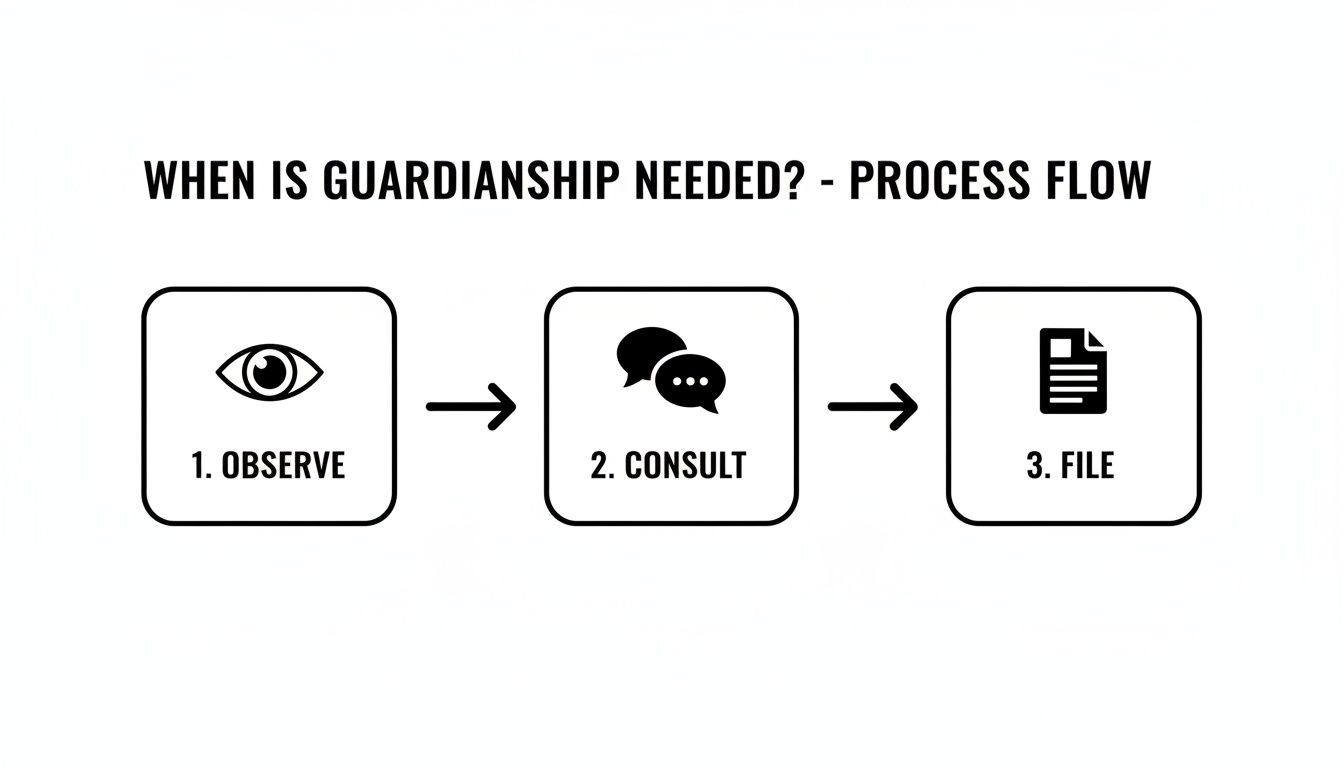
This framework gives you a high-level view, but let's break down exactly what happens once you decide to move forward with the court.
Step 1: Filing the Application
The legal journey officially kicks off when an interested person—most often a family member—files an "Application for Appointment of a Permanent Guardian." This isn't just a simple form; it's a comprehensive legal document filed with the probate court in the county where your loved one resides. Getting the location right, whether it's Harris County, Fort Bend County, or elsewhere in Texas, is the critical first move.
The Texas Estates Code requires this application to include very specific details, such as:
- Information identifying the proposed ward (your loved one).
- The specific facts and circumstances that make a guardianship necessary.
- Details about the person applying to be the guardian.
- A list of the proposed ward’s closest relatives.
One of the most vital documents you’ll file alongside the application is the Certificate of Medical Examination (CME). A licensed physician must complete this form after examining your loved one within the last 120 days. It’s the medical proof the court needs to understand their condition and capacity for self-care.
Step 2: The Court's Protective Investigation
As soon as the application is filed, the court’s own protective measures spring into action. A judge's number one priority here is to safeguard the rights and dignity of the person who is alleged to be incapacitated.
To do this, the court immediately appoints two key, independent parties: an attorney ad litem and a court investigator. This isn't optional; it's a mandatory step designed to give the judge an objective, 360-degree view of the situation.
The attorney ad litem is an independent lawyer whose only client is the proposed ward. Their job is to meet with your loved one, understand their wishes and feelings about the guardianship, and be their voice in court. This ensures their perspective is powerfully represented, even if they can no longer articulate it themselves.
At the same time, the court investigator embarks on an independent fact-finding mission. This person will visit your loved one, evaluate their living situation, review their medical records, and interview family, friends, and caregivers. Their goal is to give the judge an unbiased, boots-on-the-ground report on whether a guardianship is truly necessary and if you are a suitable person to serve as guardian.
Step 3: The Court Hearing
Let's pull all these pieces together with an example. Imagine a family in Houston whose mother has advancing Alzheimer's. The daughter files for guardianship because her mom has started wandering and can no longer manage her bills.
The court appoints an attorney ad litem, who meets with the mother. He finds she’s often confused but clearly expresses a desire to stay in her home. Meanwhile, the court investigator visits, confirms the home is safe for now, but also documents the mother’s cognitive decline and the risks it presents.
All of this information—your application, the doctor's CME, the ad litem’s report, and the investigator's findings—is compiled for the final step: the court hearing. Here, the judge will review every piece of evidence and listen to testimony. You, as the applicant, will need to prove with "clear and convincing evidence" that your mother is legally incapacitated and requires a guardian.
The judge will then make a final decision, always aiming for the least restrictive option that can keep your loved one safe. If you're facing this process, knowing these steps is the first move toward protecting your family member. For personalized advice, the best next step is speaking with an experienced guardianship lawyer.
Proving Incapacity with Medical and Legal Evidence
At the very heart of every Texas guardianship case is the crucial task of proving mental incapacity. This isn't a casual decision a judge can make based on a family's word alone. Far from it. Texas law sets a high legal bar, demanding "clear and convincing evidence" that your loved one can no longer care for themselves or manage their own finances.
What does that actually mean? This standard of proof is much tougher to meet than the "preponderance of the evidence" standard used in many other civil lawsuits. It requires that the evidence presented leaves a judge with a firm belief that the claims are true. This strict requirement is there for a good reason: to protect a person’s fundamental rights and ensure guardianships are only created when there's a solid, undeniable need.

The Cornerstone of Proof: The Certificate of Medical Examination
The single most important piece of evidence you'll need is the Certificate of Medical Examination (CME). Under the Texas Estates Code, this document is mandatory. It must be completed by a licensed Texas physician who has examined the proposed ward within 120 days of when the guardianship application is filed. This is much more than a simple doctor's note; it's a detailed, sworn statement that gives the court a professional medical opinion on the person's condition.
The physician is required to provide very specific information, including:
- A detailed description of the person's physical and mental state.
- An evaluation of their ability to handle daily life—things like eating, getting dressed, and keeping a safe place to live.
- A professional assessment of their capacity to manage their own finances.
- An opinion on whether the incapacity is total or partial, and if it's likely to be temporary or permanent.
Often, the most compelling medical evidence comes from thorough evaluations by professionals who specialize in mental health, like those offering Houston Texas mental health services. This expert opinion truly forms the foundation of your case for a mental incapacity guardianship in Texas. Our firm can guide you through the precise requirements for this critical document, and you can learn more in our guide on the physician's certificate for guardianship in Texas.
How the Court Weighs the Evidence
While the CME is incredibly powerful, a judge in a Tarrant County or Travis County probate court will look at the big picture. The CME is considered alongside other forms of evidence. This often includes testimony from you, other concerned family members, and even friends who have witnessed the decline.
The reports from the court-appointed attorney ad litem and the court investigator also carry a lot of weight. They provide the judge with an unbiased, third-party view of your loved one's situation, helping to paint a complete picture. The judge’s job is to piece all this information together to answer one fundamental question: is a guardianship absolutely necessary to protect this person from substantial harm?
Under Texas Estates Code §1101.101, the court must find that the proposed ward is incapacitated. This legal process is designed to protect individuals from hasty decisions in family disputes, but strict compliance with reporting is an ongoing challenge. For example, in reviewed counties, 32% of cases missed required reports on the ward's person and 44% had no annual accountings filed. You can discover more insights about these findings on FBFK Law.
Partial vs. Total Guardianship
Finally, all the evidence you gather helps the court make another vital decision: whether to establish a total guardianship or a partial guardianship. Texas law strongly favors the "least restrictive alternative." This means the court will only remove the specific rights that your loved one is truly unable to exercise on their own.
For instance, if the evidence shows your parent can still make sound personal decisions but is struggling with their finances, the court might grant a partial guardianship over the estate only. This approach respects their autonomy while providing the needed protection. The detailed evidence you provide is what gives the judge the power to tailor the guardianship to your loved one’s exact needs, preserving as much of their dignity and independence as possible.
Exploring Alternatives to Full Guardianship
Guardianship is a serious legal step, and Texas courts rightly view it as a last resort. Before a judge will appoint a guardian, they must be convinced that no less restrictive options can adequately protect your loved one. This part of the law offers hope, providing families with powerful tools that can preserve a person’s independence while still offering vital support.
Exploring these alternatives isn't just a suggestion; it's a mandatory step in the guardianship process. The goal is to find the most supportive solution that interferes as little as possible with a person’s right to make their own choices. For many Texas families, these alternatives are more than enough to provide the needed protection.
Pre-Planning with Powers of Attorney
The most effective alternatives are those put in place before a person loses the ability to make decisions for themselves. These proactive legal documents allow your loved one to choose, while they are still of sound mind, who they trust to make decisions for them if they become unable to do so.
- Durable Power of Attorney: This document gives a trusted person, known as an "agent," the authority to handle financial matters. This can include paying bills, managing bank accounts, selling property, and filing taxes. The key word here is "durable"—it remains in effect even if the person who created it becomes incapacitated.
- Medical Power of Attorney: This appoints an agent to make healthcare decisions. If your loved one is unable to communicate their wishes, this person can consent to medical treatments, choose doctors, and access medical records, all based on the instructions your loved one provided when they were well.
Imagine your father, concerned about an early dementia diagnosis, signs a Durable Power of Attorney naming you as his agent. A year later, he can no longer manage his bills. Because that document is already in place, you can step in and handle his finances without needing a court's permission, saving time, money, and stress.
Guardianship vs. Power of Attorney a Comparison
To better understand the differences between these two powerful tools, it's helpful to see them side-by-side. Both can be used to manage a loved one's affairs, but they operate under very different circumstances and legal authority.
| Feature | Guardianship | Durable Power of Attorney |
|---|---|---|
| Establishment | Court-ordered process after a finding of incapacity. | Created by the individual (the principal) while they have capacity. |
| Authority | Guardian is appointed by and accountable to the court. | Agent is chosen by the principal. |
| When it's Used | When an individual is already incapacitated and has no POA. | Before incapacity occurs, as a planning tool. |
| Oversight | Requires ongoing court supervision and annual reporting. | Generally private, with no court involvement unless there's a dispute. |
| Cost & Time | Can be expensive and time-consuming to establish and maintain. | Relatively inexpensive and quick to create with an attorney. |
| Flexibility | Less flexible; guardian's powers are defined by the court. | More flexible; the principal can grant broad or limited powers. |
While a Power of Attorney is a proactive measure, a guardianship is a reactive one, used when pre-planning was not possible or is no longer sufficient.
Supported Decision-Making Agreements
What if your loved one can still make decisions but needs help understanding the options and communicating their choices? This is where a Supported Decision-Making Agreement comes in. This is a formal agreement recognized under Texas law that allows an adult with a disability to choose a trusted supporter to help them.
A supporter can help with tasks like gathering information, weighing pros and cons, and communicating a decision. However, the supporter does not have the authority to make the decision for the person. This model empowers individuals, preserving their autonomy while providing a crucial support system.
This alternative is ideal for adults with intellectual or developmental disabilities who are capable of making choices but benefit from guidance. It respects their ability to direct their own lives, keeping them in the driver's seat.
Other Practical Financial Tools
Sometimes, simpler tools can solve specific problems without the need for broad legal authority. These options are often more limited but can be effective in the right situation.
- Joint Bank Accounts: Adding a trusted family member to a bank account can allow them to help pay bills and manage daily expenses. However, this gives the joint owner full access and rights to the funds, so it requires an extremely high level of trust.
- Representative Payee: For individuals receiving government benefits like Social Security or VA payments, you can apply to become a "representative payee." This allows you to manage those specific funds on their behalf to ensure their essential needs are met.
When considering a mental incapacity guardianship in Texas, it's vital to first determine if one of these less intrusive options could work. Each has its own strengths and limitations, and understanding them is key. If you are uncertain which path is right for your family, you can find more information by exploring alternatives to guardianship for adults with disabilities. The Law Office of Bryan Fagan can help you weigh these options compassionately and practically.
Navigating Your Role as a Guardian in Texas
Once a Texas court appoints you as a guardian, the legal process of establishing a mental incapacity guardianship in Texas is over, but a new, deeply meaningful chapter of responsibility begins. This role is built on a foundation of trust and legal duty, and your focus now shifts to the day-to-day responsibilities of protecting your loved one. This guide will walk you through fulfilling those duties with confidence, compassion, and legal precision.

The Texas Estates Code lays out very clear obligations for guardians. These rules are designed to ensure you remain accountable and that the person you're caring for—the ward—is always protected. Your first few steps after being appointed are critical, as they set the tone for your entire guardianship.
Initial Duties and Taking Your Oath
Before you can officially begin acting as a guardian, you have to "qualify." This involves a few key legal steps that formalize your appointment and show the court you’re committed to the role.
- Taking the Oath of Guardianship: You’ll be required to sign a sworn statement, or oath, promising to faithfully perform all the duties of a guardian. Think of it as a solemn promise, made both to the court and to your loved one.
- Posting a Bond: For most guardianships, especially if you're managing money as a guardian of the estate, the court will require you to post a fiduciary bond. This is essentially an insurance policy that protects the ward’s assets from any potential mismanagement. The judge determines the bond amount based on the value of the estate.
- Receiving Letters of Guardianship: After you’ve taken the oath and posted the bond, the court clerk will issue your "Letters of Guardianship." This is the official legal document that proves you have the authority to act on the ward's behalf.
Completing these initial steps is what gives you the legal green light to start managing your loved one’s affairs.
Guardian of the Person vs. Guardian of the Estate
Your specific duties will hinge on the type of guardianship the court has ordered. The Texas Estates Code, specifically under Title 3, Subtitle G, outlines two very distinct roles:
- Guardian of the Person: This role is all about the ward's personal and physical well-being. Your job is to decide where they live, consent to their medical treatment, and make sure they have adequate food, clothing, and a safe environment.
- Guardian of the Estate: This role is purely financial. You'll be responsible for managing the ward’s property, paying their bills, collecting any income they receive, and making sound investments on their behalf.
It’s quite common for one person to be appointed to both roles, but it’s vital to remember they require different skills and, most importantly, separate and meticulous record-keeping.
Your primary duty, above all else, is to act in the ward's best interests. This means making decisions that promote their well-being and protect their dignity, even when it's challenging.
Ongoing Reporting and Fiduciary Duties
Becoming a guardian isn't a one-time event; it's a long-term commitment that involves continuous supervision by the court. This is not a "set it and forget it" role. You have strict reporting requirements to prove you're fulfilling your duties transparently and ethically.
Within 60 days of your appointment, a guardian of the estate must file a detailed Inventory, Appraisement, and List of Claims. This document is a complete catalog of every single asset the ward owns. From there, you must file an Annual Account with the court every year, which details every dollar that came into and went out of the ward's estate.
There's a good reason for this strict oversight. While reforms in Texas guardianship law have aimed for greater accountability, compliance can be a challenge. One review found that an alarming 44% of cases in the counties sampled had missed their required annual accountings. You can read the full research about these guardianship trends to grasp just how critical strict compliance is.
Failing to meet these reporting deadlines can lead to serious consequences, including being removed as guardian. Diligently fulfilling these duties is a cornerstone of your role. For a deeper look into this topic, you can also explore the responsibilities of a legal guardian in our detailed article.
Your Compassionate Guide Through Texas Guardianship Law
When you’re considering guardianship for a loved one, the path forward can feel anything but clear. It's a journey tangled with complex Texas laws and deep family emotions. This is where the Law Office of Bryan Fagan, PLLC, comes in. We act as more than just your lawyers; we become your partners, guiding you with compassion and expertise through every single step.
Our firm was built on the understanding that this process is fundamentally about protecting someone you love. We’re committed to bringing clarity to the confusion and providing the steady support your family needs right now.
We do more than just fill out forms and file them with the court. We build a strategic, supportive relationship with you from day one. That process starts with carefully preparing the initial application, making sure every single detail required by the Texas Estates Code is perfectly in place. From there, we work directly with medical professionals to obtain the crucial physician's certificate that serves as the foundation of your case.
Your Advocate in the Courtroom and Beyond
Our role doesn't end with paperwork. We step up as your family's dedicated advocates, representing your interests in guardianship hearings across Texas. Whether your case is in a Harris County Probate Court or in front of a judge in Dallas, Austin, or San Antonio, our attorneys will be there to present a clear and persuasive case on your behalf.
Our approach is built on a single, unwavering principle: to ensure your loved one receives the protection they need while their dignity and autonomy are honored at every turn. We translate complex legal procedures into plain English, empowering you to make informed decisions.
A Partnership for Your Family's Future
We know firsthand the immense emotional and financial weight that this process can place on a family. It's natural to feel overwhelmed and unsure of what to do next. Our job is to lift that burden by creating a clear roadmap that always puts your loved one's well-being first. Whether it’s navigating disagreements among family members or ensuring every legal box is checked, we will be by your side.
If you are facing the difficult decision of pursuing guardianship, you don't have to walk this path alone. The next step is a simple conversation. We invite you to schedule a free, no-obligation consultation with our team. Let’s talk about your unique situation, explore all the options—from Probate to Estate Planning—and find the best way forward for you and your family.
Common Questions We Hear About Texas Guardianship
When families come to us exploring a mental incapacity guardianship in Texas, it's completely normal to have a long list of questions. This is a major step, and it comes with very real emotional and financial weight. To help you find some clarity, we've put together answers for some of the questions we hear most often from families in your exact situation.
How Much Does a Guardianship Cost in Texas?
This is a practical question, and one of the first things families ask. There isn't a single flat fee for guardianship, simply because the cost depends entirely on how complex your specific family situation is. However, we can break down the typical expenses you should be prepared for.
- Your Attorney's Fees: This covers the legal expert who will represent you, prepare all the necessary legal documents, and stand with you in court.
- Court Filing Fees: Every Texas county, from Harris to Dallas, has its own schedule of fees for filing the application and other court paperwork.
- Attorney Ad Litem Fees: The court will appoint a separate, independent attorney whose only job is to represent the person you're seeking to protect (the proposed ward). Their fees are usually paid out of the ward's funds or by the person applying for the guardianship.
- Court Investigator Fees: An investigator provides an unbiased report to the judge, and their work comes with an associated fee.
- Bond Premiums: If you're appointed as guardian of the estate (managing finances), you'll almost certainly need a fiduciary bond. This is like an insurance policy to protect the ward's assets, and it requires an annual premium payment.
Getting a handle on these potential costs is a crucial first step as you plan for what lies ahead.
Can I Get an Emergency Guardianship?
Sometimes, a crisis hits and you simply can’t afford to wait for the standard guardianship process to play out. For these urgent moments, Texas law provides a tool called a Temporary Guardianship, which is what most people mean when they ask about an "emergency guardianship."
A judge can grant this if there's substantial evidence that a person or their financial estate needs immediate protection. This usually involves a clear and present danger to someone's physical health or a serious risk of them losing a significant amount of money or property very quickly.
A temporary guardianship is a powerful but short-term solution. It usually lasts for no more than 60 days and gives the temporary guardian specific, limited powers to address the immediate crisis while the permanent guardianship case proceeds.
What Happens if Our Family Disagrees on Guardianship?
Family disagreements can make an already stressful process feel even more painful. When one relative objects to the guardianship itself, or perhaps to who is applying to be the guardian, the case becomes a contested guardianship. It's also often helpful for families to expand their legal vocabulary by understanding conservatorship and related concepts.
In a dispute like this, the probate court steps in to be the neutral party. The judge isn't there to take sides or rule based on family drama. Their job is to listen to the evidence and testimony from everyone involved—the applicant, the person objecting, and the independent attorney ad litem.
Ultimately, the court's decision will come down to one thing and one thing only: what is proven by clear and convincing evidence to be in the best interest of the proposed ward.
Trying to answer these questions and manage the guardianship process on your own can be overwhelming. With skilled and compassionate legal guidance, it doesn't have to be. At The Law Office of Bryan Fagan, PLLC, we help Texas families protect their loved ones with the dignity and respect they deserve. If you're facing these tough decisions, schedule a free consultation with our team today by visiting texasguardianshiplawyer.net.