Skip to content
A family member may be struggling with unpaid bills, unsafe living conditions, medication mistakes, or pressure from people who want access to their money. You may be asking, “How do I become guardian of a disabled adult in Texas?” The question often carries fear and guilt. Guardianship can protect a vulnerable adult, but it also removes some legal decision-making authority, so Texas courts require careful proof before granting it.
Texas guardianship is a court-supervised process under Title 3 of the Texas Estates Code. The court must examine the adult's actual ability to make decisions, consider less restrictive choices, and determine whether guardianship serves the person's best interest. The following guide explains the process in plain language, from the first concern through appointment, reporting, modification, or termination.
When a Texas Family Starts Asking About Guardianship
A Houston mother may first notice that her 58-year-old brother is no longer managing his affairs. His bills are piling up, a Medicaid application is pending, and he recently missed an important payment. Their sister lives three hours away and wants to help, but neither sibling knows whether a power of attorney would work or whether the family needs to seek guardianship.
That question commonly appears after a specific event. A hospital may prepare to discharge someone to an unsafe home. A mortgage payment may be missed. A stranger may begin using the adult's bank card. A caregiver may notice wandering, medication errors, or repeated difficulty handling ordinary financial decisions.

These situations create both legal and emotional pressure. Family members may disagree about whether the adult needs protection, who should serve, or how much authority a guardian should have. Meanwhile, the proposed ward may feel frightened or angry because guardianship can affect decisions about medical care, finances, residence, and daily support.
Texas Estates Code Chapter 1101 requires the applicant to prove several elements by clear and convincing evidence. The court must find incapacity, determine that guardianship is in the person's best interest, confirm that the person's rights and property will be protected, and consider whether less restrictive alternatives or available supports could work. The process is not a simple change in status.
Families should also address immediate safety without assuming that every safety tool requires guardianship. For dementia-related wandering or nighttime falls, families may research the benefits of bed alarms for safety while they evaluate medical, legal, and caregiving options.
The central question is not whether your loved one has a disability. It's whether the person currently needs court-appointed protection for specific decisions, and whether a less restrictive solution can provide it.
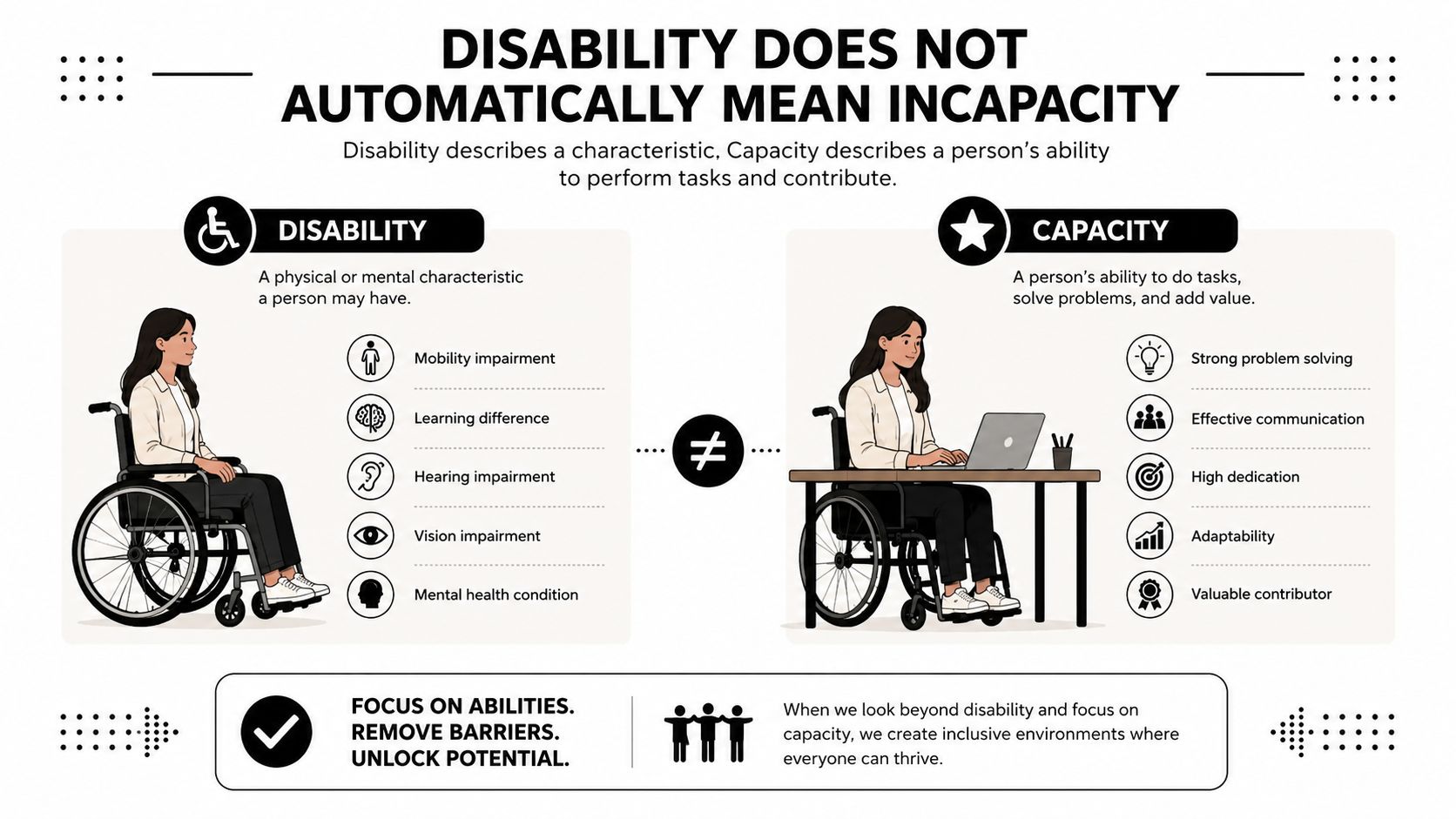
Disability Does Not Automatically Mean Incapacity
A diagnosis alone usually doesn't answer the guardianship question. Disability and legal incapacity are different concepts. TexasLawHelp explains that a person may have a disability without being incapacitated, so a diagnosis such as autism, Down syndrome, schizophrenia, cerebral palsy, or traumatic brain injury doesn't automatically justify guardianship. See the TexasLawHelp guardianship explanation for this important distinction.
Texas Estates Code Section 1002.0175 focuses on incapacity connected to a condition that impairs a person's ability to understand or communicate decisions. The court must look at how the condition affects real tasks, not automatically accept a label in a medical record.
Consider a daughter with cerebral palsy who manages her own bank account, understands her medical choices, and communicates where she wants to live. She may need transportation assistance or help with physical tasks, but those needs don't necessarily show legal incapacity. A veteran with PTSD may need therapy and support while still handling daily decisions, paying bills, and consenting to treatment.
The analysis changes when a condition prevents a person from safely managing essential affairs. For example, advanced dementia may cause recurring missed payments, unsafe medication use, or vulnerability to exploitation. Even then, the applicant must connect the medical condition to specific functional problems.
Texas reforms, including the changes associated with House Bill 39, strengthened the focus on individual rights, presumed capacity, supports, and less restrictive alternatives. In practical terms, a family should ask:
- What decision is difficult? Is the concern medical consent, housing, money, or personal safety?
- What support already works? Can a trusted person help without taking away the adult's authority?
- What evidence shows a pattern? Are there repeated problems rather than one isolated mistake?
This functional approach protects adults who can make some decisions even when they need help with others. It also helps families seek a limited guardianship instead of requesting broader authority than the facts support.
Eligibility, Evidence, and the Filing Strategy
A family may have months of bank notices, medication mistakes, and difficult conversations behind it before anyone files. The court still needs a focused record showing what the adult cannot safely manage and what authority is requested. Texas Estates Code Section 1102.001 identifies people who may apply, including a spouse, parent, adult child, sibling, or another person the court considers proper. Eligibility and residency questions may differ depending on whether the application concerns guardianship of the person, the estate, or both.
Build the record before filing
Texas generally requires a written physician's or advanced practice registered nurse's letter or certificate for an adult guardianship based on a physical or mental condition. Under Texas Estates Code Section 1101.103, the certificate must be dated within 120 days before filing and based on an examination performed within that same period. The statutory certificate requirements call for task-based information about financial management, driving, voting, residence, marriage, and medical decisions.
The certificate should connect the condition to daily functions. “The patient has dementia” gives the court a diagnosis, but repeated unpaid bills, unsafe medication management, inability to recognize financial exploitation, or inability to understand a treatment decision explains the practical risk.
Texas guidance also requires evidence of recurring acts or occurrences in the preceding six months. One missed payment may raise concern. A sustained pattern supported by bank notices, medical records, discharge instructions, texts, caregiver notes, and witness information gives the court a clearer timeline. Organize each item by task and date.
File in the proper court
The application is generally filed in the county where the proposed ward resides, or where the person's facility is located when applicable. In a large county, that may mean a probate court such as Harris County Probate Court. The filing commonly includes the Application for Appointment of Guardian and a Designation of Resident Agent, along with required court filings and fees.
Families can review a detailed guide to the Texas guardianship application before assembling the filing. A useful plain-language overview is How to Get Guardianship in Texas: The Process, which describes the court process step by step. Before filing, ask a Texas guardianship attorney or the clerk of the probate court in the filing county to confirm the current local form, fee, filing, and certificate requirements. A medical letter prepared for another purpose may not satisfy the court.

Organize the evidence by task and date. The court needs to understand what the adult cannot safely do, how often the problem occurs, and why available supports aren't enough.
The Texas Office of Court Administration reported 8,600 guardianship cases filed in 2023, and most involved adults, according to its fiscal year 2023 guardianship statistics. That volume does not predict an individual case's timing or cost. It does show why a precise application, supported by task-specific evidence and narrowly requested powers, matters.
Service, Investigation, and the Court Hearing
Filing the application doesn't end the process, and the hearing isn't a formality. The proposed ward must receive citation, and Texas procedure also requires notice to certain relatives within two degrees and, in relevant circumstances, a person with whom the proposed ward lives. The people entitled to notice have an opportunity to respond, and the case may become contested.
The proposed ward has important procedural rights. The person may appear at the hearing, object to the appointment, present evidence, and ask the court to limit the guardian's authority. A relative may also dispute who should serve or argue that a power of attorney, supported decision-making agreement, or another alternative is sufficient.
What the court investigates
The probate court may appoint professionals to assess the situation. A court investigator can interview the proposed ward in person and examine the proposed guardian's plan. A guardian ad litem may independently investigate and report to the court about the proposed ward's interests.
The judge may review:
- Medical evidence: The physician's or advanced practice registered nurse's certificate and related records.
- Functional history: Recurring conduct involving money, self-care, medication, residence, or safety.
- Financial material: Account statements, unpaid bills, property information, and evidence of possible exploitation.
- Witness testimony: Statements from relatives, caregivers, doctors, social workers, and others with direct knowledge.
- The proposed plan: The guardian's relationship with the adult, ability to serve, and understanding of the responsibilities.
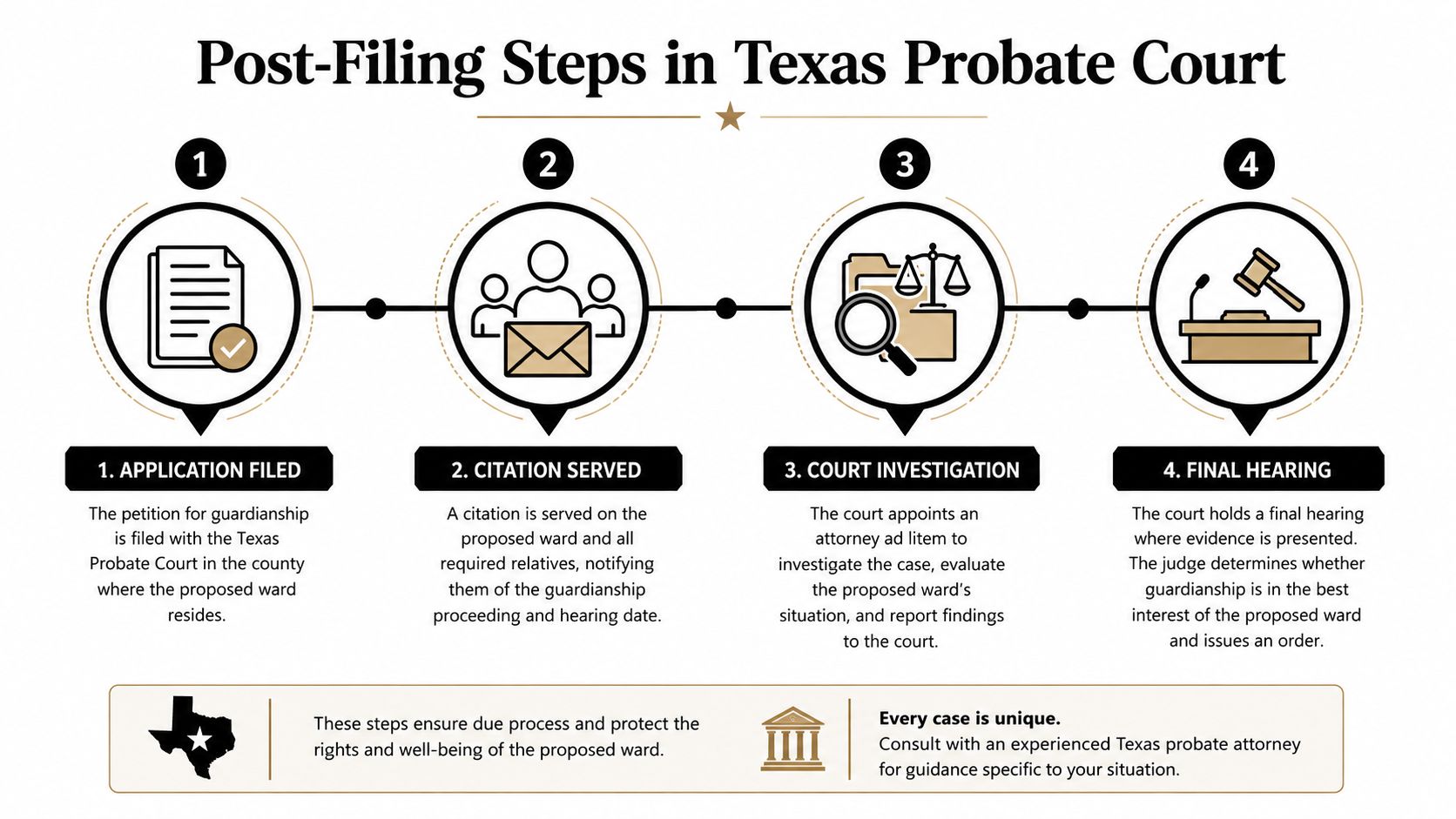
A family preparing for a contested matter may benefit from reviewing the role of evidence in an evidentiary hearing for guardianship in Texas. The court must find incapacity by clear and convincing evidence, decide whether guardianship is in the adult's best interest, and evaluate the proposed guardian's suitability and the possibility of restoration.
The courtroom may be difficult for everyone. A proposed ward can have preferences, abilities, and objections even when the court ultimately finds incapacity. Families should prepare to answer not only what authority they want, but also how they'll preserve the adult's dignity and independence.
Temporary and Emergency Guardianship in Texas
Urgent cases require careful classification. Texas law provides different remedies for immediate danger and short-term needs, and families shouldn't request emergency authority just because the permanent process feels slow.
| Feature | Temporary Guardianship | Emergency Guardianship |
|---|---|---|
| Primary purpose | Provides short-term protection while a broader case proceeds | Addresses an immediate risk of harm |
| Legal showing | The applicant must show probable cause that the person or estate needs immediate appointment | The court requires specific findings supporting imminent harm and emergency action |
| Time limit | A temporary appointment may not exceed 60 days, under Texas Estates Code Section 1251.001 | An emergency order is limited to the emergency period authorized by the applicable statute |
| Process | The court provides the process and hearing required by the statute | The court may act without the usual notice and hearing in narrowly defined circumstances |
| Scope | Authority is limited to what the order grants | Authority is tied to the immediate danger identified by the court |
A temporary guardianship may fit a situation in which a sibling needs protection while the family completes the full case. For example, a proposed ward may face a medical procedure that requires a consent decision during a short window, while the permanent application remains pending.
Emergency relief is more focused. An adult with an intellectual disability who is about to be discharged into unsafe housing, with an immediate risk of exploitation or serious harm, may require urgent court intervention. The applicant still needs current professional evidence and must identify the danger with precision.
The court's order controls what the temporary or emergency guardian may do. A guardian may receive authority over the person, the estate, or a specific urgent issue, but shouldn't assume that temporary appointment grants unlimited power.
When the emergency period ends, the family may need to continue with the standard guardianship case. The proposed ward retains the right to a full hearing on permanent appointment, and the court must still apply the ordinary proof requirements before creating a long-term guardianship.
Alternatives Worth Considering Before Court
Guardianship can solve serious problems, but it may also remove authority that an adult could retain with the right support. Texas Estates Code alternatives include a medical power of attorney, durable power of attorney, representative payee status, joint bank account, management trust, special needs trust, advance guardian designation, and supported decision-making-style options. The Texas State Law Library provides a helpful overview of alternatives to guardianship in Texas.
The right choice depends on the task. A durable power of attorney may help with financial transactions if the adult understands the arrangement and can sign it validly. A medical power of attorney can name someone to make health decisions when the adult cannot do so, while a HIPAA authorization can help a trusted person receive medical information. A representative payee may address benefit payments without placing every part of the adult's life under guardianship.
A supported decision-making agreement takes a different approach. The adult keeps decision-making authority while choosing trusted supporters to help understand information, compare options, communicate choices, or carry out decisions. A person with Down syndrome who manages daily routines with structured help may benefit from this model rather than a full guardianship. Families can learn more about supported decision-making agreements in Texas.
Match the tool to the problem
Ask these questions before filing:
- Capacity: Can the adult understand and communicate the specific decision with support?
- Scope: Is the problem limited to money, medical care, housing, or benefits?
- Reliability: Will the proposed helper act consistently and respect the adult's wishes?
- Urgency: Is immediate harm possible, or can the family plan safely?
- Durability: Will the arrangement continue to work if the adult's condition changes?
A revocable trust or special needs trust may help manage assets, but it doesn't automatically solve medical or residential decisions. A joint account may create access to funds, but it can also create risks and doesn't replace a careful fiduciary plan.
A veteran with advanced dementia who cannot understand treatment choices, manage money, or recognize exploitation may need broader protection. The court may deny or narrow guardianship when a workable alternative can protect the adult's rights and property. That is why families should document both the support they tried and the reason it no longer works.
Guardian Duties, Reporting, and Ending the Guardianship
Appointment creates an ongoing fiduciary responsibility. A guardian of the person must make decisions in the ward's best interest, protect the person's rights, and encourage independence to the greatest extent feasible. A guardian of the estate must manage property and money carefully, keep records, and follow court requirements before taking actions that need approval.
Treat reporting as part of the job
A guardian of the person must generally file an annual report within 60 days of the anniversary of qualification, according to Texas court guidance on guardian reporting and compliance. The report addresses the ward's condition, living situation, visits, care, and other required information. Courts may use Form GC-10 for the annual well-being report.
A guardian of the estate may also need to file an annual accounting, commonly using Form GC-11, with records showing income, expenses, assets, and distributions. Keep bank statements, receipts, invoices, benefit letters, care contracts, and written explanations for unusual transactions.
Texas oversight data shows why these duties matter. In the fiscal-year 2024 annual report, 12% of monitored cases were missing annual reports and 29% were missing annual accounts, according to the state's published guardianship oversight information. Those figures should not be treated as harmless administrative problems. Missing reports or accountings can lead to court scrutiny and other compliance consequences.
Keep guardianship records as if another person will need to understand every decision later. Clear records protect the ward and the guardian.
Seek modification instead of waiting
Guardianship may need to change when the ward's abilities improve, when a different person should serve, or when the ward needs less authority than the original order allowed. A guardian, the ward, or another interested person may ask the court to modify the powers granted.
Termination may be appropriate when the ward regains capacity or no longer needs court protection. The court reviews the evidence and applies the required legal standard, including clear and convincing evidence where the statute requires it. A family shouldn't assume that a guardianship ends automatically because circumstances improved.
A practical compliance file should include:
- Court calendar: Track annual report and accounting deadlines.
- Decision notes: Record the ward's preferences, alternatives considered, and the reason for major decisions.
- Financial records: Separate guardianship funds and preserve supporting documents.
- Medical information: Keep current evaluations and care updates.
- Legal changes: Contact counsel when the ward's capacity, residence, assets, or care needs change.
The Texas Office of Court Administration's reported guardianship caseload, together with ongoing monitoring requirements, reflects a system that continues well beyond the appointment hearing. Families should view guardianship as a continuing relationship with the court, not a one-time filing.
The Law Office of Bryan Fagan, PLLC helps Texas families evaluate alternatives, prepare guardianship applications, address temporary or emergency needs, and handle contested, modified, or terminated guardianships. Visit Law Office of Bryan Fagan, PLLC to schedule a free consultation and discuss the evidence, court, and protection plan that fits your loved one's situation.