Skip to content
For many Texas parents, a child’s 18th birthday is a time for celebration. But if your child has special needs, that milestone often brings a wave of anxiety. Overnight, your legal authority to make critical decisions for them simply vanishes. This is where understanding and establishing a guardianship for a special needs child in Texas becomes so important. It's the legal tool that creates a seamless transition, ensuring you can continue to protect and advocate for your child without interruption.
At The Law Office of Bryan Fagan, we recognize the emotional and financial challenges that come with this process. Our mission is to guide Texas families like yours through guardianship law with clarity and care, turning uncertainty into a secure plan for your child's future.
The Legal Cliff: What Happens When Your Special Needs Child Turns 18 in Texas
The second your child with special needs becomes a legal adult at age 18, the entire landscape of your parental rights changes. The authority you’ve always had to speak with their doctors, manage their finances, or attend school meetings is no longer automatic. This abrupt shift can leave you feeling powerless and your child vulnerable right when they need you most.
Understanding this legal "cliff" is the first step. Without a guardianship or another legal plan in place, you could suddenly be blocked by privacy laws like HIPAA when trying to get medical updates or by school officials when discussing your adult child’s educational plan.
The Critical Legal Shift at Age 18
In the eyes of Texas law, turning 18 means your child is a full-fledged adult with all the associated rights and responsibilities, regardless of their developmental capacity. This legal reality strips parents of their automatic authority over medical care, education, and finances.
This sudden change can create serious risks. For example, a new 18-year-old with developmental disabilities might struggle with managing their own finances or be vulnerable to exploitation. Legally, all those important decisions are now in your child's hands—a responsibility they may not be equipped to handle. It’s why we so often see families starting the guardianship process when their child is around 17½—to get ahead of the problem before it becomes a crisis.

Why Proactive Planning Is Essential
By anticipating this legal cliff, you can act before a crisis hits. Starting the guardianship process before your child’s 18th birthday prevents any gaps in your legal authority to protect them.
The Texas Estates Code, Title 3, Subtitle G, lays out the legal foundation for guardianship. It allows a court to appoint a qualified person—like a parent—to make decisions for an individual who is proven to be incapacitated.
Think about it this way: imagine your 18-year-old has a medical emergency. Without a guardianship, the hospital staff might refuse to even speak with you due to HIPAA privacy rules. With a guardianship already in place, you are legally empowered to step in immediately, consent to treatment, and manage their care just as you always have.
The same logic applies to managing essential government benefits like Supplemental Security Income (SSI) or navigating housing contracts. If you're looking for more detail on how this works, you can find a helpful overview in our guide on the steps for obtaining guardianship of an adult child in Texas.
The goal isn't to take away your child's independence but to provide a vital legal safety net. The team at The Law Office of Bryan Fagan understands the emotional weight of this process. We're here to help you turn that anxiety into a sense of control by securing your child's future.
Navigating the Texas Guardianship Establishment Process
The legal system can feel like an intimidating maze, especially when your child's future is at stake. But when it comes to establishing guardianship for a special needs child in Texas, the process is structured and clear. Think of it less as a maze and more as a well-marked path designed to protect your child.
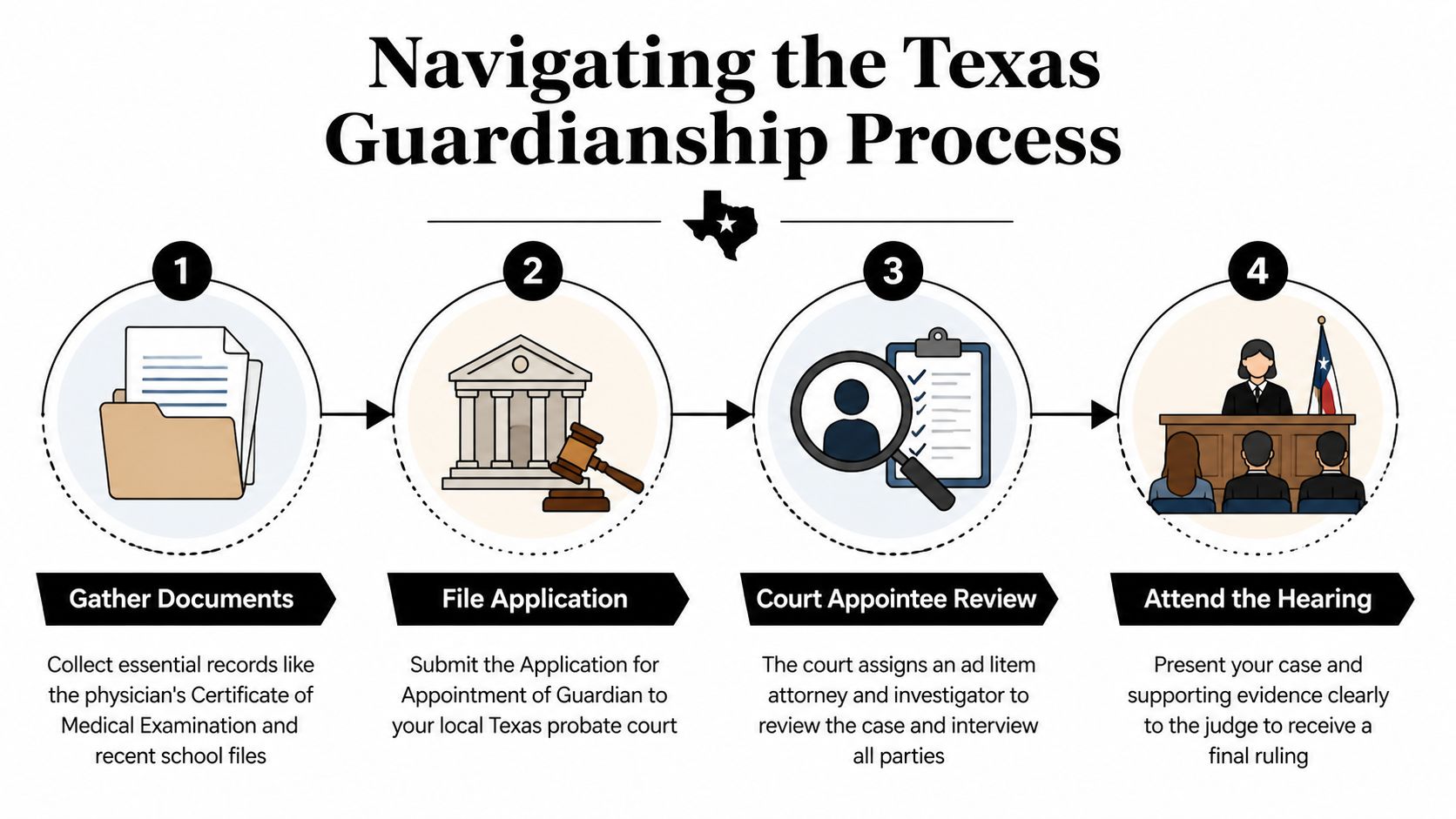
Understanding this path from the start can turn what feels overwhelming into a series of practical, manageable steps. Your journey will begin with critical document gathering, move into a formal court filing, and end with a hearing before a judge. Each stage has a specific purpose—to ensure guardianship is absolutely necessary and that you are the right person for the job.
Step 1: Gathering Your Essential Documentation
Before you ever set foot in a courthouse, the most important work happens at your desk. You need to assemble the proof that shows why a guardianship is needed. The single most critical document is the Certificate of Medical Examination (CME).
This is an official court form that must be filled out by a physician who has examined your child within the last 120 days. The doctor will assess your child’s condition and give a professional opinion on their ability to manage their own health, safety, and financial affairs. The court relies heavily on this document, as it provides the objective medical basis required under the Texas Estates Code.
Beyond the CME, you’ll want to pull together other key records:
- School Records: Documents like Individualized Education Programs (IEPs) and school-based evaluations paint a picture of a long-standing need for support.
- Medical History: Gather any relevant medical records that detail your child’s diagnosis, treatment history, and overall condition.
- Personal Information: Make sure you have your child’s birth certificate, Social Security card, and other forms of identification organized and ready.
Having this file prepared from day one will make the entire process run much more smoothly.
Step 2: Filing the Application and Court Proceedings
With your documents in order, the next step is to file an Application for Appointment of Guardian with the correct probate court. This is almost always filed in the county where your child lives, such as the Harris County Probate Court or the Travis County Probate Courts.
Filing this application officially kicks off the legal process. From there, the court will appoint an attorney ad litem. This is an independent lawyer whose only job is to represent your child's best interests. They are not on your side or the court's side; they serve as a neutral advocate for your child, who the court calls the "proposed ward."
The ad litem will schedule a time to meet with you, your child, and possibly other family members or teachers. They'll review all the paperwork you submitted and then write a formal report for the judge with their findings and recommendation. In some situations, the court might also bring in a court investigator to conduct a separate, impartial review.
Key Takeaway: The court’s number one priority is making sure guardianship is the least restrictive option available to protect your child. The ad litem and investigator are the judge's eyes and ears, providing the unbiased information needed to make that crucial decision.
Step 3: What to Expect at the Guardianship Hearing
The guardianship hearing is the final step where you present your case to the judge. While it is a formal court proceeding, it's not nearly as scary as it sounds on TV. Your attorney will be right there with you to handle the legal talk and guide you through it.
During the hearing, the judge will:
- Review all the evidence, including your Application, the Certificate of Medical Examination, and the report from the attorney ad litem.
- Listen to testimony, which will include you explaining why you believe the guardianship is necessary for your child's well-being.
- Ask questions to get a complete understanding of the situation. Your child must be at the hearing unless the court waives this requirement for specific medical reasons.
The judge’s entire focus is on confirming that granting the guardianship is truly in your child's best interest. If they agree, they will sign an official order appointing you as guardian. After the hearing, you’ll have to take an oath and sometimes post a bond before the court issues your official Letters of Guardianship.
This legal process is a significant undertaking, but you don't have to face it alone. At The Law Office of Bryan Fagan, we guide families through every step with clarity and compassion. To get help with your guardianship for a special needs child in Texas, schedule a free consultation with our experienced team today.
Choosing the Right Type of Guardianship for Your Child
When it comes to guardianship for a special needs child in Texas, one size definitely does not fit all. The law is designed to be flexible because every child and every family situation is unique. Your goal is to find the right legal tool that provides the support your child needs without overstepping and removing rights they can and should keep.
You'll primarily encounter two main types of guardianship: Guardian of the Person and Guardian of the Estate. For some families, one is all that's needed. For others, both are essential for providing a complete safety net.
Guardian of the Person vs. Guardian of the Estate
The easiest way to understand these roles is to think of them as two separate, but sometimes overlapping, jobs. A Guardian of the Person makes decisions about your child’s life and well-being. A Guardian of the Estate manages their money and property.
A Guardian of the Person is appointed to handle critical life decisions. This authority covers things like:
- Healthcare: Making medical decisions, consenting to surgeries, and choosing therapies.
- Living Arrangements: Deciding where your child will live, whether that’s at home with family, in a group home, or another supported living environment.
- Daily Life: Overseeing day-to-day care, social activities, and educational or vocational programs.
A Guardian of the Estate, meanwhile, focuses exclusively on your child’s financial world. This guardian is responsible for every dollar and asset your child owns. Their duties involve:
- Managing Finances: Handling bank accounts, paying bills, filing taxes, and making sound investments.
- Government Benefits: Applying for and managing crucial benefits like Supplemental Security Income (SSI) and Medicaid.
- Protecting Assets: Ensuring any property, inheritance, or legal settlement funds are used for the child’s benefit and in strict compliance with the law.
The distinction between these two roles is incredibly important, especially for maintaining eligibility for government benefits. For instance, if your child receives an inheritance, a Guardian of the Estate can manage those funds properly. Without that oversight, a lump sum of cash could easily push them over SSI's strict $2,000 individual asset limit and cause them to lose their monthly income and healthcare.
To make the differences clearer, here’s a breakdown of the distinct responsibilities.
Guardian of the Person vs. Guardian of the Estate Responsibilities
| Responsibility Area | Guardian of the Person | Guardian of the Estate |
|---|---|---|
| Primary Focus | Personal well-being, health, and daily care | Financial assets, property, and income |
| Healthcare | Consents to medical treatments and chooses doctors | Pays medical bills from the estate's funds |
| Living Situation | Decides where the ward lives | Pays for housing, rent, or facility costs |
| Daily Needs | Oversees education, social activities, and daily care | Manages budget for food, clothing, and activities |
| Legal & Financial | Cannot manage or access the ward's money | Manages bank accounts, applies for benefits, pays bills, files taxes |
| Reporting to Court | Files an Annual Report on the ward's condition | Files a detailed Annual Accounting of all financial activity |
As you can see, the duties are separate but complementary. The Guardian of the Person determines the need for a medical procedure, and the Guardian of the Estate ensures the bill gets paid from the correct funds.
Which Type of Guardianship Is Right for Your Family?
The right answer depends entirely on your child’s abilities and assets. A young adult who is mostly independent but struggles to understand and consent to complex medical care may only need a Guardian of the Person. On the other hand, a child with significant assets but strong self-care skills might just need a Guardian of the Estate. In our experience, however, a child with significant intellectual or developmental disabilities often needs both to ensure they are fully protected.
The legal path—the filings, the hearings, the evidence—is largely the same whether you're asking the court to appoint a Guardian of the Person, Estate, or both.
This decision is deeply personal, and national data shows how the need for guardianship varies. Research from National Core Indicators shows that while 34.0% of adults with autism spectrum disorder are under some form of guardianship, that number climbs to 52.1% for adults with Down syndrome. This reflects how the specific challenges associated with a disability often guide the legal solution. You can dig deeper into these numbers in the full report on national trends.
A Note on Limited Guardianship: It's important to know that Texas courts are required to use the least restrictive alternative. If your child is capable of making some decisions on their own, the judge will likely grant a limited guardianship. This means your authority as guardian is tailored specifically to the areas where help is truly needed, allowing your child to retain as much independence as possible.
Navigating these choices can be overwhelming, but you are not in this alone. An experienced Guardianship attorney can help you assess your child’s needs and petition the court for the right level of protection to secure their future.
Exploring Alternatives to Full Guardianship
Guardianship is a powerful safety net, but it's also the most restrictive legal path you can take. It involves a court stripping your loved one of their legal right to make their own choices. For this reason, Texas law requires judges to first consider less restrictive options. For many families, exploring these alternatives is about finding the right balance that empowers your child while still keeping them safe.
The goal here isn't just protection; it's about respecting autonomy wherever possible. Before you jump into a full guardianship, it’s crucial to see if other tools could do the job, either on their own or combined to create a customized support system.
Supported Decision-Making Agreements
Texas was one of the first states to formally recognize Supported Decision-Making (SDM), a fantastic alternative for adults who can make decisions but just need some trusted help to do it.
An SDM agreement is a formal, notarized document where your adult child names one or more "supporters"—people they trust, like you, a sibling, or a close friend. These supporters are then authorized to:
- Help them gather and make sense of information.
- Assist in communicating their decisions to doctors, bankers, or others.
- Go with them to appointments to offer advice and take notes.
The crucial difference here is that with an SDM, the individual with the disability always gets the final say. It keeps their legal rights intact while building a formal structure for support. This is a powerful tool for promoting self-advocacy and independence.
Powers of Attorney and Trusts
If your child has the capacity to understand and sign legal documents, Powers of Attorney are another excellent alternative to guardianship. These documents let them grant decision-making power to a trusted "agent" without court involvement.
Two key documents come into play:
- Medical Power of Attorney: This lets your child name an agent to make healthcare decisions for them if they ever become unable to. It's a non-negotiable tool for handling medical emergencies.
- Durable Power of Attorney: This gives an agent the authority to manage financial matters—things like banking, paying bills, and handling property. It's called “durable” because it stays in effect even if your child later becomes incapacitated.
A Special Needs Trust is another piece of the Estate Planning puzzle, particularly for managing finances. A trustee manages funds for your child’s benefit without jeopardizing essential government benefits like SSI and Medicaid. You can get more details on how these work hand-in-hand by reading about guardianship and special needs trusts in Texas.
Practical Financial and Daily Support Tools
Sometimes the simplest solutions are the best. For day-to-day financial help, a joint bank account can be enough. This allows you to monitor spending and help pay bills while your child maintains access to their money. Similarly, being named a representative payee for their Social Security benefits lets you manage those specific funds on their behalf, ensuring they are used for your child's needs.
For many families, however, full guardianship remains the necessary and correct path. This is especially true for children in certain vulnerable situations. Choosing between these options is a deeply personal process that demands a clear-eyed assessment of your child’s abilities. If you're wrestling with this decision, you don't have to do it alone.
Your Duties and Responsibilities After a Guardianship is Granted
When the judge signs the final order, you might feel a huge sense of relief. The court process is over. But in reality, this is where your journey as a guardian truly begins. Being appointed is a major milestone, but it comes with a new set of legal duties and ongoing responsibilities. We know it can feel like a heavy weight has been placed on your shoulders, but with the right guidance, you can step into this role with confidence.
The First Things You Must Do After Your Hearing
The court’s order gives you the authority to act, but you can’t make any decisions just yet. Before you can legally act on your child's behalf, you have to complete a few crucial administrative steps. These actions are what officially formalize your appointment.
Under Texas law, you’ll need to complete these tasks, typically within 20 days of the judge signing the guardianship order:
- Take the Oath of Guardianship: This is a sworn statement, usually signed in front of a court clerk or notary, where you promise to faithfully carry out all your duties as a guardian. Think of it as your personal pledge to the court and to your child (who is now legally referred to as the "Ward").
- Post a Bond (If Required): If you’ve been named Guardian of the Estate, the court will almost certainly require you to buy a surety bond. This is essentially an insurance policy that protects the Ward’s assets from any potential mismanagement. The judge sets the bond amount based on the value of your child's estate.
- Receive Your Letters of Guardianship: After you’ve taken the oath and filed your bond, the court clerk will issue your Letters of Guardianship. This one-page document is your golden ticket—it's the legal proof you'll show to doctors, banks, schools, and government agencies to prove you have the authority to make decisions.

Ongoing Reporting and Compliance with the Court
Your work doesn’t stop after those initial steps. The Probate court in your county—whether it's Harris, Dallas, or Bexar—maintains oversight to ensure you’re living up to your responsibilities. This supervision happens through mandatory annual reports, which can sometimes lead to guardianship disputes if not handled correctly.
Key Takeaway: Your most important job now is record-keeping. Starting today, keep detailed, organized records of every decision made, every conversation had, and every dollar spent. This single habit will turn your annual reporting from a stressful chore into a straightforward task.
These reports are required by the Texas Estates Code and are not optional. The two most common reports are:
- Annual Report on the Condition and Well-Being of the Ward: As Guardian of the Person, you'll file this report every year. It updates the court on your child’s living situation, physical and mental health, and social life. It’s how you demonstrate to the judge that your child is safe, healthy, and well-cared for.
- Annual Account: If you are Guardian of the Estate, you must file this extremely detailed financial report. It requires a complete accounting of every single penny that entered and left your child's estate over the last year. You must back up every transaction with receipts, bank statements, and other proof.
The court may also review whether the guardianship should be terminated or modified if the ward’s condition improves. This commitment to ongoing review ensures the guardianship remains the least restrictive option over time.
Fulfilling these duties is a profound act of love and responsibility. We have a more detailed discussion on this topic available; learn more about the responsibilities of a legal guardian in our comprehensive article.
Your Top Questions About Special Needs Guardianship Answered
As a parent on this journey, your head is probably swimming with questions. That’s completely normal. Deciding to pursue guardianship is a major legal step, and feeling a bit overwhelmed by the costs, timelines, and court procedures is part of the process. Our job is to cut through the noise and give you clear, straightforward answers.
Let’s tackle some of the most common questions we hear from parents about getting guardianship for a special needs child in Texas.
How Much Does It Cost to Get Guardianship in Texas?
This is often the very first question parents ask, and the honest answer is: it varies. The total cost really depends on your specific county and whether the case is straightforward or contested. It’s best to think about the expenses in a few different buckets.
First up are the fixed court costs that you can't avoid. No matter what, you should plan for:
- Court Filing Fees: Expect to pay between $350 and $500 just to get your case filed and on the court’s radar. This fee changes slightly from county to county, but it’s the starting point everywhere from Harris County to Dallas County.
- Ad Litem Attorney Fees: The judge will appoint an independent attorney, called an "ad litem," whose only job is to represent your child’s best interests. You are responsible for their fee, which typically runs from $500 to over $1,500, depending on how much work your case requires.
- Physician's Examination Fee: A doctor must complete a specific form called the Certificate of Medical Examination. This is a mandatory piece of evidence, and the cost will depend on your physician.
The other major expense is your own attorney's fees. If the guardianship is uncontested—meaning the whole family agrees it’s the right move—the legal costs are much more predictable. But if a guardianship dispute arises, the work involved, and therefore the cost, will increase.
We believe you should never have to guess about something this important. In a free consultation, we can give you a much more specific, personalized cost estimate for your case so you know exactly what to expect.
When Should We Start the Guardianship Process for Our Child?
Timing is everything in a guardianship case. We tell every family the same thing: the sweet spot for starting the process is when your child is about 17 and a half years old.
Why so specific? Because starting at this age gives you a solid six-month runway before they legally become an adult on their 18th birthday. The court process isn't instant; it takes a few months to get everything filed, have the ad litem do their investigation, and get a final hearing scheduled with the judge.
By filing at 17 ½, you give the system enough time to work. The goal is to walk out of the courthouse with a signed judge's order and your Letters of Guardianship in hand right around your child’s 18th birthday. This prevents a dangerous legal gap where you have no authority to make critical decisions on their behalf.
What Happens If We Do Nothing When Our Child Turns 18?
Life moves fast, and it’s a scenario we see all too often: a child turns 18, and no legal plan is in place. The moment that happens, your legal rights as a parent vanish. Under the law, your child is now an adult, and privacy laws like HIPAA slam the door shut. You can’t talk to their doctors or access their medical records without their express permission.
Without guardianship or a valid Power of Attorney, you suddenly can't:
- Sit in on ARD or IEP meetings for their education.
- Manage their government benefits, like SSI, or help with their bank account.
- Give consent for medical procedures or make decisions in an emergency.
- Help them sign a lease or other legally binding documents.
This can become a full-blown crisis overnight if a medical or financial problem arises. The good news? It's never too late. If your child is already 18 or older, you can still file for an adult guardianship. The process is identical, and we can help you get it done.
Is It Possible to Get Emergency or Temporary Guardianship?
Yes, but it's important to understand that Texas courts reserve this for true, dire emergencies. The bar for getting a temporary guardianship is incredibly high. You have to present the judge with clear and convincing evidence that there's an immediate, substantial risk of harm to the person's health or their finances.
A temporary guardianship, as outlined in Texas Estates Code Title 3, Subtitle G, is a short-term fix. It’s designed to last no more than 60 days. Its only purpose is to put someone in charge immediately to handle a crisis while the permanent guardianship case moves forward at a normal pace.
For example, imagine an 18-year-old with a profound disability whose only caregiver passes away unexpectedly. A judge would likely grant a temporary guardianship to a family member to ensure they have access to medical care and supervision right away. If you believe you're in a crisis situation, our firm can act quickly to assess the facts and file for this emergency protection if it's needed.
Navigating the path to guardianship for a special needs child in Texas requires care, precision, and compassionate legal advice. At The Law Office of Bryan Fagan, PLLC, our experienced attorneys are dedicated to helping your family secure your child's future. For personalized guidance on your specific situation, please schedule a free, no-obligation consultation with our team. We are here to help.