Skip to content
A child is hurt at school. A parent is out of reach. A grandparent is standing in the hospital hallway, trying to help, but the nurse asks a hard question: “Do you have legal authority to consent?”
That moment is where many Texas families first encounter the phrase medical consent guardianship texas minor. And it’s often misunderstood. Families assume they must rush into court for guardianship any time a parent isn’t available. In many situations, that isn’t true. Texas law gives families a practical decision tree.
The first question is simple. Can someone already consent without a court order? If not, the next question is whether a signed authorization agreement will solve the problem. If that still doesn’t fit, then guardianship may be necessary, either temporarily or on a longer-term basis.
I’ve seen concerned relatives in Harris County, Dallas County, Bexar County, and Travis County carry a heavy burden because they don’t know which legal tool matches their situation. The law can feel intimidating, but the underlying idea is straightforward. Texas courts prefer the least restrictive option that still protects the child.
Who Can Consent to a Minor's Medical Care Without a Court Order
Parents usually have the first right to make medical decisions for their child. That’s the baseline. But real life doesn’t always wait for a parent to pick up the phone, return from deployment, recover from an illness, or make it to the emergency room in time.
Texas law recognizes that problem. Under Texas Family Code Section 32.001(a), 8 specified categories of non-parents may consent to a minor’s medical, dental, psychological, and surgical care when a parent can’t be contacted and hasn’t objected.

The eight people or entities Texas law allows
The authorized categories include:
- Grandparents
- Adult brothers or sisters
- Adult aunts or uncles
- An educational institution that has written parental authorization
- An adult with actual care, control, and possession of the child who has written parental authorization
- A court with jurisdiction in a suit affecting the parent-child relationship
- An adult responsible for the child under juvenile court order or state agency authority
- A peace officer who reasonably believes the child needs immediate medical care
This rule matters because it can prevent a dangerous delay. If a grandparent has the child and the parent can’t be reached, the law may let that grandparent step in for treatment without first filing a guardianship case.
What confuses families most
People often hear terms like in loco parentis and assume they need some formal legal label. In plain language, the core question is usually much narrower: Does Texas law already recognize this caregiver’s authority in this moment?
A caregiver who is actively caring for a child may have some ability to help, but that doesn’t mean they have every legal right a parent has. Medical consent is one area where Texas spells out specific categories and conditions. That’s why guessing is risky.
Practical rule: If a child needs care and a parent can’t be contacted, start by asking whether the person with the child falls into one of the categories recognized by Texas Family Code Section 32.001(a).
A simple example
A child lives with her grandmother during the school week because her mother works in another city. The child breaks an arm at soccer practice. The mother doesn’t answer repeated calls. In that setting, the grandmother may already have authority to consent under the statute.
That’s very different from a full custody or conservatorship order. If you’re dealing with broader decision-making rights between parents, sole managing conservatorship in Texas is a separate issue from emergency medical consent.
When this option isn’t enough
This no-court-order path helps with immediate care, but it has limits. It doesn’t resolve long-term disputes between adults. It doesn’t replace a parent’s legal role across every area of the child’s life. It also may not satisfy a school, insurer, or provider that wants more formal paperwork for ongoing authority.
That’s where a signed authorization agreement often becomes the better fit.
When a Signed Form Is Enough The Authorization Agreement
A lot of families reach a point where they need more than a phone call from a parent, but far less than a court case.
That is the job of an authorization agreement under Texas Family Code Chapter 34. It works like a written set of house keys. The parent keeps ownership of the house, but gives a trusted adult permission to open the doors that daily life keeps putting in front of the child. For many families, this is the middle branch of the decision tree. If a parent is available, willing to sign, and the problem is day-to-day authority, this option is often enough.
A parent can sign an Authorization Agreement for Nonparent Relative or Voluntary Caregiver, often called Form 2638, to give a nonparent defined powers without filing a guardianship case.
What the agreement is designed to solve
This agreement is practical because it covers the routine decisions that tend to stall when a child is living with someone other than a parent for a period of time.
Depending on what the parent authorizes, the agreement may allow the caregiver to handle:
- Medical and mental health care, including consent for medical, dental, surgical, and psychological treatment
- School and daycare matters, including enrollment
- Insurance issues, including enrollment and related paperwork
- Activities and programs, such as extracurricular participation
- Identification documents and records, subject to the limits in the form and the law
- Teen-related decisions, including some matters tied to employment or a driver’s license
- Public benefits matters for a child who qualifies
The agreement does not give unlimited authority. Some decisions remain outside its reach, including abortion-related decisions and emergency contraception.
When this option fits, and when it does not
Families often ask a simple question. Is a signed form enough, or do we need guardianship?
A good way to sort that out is to focus on the reason authority is missing.
If the parent is still living, still has legal rights, and still agrees that another adult should handle school, medical visits, prescriptions, or insurance paperwork for a period of time, an authorization agreement is often the right tool. It solves a paperwork problem.
If the parent cannot be found, refuses to cooperate, is no longer able to make decisions, or the child needs a legally recognized decision-maker on an ongoing basis, the issue is no longer paperwork. At that point, families start moving toward temporary or permanent guardianship.
That distinction matters. A Chapter 34 agreement is permission from a parent. Guardianship is authority from a court.
Limits families should understand before relying on it
This form is helpful, but it has boundaries.
- It can usually be revoked by a parent. If the parent changes course, the authority can end unless a court order says otherwise.
- Notice to the other parent may still be required. Families should treat that step seriously because skipped notice can create problems later.
- It is not a permanent solution. If the child’s living arrangement will continue and major decisions keep piling up, a revocable form may stop being enough.
A short example shows why.
Suppose a mother is hospitalized for several months, and her child will stay with an aunt in Tarrant County during that time. The aunt needs to enroll the child in school, take the child to medical appointments, fill prescriptions, and deal with insurance forms. If the mother can still sign and agrees to delegate those tasks, an authorization agreement usually makes more sense than asking a court to appoint a guardian.
The practical goal is clarity. Schools, doctors, and insurers are more comfortable when the caregiver arrives with organized documents rather than a verbal explanation. If you need a clean way to present that arrangement, a sample guardianship-related letter and document format can help you prepare the paperwork in a clear and credible way.
Stepping into Guardianship When It Becomes Necessary for a Minor
Sometimes the decision tree ends at court.
A simple consent rule won’t solve the problem. A signed authorization agreement won’t solve it either. The law reaches that point when the child doesn’t have a parent or authorized caregiver who can legally act, or when the child’s situation involves ongoing decision-making that requires court oversight.
Texas law also recognizes that minors can sometimes consent on their own. Under Texas Family Code §32.003(a), a minor may consent in six specific scenarios, including active military service, certain situations involving a minor age 16 or older with parental unavailability, marriage, being a parent, pregnancy-related care other than abortion, and treatment for drug or chemical addiction. When a child falls outside those categories and lacks a parent or authorized adult, guardianship may become necessary.

A story that shows the legal line
A teenager in Austin is injured in a car crash. One parent died years ago. The other parent is missing and can’t be located. The child’s aunt has stepped in and is doing everything she can.
At first, the immediate medical crisis may be addressed through one of the consent rules discussed earlier if the facts fit. But after the emergency passes, the child needs follow-up surgeries, therapy decisions, school coordination, and long-term stability. If no parent is available to legally act and no valid authorization agreement exists, the aunt may need to ask the court to appoint her as guardian.
When finances change the answer
There’s another common trigger. A minor may receive money from an inheritance or injury claim. In that situation, the issue isn’t only medical consent. It’s also who can legally manage the child’s property or funds.
The verified materials state that settlements over $100,000 can trigger estate-related guardianship concerns under the Texas Estates Code chapters governing management of minors’ property, as noted in the guardianship alternatives materials. When money is involved, families often need to think about a guardian of the estate in addition to a guardian of the person.
Signs that guardianship is likely the only path
A court filing becomes more likely when:
- Both parents are unavailable because of death, incapacity, disappearance, or another serious barrier
- The child needs continuing medical decision-making and no valid non-court alternative exists
- The child has significant property or settlement funds that require legal management
- Adults disagree sharply about who should make decisions, and there’s no enforceable authority in place
Guardianship is the legal tool Texas uses when a child’s needs have outgrown informal family arrangements.
The issue then becomes less about convenience and more about legal authority that third parties must respect.
Navigating the Texas Guardianship Process for a Minor
When guardianship is necessary, families need a roadmap. The process lives mainly in Texas Estates Code Title 3, Subtitle G, which contains the state’s guardianship rules. For minor cases, filings often go through probate courts or county courts with probate jurisdiction, including courts such as Harris County Probate Court or the probate courts in Dallas County, depending on where the child lives and the local court structure.
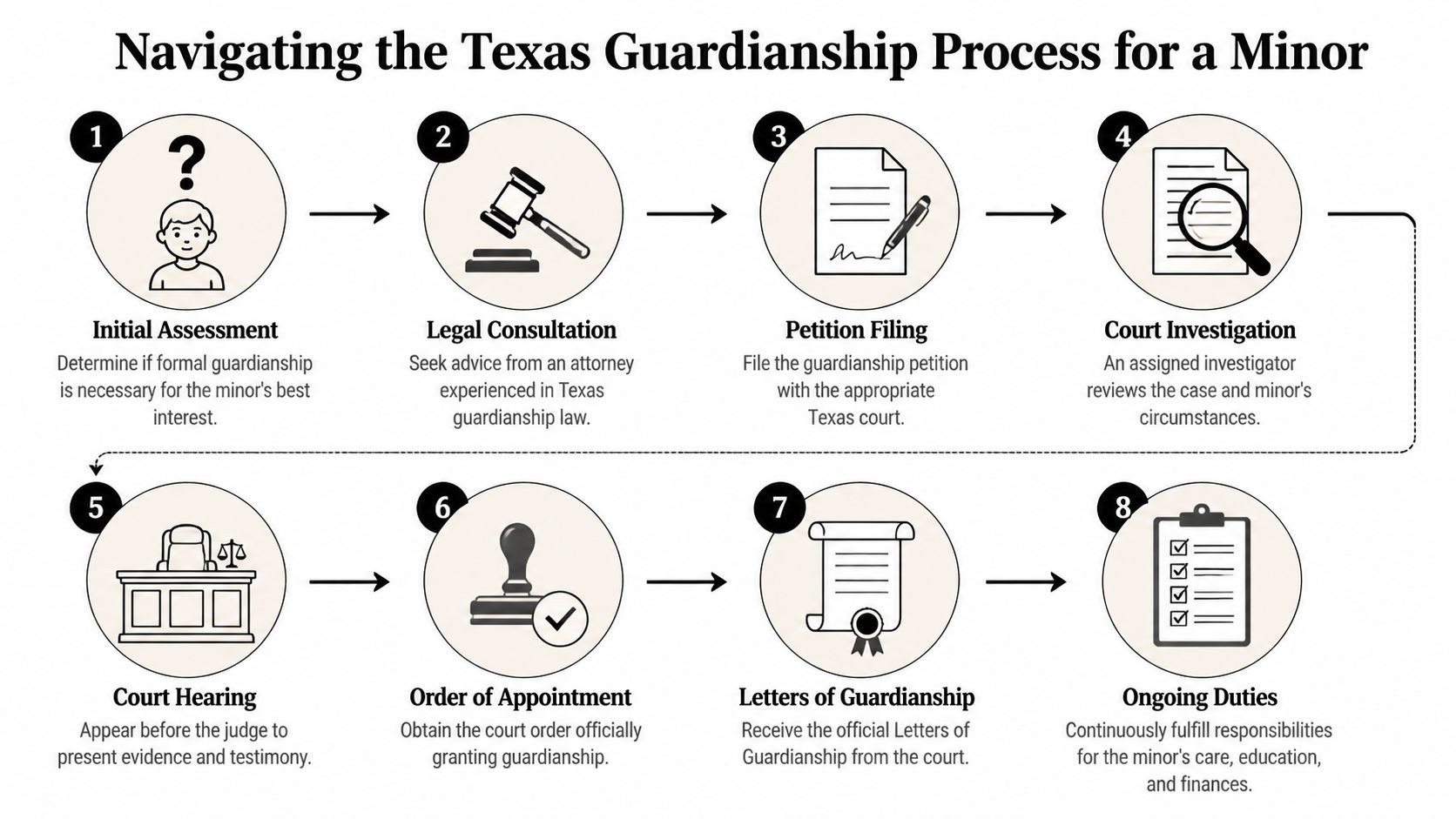
Step one is proving why the court should act
A guardianship case starts with an application. In plain terms, you are asking the court to do two things:
- Decide that guardianship is needed.
- Decide who should serve.
Texas courts don’t grant guardianship just because a caring relative asks. The court wants details about the child, the parents, the reason guardianship is needed, and whether a less restrictive option would work.
That “less restrictive alternative” idea matters. The verified materials state that the court appoints a guardian only after exploring other options, according to the Texas guardianship process materials discussing Estates Code §1002.017 and alternatives.
Step two may involve medical proof
If incapacity is part of the case, the process may require a physician’s Certificate of Medical Examination under Texas Estates Code §1002.017. That often applies when the facts involve a parent’s incapacity, a child’s special limitations relevant to the requested guardianship, or another issue the court needs medically supported.
This document helps the court avoid overreaching. Guardianship removes or shifts legal authority, so judges want evidence, not assumptions.
A helpful visual summary appears below.
Step three involves notice and court review
Families are often surprised that this process isn’t only paperwork. Other interested people may need notice. The court may appoint an attorney ad litem or another court representative to look at the child’s best interest and the proposed guardian’s suitability.
Here’s a simple view of the court’s focus:
| Court concern | What the judge is looking for |
|---|---|
| Need | Is guardianship actually necessary? |
| Scope | Should it cover the person, the estate, or both? |
| Fit | Is the proposed guardian appropriate and trustworthy? |
| Alternatives | Would a less restrictive option work instead? |
Step four is the hearing
At the hearing, the judge reviews the evidence. In some counties, that setting feels formal and intimidating at first. But the core questions are practical: Who is caring for this child now? Why can’t a parent act? What authority does the child need someone else to have? What arrangement protects the child without taking more control than necessary?
If the court approves the request, the proposed guardian usually must complete final qualification steps. Depending on the case, that can include an oath and sometimes a bond before the clerk issues Letters of Guardianship.
Before the hearing and after the hearing
Families tend to focus on the court date, but preparation before and compliance after matter just as much.
Before the hearing
- Gather records early. Collect birth records, existing court orders, medical information, and any written parental authorizations.
- Map the decision gap. Write down exactly which decisions no one can currently make for the child.
- Prepare for alternatives questions. Be ready to explain why a consent statute or authorization agreement isn’t enough.
After the hearing
- Use the Letters of Guardianship correctly. Schools, doctors, insurers, and banks often want the official letters, not just the signed order.
- Calendar renewal and reporting deadlines. Guardianship is supervised by the court.
- Keep decisions child-focused. Judges expect guardians to act in the minor’s best interest, not in the convenience of adults.
If you’re trying to understand the filing sequence in more detail, how to get guardianship of a minor in Texas gives a focused starting point for the broader process.
Understanding Temporary and Emergency Guardianship
The hospital calls on Tuesday. Surgery may be needed by Friday. The parent is unconscious, out of the country, missing, or otherwise unable to act. A relative is at the child’s bedside, but the nurse asks the question that stops everything: “Who has legal authority to consent?”
That is the moment families need a decision tree, not just legal vocabulary.
Temporary and emergency guardianship both address a gap in authority, but they solve different problems. A temporary guardianship is the court’s short-term tool when a child needs a legal decision-maker before a full case can be completed. Emergency relief is for a more immediate threat, where delay itself may put the child at risk. The closer the facts are to imminent harm, the faster and narrower the request usually needs to be.
A useful way to frame it is this. A signed authorization is like giving someone a key for a specific door. Temporary guardianship is closer to giving a trusted adult a short-term job title with court approval. Emergency relief is the fire alarm. It exists for situations where waiting for the normal timeline could cause real harm.
The practical difference
Families often ask, “Which one do we need?” The better question is, “What problem must be solved today?”
| Issue | Temporary guardianship | Emergency-style relief |
|---|---|---|
| Purpose | Cover a short-term decision-making gap | Respond to immediate danger or urgent harm |
| Timing | Faster than a full guardianship case | The fastest court response when the facts justify it |
| Proof the court expects | Specific facts showing the child needs someone to act now | Strong facts showing delay could harm the child’s health, safety, or welfare |
| What happens after | Often followed by continued court proceedings | Usually followed by prompt additional review by the court |
The distinction matters because judges do not grant broad authority just because a situation feels stressful. They want to see the missing decision, the risk created by that gap, and why a less restrictive option will not work.
Medical consent can still be complicated
Medical cases are where confusion shows up fastest.
For example, Texas law allows minors in some situations to consent to certain kinds of their own medical care, including some pregnancy-related care. But that does not mean every question disappears once a guardianship order exists. Providers may still need to examine the type of treatment, the scope of any existing order, and whether the minor has independent statutory consent rights for that particular care.
That overlap can leave families and providers talking past each other. One person is focused on the child’s condition. Another is focused on who may sign. The court is focused on whether a short, targeted order is enough or whether the child needs a temporary guardian with clearly defined authority.
In urgent cases, the first question is usually not whether the family wants guardianship. The first question is what authority is missing right now, and what could happen if no one can act.
How to choose the right path in a crisis
Start with the least restrictive option that solves the problem.
If an existing parent, managing conservator, or another person already has authority under Texas law to consent, court action may not be needed. If the problem is limited and a properly executed authorization will satisfy the provider, that is often the simpler path. If no one can legally act and the child needs ongoing decisions made for more than a brief emergency, temporary guardianship may fit better. If the child faces immediate harm and there is no time for the regular pace of a case, emergency relief may be the only realistic option.
In practice, families should gather four things quickly:
- The urgent medical facts. What treatment is needed, who is requesting consent, and why delay matters.
- The authority documents already in hand. Prior court orders, authorizations, conservatorship papers, and discharge instructions.
- The exact decision no one can make. Surgery consent, medication decisions, admission paperwork, follow-up care, or access to records.
- A narrow proposed solution. Courts respond better when the request matches the problem instead of asking for more control than the situation requires.
Specificity helps. “The child needs a guardian” is a conclusion. “The child is scheduled for a procedure in two days, the parent cannot communicate, and the hospital requires a legally authorized adult to consent” is the kind of fact pattern a court can act on.
In a real emergency, the goal is not to ask for every power available. The goal is to get the child through the immediate risk with an order that fits the problem and goes no further than necessary.
A Guardian's Role Rights Duties and Responsibilities
A court order doesn’t end the matter. It starts a supervised legal relationship.
Under Texas Estates Code Title 3, Subtitle G, a guardian acts as a fiduciary. That means the guardian must put the child’s interests first and follow the limits written into the order. This is one reason courts take guardianship so seriously. A guardian receives authority, but also ongoing duties.

Guardian of the person and guardian of the estate
These are different jobs.
Guardian of the person usually handles the child’s daily welfare. That can include medical care, residence, education coordination, and other personal decisions allowed by the court.
Guardian of the estate manages money or property that belongs to the child. If a child has settlement funds, inherited property, or another financial asset, the court may require this separate role.
Daily duties families don’t always expect
Many new guardians expect authority. They don’t expect administration.
A guardian may need to:
- Follow the court order closely. The order defines the scope of authority.
- Keep records. Medical decisions, schooling issues, expenses, and important contacts should be documented.
- File required reports or accountings. Courts want updates because guardianship remains under supervision.
- Avoid conflicts. A guardian can’t treat the child’s funds or rights as if they were the guardian’s own.
What good guardianship looks like in practice
A responsible guardian doesn’t only sign forms. The guardian learns the child’s doctors, keeps copies of orders and letters, tracks appointments, and responds carefully when schools or hospitals ask for proof of authority.
If the child’s condition improves, family circumstances change, or the order becomes too broad, the guardian should revisit the issue rather than assume the original order lasts forever in the same form.
A guardian’s job is to protect, not to control more of the child’s life than the court has authorized.
Compliance and possible disputes
Guardianship can also become contested later. Other relatives may argue that the guardian isn’t acting in the child’s best interest. In estate matters, accounting problems can trigger court concern. In person-based guardianship, disputes often involve medical choices, school placement, or where the child should live.
That’s why some families use legal counsel not only to obtain guardianship, but also to stay compliant. One available option is the Law Office of Bryan Fagan, PLLC, which handles guardianship filings, hearings, and ongoing compliance matters for Texas families, along with related probate and estate planning issues.
When guardianship ends or changes
Minor guardianship may end because the child turns eighteen, the court modifies the order, another legal arrangement replaces it, or the court determines the guardianship is no longer needed. The exact path depends on the type of guardianship and the facts.
The key point is simple. Guardianship is not “set it and forget it.” It’s an active legal duty with continuing court oversight.
Your Path Forward Protecting a Minor in Your Care
If you’re caring for a child and trying to sort out medical authority, start with the narrowest question first. Can someone already consent under Texas law without going to court? If not, ask whether a parent can sign an authorization agreement that gives a caregiver enough power for school, medical care, and daily needs. If neither option fits, guardianship may be the legal path that protects the child and gives providers clear authority to act.
For many families, the hardest part isn’t the paperwork. It’s the uncertainty. You may be grieving, juggling work, helping a child through treatment, or stepping into a role you never expected to fill. That’s why a clear decision tree matters. It helps you choose the tool that matches the problem, rather than taking on a larger court process too soon or waiting too long when a judge’s order is required.
These issues often overlap with other areas of planning. If the child has inherited property, settlement funds, or needs a longer-term care structure, it can help to review related topics like Texas probate matters and Texas estate planning options.
If you need personalized guidance about medical consent guardianship texas minor issues, Law Office of Bryan Fagan, PLLC offers free consultations for Texas families. Whether you’re deciding between a consent statute, an authorization agreement, temporary guardianship, or a full guardianship case, you don’t have to sort it out alone.