Skip to content
You open the refrigerator and find spoiled food. You notice unopened pill bottles on the counter. Your parent says they’re “doing just fine,” but the house tells a different story. Many Texas families end up in this exact place, trying to respect a parent’s independence while fearing what might happen next.
This is one of the hardest problems in elder care because love pulls in two directions at once. You want to honor your parent’s choices. You also want them safe. When those two goals stop lining up, families often feel guilt, anger, and exhaustion all at the same time.
The Heartbreaking Dilemma When a Parent Refuses Care
A lot of families think they’re failing because they can’t “convince” a parent to accept help. Usually, that’s not the actual problem. The underlying problem is that the parent may be dealing with fear, denial, memory loss, depression, or a deep need to stay in control. A son sees missed medications. A daughter sees bruises from falls. The parent sees an adult child trying to take over.

Texas families are carrying this burden every day. According to AARP Texas, 23% of adults in Texas, approximately 5 million Texans, are family caregivers providing largely unpaid care. These caregivers provide the state with $41 billion worth of unpaid care annually. If you’re trying to manage a parent’s safety while also working, parenting, or caring for your own health, you’re not alone.
What refusal often looks like in real life
Refusal doesn’t always sound dramatic. Sometimes it sounds polite.
- “I don’t need a walker.” Even after a recent fall.
- “I already took my medicine.” Even when the pill organizer says otherwise.
- “A stranger isn’t coming into my house.” When home care is suggested.
- “Stop treating me like a child.” When money problems or unpaid bills come up.
In some families, the issue is early cognitive decline. If you’re noticing forgetfulness, confusion, personality changes, or trouble with daily routines, a plain-language guide for caregivers on dementia can help you spot warning signs and describe them more clearly to a doctor.
Practical rule: Don’t treat every refusal as stubbornness. Sometimes refusal is fear. Sometimes it’s impairment. Sometimes it’s a competent adult making a choice you don’t like.
That distinction matters in Texas. A parent who still has decision-making capacity has the right to make bad choices. A parent who no longer understands the consequences may need protection. Families often don’t know where that line is until a crisis forces the question.
Why legal knowledge matters before a crisis
By the time many people call a guardianship lawyer, they’ve already spent months arguing, pleading, and scrambling. That delay can make everything harder. In Texas, the details matter. What you document during the refusal stage can later become the evidence a probate court needs to evaluate capacity, less restrictive alternatives, and whether a guardianship is necessary.
You don’t have to jump straight to court. In most cases, you shouldn’t. But you do need to know your options before the next fall, hospitalization, wandering episode, or financial mistake. That knowledge gives you something steady to hold onto when emotions are high.
Assessing Immediate Risk and Improving Communication
Start with safety, not debate. Before you worry about legal paperwork, figure out whether your parent is safe tonight, this week, and over the next month.
Check for urgent risk first
Look at the situation like a triage nurse would. You’re not deciding whether your parent is “winning” or “losing” aging. You’re deciding whether the current setup is unsafe.
A quick home review often reveals more than a long argument. Pay attention to patterns, not isolated bad days.
- Falls and movement problems. Look for bruises, trouble getting up from a chair, holding onto walls, or avoiding stairs.
- Medication mistakes. Check whether bottles are expired, duplicated, unopened, or mixed together.
- Food and hydration issues. Notice spoiled groceries, empty cabinets, weight loss, or dishes untouched for days.
- Financial red flags. Watch for unpaid utilities, stacks of mail, unusual withdrawals, or confusion about routine bills.
- Driving concerns. Scraped bumpers, getting lost on familiar routes, or new traffic tickets should not be ignored.
- Household hazards. Burn marks on pans, unsecured doors, hoarding, infestation, or poor hygiene can all signal declining function.
If one category worries you, monitor it. If several are happening at once, the issue is usually bigger than “being stubborn.”
Say less, ask better
The fastest way to make a resistant parent dig in is to lead with commands. “You can’t live like this” may be true, but it rarely helps. Conversations go better when the parent feels respected.
Try language that keeps some control in their hands:
- Instead of “You need help.”
Try “What feels hardest around the house right now?” - Instead of “You can’t manage your medications.”
Try “Would it help if we made medicines easier to track?” - Instead of “You’re not safe living alone.”
Try “What would help you feel more secure at home?”
These are small shifts, but they lower defensiveness. If dementia may be part of the picture, practical communication techniques for dementia can help families reduce conflict and keep conversations calmer.
When a parent hears “I’m trying to keep you in charge,” they usually respond better than when they hear “I’m taking over.”
What usually works and what usually fails
Families often make the same understandable mistakes. They lecture. They pile on examples. They bring up ten problems at once. The parent feels cornered and stops listening.
What works better is slower and more focused.
Better approaches
- Pick one issue at a time. Start with meals, transportation, or medication support. Don’t argue about everything in one sitting.
- Offer choices. “Would mornings or afternoons work better for someone to help with bathing?” feels different from “Someone is coming to help you bathe.”
- Frame help as independence. A ride service, meal delivery, or medication setup can help a parent stay at home longer.
- Use your own concern, not accusations. “I got scared when you told me about the fall” lands better than “You’re being reckless.”
- Talk at calm times. Don’t start these conversations during a hospital discharge, after an argument, or when your parent is already embarrassed.
Approaches that often backfire
- Threats. “If you don’t do this, I’m done helping.”
- Public pressure. Bringing multiple siblings to confront the parent.
- Arguing facts. Especially if memory loss is involved.
- Talking like a supervisor. Parents hear tone before content.
Set boundaries without abandoning your parent
Supporting a parent doesn’t mean doing the impossible. You can be loving and still say, “I can help with appointments on Fridays, but I can’t provide daily hands-on care.” Clear limits protect both of you. They also create a more realistic plan if legal action later becomes necessary.
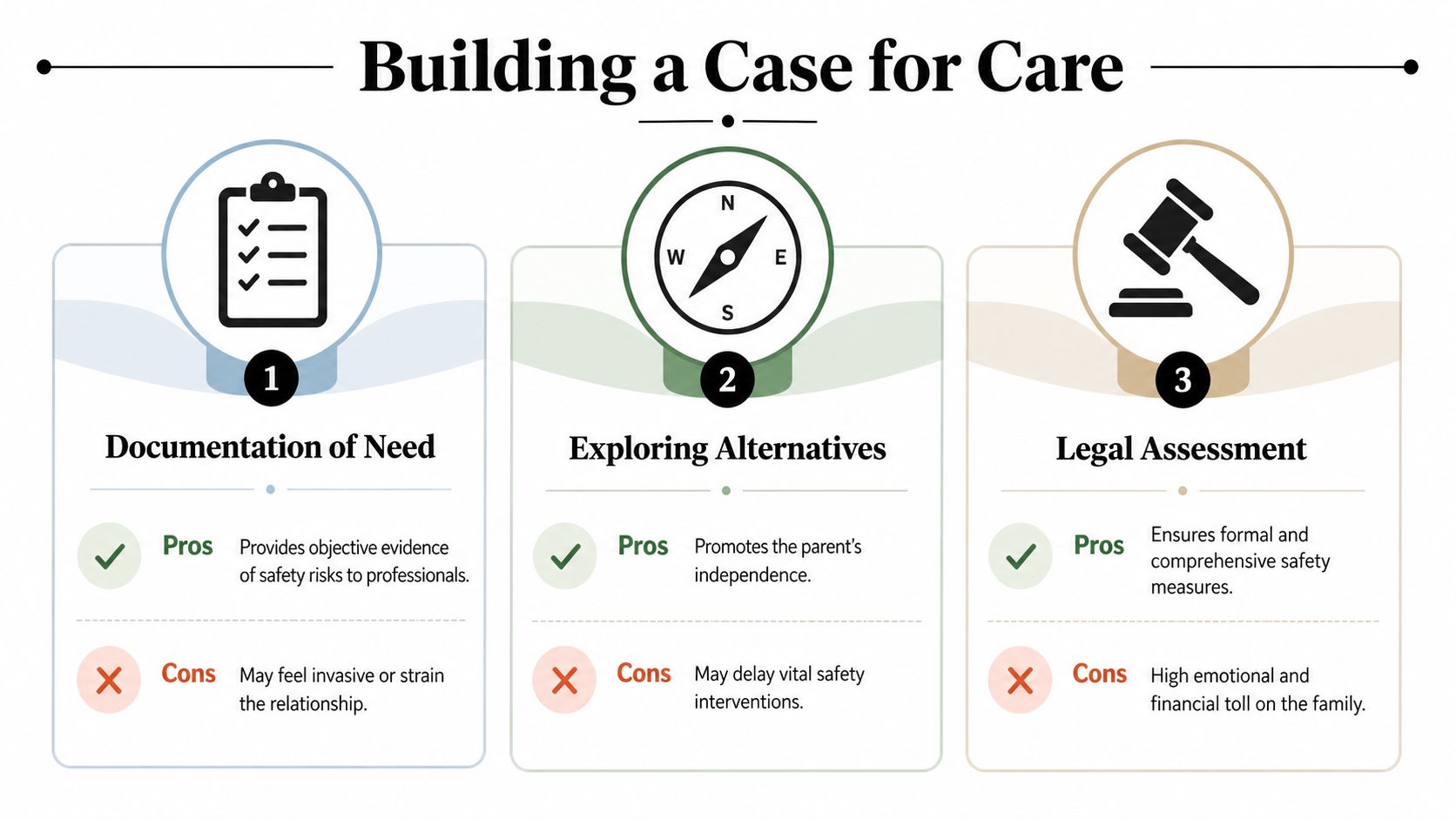
Building a Case for Care Documenting Need and Exploring Alternatives
In Texas, families do not win guardianship because they are worried. They win because they can prove facts. That’s why documentation matters. You are not building a case against your parent. You are creating a reliable record of what daily life looks like.
What incapacity means in Texas
Under Texas Estates Code §1101.101, the court looks closely at whether the proposed ward can manage personal needs or property. Medical proof matters. According to this Texas guardianship discussion, guardianship grant rates rise from 65% to 85% with dual MD certifications, and 92% of cases meet the clear and convincing standard with geriatrician involvement. That tells families something important. General worry is not enough. Detailed medical evaluation is often what moves a case from concern to proof.
Document what the court will actually care about
Vague notes don’t help much. “Mom is declining” is too general. “Mom left the stove on twice this week and missed heart medication three times” is more useful.
Keep a dated log. Include who observed the event, what happened, and the consequence.
- Medical issues. Missed medications, repeat hospital visits, confusion about diagnoses, refusal to follow discharge instructions.
- Daily living problems. Trouble bathing, dressing, eating, toileting, walking safely, or keeping the home sanitary.
- Safety incidents. Falls, wandering, leaving doors open, burner accidents, calling family in confusion at odd hours.
- Financial concerns. Unpaid bills, unusual purchases, duplicate payments, giving money away, confusion with bank accounts.
- Failed attempts at help. Note offers of home care, transportation, housekeeping, meal delivery, or assisted living tours that were refused.
Keep your notes factual and plain. Courts trust specific observations more than emotional conclusions.
Work with doctors early
Many families wait too long to involve the parent’s physician. If capacity is slipping, the doctor’s record may become one of the most important parts of any future case. Ask for an appointment focused on function, not just diagnosis. It helps to describe what your parent can no longer do safely.
Useful information to bring includes:
- A brief incident timeline
- Medication concerns
- Changes in memory or judgment
- Recent falls or hospitalizations
- Names of family members involved in care
If a physician recommends formal evaluation, follow through. The court will want evidence tied to real impairments, not just family disagreement.
Alternatives to Guardianship in Texas
Texas courts must consider less restrictive options before taking away decision-making rights. That’s not a formality. It’s central to the process. In many families, one of these options solves the problem without a full guardianship. Families can also learn more about supported decision-making in Texas when a parent needs help understanding choices but may not need a guardian.
| Option | Best For | Limitations |
|---|---|---|
| Power of attorney | A parent who still understands the document and is willing to sign | Won’t work if the parent refuses or lacks capacity to sign validly |
| Medical Power of attorney | Health care decision support during illness or hospitalization | Only helps if validly signed before incapacity becomes too severe |
| Supported decision-making agreement | A parent who can still participate but needs help understanding and communicating decisions | Not enough when danger is immediate or the parent can no longer grasp consequences |
| Representative payee or bill-pay help | Limited financial management issues | Doesn’t cover broader personal care or property decisions |
| Home health or care manager | Daily support needs where the parent will cooperate | Fails if the parent repeatedly refuses entry or services |
| Trusts or estate planning updates | Families trying to organize assets and future authority before a crisis | Requires planning and cooperation, which may disappear as decline progresses |
The hard part is timing. If your parent still has capacity, planning tools can preserve choice. If your parent has crossed into incapacity and refuses all help, the court may become the only path left.
Involving a Third Party When to Call APS or a Doctor
Families often hesitate to involve outsiders because it feels disloyal. In practice, bringing in a doctor or Adult Protective Services can be the most protective thing you do. The key is knowing what each one can do.

When a doctor should be your first call
If the main concern is memory loss, medication misuse, sudden personality change, falls, or confusion after illness, start with the physician when possible. Doctors can assess whether the problem may involve dementia, delirium, depression, medication interaction, or another medical cause.
Call with concrete facts. Don’t say, “She’s gotten difficult.” Say, “He’s missed medications, got lost driving home from a familiar store, and forgot a recent hospital discharge plan.” That kind of information helps a doctor decide how urgently your parent needs evaluation.
What APS can and cannot do in Texas
In Texas, Adult Protective Services investigates abuse, neglect, and exploitation of adults 65+ or those with disabilities. While APS cannot force a competent adult to accept services, they can seek emergency removal if a person lacks capacity and is in immediate danger.
That means APS is not a shortcut for making a stubborn but competent parent comply. It also means APS may be appropriate when the conditions are dangerous enough that the issue has moved beyond family conflict.
A helpful overview of the role of the Texas Department of Family and Protective Services in guardianship can clarify how protective agencies fit into the larger legal picture.
Calling APS is not “turning your parent in.” It is asking the state to evaluate danger, neglect, or exploitation when the family cannot safely manage the situation alone.
Situations that justify outside intervention
Consider involving a third party when you see problems like these:
- Immediate danger at home. Fire risk, no food, severe self-neglect, untreated medical issues, or repeated wandering.
- Suspected exploitation. A relative, neighbor, or stranger may be taking money or isolating the parent.
- Repeated medical breakdowns. The parent leaves the hospital and quickly becomes unsafe again.
- You can no longer monitor alone. The family has reached a point where informal care is breaking down.
Here is a short explainer that helps many families understand how these situations develop and why waiting can make them harder to fix.
Prepare before you make the call
Whether you’re calling a doctor, hospital social worker, or APS investigator, have a short, factual summary ready:
- Who is at risk
- What specific conduct or condition worries you
- How long it has been happening
- What help has been offered and refused
- Whether there is immediate physical danger
That preparation makes the call more useful. It also starts a paper trail, which can matter later if emergency or court involvement becomes necessary.
The Texas Guardianship Process A Last Resort for Protection
If communication, in-home help, planning documents, and medical involvement haven’t solved the problem, guardianship may be necessary. In Texas, guardianship is serious because it removes some decision-making rights from an adult. Courts are supposed to use it only when less restrictive options won’t protect the person.
Step one is proving incapacity
The legal standard matters. The Texas guardianship process requires filing an application in the county probate court, including physician affidavits confirming incapacity. Success hinges on proving clear and convincing need under §1101.103. Temporary guardianships under §1251 can be established within 10-30 days in emergencies.
That usually means families need medical evidence, a detailed factual history, and a clear explanation of why alternatives failed. Harris County Probate Court, Dallas County probate courts, and other Texas courts look closely at whether the person can manage personal care, property, or both.

A detailed primer on how to get legal guardianship of a parent can help families understand the sequence before they file.
What filing looks like in plain English
A guardianship case generally starts in the county probate court where the parent lives. The application identifies the proposed ward, the proposed guardian, and the type of guardianship sought.
The court does not rely solely on the family’s word for it. It appoints an attorney ad litem to represent the proposed ward’s interests. That lawyer interviews the parent, reviews the situation, and reports to the court.
Typical parts of the case
Medical evaluation
The court expects reliable evidence of incapacity. Physician certifications and related records often carry the most weight.Court application
The filing explains why guardianship is needed and whether the family is seeking guardianship of the person, estate, or both.Notice and appointment of counsel
The proposed ward has rights. One of those rights is legal representation through the ad litem process.Hearing
The judge hears evidence about capacity, safety, and whether a less restrictive solution can work.Court order
If granted, the order defines what powers the guardian has and what limits remain.
A strong case is not just “Dad needs help.” A strong case shows why help is necessary, why other options failed, and what specific authority the guardian needs.
Temporary guardianship versus full guardianship
Some families need action fast. A parent may be hospitalized, confused, refusing care, and facing immediate danger. In those situations, a temporary guardianship may be the right tool. Texas law allows a quicker path in emergencies under §1251.
A full guardianship usually takes more development because the court must carefully weigh evidence and rights. A temporary guardianship is narrower and tied to urgent need. It is not meant to replace the full process forever.
What happens after appointment
Winning the hearing is not the end of the job. Guardians have duties. They must act in the ward’s best interest, follow court orders, and keep up with required reporting and accountability under the Texas Estates Code.
A guardian’s responsibilities often include:
- Care decisions such as residence, medical coordination, and daily needs, if appointed guardian of the person
- Financial management if appointed guardian of the estate
- Court compliance through reports, accountings, and other required filings
- Respect for remaining rights because even under guardianship, a ward does not lose every right
Families sometimes underestimate this part. Guardianship can protect a loved one, but it also places real legal duties on the guardian. If conflict develops, guardianship disputes can arise over who should serve, how money is handled, or whether the guardianship should be limited, modified, or ended.
Common trade-offs families should understand
Guardianship can stop a dangerous slide. It can also increase family tension. Siblings may disagree. The parent may feel betrayed. Court supervision can be burdensome. Costs, paperwork, and emotional strain are real.
Still, when the alternative is repeated crises, exploitation, or serious harm, guardianship may be the only practical way to protect the parent. The better prepared the family is before filing, the more focused and respectful the case tends to be.
Conclusion Protecting Your Parent’s Dignity and Your Own Well-Being
When a parent refuses help, families often feel trapped between respect and rescue. Texas law doesn’t expect you to solve that tension perfectly. It does expect families and courts to use the least restrictive option that protects the parent.
That usually means starting with observation, documentation, medical input, and narrower tools like powers of attorney or supported decision-making when those options are still available. If those measures fail and incapacity is clear, guardianship may become necessary. The important thing is not to wait until every option has collapsed in a hospital room or emergency hearing.
Your parent’s dignity matters. So does your health. Caregivers often spend months carrying fear, financial pressure, and second-guessing in silence. If you’re juggling coverage questions while planning care, a basic resource on understanding family health insurance may help you think through how benefits and family support fit together.
The most effective families I’ve seen do two things at the same time. They stay compassionate, and they get organized. They stop arguing in circles. They start gathering records, involving the right professionals, and preparing for the possibility that a probate court may need to step in.
If you’re facing What to Do When a Parent Refuses Help but Clearly Needs It in Texas, don’t treat it as only a family communication problem. Sometimes it is also a legal capacity problem. Knowing the difference can protect your parent from avoidable harm and protect you from carrying this alone.
If your family is struggling with a parent who refuses needed care, Law Office of Bryan Fagan, PLLC can help you understand your options under Texas law. Our team helps families with guardianship, probate matters, and estate planning solutions across Houston, Dallas, Austin, San Antonio, and statewide through virtual consultations. Schedule a free consultation to discuss your parent’s situation, the available alternatives, and whether guardianship is the right next step.