Skip to content
When a family member can no longer make safe decisions for themselves, the path forward can seem overwhelming and filled with uncertainty. In Texas, establishing guardianship is a formal legal process designed to protect vulnerable individuals, and it often begins with a crucial document: a letter expressing the need for guardianship. This isn't just a simple note; it's a foundational piece of a legal strategy that speaks for those who cannot, initiating a process governed by Title 3 of the Texas Estates Code.
Navigating the requirements of a Harris County or Dallas County Probate Court can be complex and emotionally taxing. We understand the emotional and financial challenges this journey presents. This guide is designed to provide clarity and actionable direction. We will break down five distinct letter of guardianship example scenarios, analyzing the purpose, strategy, and legal weight behind each one. You will see how these documents function as the first step in protecting a minor child, an incapacitated adult, or an elderly parent.
Our goal is to demystify this process with compassion, offering practical steps for Texas families considering this profound responsibility. For families considering the long-term protection of their loved ones, guardianship letters are often an integral part of broader comprehensive estate planning strategies. This article will provide the tools you need to understand and draft these critical letters, empowering you to advocate effectively for your loved one's well-being and security.
1. Letter of Intent for Guardianship of Minor Child
A Letter of Intent for Guardianship is a crucial document for any Texas parent, especially those with children who have special needs or complex medical conditions. While not a legally binding court order on its own, this letter serves as powerful evidence to a judge, clearly communicating a parent's wishes for who should care for their child if they become incapacitated or pass away. It is a foundational step in proactive estate planning, ensuring a child's stability and well-being during a time of immense family crisis.
, your child's full legal name and date of birth, and the full legal name and address of your chosen guardian(s).
- Why: This eliminates ambiguity and establishes the core purpose of the document from the outset.
2. Detailed Rationale for Guardian Choice:
- Who: Explain your relationship with the proposed guardian and why you trust them.
- Why: Describe their experience with your child, their understanding of any special needs, their financial stability, and their alignment with your parenting values. This helps the court understand your decision-making process.
3. Comprehensive Child-Centric Information:
- Who: This section is all about your child.
- Why: Include detailed information on their medical history, doctors, medications, allergies, daily routines, educational needs (including IEP or 504 plan details), favorite activities, friends, and even fears. This paints a complete picture of your child's world for the court and the future guardian.
4. Notarization and Witnessing:
- Who: You (the parent) and a licensed Texas notary public.
- Why: Having the letter notarized adds a significant layer of authenticity. It confirms your identity and that you signed the document willingly, making it much more persuasive in a legal setting.
Actionable Takeaways for Texas Parents
- Coordinate with Your Nominee: Discuss your wishes with your proposed guardian before finalizing the letter. Ensure they are willing and able to accept this profound responsibility.
- Be Incredibly Specific: Vague statements are not helpful. Instead of "is good with kids," write "has cared for our son every weekend for the past two years and is trained to administer his seizure medication."
- Review Texas Family Code: Familiarize yourself with the basic rights and duties of parents as outlined in the Texas Family Code, particularly section 151.001. This context helps you understand the responsibilities you are asking someone else to assume.
- Consult a Guardianship Attorney: While a Letter of Intent is a powerful tool, it does not replace the formal court process. Working with the Law Office of Bryan Fagan ensures your letter is drafted effectively and aligns with the necessary legal steps for establishing a guardianship in Texas. We can help you understand what a court will look for and ensure your wishes are presented in the strongest possible way.
2. Letter Requesting Guardianship of Incapacitated Adult
A letter requesting guardianship of an incapacitated adult is a formal petition submitted to a Texas court, marking the start of a profound legal process. This document is essential when an adult, often an aging parent or a spouse, can no longer make safe decisions about their own health, finances, or personal care due to conditions like dementia, Alzheimer's, or a severe injury. This letter, which forms the basis of the "Application for Appointment of a Permanent Guardian," is a petitioner's formal statement to a judge, asserting that a loved one is incapacitated and that appointing a guardian is necessary to protect them from neglect, exploitation, or harm.

This request is far more than a simple letter; it is the cornerstone of a legal proceeding that must present compelling evidence to the court. A judge in a Dallas County or Tarrant County probate court will scrutinize this application to determine if guardianship is truly the least restrictive option available to protect the proposed ward. The letter must clearly articulate the individual's condition, the specific limitations they face, and why the proposed guardian is the most suitable person for this immense responsibility, as defined under the Texas Estates Code.
When to Use a Letter Requesting Guardianship
This formal request is necessary in serious situations where an adult's safety and well-being are at immediate risk due to a lack of decision-making capacity. Common scenarios include:
- Progressive Cognitive Decline: An adult child may file this request for a parent with advanced Alzheimer's who is forgetting to pay bills, wandering, or unable to manage their own medication and daily hygiene.
- Sudden Medical Crisis: A spouse may need to seek guardianship after their partner suffers a major stroke that leaves them unable to communicate, sign documents, or manage their financial affairs.
- Severe Mental Illness: When an adult's mental health condition prevents them from understanding the consequences of their actions, leading to self-neglect or vulnerability to financial abuse, family members may need to intervene.
- Developmental Disability: For parents of an adult child with a severe lifelong disability, establishing guardianship ensures they can continue to make critical medical and life decisions once the child turns 18.
Strategic Breakdown: Key Elements of an Effective Letter
A strong guardianship application is built on clear, factual, and legally sound components that address the court's primary concerns.
1. Precise Identification and Statement of Incapacity:
- Who: Clearly identify the applicant (proposed guardian), the proposed ward (the incapacitated person), and any interested parties.
- Why: The application must state explicitly why the proposed ward is believed to be incapacitated, describing the nature and degree of their inability to manage their affairs. This sets the legal foundation for the entire case.
2. Supporting Medical Evidence:
- Who: A physician must provide a formal evaluation.
- Why: Texas Estates Code § 1101.103 requires a written letter or certificate from a physician based on an examination conducted within 120 days of filing the application. This medical evidence is the most critical piece of proof, detailing the diagnosis, prognosis, and functional impairments.
3. Justification for Guardianship Type:
- Who: The applicant must specify the type of guardianship needed.
- Why: You must articulate whether you are seeking guardianship of the person (for healthcare and living decisions), guardianship of the estate (for financial matters), or both. Detailing the specific needs, such as managing a $500,000 investment portfolio or consenting to medical procedures, justifies the scope of authority you are requesting. You can learn more about the different types of guardianship in Texas to determine which is most appropriate.
4. Proposed Guardian's Fitness:
- Who: The applicant provides their personal information.
- Why: The letter must establish that the proposed guardian is qualified and suitable. This includes providing their address, relationship to the ward, and a statement confirming they are not disqualified for any reason listed in the Texas Estates Code, such as having a conflict of interest or a history of bad conduct.
Actionable Takeaways for Texas Families
- Obtain the Physician's Letter First: Do not start the court process without a recent and detailed medical evaluation. This is a non-negotiable requirement and the strength of your case depends on it.
- Document Everything: Keep a log of specific incidents that demonstrate the proposed ward's inability to care for themselves. Note instances of missed appointments, unpaid bills, confusion, or dangerous behavior. This provides concrete examples for the court.
- Understand Care Needs: For those requesting guardianship of an incapacitated adult, particularly individuals with cognitive impairments, understanding effective strategies for supporting dementia patients can be beneficial. This knowledge shows the court you are prepared for the hands-on responsibilities of being a guardian.
- Consult an Experienced Guardianship Attorney: Filing for guardianship is a complex legal action with serious implications. An attorney at the Law Office of Bryan Fagan can ensure your application is correctly filed, that all statutory requirements are met, and that you are prepared for the court hearing. We can guide you through every step, from obtaining the necessary medical evidence to representing you before the judge.
3. Letter of Consent to Guardianship
A Letter of Consent to Guardianship is a proactive and powerful legal tool used in Texas when an adult acknowledges the need for assistance and agrees to the appointment of a guardian. This document is most often created by an individual who is experiencing the early stages of a progressive illness, such as dementia or Parkinson's disease, but still possesses the mental capacity to make informed decisions about their future. It serves as clear and convincing evidence to a Texas probate court, like those in Dallas County or Tarrant County, of the proposed ward’s wishes, dramatically simplifying the guardianship process.
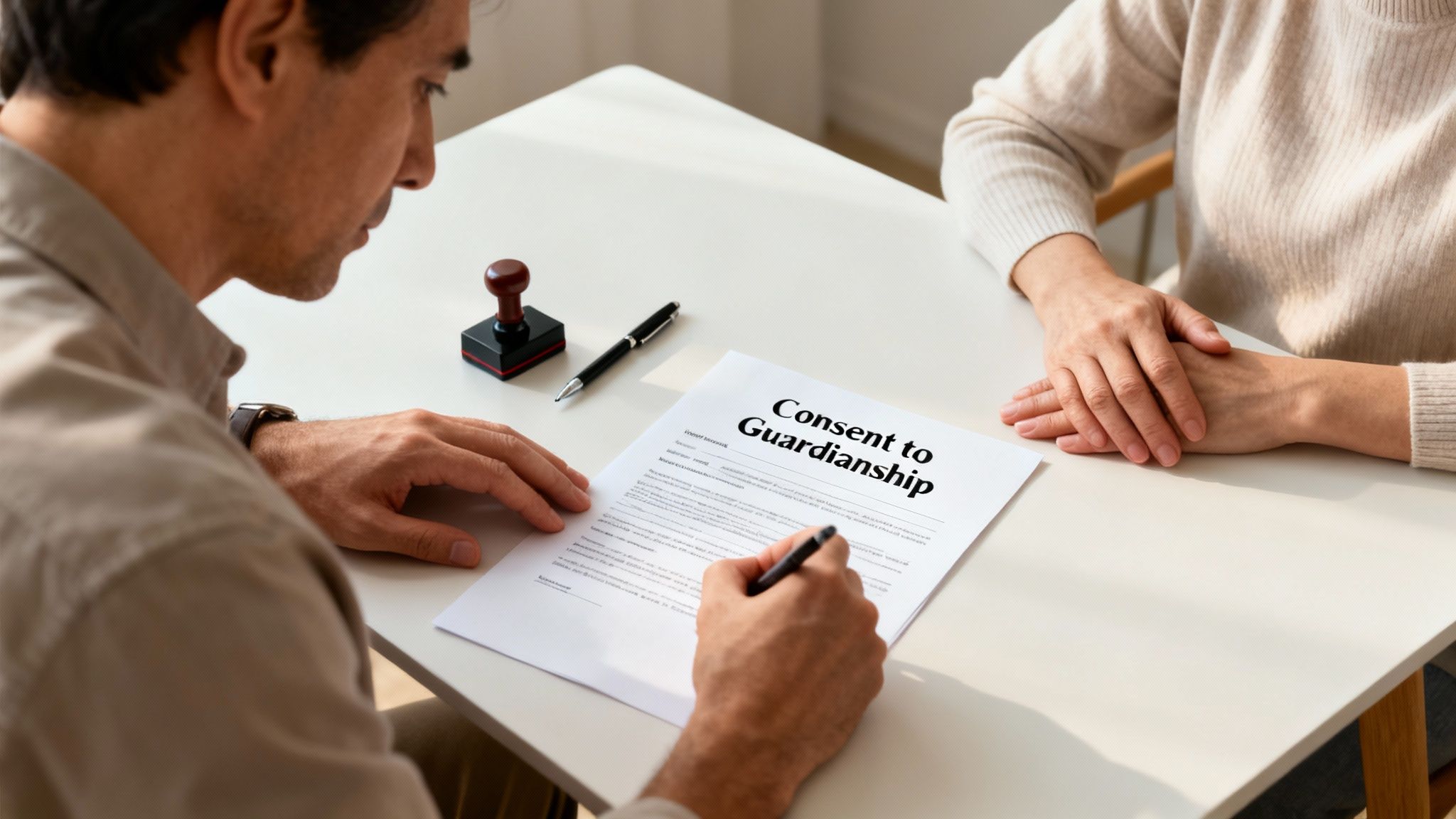
Unlike other scenarios where guardianship is imposed upon an unwilling or incapacitated person, this letter demonstrates volition and understanding. By consenting to the appointment of a trusted family member or friend, the individual retains a significant degree of control over their future. For a judge, this letter can reduce the adversarial nature of a guardianship hearing, transforming it into a proceeding that affirms the person's own well-laid plans and preserving their dignity.
When to Use a Letter of Consent
This letter is a key component of anticipatory planning and is invaluable in several sensitive situations Texas families encounter:
- Early-Stage Cognitive Decline: An individual diagnosed with early-onset Alzheimer's or mild cognitive impairment can use this letter to designate a trusted spouse or child as their future guardian while their judgment is still clear.
- Progressive Medical Conditions: Someone with a diagnosis like Parkinson's disease or ALS can consent to a guardianship that will manage their affairs when the physical or cognitive symptoms make it impossible for them to do so.
- Aging Parents Planning Ahead: An elderly parent who recognizes their increasing vulnerability can work with their adult children to prepare a Letter of Consent, ensuring a smooth transition of decision-making authority when the time comes.
- Adults with Developmental Disabilities: In some cases, a high-functioning adult with a developmental disability may consent to a co-guardianship arrangement with a sibling or parent to provide an additional layer of support.
Strategic Breakdown: Key Elements of an Effective Letter
A persuasive Letter of Consent must clearly establish the individual's capacity and informed agreement, leaving no doubt for the court about their wishes.
1. Clear Statement of Capacity and Understanding:
- Who: The proposed ward (the person consenting).
- Why: The letter must begin with an unambiguous declaration that the individual is of sound mind, understands the nature and consequences of a guardianship, and is signing the document of their own free will without coercion.
2. Specific Identification of the Proposed Guardian:
- Who: State the full legal name of the person you are consenting to have as your guardian.
- Why: This clarity is critical. The letter should also explain the relationship and why this specific person is trusted, for example, "my son, John Doe, who has helped manage my finances for the past five years."
3. Acknowledgment of Rights Affected:
- Who: The proposed ward, demonstrating their comprehension of the process.
- Why: A powerful consent letter will explicitly acknowledge which rights will be transferred to the guardian (e.g., the right to make medical decisions, manage finances, or determine residency). This shows the Texas court that the consent is truly informed, a key requirement under the Texas Estates Code.
4. Independent Witnesses and Notarization:
- Who: You (the consenting individual), a Texas notary public, and ideally two disinterested witnesses.
- Why: Witness signatures and notarization provide strong proof against any future claims of undue influence or lack of capacity. This legal formality gives the document significant weight in a guardianship proceeding.
Actionable Takeaways for Texas Families
- Act While Capacity is Clear: The most critical element is timing. This letter is only valid if signed when the individual has the legal capacity to understand it. Coordinate its signing with a recent physician's evaluation of capacity.
- Consult Independent Counsel: To further prove the consent is voluntary, the individual signing the letter should consider having it reviewed by their own independent attorney. This step demonstrates to the court that they received impartial advice.
- Be Specific About Powers: The letter can specify consent for a "guardianship of the person" (for healthcare decisions), a "guardianship of the estate" (for financial matters), or both. Being specific helps tailor the guardianship to the person's actual needs.
- Integrate with Your Guardianship Petition: This Letter of Consent is not a standalone solution; it is a vital piece of evidence. It must be filed with the formal Application for Appointment of Permanent Guardian in the appropriate Texas probate court. The Law Office of Bryan Fagan can ensure all documents are filed correctly and that the consent letter is presented effectively to support your case and honor your loved one's wishes.
4. Emergency or Temporary Guardianship Request Letter
An Emergency or Temporary Guardianship Request Letter is an urgent formal communication, often submitted to a Texas court alongside a formal application, when a person's health, safety, or financial well-being is in immediate danger. Unlike other guardianship processes that follow a standard timeline, this letter helps establish the critical need for an expedited hearing and the immediate appointment of a guardian. This action is reserved for crisis situations where waiting for a standard court date would cause irreparable harm to the proposed ward.
This type of request is a powerful tool under the Texas Estates Code, specifically provisions like §1251.001, which allow a judge in Bexar County or Dallas County probate court to act swiftly. The letter and accompanying application must present "substantial evidence of imminent danger," persuading the court that immediate intervention is the only way to protect a vulnerable individual from physical harm, severe financial loss, or a life-threatening medical situation.
When to Use an Emergency or Temporary Guardianship Request
This time-sensitive request is essential in acute crisis scenarios that Texas families, caregivers, and healthcare providers may suddenly face:
- Sudden Medical Crisis: An individual is hospitalized and unresponsive after an accident or stroke, and a critical medical decision (like surgery) is needed immediately, but no advance directive or power of attorney exists.
- Discovery of Elder Abuse or Exploitation: An adult child discovers their elderly parent is being financially exploited by a new "friend" or caregiver, with large, suspicious withdrawals from their bank accounts happening daily.
- Imminent Physical Danger: A person with severe dementia is found wandering in a dangerous area, or their living conditions have become so unsanitary and unsafe that they pose an immediate threat to their own life.
- Parental Incapacity: Both parents of a minor child are suddenly hospitalized after a car accident, leaving the child with no legal guardian to authorize medical care or make other essential decisions.
Strategic Breakdown: Key Elements of an Effective Letter
A compelling Emergency Guardianship Request Letter must be precise, evidence-based, and focused on demonstrating immediate peril. It's not just a request; it's an urgent plea for judicial intervention.
1. Clear Identification and Statement of Emergency:
- Who: Clearly identify the applicant (the person seeking guardianship), the proposed ward, and the proposed guardian.
- Why: The opening sentence must immediately state that this is an application for emergency or temporary guardianship and summarize the imminent danger. This sets the urgent tone for the judge from the first line.
2. Articulation of Imminent Danger:
- Who: This section details the specific, observable threats to the proposed ward.
- Why: Vague claims are insufficient. You must provide concrete facts. For example, instead of saying "he is unsafe," state "On May 15th, Mr. Smith, who has advanced dementia, was found by police attempting to cross a major highway four miles from his home, constituting an immediate danger to his life."
3. Physician's Affidavit and Medical Evidence:
- Who: A licensed physician who has recently examined the proposed ward.
- Why: A signed, detailed affidavit or a Certificate of Medical Examination from a doctor is the most critical piece of evidence. It provides the court with a professional medical opinion on the person's incapacity and the urgency of the situation, giving significant weight to the request.
4. Explanation of Why Standard Timelines are Inadequate:
- Who: The applicant explains the time-sensitive nature of the crisis.
- Why: The letter must explicitly state why the standard guardianship process, which can take weeks or months, would result in harm. For example, "The proposed ward requires emergency heart surgery within 48 hours, a timeline that a standard guardianship proceeding cannot accommodate."
Actionable Takeaways for Texas Families
- Gather Evidence Immediately: Before even drafting the letter, secure a physician’s affidavit, any relevant police reports, bank statements showing exploitation, or statements from social workers. Time is of the essence.
- Identify a Ready Guardian: The person you nominate as the temporary guardian must be prepared to assume their duties the moment the judge signs the order. They need to be available and fully understand the responsibilities.
- Understand Expedited Hearing Rules: An emergency guardianship hearing in Texas can happen very quickly, sometimes within days. You must be prepared to present your evidence to the judge on short notice.
- Consult an Emergency Guardianship Attorney: The legal standard for proving "imminent danger" is high, and procedural mistakes can cause fatal delays. The Law Office of Bryan Fagan has experience with these urgent filings and can act immediately to protect your loved one. Contact us for a same-day consultation to navigate this crisis with skill and speed.
5. Letter to Contest or Modify Existing Guardianship
A letter to contest or modify an existing guardianship is a critical legal tool for interested parties who believe a guardianship is no longer necessary, is being mismanaged, or requires changes to better serve the ward's best interests. This formal communication, often a precursor to a court filing like a Petition for Removal or a Motion to Modify, serves as the initial step in challenging the status quo. It is used to formally notify the court, the current guardian, and other involved parties of serious concerns, such as fiduciary misconduct, neglect, or a significant change in the ward's condition.
While the letter itself does not automatically change the guardianship, it creates an official record of the issues and can be presented as evidence in a Harris County or Bexar County probate court. It demonstrates a proactive effort to protect the ward and hold the guardian accountable under the Texas Estates Code. For families discovering mismanagement or for wards who have regained capacity, this letter is the first formal step toward seeking justice and ensuring the ward's well-being and rights are protected.
When to Use a Letter to Contest or Modify
This type of formal communication is essential in several serious and often contentious guardianship situations:
- Guardian Misconduct or Neglect: If an adult child discovers a guardian has embezzled funds from their parent's estate, failed to provide adequate medical care, or is isolating the ward from family, this letter initiates the process of holding them accountable.
- Ward's Improved Capacity: Following a stroke or brain injury, a ward may regain significant cognitive function through rehabilitation. A letter, supported by medical evidence, can be used to request the termination of the guardianship because it is no longer needed.
- Changed Circumstances: If a guardian's health declines, making them unable to fulfill their duties, or if they plan to make a significant decision against the ward's best interests (like selling a beloved family home), a letter can request a modification, such as adding a co-guardian or limiting the guardian's powers.
- Failure to Comply with Court Requirements: When a guardian fails to file required annual accountings or reports with the court, a letter can formally object and lay the groundwork for a petition to have them removed for failing their legal duties.
Strategic Breakdown: Key Elements of an Effective Letter
A letter intended to challenge a guardianship must be precise, fact-based, and legally sound to be taken seriously by a Texas court.
1. Clear Identification and Case Information:
- Who: State your full legal name, your relationship to the ward, the ward's full name, and the case number of the existing guardianship proceeding. Clearly name the current guardian you are challenging.
- Why: This immediately orients the court and all parties to the specific legal case at issue, preventing administrative confusion and ensuring your concerns are directed correctly.
2. Specific Allegations and Supporting Facts:
- Who: This section outlines the specific actions or inactions of the guardian that form the basis of your complaint.
- Why: Vague accusations are easily dismissed. You must state specific grounds, such as "failure to account for assets from January 1, 2023, to December 31, 2023, in violation of Texas Estates Code § 1163.003" or "co-mingling the ward's funds with personal funds." Attach financial records, photos, or witness statements as evidence.
3. Reference to Legal Standards:
- Who: The person writing the letter (or their attorney) should cite the relevant sections of the Texas Estates Code.
- Why: Citing specific statutes (e.g., grounds for removal under § 1203.051) shows the court you have a legally valid reason for your request, not just a personal disagreement. It transforms a complaint into a legitimate legal challenge.
4. A Clear Request for Relief:
- Who: You must clearly state what you want the court to do.
- Why: Be explicit. Are you requesting the complete removal of the guardian and appointment of a successor? Or are you asking for a more limited modification, like requiring court approval for all financial transactions over $500? This clarity helps the judge understand your desired outcome.
Actionable Takeaways for Texas Families
- Gather Your Evidence First: Before sending any letter, compile all supporting documentation. This includes bank statements, medical records from a physician attesting to a ward's restored capacity, emails, and sworn affidavits from witnesses.
- Document Everything: Keep a detailed, dated log of every instance of suspected misconduct or neglect. Record dates, times, specific events, and who was present. This detailed record is invaluable in court.
- File Formal Objections: If a guardian submits an annual accounting that you believe is inaccurate or incomplete, file a formal, written objection with the court. This creates an official record of your dispute. You can learn more about the formal process of how to contest or terminate guardianship in Texas on our website.
- Consult a Guardianship Litigation Attorney: Contesting a guardianship is an adversarial legal process. The Law Office of Bryan Fagan has experience in these complex disputes and can help you gather evidence, draft compelling legal arguments, and represent the ward's best interests in court. We can help you navigate the process and fight to protect your loved one.
Comparison of 5 Guardianship Letter Examples
| Document | Process / Complexity 🔄 | Resources & Speed ⚡ | Outcomes & Impact 📊⭐ | Ideal Use Cases 💡 | Key Advantages ⭐ |
|---|---|---|---|---|---|
| Letter of Intent for Guardianship of Minor Child | Moderate; preparatory document that supports later court filing | Low–Moderate: drafting, notarization; not time‑sensitive | Documents parental intent and child's needs; aids court understanding | Planning for unexpected loss; special‑needs children; relatives assuming care | Establishes intent record; clarifies child's needs; court‑friendly evidence |
| Letter Requesting Guardianship of Incapacitated Adult | High: requires medical proof, estate details, formal petition and hearings | High: physician evaluations, financial inventories, attorney involvement; time‑intensive | Legal authority over person and/or estate; protects health decisions and assets | Dementia/Alzheimer's, stroke, severe cognitive impairment with assets | Comprehensive legal basis; enables fiduciary management; protects ward/assets |
| Letter of Consent to Guardianship | Low–Moderate: must show contemporaneous capacity and voluntariness | Low: notarization, witnesses, possible independent counsel; expedites process | Demonstrates voluntary consent; can streamline or shorten court proceedings | Anticipatory planning; early cognitive decline; individuals choosing their guardian | Speeds proceedings; respects individual choice; may reduce litigation and cost |
| Emergency or Temporary Guardianship Request Letter | High complexity under urgent conditions; must meet emergency legal thresholds | Very High urgency: immediate medical affidavits, expedited filings, rapid hearings | Temporary authority (typically 60–120 days); prevents imminent harm; enables urgent decisions | Acute medical crises, imminent abuse/exploitation, hospitalized unresponsive persons | Rapid protective authority; ex parte relief possible; buys time for permanent plan |
| Letter to Contest or Modify Existing Guardianship | High: litigation‑oriented, evidence‑intensive; burden of proof often elevated | High: discovery, counsel, medical/financial evidence; can be lengthy and costly | Can remove or modify guardian, restore rights, enforce accountability | Alleged fiduciary misconduct, restored capacity, disputes over guardian decisions | Protects ward from abuse, enforces fiduciary duties, enables corrective remedies |
Taking the Next Step: How to Move from Example to Action
Navigating the complexities of Texas guardianship law can feel overwhelming, but understanding how to properly structure a letter of guardianship is a crucial first step. Throughout this guide, we have dissected various examples, from a heartfelt letter of intent for a minor child to a formal request for an incapacitated adult. Each letter of guardianship example serves a distinct purpose, yet they all share a common foundation: the need for clarity, precision, and adherence to the strict requirements of the Texas Estates Code.
We've seen how a well-drafted letter is not merely a formality but a powerful legal instrument. It sets the stage for court proceedings, clearly communicates your intentions, and provides the initial evidence needed to protect a vulnerable loved one. The key is to move beyond simply copying a template and instead use these examples as a strategic framework.
Key Takeaways from Our Guardianship Letter Examples
As you prepare to take action, remember these critical insights drawn from the examples we analyzed:
- Specificity is Non-Negotiable: Vague statements have no place in a legal document. Whether you are detailing an adult's incapacities or explaining why you are the best choice to be a guardian for a minor, every claim must be supported by specific, factual details.
- Acknowledge the Legal Standard: Your letter should implicitly or explicitly address the core legal tests required by Texas law. For an incapacitated adult, this means demonstrating a lack of capacity to manage their own affairs, as defined in the Texas Estates Code.
- The "Why You" Factor is Crucial: The court needs to understand not just why a guardian is necessary, but why you are the appropriate person for this profound responsibility. Highlighting your relationship, capabilities, and commitment is essential.
- Formatting Matters: A clean, organized, and professionally formatted letter demonstrates seriousness and respect for the legal process. This initial impression can significantly influence how your petition is received by courts in jurisdictions like Harris County or Fort Bend County.
Your Action Plan: From Document to Courtroom
Viewing a letter of guardianship example is the beginning of the journey, not the end. To effectively move forward, your next steps must be deliberate and legally sound. Consider this your action plan:
- Gather Comprehensive Documentation: Before drafting any letter, collect all necessary supporting evidence. This includes medical records, doctors' evaluations, financial statements, and any other documents that substantiate the need for a guardianship.
- Tailor the Letter to Your Unique Situation: Use the examples provided as a guide, but ensure every word reflects your family's specific circumstances. A generic letter will likely fail to meet the rigorous standards of a Texas probate court.
- Consult with a Guardianship Attorney: This is the most critical step. An experienced Texas guardianship lawyer can review your situation, ensure your letter is legally sufficient, and guide you through the complex court filing process, including the application for guardianship and any required hearings.
- Prepare for the Legal Process: Drafting the letter is just one piece of the puzzle. The full guardianship process involves filing a formal application with the court, serving notice to interested parties, securing a physician’s certificate of medical examination, and attending a court hearing where a judge will make the final determination.
Ultimately, a letter of guardianship example is a tool to help you articulate a profound need. It is the first formal step in a legal process designed to protect the most vulnerable members of our families. By approaching this task with diligence, compassion, and the right legal guidance, you can build a strong foundation for your case and ensure your loved one receives the care and protection they deserve.
Navigating the Texas guardianship process requires more than a template; it demands personalized legal strategy and compassionate counsel. The attorneys at the Law Office of Bryan Fagan, PLLC specialize in guiding families through these complex and emotional matters, ensuring every document is crafted to meet the specific standards of Texas probate courts. Schedule a free consultation with us today to discuss your unique situation and protect what matters most.