Skip to content
You may be reading this because something feels off. Your father's bills used to be paid on time. Your sister used to be able to visit your mother without excuses from the guardian. Now the home looks neglected, your loved one seems withdrawn, and every question about money gets brushed aside.
That kind of concern is hard to voice. Guardianship is supposed to protect a vulnerable adult, not cut the family out or put the person's finances and care at risk. In Texas, families often hesitate because they don't want to accuse the wrong person or make an already painful situation worse.
That hesitation is understandable. It's also why a clear plan matters. In guardianship abuse cases in Texas, warning signs only help if you know what to do next, what proof courts rely on, and which legal remedies fit the facts.
A Gut Feeling You Can't Ignore
A common pattern starts small. A son visits his mother and notices unopened mail on the kitchen counter. Her clothes aren't clean. She seems nervous when the guardian walks into the room. He asks for a copy of the annual accounting and gets a vague answer. Then he learns a medical appointment was missed, even though money was available for transportation and care.
None of those facts alone proves abuse. Together, they may justify immediate attention.
Texas courts see guardianship oversight problems often enough that families shouldn't dismiss those instincts. In Fiscal Year 2025, guardianship compliance specialists reviewed 7,590 guardianship cases across Texas courts and found 1,569 cases, about 34%, out of compliance with required statutory reporting, according to the Texas Judicial Branch FY 2025 guardianship report. The same report showed that the most common warning signs in deficient cases were missing annual accounts in 40%, missing required inventories in 41%, and missing annual reports in 23% of those deficient cases.
That matters because abuse doesn't always begin with obvious theft or visible injury. Sometimes it starts with noncompliance. A guardian who won't file inventories, won't account for funds, or won't submit annual reports is often creating a record gap that makes deeper problems harder to spot.
What a family should hear from this
If you've noticed strange withdrawals, blocked access, poor living conditions, or repeated excuses about paperwork, you are not overreacting. You are seeing the kinds of issues that often bring a guardianship back under court review.
Practical rule: In Texas guardianship disputes, courts respond better to specific facts than to family frustration. Start with what you can observe, date, and preserve.
Texas guardianships are generally handled under Title 3, Subtitle G of the Texas Estates Code, which governs the creation, administration, modification, and ending of guardianships. That framework gives courts tools to require accountings, review a guardian's conduct, and remove a guardian when the law and the facts support it.
Families in Harris County Probate Court, Dallas County probate proceedings, and courts across Texas usually feel overwhelmed at first. That's normal. The key is to move from concern to proof, then from proof to the right court filing.
Identifying the Warning Signs of Guardianship Abuse
The most useful way to evaluate a case is to look for red-flag clusters, not a single odd event. Texas-specific guidance on financial exploitation within guardianship points to a pattern that may include sudden unexplained withdrawals, abnormal gifting, unpaid bills despite available assets, restricted access to the ward, and rapid changes in estate-planning documents, as explained in this discussion of elder abuse through guardianship.

Financial red flags
Money problems often leave the clearest paper trail.
- Unexplained withdrawals: Repeated cash withdrawals, transfers to unknown accounts, or spending that doesn't match the ward's needs.
- Odd gifting patterns: The guardian claims the ward wanted to “help” someone, but there's no history of similar gifts.
- Unpaid basics despite available funds: Utilities, medications, rent, or assisted living charges fall behind even though accounts appear funded.
- Changes to legal or property documents: A deed changes, beneficiary designations shift, or estate-planning papers are revised under suspicious circumstances.
A practical example helps. If a guardian uses the ward's money for a “shared vacation,” but the ward was medically unable to travel and received no real benefit, that may support a claim that the guardian used estate funds for personal benefit rather than for the ward.
Care and isolation red flags
Abuse in a guardianship case isn't always about money. It can involve control.
- Restricted family access: Calls go unanswered, visits are delayed, or the guardian always insists on being present.
- Fear or withdrawal: The ward becomes quiet, anxious, or unusually guarded.
- Sudden isolation: Church attendance stops, longtime friends disappear, and activities end without a medical explanation.
Sometimes families also notice practical signs in the home. Lingering odor, soiled equipment, or bedding that clearly hasn't been cleaned can point to neglect. If a loved one uses durable medical equipment and hygiene has become a problem, simple caregiving guides like this one on cleaning urine smell from DME can help you tell the difference between a manageable care issue and a larger neglect pattern.
A guardian may limit access for legitimate safety reasons. But when isolation appears alongside money problems, poor hygiene, or missed care, the pattern deserves scrutiny.
Neglect and daily living concerns
Neglect cases often develop unnoticed.
| Warning sign | Why it matters |
|---|---|
| Poor hygiene | May show the guardian isn't meeting basic care duties |
| Untreated medical issues | Missed appointments or ignored symptoms can put the ward at risk |
| Unsafe living conditions | Fall hazards, spoiled food, or lack of heat or cooling may support urgent court review |
| Malnutrition or dehydration concerns | Suggests the ward's daily needs aren't being managed properly |
If you need a practical overview of reporting options, this guide on how to report guardianship abuse in Texas can help families understand where to start.
How to Document Suspected Abuse for Court
Once concern becomes suspicion, your job changes. You are no longer only observing. You are preserving evidence.
A probate judge won't remove a guardian because family members are upset. The court needs facts it can evaluate. In many cases, the difference between action and delay is the quality of the file placed in front of the judge.

Build one organized record
Start a single folder, paper or digital, and keep everything in it. Don't scatter proof across texts, voicemail, screenshots, and loose notes.
Use a structure like this:
Incident log
Record dates, times, locations, and who was present. Keep entries factual. “Mom had no prescribed medication in the house on May 3” is useful. “The guardian is awful” is not.Financial records
Save bank statements, billing records, credit card statements, receipts, and screenshots of suspicious transactions if you lawfully have access to them.Care evidence
Keep discharge paperwork, appointment summaries, medication lists, photographs of living conditions, and notes about missed care.Communication file
Preserve emails, letters, voicemails, and text messages with the guardian or facilities involved.
Focus on proof a court can use
The strongest guardianship abuse cases usually include details at the transaction level or care level.
- Photographs: Take clear photos of unsafe conditions, visible injuries, empty refrigerators, or untreated hygiene problems.
- Witness statements: Relatives, neighbors, caregivers, social workers, and facility staff may have relevant observations.
- Medical records: These can show missed follow-up, untreated conditions, or a decline inconsistent with the guardian's explanations.
- Account discrepancies: Highlight unusual payments, repeated ATM withdrawals, or charges that seem unrelated to the ward's needs.
Courtroom reality: A well-organized binder with dates, records, and photos usually carries more weight than an emotional but vague accusation.
Keep your notes clean and credible
Families sometimes hurt their own case by overstating what they know. If you did not witness a transfer, don't state it as a fact. If you suspect forgery, label it as a concern and let your attorney investigate.
In Harris County Probate Court and other Texas courts, credibility matters. Judges often see family disputes mixed with legitimate concern. Clean, careful documentation helps the court separate personal conflict from fiduciary misconduct.
A short hypothetical shows the difference. If you tell the court, “He's stealing from her,” that may go nowhere. If you show that the ward's mortgage went unpaid while the guardian transferred funds to an account the guardian controls, your lawyer has something a judge can act on.
Your Legal Roadmap for Removing an Abusive Guardian
Texas courts usually expect a sequence. First, gather concrete evidence. Then report concerns to the proper authorities. Then ask the court that created the guardianship to step in. That order matters because a guardian can't be removed just because relatives disagree.
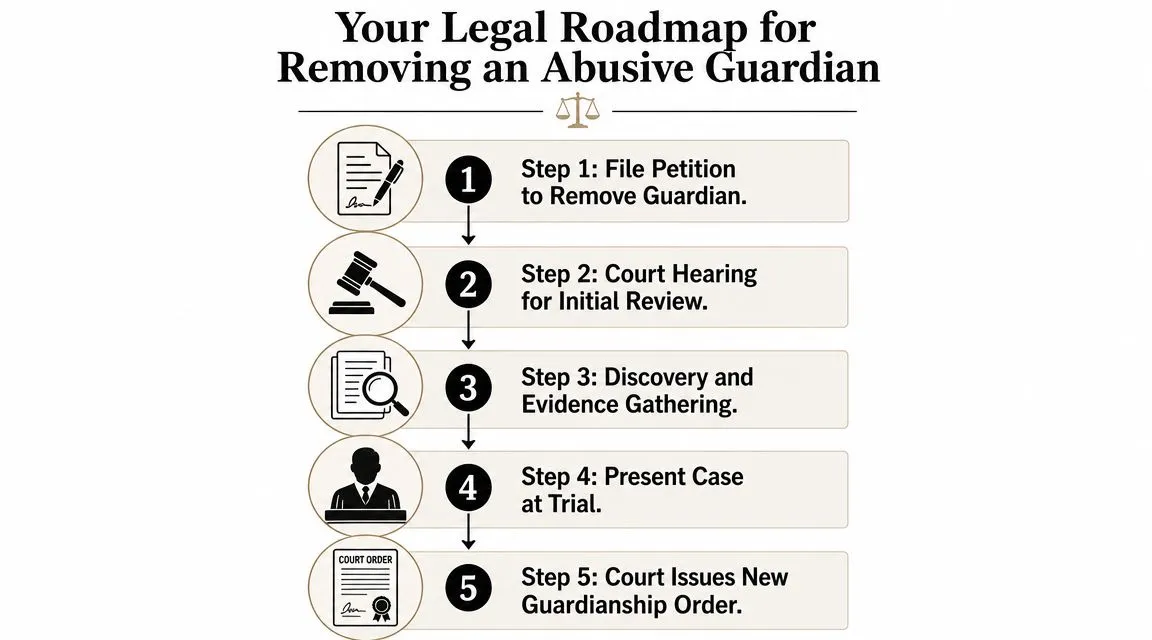
Texas Adult Protective Services guidance reflects the practical intervention sequence. The most effective path is typically to document concrete indicators, report to APS, and move quickly for court review or removal, and a major pitfall is relying on generalized suspicion instead of transaction-level proof, as described in the Texas APS policy materials.
Step one reports and immediate review
If the ward is an elderly adult or vulnerable adult facing abuse, neglect, or exploitation, report the matter to Adult Protective Services. If money is being stolen or the ward is in immediate danger, law enforcement may also need to be involved.
APS is not the probate court. APS can investigate and create records, but it does not replace the court process required to remove a guardian.
That distinction surprises many families. They think a report alone will end the problem. It usually won't.
Step two file in the original guardianship court
The proper court is usually the same court that appointed the guardian. In counties such as Harris County, this may be a probate court. In other counties, a county court with probate jurisdiction may handle the matter.
Your attorney may file a pleading asking the court to review conduct, compel accountings, modify the guardianship, suspend powers, or remove and replace the guardian. The specific filing depends on the facts.
Under Texas Estates Code Title 3, Subtitle G, guardians are fiduciaries. That means they must act for the ward's benefit, follow court orders, account for money and property, and comply with reporting duties. Texas law also requires guardians to qualify properly, and families often learn during a dispute that compliance failures are part of the larger problem. Texas Law Help explains that guardians must post bond, submit annual reporting, and may be removed for violating duties or using the ward's funds for personal benefit.
Step three use discovery to prove the case
After filing, formal evidence gathering may begin. During this phase, many strong cases are won.
Your lawyer can seek records such as:
- Bank statements and transaction logs
- Care facility records
- Medical records
- Guardian accountings and inventories
- Communications with financial institutions or service providers
That's also where legal representation matters. A family member may suspect missing funds, but discovery can reveal whether the money was spent on care, transferred improperly, or hidden inside incomplete reports.
For families trying to understand the broader process, practical reading like these Family Caregiving Kit resources can help organize questions before meeting counsel.
Here is a short overview of what tends to work versus what tends to fail:
| Approach | What usually happens |
|---|---|
| Detailed records plus court filing | Gives the judge a basis to act |
| Only arguing with the guardian | Often creates conflict without legal change |
| General suspicion without documents | Usually stalls |
| Fast action after preserved evidence | Improves the chance of meaningful relief |
Step four prepare for hearing
Many Texas guardianship disputes turn on whether the evidence shows a breach of fiduciary duty. That may involve misuse of funds, failure to account, neglect of care duties, or violation of court orders.
The court may also involve an attorney ad litem, whose role is to represent the ward's interests in the proceeding. Families should expect careful scrutiny, not automatic agreement.
This overview may help if you want a closer look at removing a guardian in Texas.
A short video explanation can also make the process easier to follow.
Step five expect a tailored remedy
Removal is not the only possible result. Depending on the proof, a judge may order an accounting, require corrective compliance, restrict the guardian's powers, appoint a successor, or modify the guardianship to fit the ward's current needs.
That is why precision matters. The remedy has to match the record.
Emergency Actions for Situations of Imminent Harm
Some cases cannot wait for the ordinary pace of guardianship litigation. If the ward faces immediate physical danger or the estate is at risk of rapid loss, a family may need emergency court intervention.
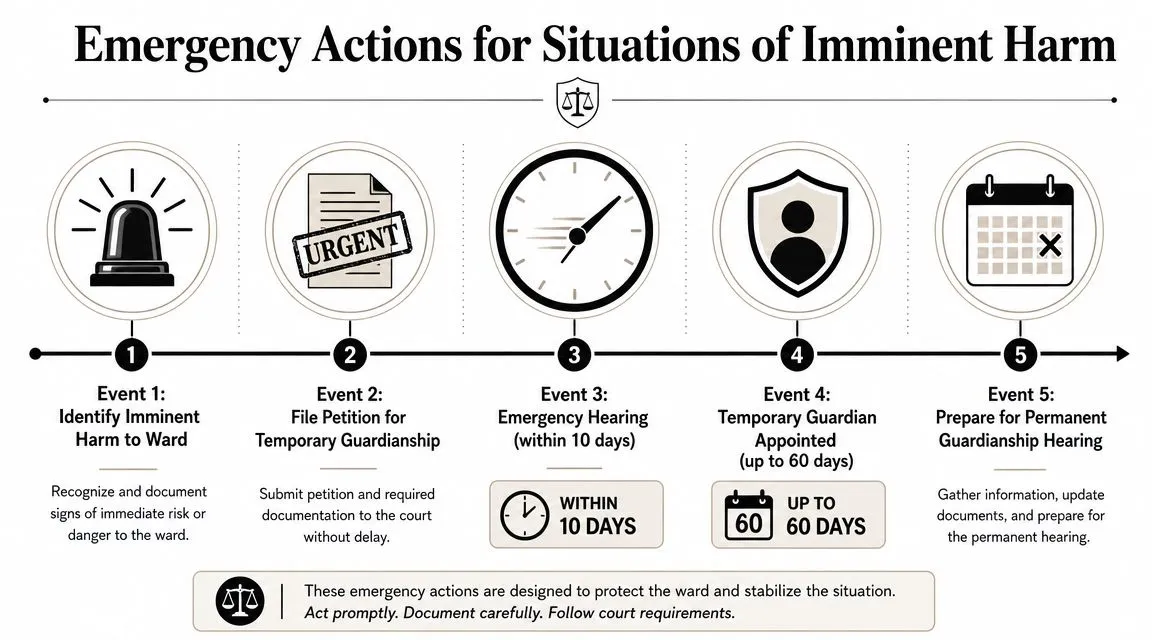
Standard removal versus emergency action
A standard removal case usually focuses on building a full record and asking the court for a lasting change. An emergency case is different. It asks the court to prevent immediate harm before more damage occurs.
Examples include:
- A guardian is liquidating assets quickly
- The ward is being moved out of state against medical advice
- Medications or care are being withheld
- The living situation has become unsafe right now
The temporary remedy in Texas is often a form of temporary guardianship or emergency relief within the existing guardianship case, depending on the posture of the matter.
What the court will want to see
Texas courts don't grant emergency relief because a family is frightened. They grant it when the evidence shows imminent harm and the requested order is necessary to protect the ward.
That usually means showing:
- Specific recent events, not old grievances
- Clear risk to health, safety, or property
- Why waiting for a normal hearing would be dangerous
- Who should step in temporarily and why
A strong emergency filing often includes affidavits, recent photos, care records, and financial proof. If incapacity or authority is part of the dispute, the court will still pay close attention to whether the legal prerequisites have been met.
If the danger is immediate, don't spend a week trying to negotiate with the guardian. Preserve proof and get legal help quickly.
Procedure still matters in urgent cases
Even emergency filings must comply with Texas guardianship procedure. Texas Law Help explains that a guardianship application is generally filed in county court, supported by a doctor's incapacity certification, personal service on the proposed ward, notice to interested persons, and appointment of an attorney ad litem. Cases often fail when those procedural steps are incomplete.
That is especially important where there is confusion about capacity. If the adult still has legal capacity, the court may view financial decisions differently than the family does. In other words, bad judgment is not always legal incapacity.
For a closer look at urgent filings, this page on an emergency guardianship hearing in Texas is a useful starting point.
Why You Need an Experienced Attorney on Your Side
A guardianship abuse case often turns on a frustrating gap between what the family knows and what the court can act on. Relatives may see isolation, missing money, medication problems, or a sudden change in living conditions. Probate judges still need admissible proof, the right pleading, proper notice, and a request that fits Texas law.
That is where counsel helps in a practical way. A lawyer identifies the actual dispute, whether it is removal, an accounting, a motion to enforce duties, a freeze on assets, or emergency temporary relief. That choice matters. The wrong filing can waste time, alert the guardian before records are secured, or leave the judge without a clean path to intervene.
The larger concern is not just one bad decision by a guardian. It is the amount of control a guardian may hold over housing, medical care, finances, and access to other family members. Reporting discussed by the Texas Observer described the scale of that authority in Texas, as summarized in this Texas Observer report on guardianship abuse. In court, that means allegations must be organized into something specific the judge can verify and correct.
Families often run into the same procedural problems:
- Proof is incomplete: strong suspicions are not enough without bank records, care records, photos, messages, or witness statements
- The remedy is mismatched: some cases call for removal, while others are stronger as a demand for accounting, visitation relief, or a narrowed guardianship order
- Capacity is misunderstood: an unpopular or unwise choice by the ward is not automatically legal incapacity
- Procedure gets overlooked: service, notice, medical support, and local probate practice can affect whether the court hears the request quickly
Good counsel also helps control the pace of the case. In many families, fear turns into confrontation, and confrontation gives the guardian time to explain away missing records or harden access to the ward. A lawyer can move the matter out of family argument and into subpoenas, sworn testimony, and enforceable court orders.
That shift is often what gets results.
The Law Office of Bryan Fagan, PLLC handles Texas guardianship establishment, emergency guardianship matters, disputes, compliance issues, and related probate concerns. In suspected abuse cases, the job is not to give general advice. It is to connect the warning sign to the proof, the proof to the proper filing, and the filing to a remedy the probate court can grant.
If your loved one may be at risk, early legal advice can prevent avoidable mistakes and preserve options that are harder to recover later.
If you're dealing with suspected guardianship abuse, you don't have to sort it out alone. Law Office of Bryan Fagan, PLLC helps Texas families evaluate warning signs, preserve evidence, and pursue the right remedy in probate court. Schedule a free consultation to talk through your situation, your county, and the fastest safe path forward for your loved one.