Skip to content
When you start to suspect that a court-appointed guardian is hurting, neglecting, or financially exploiting someone you love, the question usually comes out fast and blunt: Can you sue a guardian in Texas? The short answer is yes, sometimes. But in many Texas guardianship disputes, the better question is where and how you challenge the guardian.
That distinction matters. Families often assume they should file a regular civil lawsuit, the way they would in a business dispute or injury case. In guardianship matters, that approach often overlooks the effective means of recourse. Texas guardianships are supervised by probate courts, and those courts already have tools to review conduct, demand records, remove a guardian, and address losses tied to the guardian's duties.
If your parent, adult child, or other vulnerable relative lives in Harris County, Dallas County, Travis County, Bexar County, or elsewhere in Texas, the process can feel intimidating. It's also very personal. Many of these cases involve siblings who no longer trust each other, caregivers who feel shut out, or a ward who can't fully explain what's happening.
A Family's Concern When a Guardian's Actions Seem Wrong
Maria started noticing small things first. Her uncle's phone went unanswered for days. His electric bill, which he had always paid on time before his decline, was suddenly overdue. Then she learned a family heirloom had been sold, but no one could explain why. The guardian told relatives to stop asking questions and said, “The court already approved everything.”
That kind of situation leaves families feeling trapped. They worry about making things worse. They worry the court will ignore them. They worry that if they speak up, the guardian will isolate their loved one even more.

Sometimes the problem is money. Sometimes it's care. Sometimes it's control. A guardian may be refusing family contact, changing doctors without good reason, ignoring medical needs, or making property decisions that don't seem tied to the ward's best interest.
Practical rule: If your concern can be tied to a specific decision, missing report, financial transaction, or harmful pattern of care, you may have something the court can act on.
A lot of families hesitate because they think they need proof of outright theft before they can do anything. That isn't always true. Texas courts look at whether the guardian is carrying out court-supervised duties properly. A guardian doesn't get a free pass just because a judge appointed them.
Common red flags include:
- Unexplained spending: Bills are unpaid, accounts look drained, or property is sold without a clear benefit to the ward.
- Isolation: The guardian blocks contact for no obvious protective reason.
- Poor living conditions: The ward seems neglected, unsafe, or without basic care.
- Silence around records: Requests for accountings, receipts, or updates get ignored or brushed aside.
If this sounds familiar, your concerns aren't overreacting. They may be the beginning of a probate court challenge.
Understanding a Guardian's Fiduciary Duty in Texas
A Texas guardian stands in a position of trust. The job involves more than making decisions. It is to make the right decisions for the ward, keep records, follow court orders, and answer to the probate court that granted the appointment.
That point matters because families often ask the wrong first question. They ask, “Can we sue?” Before that, ask what duty the guardian owed, which role the guardian held, and whether the conduct should be addressed inside the guardianship case or in a separate lawsuit. In these cases, the procedure often shapes the result.
That duty comes from the Texas Estates Code, especially Title 3, Subtitle G, which governs guardianships and ongoing court supervision. In practical terms, a guardian must act with loyalty, care, honesty, and accountability. A guardian cannot use the ward's authority, money, housing, or medical decisions for personal convenience or personal gain.
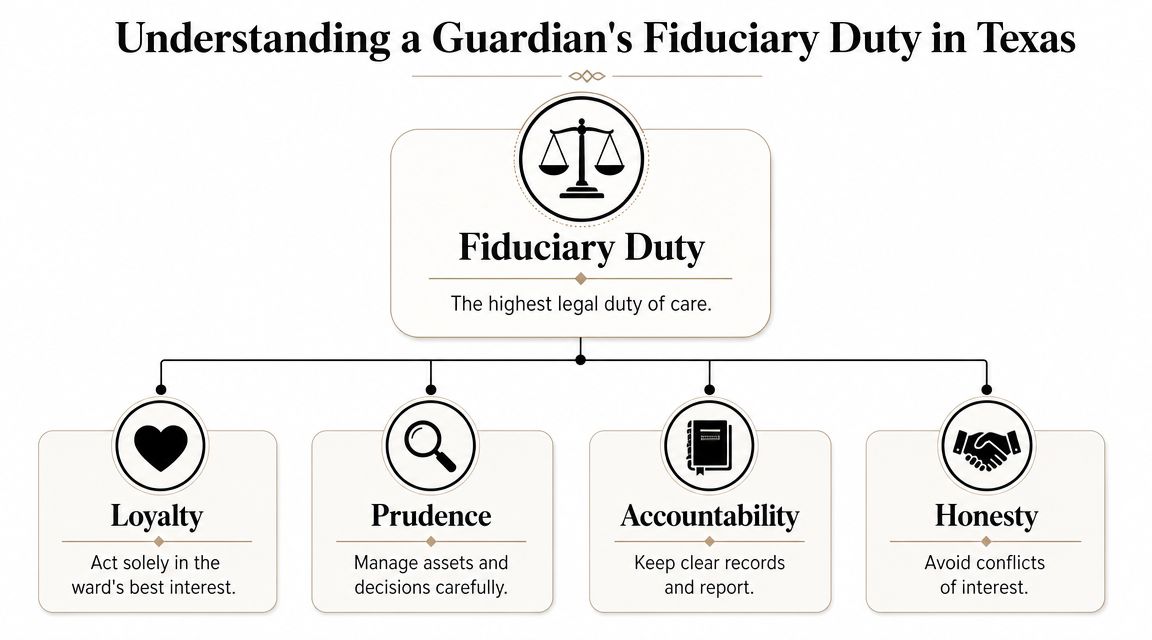
Two different guardianship roles
Texas recognizes two separate roles. A guardian of the person makes personal decisions, such as where the ward lives, what care the ward receives, and how daily needs are met. A guardian of the estate manages property, income, bills, and other financial matters.
That distinction often determines both the legal theory and the remedy. Complaints about missed medical care, unsafe placement, poor supervision, or unreasonable restrictions on contact usually point to the guardian of the person. Complaints about missing funds, undocumented withdrawals, unpaid taxes, questionable sales, or bad accounting usually point to the guardian of the estate.
One person may serve in both roles. The court may also split them between different people.
Why the appointment details matter later
The guardianship file usually contains the roadmap for challenging misconduct. Appointment requires a formal court process, and once the court signs the order, the guardian takes on specific duties under oath. Those duties are enforceable. If the guardian ignores reporting requirements, acts outside the scope of authority, or lets qualifications lapse, that is more than sloppy paperwork. It may support removal, surcharge, bond claims, or other probate relief.
The same is true for ongoing supervision. Guardians are expected to maintain current authority, comply with reporting rules, and stay within the limits set by the court. Families who suspect misconduct should review the guardianship order, any letters of guardianship, inventories, annual accountings, annual reports, and later court filings before deciding on strategy.
| Guardian role | Main responsibility | Typical dispute |
|---|---|---|
| Guardian of the person | Personal care and living decisions | Neglect, unsafe placement, isolation |
| Guardian of the estate | Property and financial management | Missing funds, bad records, self-dealing |
What fiduciary duty looks like in real life
In day-to-day terms, fiduciary duty means the guardian keeps clean records, avoids conflicts of interest, preserves the ward's property, pays proper expenses, seeks court approval when required, and makes decisions the guardian can justify to a judge. If you want a closer explanation of how Texas courts evaluate a guardian's breach of fiduciary duty, the core question is usually straightforward.
Did the guardian act for the ward's benefit, or for the guardian's own benefit?
That is the standard probate courts return to again and again. It is also why the “how” matters so much in these cases. The same conduct that supports a damage claim in civil court may also support faster, more targeted relief inside the guardianship itself, including orders to produce records, repay funds, change care arrangements, or remove the guardian altogether.
Recognizing the Grounds for a Lawsuit Against a Guardian
A common call starts like this. A daughter has finally obtained bank statements and sees withdrawals she cannot match to her mother's care. Or a brother visits a ward and finds missed medications, weight loss, and no clear explanation from the guardian. At that point, the question is usually not just whether something feels wrong. The question is whether the conduct fits a legal ground the probate court can act on.
Texas law focuses on duty, authority, and harm. A guardian can be challenged when the facts show misuse of money, neglect of personal care, concealment, conflicts of interest, or actions outside the authority granted by the court. Some claims support removal. Some support repayment. Some support both. If you need a clearer framework for a breach of fiduciary duty by a Texas guardian, start there and match the rule to the records you have.
Conduct that often supports court action
Families usually raise one or more of these problems:
- Breach of fiduciary duty: The guardian puts personal convenience or financial interest ahead of the ward's interest.
- Neglect of care: The ward is left without proper medical care, safe housing, hygiene, supervision, or necessary services.
- Self-dealing: The guardian uses the ward's funds, credit, home, or other property for the guardian's own benefit.
- Conversion or misappropriation: Money or property is taken, redirected, or spent without lawful authority.
- Fraud or concealment: The guardian hides transactions, gives false information, or omits material facts from court filings.
- Acting outside the court's order: The guardian makes decisions that required prior court approval and proceeds anyway.
The same basic event can point to different remedies depending on how the case is framed. A guardian of the estate who pays personal travel expenses with the ward's funds may face a surcharge request in probate court and, in some cases, a separate civil claim. A guardian of the person who ignores urgent follow-up care may face removal, restrictions, or emergency orders directed at the ward's safety.
That difference matters.
The strongest cases usually tie three things together. A specific duty. A document or witness that shows what happened. A concrete harm to the ward or the ward's property.
What judges look for
Probate judges are used to family conflict. They give much more weight to records than to suspicion alone. Missed accountings, unexplained transfers, invoices that do not match the ward's needs, medical records showing gaps in treatment, facility notes, text messages, and sworn testimony often matter more than heated email threads.
These fact patterns commonly get attention from the court:
- Repeated filing failures: Required reports or accountings are late, incomplete, or missing, and the guardian cannot produce supporting records.
- Questionable property transactions: A house, vehicle, or account is sold, emptied, or retitled without a clear ward-related reason or court approval where approval was required.
- Isolation that harms the ward: Family contact is blocked without a safety basis, and the isolation appears to worsen the ward's condition or limit oversight.
- Care decisions with no paper trail: The guardian claims everything is under control but cannot show appointments kept, prescriptions filled, or services arranged.
Property issues often overlap with guardianship disputes, especially where a ward's home is involved. A practical guide for executors on probate homes can help families understand how legitimate probate sales are usually documented, which makes it easier to spot a transaction that does not look right.
A good claim is rarely built on one alarming moment. It is built on a pattern you can prove.
Choosing Your Legal Path: Probate Remedies vs Civil Lawsuits
Families often ask whether they should “sue” the guardian in a new case. Sometimes that happens. But in many guardianship disputes, the stronger move is to seek relief inside the existing probate matter.
That's because the probate court already supervises the guardianship. The judge already has the file, the prior orders, the reporting history, and the power to enforce the guardian's obligations. If the case is pending in a court such as Harris County Probate Court or a statutory probate court in Dallas, that court is often the most direct place to act.

What usually works better in probate court
The most useful remedies are often targeted motions within the guardianship itself. These may include asking the court to compel compliance, require an accounting, remove the guardian, or surcharge the guardian for losses tied to misconduct.
A surcharge is a probate remedy that asks the court to hold the guardian financially responsible for loss caused by improper conduct. It's different from a generic damages claim because it grows out of the guardian's court-supervised fiduciary role.
You may also ask the court to:
- Compel an accounting: Force the guardian to produce records and explain transactions.
- Limit powers: Narrow the guardian's authority if the current arrangement is too broad.
- Remove the guardian: Replace the guardian when the conduct shows the person is no longer suitable.
- Recover against the bond: If estate losses can be tied to misconduct, the bond may become important.
When a civil lawsuit may still be considered
A separate civil lawsuit may make sense in a narrower set of cases, especially when the facts involve broader claims beyond the court's day-to-day supervision of the guardianship. Even then, strategy matters. Starting in the wrong court or pleading the wrong theory can slow down relief for the ward.
Here is the practical difference:
| Option | Best use | Main advantage | Main downside |
|---|---|---|---|
| Probate remedy in existing case | Ongoing guardianship misconduct | Faster access to supervising judge and court records | Relief is tied to guardianship framework |
| Separate civil lawsuit | Broader damage claims or related third-party issues | May allow claims beyond immediate guardianship administration | Often slower and more procedurally complex |
If the dispute involves real property, families often get tangled up in overlapping probate and title questions. This guide for executors on probate homes gives useful background on how court-supervised property issues can develop, especially when a house is being sold under legal authority.
For disputes centered on replacing the current guardian, this resource on removing a guardian in Texas may help you understand the relief families commonly seek.
Why the “how” matters as much as the “why”
A strong complaint filed in the wrong form can stall. A weaker complaint filed in the right court with the right records can gain traction quickly.
That's especially true because guardianship courts are designed to supervise ongoing performance. If your goal is to protect the ward now, a motion in probate court is often more useful than a new lawsuit that starts from scratch.
A Step-by-Step Guide to Challenging a Guardian in Court
A common call goes like this: a daughter sees withdrawals she cannot explain, the care facility says no one has answered for weeks, and the guardian insists everything is fine. At that point, the question is not only whether the guardian has done something wrong. The question is how to raise the issue in a way the probate court can act on quickly.

In many cases, the best first move is not a brand-new lawsuit. It is a targeted filing in the existing guardianship case, asking the supervising probate judge to order records, set a hearing, freeze a harmful practice, or remove the guardian. That choice matters because the judge already has authority over the guardianship and access to the court file.
Step one through step three
Define the problem in court-ready terms
Start with specific conduct and specific dates. “The guardian is awful” does not help much. “The ward missed medical appointments in March,” “the house was listed without family notice,” or “the accounting does not explain these withdrawals” gives the court something concrete to review.Organize what you already have
Gather bank statements, care notes, emails, texts, photographs, facility notices, and prior court filings. Put them in chronological order. A simple timeline often does more work than a long emotional statement.Get legal advice before you file
Texas guardianship disputes are procedure-driven. The same facts can support very different requests, such as an accounting, a motion to compel, a request for temporary relief, a surcharge claim, or removal of the guardian. A lawyer can also tell you whether the immediate goal is to protect the ward, recover money, replace the guardian, or all three.
In appropriate cases, families may consult firms that handle Texas guardianship disputes, including the Law Office of Bryan Fagan, PLLC, which represents clients in guardianship, probate, and related matters.
Step four and step five
File the remedy that fits the problem
If the guardianship is still open, the probate court usually gives you the most direct path. You may ask the court to order a formal accounting, require the guardian to produce records, restrict a proposed sale, remove the guardian, or appoint a successor. If the concern centers on missing money, it also helps to review a practical breakdown of reporting financial abuse by a guardian in Texas so the complaint is framed around records the court can test.Prepare for a focused hearing
Probate judges want a clear connection between the guardian's duty, the conduct at issue, and the relief requested. Bring a timeline, key exhibits, and a short explanation of what order you want the court to sign. If witnesses are needed, use people with first-hand knowledge, such as a facility employee, bookkeeper, physician, or social worker.
Anger is understandable. Proof is what moves the case.
Step six and emergency issues
- Follow through after the first ruling
An order on paper does not always fix the problem by itself. You may still need enforcement, turnover of records, transfer of funds, a new inventory, a bond issue addressed, or supervision of a successor guardian.
Emergency situations need a tighter response. If the ward is unsafe, medications are being missed, or assets are disappearing, ask counsel whether immediate temporary relief is available in the probate court. Speed matters, but so does precision. A rushed filing with vague accusations can lose momentum fast.
These practical steps help in urgent cases:
- Preserve digital evidence early: Save screenshots, portal messages, account alerts, and voicemail summaries before access changes.
- Identify neutral witnesses: Staff members and professionals often carry more weight than relatives in a family conflict.
- Ask for specific relief: If you need an accounting, say that. If a property sale must stop, say that. If the guardian should be suspended, ask for that directly.
Families often assume they must choose between “doing nothing” and “filing a lawsuit.” In guardianship cases, there is usually a middle route that works faster: ask the probate court supervising the guardian to enforce its own orders and duties. That is often the most practical way to protect the ward while preserving any larger claims for later.
Gathering the Right Evidence to Support Your Claim
Guardianship cases turn on proof. The court needs something it can verify, compare, and weigh.
If you're building a challenge, think in categories instead of chaos. You want financial evidence, care evidence, court-file evidence, and witness evidence. Together, those categories tell the story.
The most useful records
Start with documents that are hard to argue with:
- Financial records: Bank statements, receipts, canceled checks, credit card records, sale documents, and missing-account explanations.
- Court records: Annual accountings, reports, prior orders, letters, and any filings that show what the guardian was supposed to do.
- Medical and care records: Discharge notes, medication logs, appointment records, care plans, and facility incident reports.
- Communications: Emails, texts, voicemail summaries, and written requests for information.
If your concern is misuse of money, this guide on reporting financial abuse by a guardian in Texas may help you organize the issue.
Witnesses and real-world proof
Witnesses matter most when they can describe what they personally saw. A home health aide who observed unsafe conditions may be more persuasive than a relative repeating rumors. A bank employee, property manager, or physician may also provide useful context if the facts support it.
Photos and timelines can be powerful too. If the ward's room was unsanitary, take dated photographs if you can do so lawfully. If visits were blocked, keep a log of dates, times, and responses.
The strongest evidence usually answers three questions. What happened, when did it happen, and how did it harm the ward?
Avoid editing the facts to make them sound worse. Courts notice exaggeration. Clean records, complete copies, and a calm timeline usually carry more weight than dramatic accusations.
When to Call a Guardianship Attorney for Help
Your mother's bills are unpaid, the guardian will not answer basic questions, and the next probate hearing is already on the calendar. At that point, the issue is no longer whether something feels off. The issue is which court request will protect the ward fastest and do the least collateral damage.
That is usually the moment to involve a guardianship attorney.
Texas guardianship disputes are not handled like ordinary family disagreements, and they are not always handled like regular civil lawsuits either. A lawyer can help decide whether you should ask the probate court for an accounting, seek temporary restrictions on the guardian's authority, request removal, pursue a bond claim, or prepare a separate damages case if the facts justify one. The reason this matters is practical. The wrong filing can delay relief, increase costs, and leave the ward in the same risky situation while everyone argues about procedure.
Timing also matters more than families expect. If a hearing is coming up, if money is missing, if medical care appears to be slipping, or if property may be sold before the court reviews the problem, get advice quickly. I often tell families that the first job is to stop guessing about the proper remedy. Probate courts want focused requests supported by records, not a general accusation that the guardian is doing a bad job.
An attorney also helps assess the trade-offs. A push to remove the guardian may be justified, but in some cases a narrower order gets protection in place faster. A civil lawsuit may sound stronger, but the probate court may already have direct tools to compel records, freeze conduct, or require a new fiduciary. How you proceed can matter just as much as why you are upset.
Local practice can affect the path as well. A filing that works smoothly in one county may need different timing, notice, or evidentiary support in another. That does not change the law, but it does affect how efficiently the court can act.
Protecting a vulnerable loved one is hard, and families are often carrying guilt, anger, and exhaustion at the same time. Clear legal advice can bring the problem back into a form the court can address.
If you're worried about a guardian's conduct and need clear advice about your next legal step, contact Law Office of Bryan Fagan, PLLC to schedule a free consultation. We help Texas families evaluate guardianship disputes, understand probate court remedies, and take practical action to protect loved ones with clarity and care.