Skip to content
When a parent falls, forgets to pay bills, or starts making unsafe money decisions, families often face two problems at once. First, someone needs legal authority to step in. Second, the cost of long-term care can threaten a lifetime of savings.
That's where an elder law attorney for Medicaid can make a real difference. In Texas, Medicaid planning and guardianship often overlap. They aren't always separate steps. If your loved one can no longer manage finances or understand legal documents, you may need court help under the Texas Estates Code before any solid Medicaid strategy can move forward.
Families in Houston, Dallas, Austin, San Antonio, and across Texas often arrive at this point exhausted. They're worried about nursing home costs, confused by paperwork, and unsure whether a power of attorney is enough. Clear legal guidance matters because the wrong move can create delays, denials, or court problems that are hard to undo.
What an Elder Law Attorney Handles for Medicaid
An elder law attorney for Medicaid studies the whole problem, not just the application. In a Texas family crisis, that usually means looking at five connected issues at once: who can act, what care is needed, what money and property exist, which deadlines are approaching, and which legal steps are still available under state law.

The job is larger than filing forms
Families often call after a hospital stay or during a nursing home admission. They may believe the main task is finishing paperwork quickly. In reality, the lawyer first has to determine whether the family has the legal ability to make decisions at all, and whether any recent transfers, account changes, or missing records could cause trouble later.
A good review usually starts with questions like these:
- Who can sign now: Is there a valid power of attorney, or has incapacity made court action more likely?
- What property exists: Checking, savings, a home, retirement income, life insurance, or other assets can affect planning choices.
- What care is expected: Home care, assisted living, and nursing facility care do not create the same Medicaid issues.
- What happened recently: Gifts, added names on accounts, or asset transfers can trigger penalties or extra review.
- What documents are missing: Bank statements, deeds, tax records, and medical evidence often shape the timeline.
An attorney also helps families separate legal advice from casual suggestions. A nurse, social worker, or family friend may mean well, but they cannot decide whether a transfer is lawful, whether a trust is appropriate, or whether someone without capacity can still sign.
The wrong move can create delays, denials, or a penalty period at the worst possible time.
What this looks like in real life
A son in Fort Bend County may discover that his mother has not opened her mail in months. Her checking account is overdrawn, a small annuity is still paying out, and the nursing home wants financial information right away. The family may be tempted to start moving money or adding a child to accounts before they understand the rules.
That is where an elder law attorney adds value. The lawyer can sort the facts in the right order, identify which actions are still safe, and stop steps that could backfire. Families who are also worried about preserving a home or other property often review options for asset protection planning with an attorney.
One problem often hides inside another. A Medicaid case may look like an income and asset question on the surface, but the primary barrier is authority. If no one can legally access records, sign a contract, explain a transfer, or respond to state requests, even a strong Medicaid plan can stall.
Core tasks an attorney may handle
- Reviewing eligibility based on income, resources, exempt property, and prior transfers
- Examining legal authority to see whether an existing power of attorney works or whether court involvement may be needed
- Preparing legal documents such as trusts or other planning tools allowed under Texas law
- Organizing the application with records, explanations, and follow-up responses
- Advising the family on actions to avoid, including rushed gifts, informal sales, or account changes made without legal review
- Coordinating with care providers and financial institutions so the application matches the client's actual care plan and available records
This kind of work is part legal analysis, part crisis management, and part long-range planning. Families are often trying to protect a loved one from immediate harm while also avoiding mistakes that could cost months of Medicaid eligibility.
That is why elder law help is rarely limited to forms. It often includes deciding what can be done, who can do it, and when those steps must happen to protect the person who needs care.
The Critical Link Between Guardianship and Medicaid Planning
In many Texas cases, Medicaid planning can't begin in a meaningful way until someone has legal authority to act. That's where guardianship enters the picture. If an older adult has lost the ability to manage money, sign documents, or understand choices, the family may need court approval before major planning steps can happen.
To understand the relationship visually, this overview helps:
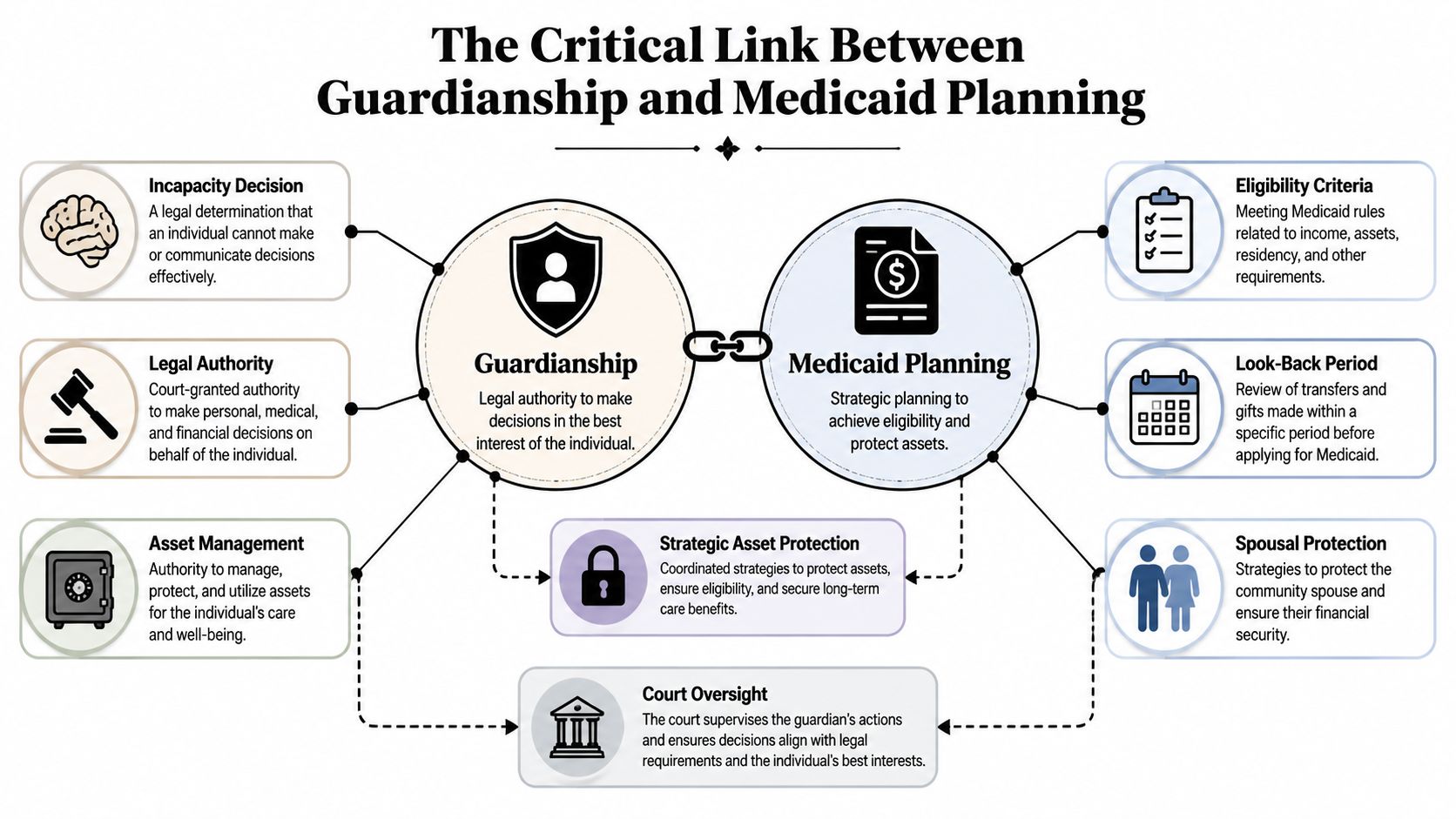
What Texas requires before appointing a guardian
Under Title 3, Subtitle G of the Texas Estates Code, a court must find that a person is incapacitated before appointing a guardian. As explained in the Texas Estates Code provisions on incapacity and guardianship, this often means presenting a physician's certificate to the court, including courts such as Harris County Probate Court, to show the person can't manage personal or financial affairs.
That rule protects the individual's rights. It also means families can't decide among themselves who will control accounts, sign legal documents, or redirect spending. The court has to authorize that authority when less restrictive options no longer work.
The Divestment Paradox
One of the hardest situations arises when a loved one is already impaired and still has access to money. The family sees the need for Medicaid planning, but the parent is making erratic spending decisions, giving money away, or failing to protect resources needed for care. This is the Divestment Paradox. The planning problem and the guardianship problem are happening at the same time.
A son in Dallas might see his mother write large checks to strangers, forget recurring withdrawals, or liquidate assets without understanding the consequences. Waiting to finish one process before starting the other can make things worse. In these cases, guardianship and Medicaid planning often need to move together.
Families trying to understand this overlap may also benefit from reading about guardianship in Texas and the ethical management of public benefits.
When capacity is gone, legal authority isn't a formality. It's the key that lets responsible planning begin.
Later in the process, some families also need Temporary and Emergency Guardianship in Texas because a court can act quickly when a person faces immediate harm.
A short video can also help clarify how these issues connect in practice.
Before, during, and after the hearing
If your family is heading toward guardianship, practical preparation matters.
- Before the hearing, gather medical records, financial statements, and names of the people already helping with care.
- During the case, be ready to explain why a power of attorney or trust alone isn't enough.
- After appointment, follow court orders carefully. A guardian's authority is supervised, not unlimited.
Texas courts also must consider less restrictive alternatives before granting guardianship. That can include powers of attorney, living trusts, or similar tools when they still function.
Understanding Texas Medicaid Eligibility in 2026
Most families don't struggle because they don't care. They struggle because Medicaid rules feel technical, and fear leads people to act too fast. They hear “spend-down,” “look-back,” and “income limits,” then wonder if they should transfer assets immediately. Usually, the safer answer is to slow down and get legal guidance first.
One reason planning matters so much is simple. About 70% of people turning 65 today will need some form of long-term care services in their lifetime, according to this discussion of when to hire an elder law attorney. That reality is why so many Texas families eventually face Medicaid questions.
The three parts families usually need to understand
Texas Medicaid planning often turns on three basic issues:
Income
Medicaid reviews what the applicant receives and how that income is treated.Assets or resources
Not every asset is treated the same way, and a family's structure matters.The 60-month look-back period
Prior transfers can create serious problems if they were handled the wrong way.
A helpful starting point for families trying to sort through the income side is this Medicaid income limits overview from Family Caregiving Kit. It won't replace legal advice, but it can make the terminology less intimidating before a consultation.
A Texas family example
Suppose a married couple in San Antonio is helping an aging mother who now needs nursing home care. The family's first instinct may be to “move assets out of her name” quickly. That's where confusion starts.
If transfers happened during the look-back period, Medicaid may examine them closely. If the mother can't understand what she's signing, the family may also face an authority problem. If the income side doesn't line up cleanly, additional legal planning may be needed.
The hardest part for many families isn't gathering documents. It's knowing which actions help and which actions create penalties.
Why timing matters
Planning ahead gives families more room to act carefully. Crisis planning is still possible in many cases, but the options can be narrower when care is already needed and bills are already due. That's especially true when a loved one has cognitive decline and no workable decision-making documents in place.
If you're feeling overwhelmed, that reaction is normal. Medicaid eligibility isn't just a money question. It's a legal, medical, and practical puzzle that has to be handled in the right order.
Proven Strategies to Qualify for Medicaid in Texas
Families often ask the same question in different words. “What can we legally do now?” The answer depends on the person's income, assets, capacity, and existing legal documents. There isn't one universal fix. There is a toolkit.
Some strategies focus on reducing countable resources in a lawful way. Others deal with income that exceeds program limits. In some cases, the issue isn't planning technique at all. It's whether someone has authority to act for the applicant.
Common strategies families discuss with counsel
A spend-down usually means using resources in a lawful, purposeful way to meet eligibility rules. That might involve paying valid debts, covering care costs, or making approved purchases rather than giving money away casually.
A Qualified Income Trust, sometimes called a Miller Trust, may become part of the discussion when income treatment creates a barrier. This is a legal tool, not a shortcut, and it needs to be set up correctly.
A Medicaid Compliant Annuity may also come up in planning conversations. The legal standards matter. The annuity must be structured properly to fit Medicaid rules.
Some families also need to think first about whether a less restrictive option is available before asking for guardianship. Texas courts consider alternatives such as powers of attorney and trusts before removing someone's rights through a full guardianship.
Comparing Texas Medicaid Planning Strategies
| Strategy | Primary Purpose | Best For |
|---|---|---|
| Spend-down | Reduce countable resources in a lawful way | Families with assets that can be redirected toward approved needs |
| Qualified Income Trust | Address income treatment issues | Applicants whose income structure creates an eligibility problem |
| Medicaid Compliant Annuity | Convert certain resources into a qualifying income stream under legal rules | Cases involving more complex asset planning |
| Guardianship | Create legal authority to manage finances and decisions | Incapacitated adults who can't sign or understand planning documents |
| Power of Attorney or trust alternatives | Avoid unnecessary court intervention when valid authority already exists | Families with functioning legal documents already in place |
Choosing the right tool
The “best” strategy depends on fit, not popularity. A family in Austin might need to repair authority first because the parent has dementia and can't sign. A family in Houston might have authority already but need help handling past transfers and the look-back period. Another family may have no transfer issue at all and only need a lawful plan for income.
For readers focused on the asset side of care planning, guidance on protecting assets from nursing home costs can help frame the larger legal questions.
Keep autonomy in view
Guardianship can be necessary, but it shouldn't be automatic. Texas law requires courts to consider less restrictive alternatives first. If a valid durable power of attorney is already in place and the agent is acting appropriately, that may prevent a separate guardianship fight.
That's one reason families should gather all existing documents before filing anything. The legal answer often turns on paperwork that was signed years earlier and forgotten until a crisis brings it back into focus.
Choosing Your Attorney and What to Expect
A daughter may be standing in a nursing home business office with a stack of admission papers, while her father no longer understands what he is signing and the family is asking how to pay for care. At that moment, hiring the right lawyer is not just about filing a Medicaid application. It is about solving two problems at once. Who has legal authority to act, and what steps can be taken to protect eligibility without creating a penalty.
That is why families should look for an attorney who handles both Medicaid planning and Texas guardianship matters. In many cases, these are parallel tracks. One track deals with authority. The other deals with eligibility. If either track is ignored, the whole plan can stall.
A first meeting should help you answer a few basic questions. Is there already valid authority under a power of attorney. Is guardianship likely. Are there past gifts or transfers that could affect Medicaid. Is the family dealing with a court case, a care crisis, or both.
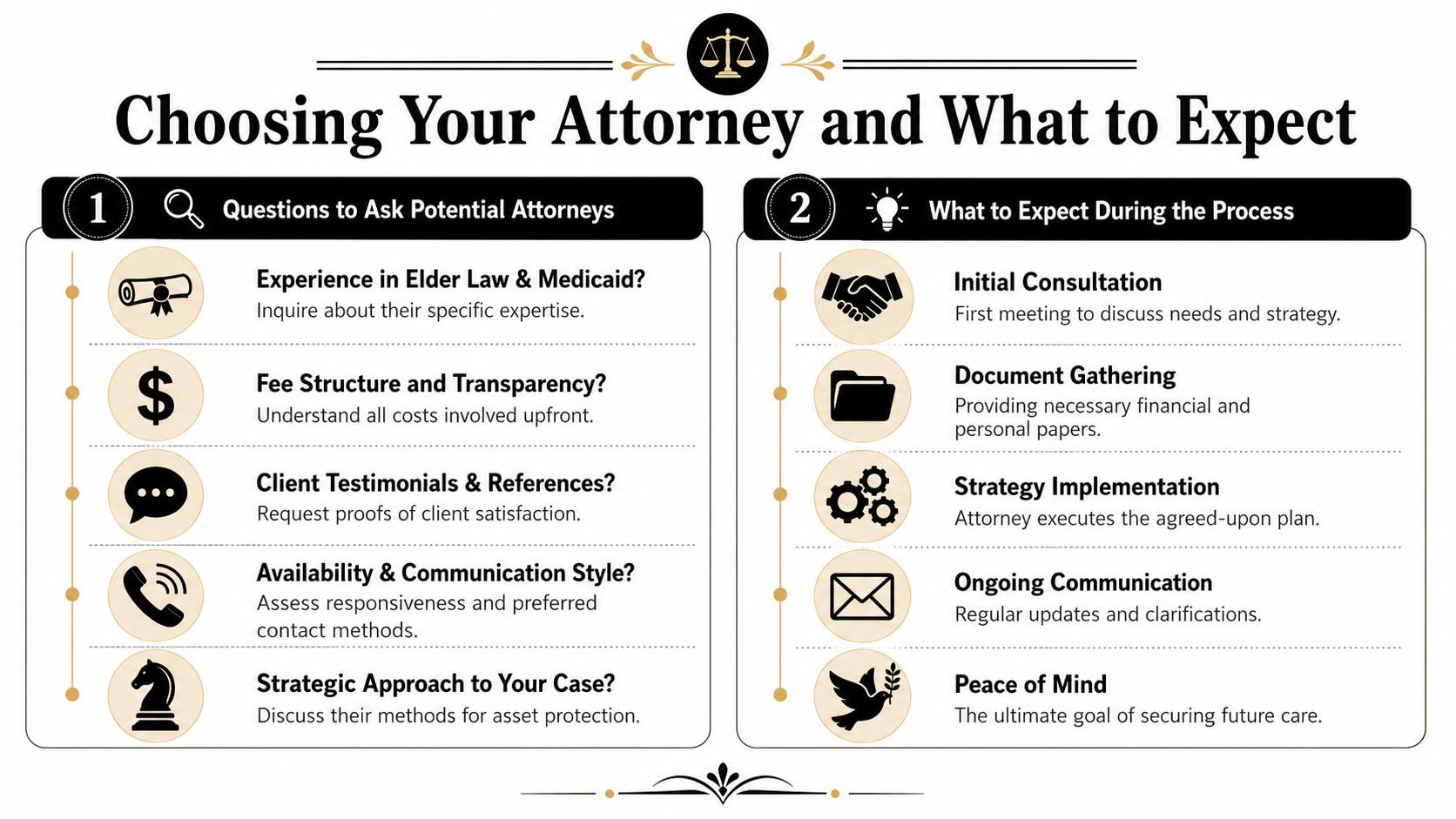
Questions worth asking at the first meeting
Bring records, but also bring pointed questions.
Do you handle both Medicaid planning and Texas guardianship matters?
A lawyer who only handles one side may miss how the two cases affect each other.If my loved one cannot sign, what legal authority do we need before any planning happens?
This gets to the heart of the problem early. Families often assume they can act because they are close relatives. Texas law does not work that way.How do you deal with the divestment problem if assets need to be repositioned but no one has authority yet?
This is the overlooked trap in many crisis cases. Waiting for guardianship can waste time. Acting without authority can create bigger legal trouble.What documents should we gather right away?
Ask for a list. It often includes bank statements, deeds, insurance information, benefit letters, medical records, and any older powers of attorney or estate planning papers.Who handles the court work if guardianship is filed?
Families should know who prepares pleadings, appears at hearings, and explains the reporting duties that continue after appointment.How will you update us during the case?
Clear communication matters when deadlines, facility bills, and family stress are all hitting at once.
One Texas option for families dealing with guardianship of the person or estate is the Law Office of Bryan Fagan, PLLC, which handles guardianship, probate, estate planning, and related incapacity matters across Texas.
What the fees often cover
Families often focus on the price of hiring a lawyer because the care bills are already frightening. A better way to look at the fee is to ask what risks the attorney is helping you avoid.
A Medicaid and guardianship matter can involve record review, legal analysis, document preparation, application work, court filings, medical evidence, hearing preparation, and follow-up compliance. If there were prior transfers, the attorney may also need to trace where money went and whether anything can be corrected. That work is a lot like hiring an engineer before repairing a cracked foundation. The cost is tied to how many structural problems have to be identified and fixed before the house is safe again.
As noted earlier, fees for Medicaid planning often range from a few thousand dollars to much more in difficult cases, and consultations may be billed separately. The price usually rises when incapacity, disputed family authority, missing records, or guardianship litigation are part of the case.
What to expect after hiring
The first phase is usually information gathering. The attorney will want the financial picture, the medical picture, and the authority picture. Those three pieces have to fit together before a sound plan can be built.
Next comes strategy. In one case, the lawyer may decide an existing power of attorney is enough and start Medicaid planning right away. In another, the lawyer may need to file for guardianship quickly because no one has lawful authority to move assets, sign papers, or respond to agency requests. Sometimes both paths begin at nearly the same time.
That overlap surprises families. It should not. If a loved one is incapacitated, Medicaid planning is only as strong as the legal authority behind it. A good attorney explains that connection early, sets realistic expectations about timing, and helps the family avoid well-meant mistakes that can delay benefits or trigger a penalty.
Your Questions About Medicaid and Guardianship Answered
Families usually don't ask simple questions at this stage. They ask stressful ones. Here are some of the most common.
Can I help from another state if my parent lives in Texas
Yes, but distance creates legal risk if you act without proper authority. That's especially true when financial decisions are involved.
According to this discussion of Texas elder law issues for families, out-of-state relatives face a significant liability gap. Without a limited guardianship for financial management filed in Texas, attempts at Medicaid planning can be treated as unauthorized fiduciary misconduct, which can lead to denials.
If you live outside Texas, don't assume your role as son, daughter, or sibling gives you automatic authority over accounts or planning choices. Texas may require specific court authority.
What does a Texas guardian have to do after appointment
Guardianship doesn't end when the judge signs the order. A guardian has ongoing duties.
A guardian of the estate must manage assets, pay valid debts, keep records, and comply with court reporting rules. A guardian of the person must help make sure the individual receives proper care and lives in a safe setting. Courts can review the guardian's actions, and failure to comply can lead to removal.
This is why families should ask early whether they're ready for the work. Loving someone and serving as guardian are not always the same thing.
What if the court says guardianship isn't necessary
That can happen if there's a workable, less restrictive alternative in place, such as a valid power of attorney. Texas courts must consider those alternatives before granting guardianship. If the document is still effective and the agent is acting responsibly, the court may decide guardianship would remove more rights than necessary.
That result isn't a failure. In many cases, preserving autonomy is exactly what the law is supposed to do.
What if the Medicaid application is denied
A denial doesn't always mean the case was hopeless. It may mean documents were incomplete, transfers need explanation, authority was missing, or the legal strategy needs to be corrected.
Start by reviewing the denial notice carefully. Then gather the records tied to the issue, especially financial statements, transfer documentation, and any court papers. If guardianship or a limited guardianship should have been filed earlier, that may need to be addressed before reapplying or appealing.
Can guardianship end later
Yes, guardianship isn't always permanent in every form. Courts can modify or terminate guardianship if circumstances change, if a less restrictive option becomes available, or if the ward regains capacity in a meaningful way. The court stays involved because the goal is protection, not control for its own sake.
Taking the Next Step for Your Family's Future
A common Texas family crisis looks like this. A parent needs nursing home care soon, bills are rising, and no one is sure who has the legal authority to move money, sign applications, or deal with the court. Medicaid planning and guardianship can start to feel like two separate problems. In many cases, they are really part of the same problem.
Early action is therefore critical. When a loved one still has capacity, signed planning documents may allow the family to address Medicaid without court involvement. When capacity is already gone, guardianship under Title 3, Subtitle G of the Texas Estates Code may be the step that allows lawful Medicaid planning to begin. That overlap is easy to miss, and it is often where families lose time.
The hard part is what many families run into without expecting it. Medicaid may require spending down or repositioning certain assets, but an incapacitated person cannot approve those choices alone. A guardian may need court authority before those decisions can be made. It works like trying to repair a leaking roof when the ladder is locked in the garage. The financial problem is urgent, but access comes first.
Start with the papers and facts already in front of you. Gather powers of attorney, bank statements, deeds, benefit letters, insurance information, and recent medical records. Families exploring court-based help can also review the firm's Texas guardianship services, along with related Guardianship, Probate, and Estate Planning resources, to see how authority and Medicaid planning connect in practice.
One clear step today can prevent a much harder problem later.
If your family is facing Medicaid questions, incapacity concerns, or a possible guardianship case in Texas, a free consultation with Law Office of Bryan Fagan, PLLC can help you understand your options and build a plan that fits your loved one's needs.