Skip to content
Yes, a Texas guardian can be paid from the ward's estate, and a guardian of the person is capped at the greater of $3,000 per year or 5% of the ward's gross income. For a guardian of the estate, Texas uses a formula based on 5% of gross income plus 5% of money paid out of the estate.
A daughter in Houston who just got appointed guardian often asks the same thing next, can she be paid for the hours she spends on her parent's care, bills, and court paperwork? Texas law says payment is possible, but it is not automatic, and the judge still has to approve it under the Texas Estates Code.
A Caregiver's First Question About Pay
The first conversation usually happens at the kitchen table, not in a courtroom. A daughter has been taking her mother to appointments, sorting medicine, answering bank questions, and now she has been appointed guardian in Harris County Probate Court. She wants to know whether she can be reimbursed or paid, because caregiving has become a real second job.
Texas gives a clear answer, but not a simple one. Under Texas Estates Code Chapter 1155, a guardian of the person alone may be paid from the ward's estate or other available funds, but the court may cap that compensation at the greater of $3,000 per year or 5% of the ward's gross income. That means the law allows payment, yet the judge still controls the amount and the source.
What that means in plain English
If you are acting as guardian, you are not expected to guess at a private hourly rate and bill the family later. Texas uses a court-supervised system, so the judge looks at the ward's income, estate activity, and the kind of guardianship in place before approving compensation. That framework matters because it keeps payment tied to the ward's finances rather than an open-ended private arrangement.
Families often confuse three different things. There is the guardian's compensation, there are court-set professional fees, and there are guardianship costs that may be reimbursed if the estate has money. Those are not the same, and separating them early can save a lot of frustration.
Practical rule: if you want to be paid, assume you will need a court order and supporting records, not just a promise from other relatives.
That is why the rest of the discussion has to start with the statute, not with guesswork. If you're also looking at the broader guardianship process for an adult parent, the Guardianship of an Incapacitated Adult in Texas page explains how a court establishes guardianship for an adult who cannot manage their affairs.
How Texas Estates Code Chapter 1155 Sets Guardian Fees
Texas Estates Code Chapter 1155 gives judges a formula, and that formula is the heart of the compensation issue. For a guardian of the person, the legislature set a default benchmark at the greater of $3,000 per year or 5% of the ward's gross income. For a guardian of the estate, the benchmark is generally 5% of the ward's gross income plus 5% of money paid out of the estate.
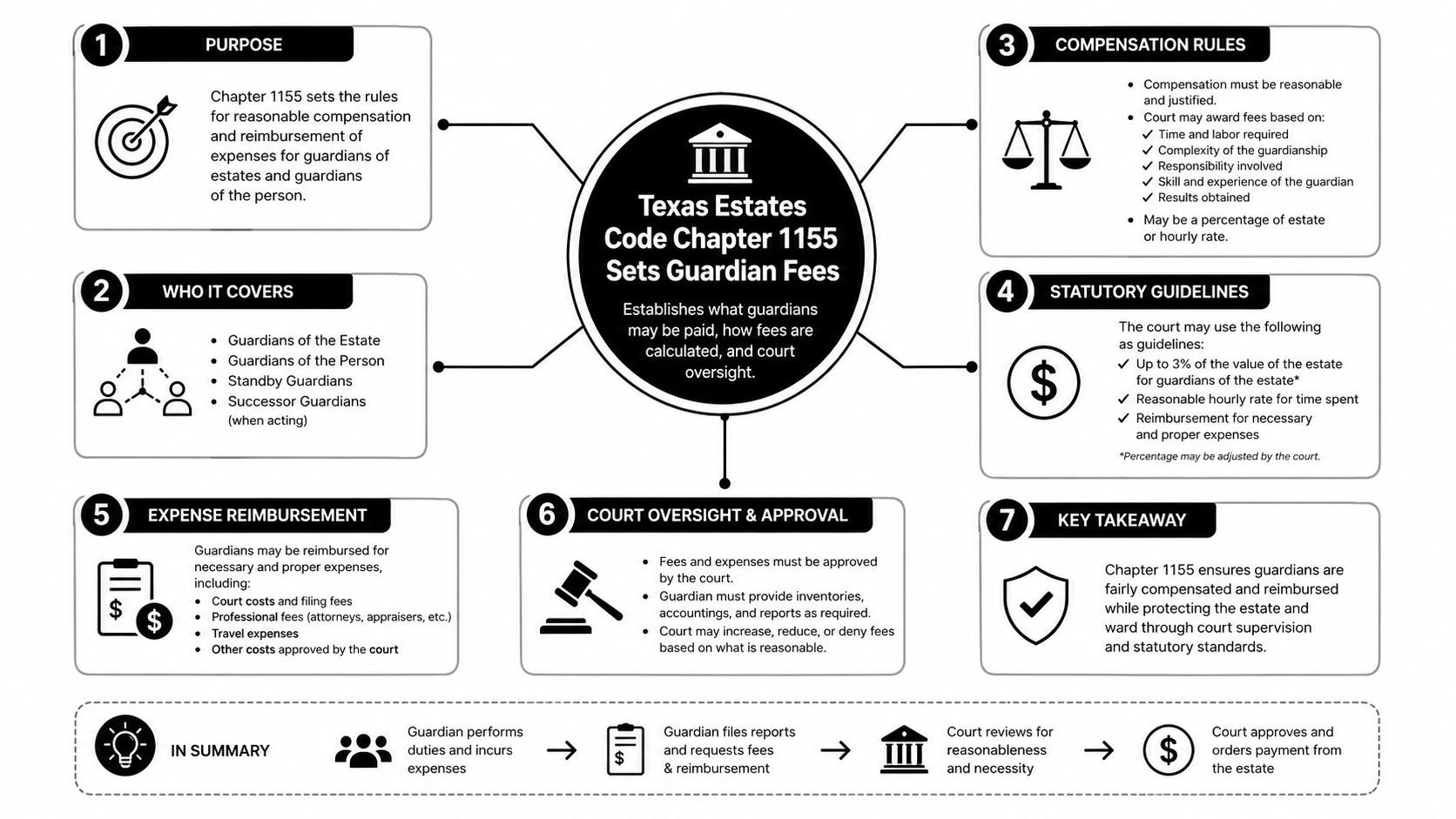
Guardian of the person and guardian of the estate are different jobs
A guardian of the person handles personal care decisions, like medical coordination, placement, and daily support. A guardian of the estate handles money, property, and financial administration. Texas treats those roles differently because the amount of work and the type of responsibility are not the same.
That difference is why a formula makes sense. The court has a built-in way to measure compensation against the size of the ward's income and the amount of estate activity. It's predictable, which helps families understand what a judge may approve before they spend more time and money on the case.
The law also gives the court flexibility. If the statutory amount is unreasonably low or the facts justify a different result, the judge can adjust compensation. That prevents the formula from becoming unfair in a hard case, but it also means the amount still depends on judicial approval.
Why Texas uses a formula instead of hourly billing
Families often ask why a guardian can't just submit time sheets like a contractor. Texas chose a formula-based default because guardianship is a court-supervised fiduciary role, not a private business relationship. The law ties compensation to income and estate transactions so the payment fits the estate's size and the work performed.
That structure also keeps expectations clearer in probate courts across Texas, including busy courts in Dallas County and Travis County. Judges are looking for a statutory basis, a clean request, and proof that the fee fits the ward's finances. If you want the legal text itself, Chapter 1155 is the controlling statute, and the court's discretion sits inside those limits.
Attorney Fees, Guardian Ad Litem Costs, and Other Court-Set Expenses
Guardian compensation is only one piece of the financial picture. Texas also lets courts set certain guardianship expenses in an amount it considers equitable and just, including fees for guardians ad litem, attorneys ad litem, court visitors, mental health professionals, and interpreters. Those charges are separate from the guardian's own pay, even though families often lump them together.
| Fee Type | Paid From | How Amount Is Set | Governing Rule |
|---|---|---|---|
| Guardian compensation | Ward's estate or other available funds | Statutory formula, with court review | Texas Estates Code Chapter 1155 |
| Guardians ad litem, attorneys ad litem, court visitors, mental health professionals, interpreters | Usually estate funds when available | Court sets an amount it considers equitable and just | Texas Estates Code Section 1155.151 |
| Guardianship-related costs in some institutional settings | Countable income only after court order | Limited to the amount approved by the court | Texas HHS guidance |
The difference matters because a guardian's pay is not the same as a court-appointed professional's fee. In some cases, if the estate later has enough assets, the court can require payment of those costs into the county treasury. That is a court-ordered reimbursement concept, not a private invoice arrangement.
A guardian who is also paying a lawyer needs to keep that distinction clear. Legal fees for getting the guardianship established may be reimbursable from the estate when funds exist, but the judge controls the approval and the source of payment. Texas HHS explains that court-awarded guardianship-related costs and fees may be deducted prospectively from countable income in some institutional settings, but only after a judge signs the order and only up to the amount approved by the court, so payment still depends on court action, not assumption.
If you're sorting out who owes what in a contested case, the duties of a guardian ad litem are a separate topic. A useful overview is available at Guardian Ad Litem Duties, which helps show why ad litem work is treated differently from guardian compensation.
Requesting and Getting Guardian Fees Approved by the Court
Getting paid starts with asking properly. In Texas probate courts, that usually means including the request in the guardian's annual accounting or filing a separate application if the timing calls for it. A judge wants to see what work was done, what funds are available, and whether the request fits the statutory framework.
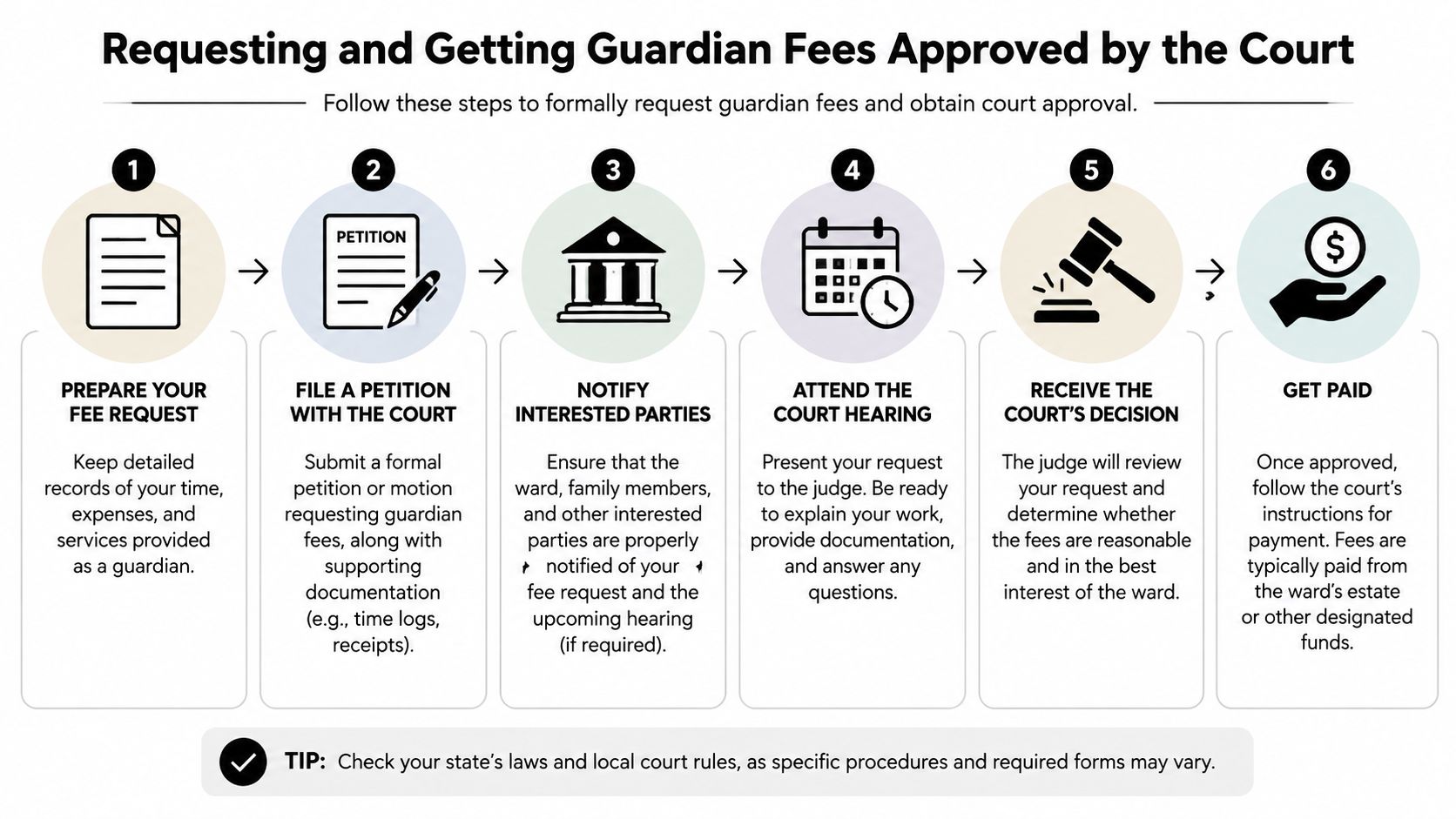
What courts usually look for
The paperwork should show the guardian's role, the date of appointment, the income or money handled, and the services performed for the ward. Judges in Harris County, Dallas County, and Travis County probate courts generally want a clean record that connects the request to the ward's estate, not just a general statement that the guardian worked hard.
The court is not guessing. It is checking whether the estate can support the request and whether the requested amount fits the law.
Texas HHS guidance also matters when payment is prospective in certain institutional settings. That guidance explains that the judge must sign the order first, and the approved amount limits what can be deducted. In other words, a guardian should not assume payment has been authorized until the order is entered.
A practical filing checklist
- Track time and tasks: Keep a dated record of calls, appointments, banking work, and court-related activity.
- Save proof of expenses: Hold onto receipts and invoices for anything you expect to ask the court to reimburse.
- Match the request to the ward's funds: If the ward has income or assets, show where the payment will come from.
- Use the annual accounting correctly: If your court requires it, include the compensation request in the filing that reports the estate activity.
- Wait for the order: Do not pay yourself until the judge has approved the amount and the source.
Families who are new to this process often find the annual accounting intimidating. A plain-English guide to that filing is available at Annual Accounting Guardianship Texas, and it helps explain why careful records matter before a fee request goes in.
A Realistic Example of How Guardian Fees Are Calculated
A daughter in San Antonio is guardian of her father. He receives $2,400 per month in Social Security and a small pension, so his gross monthly income is $2,400. To estimate the guardian-of-the-person compensation, the court looks at the annual income first, which would be $28,800 for the year if that income stays steady.
Five percent of $28,800 is $1,440. Because Chapter 1155 says the guardian of the person may be capped at the greater of $3,000 per year or 5% of gross income, the benchmark in this example would be $3,000, not $1,440. That is the key part families often miss. The statute's floor can matter more than the percentage when the ward's income is modest.
What changes if there is estate activity
Now assume the father also owns a $40,000 brokerage account and the guardian pays bills, handles distributions, and manages transfers from that account. The guardian of the estate formula looks at 5% of gross income plus 5% of money paid out of the estate. If the estate pays out money during the year, that extra activity can increase the compensation benchmark.
The exact amount depends on how much money is paid out of the estate, and the court will want the accounting to show it. If there are no distributions, then there is less estate activity to calculate. If there are regular disbursements, the compensation request should line up with those documented transactions.
Families often ask whether this means the guardian gets paid for every hour spent. Not exactly. Texas is not using a standard hourly billing model here. The judge is looking at the statutory benchmark, the estate records, and whether the facts justify an adjustment up or down.
For broader estate administration context, families also often need help with how to settle an estate, especially when guardianship overlaps with later probate or asset transfer issues. That kind of planning can prevent confusion when one person is serving as guardian today and may later have to help with estate administration.
What Happens When the Ward Has Little or No Money
This is the part many families worry about most. If the ward has very little cash, who pays the filing fees, attorney costs, and other upfront expenses before the court can approve reimbursement? Texas HHS says that if the ward has sufficient funds, legal fees may be reimbursed and court costs may be paid from the ward's estate, but if the ward lacks adequate funds, the guardian may need to pay personally, seek low-cost help, or ask the court for payment under certain conditions.
The cash-flow problem families feel first
A guardian may be doing the right thing and still not have a clear path to being reimbursed right away. That's why the money question comes up before the legal theory does. Families want to know whether they can move forward without draining their own savings, and the honest answer is that sometimes they can't avoid fronting costs if the estate has no money yet.
Emergency or temporary guardianship can make that pressure worse because the timeline is tighter. The court still oversees payment, but the need for fast action can leave a caregiver paying upfront while waiting for approval later. If the ward later receives funds, the court may allow reimbursement, but that depends on the facts and the order entered by the judge.
Practical ways families handle the gap
- Ask about reduced-fee help: Some families qualify for lower-cost legal assistance when the ward has limited assets.
- Document every payment: If you advance money, keep the receipts and note what the payment was for.
- Request reimbursement in writing: Do not assume the court will infer it from the file.
- Talk to counsel early: A lawyer can help decide whether to seek immediate payment, reimbursement later, or another legal path.
The question of who pays for guardianship often reaches beyond the guardian's own fee. The details are covered in the guide on Who Pays for Guardianship in Texas, which is useful when the ward's estate is tight and every dollar matters.
Taxes, Reporting, and Smart Practices for Texas Guardians
Guardian compensation can create tax questions, and guardians of the estate also have reporting duties under the Texas Estates Code. If a guardian pays themselves from the estate, that payment should be treated carefully and reported the right way on the guardian's federal return if it is taxable income. The safest habit is to keep the compensation separate from other reimbursements so the records stay clean.

Habits that prevent fee disputes
A court can only approve what it can understand. That is why detailed logs, receipts, and clear accounting entries matter so much in guardianship cases. If multiple family members are involved, a written update can also reduce conflict before someone objects to the request.
Smart practice: review the court's order before any payment goes out, because the order controls the amount and the source.
Keep communication steady with co-guardians, if there are any, and make sure everyone understands what has been spent and why. Guardians of the estate should also stay current on the annual reporting and accounting duties tied to the ward's property. When the paperwork is organized, the judge has less reason to question the request.
For families who want help with guardianship, estate planning, or probate coordination, the Law Office of Bryan Fagan, PLLC works with Texas families on applications, hearings, accountings, and compliance. That kind of support can be especially useful when you are trying to protect a parent, document your own time, and keep the case moving without making avoidable mistakes.
If you're trying to figure out whether you can be paid, how to document your work, or how to ask a Texas probate court for approval, the Law Office of Bryan Fagan, PLLC can help you sort through the guardianship rules in plain English. Visit Law Office of Bryan Fagan, PLLC to schedule a free consultation and get guidance for your family's situation.