Skip to content
If your mother is sitting on settlement money, your dad owns a house he can't manage anymore, or your adult son needs help after an inheritance hits his account, the question can feel urgent and confusing at the same time. In a Texas probate court, families often get pushed toward one of two paths, a Chapter 1301 management trust or a guardianship of the estate, and sometimes both in sequence. The right answer usually depends on the assets, the person's capacity, and how much court involvement the family can live with.
| Criteria | Chapter 1301 Management Trust | Guardianship of the Estate |
|---|---|---|
| Legal source | Texas Estates Code Chapter 1301 | Texas Estates Code Title 3 |
| Main purpose | Court-created trust for asset management | Court-appointed fiduciary to manage finances |
| Who controls assets | Trustee | Guardian of the estate |
| Court involvement | Court supervises, annual accountings continue | Full guardianship supervision, accountings and more court steps |
| Best fit | Often stronger for liquid assets and settlement proceeds | Often needed when property is harder to manage or sell |
| Can coexist with the other tool | Yes, and the court can also discharge the guardian of the estate if trust funding serves the ward's best interests | Yes, especially before a trust is funded |
A Family at a Crossroads in Texas Probate Court
A daughter walks into the Harris County Probate Court with a folder full of medical records, bank statements, and emails from a claims adjuster. Her father has dementia, his checking account is still active, and the family home needs repairs before it can be sold. She is trying to protect him from financial harm, but she also knows the court will want a clear plan, not just a worried story.
That same kind of pressure shows up in other Texas families too. A minor may be getting a settlement after an injury, or an adult with disabilities may be receiving inheritance money that needs long-term protection. In each situation, the family has to decide whether a court should open a guardianship of the estate, create a management trust, or use one tool first and the other later.
The stakes are not only legal. Families worry about paying bills, keeping benefits intact, and making sure the money lasts. They also worry about delay, because every month of waiting can create more stress for the person who needs help.
Practical rule: if the assets are already easy to manage, the trust route often looks more attractive. If the assets are tied up in a house, business interest, or pending dispute, the court may need broader guardianship power first.
Texas courts do have flexibility here. Under the Chapter 1301 framework, the judge is not locked into one outcome, and that matters when the family's situation is messy rather than tidy. The next step is understanding what each tool does, so the choice feels less like guesswork and more like a real plan.
What Each Texas Legal Tool Actually Does
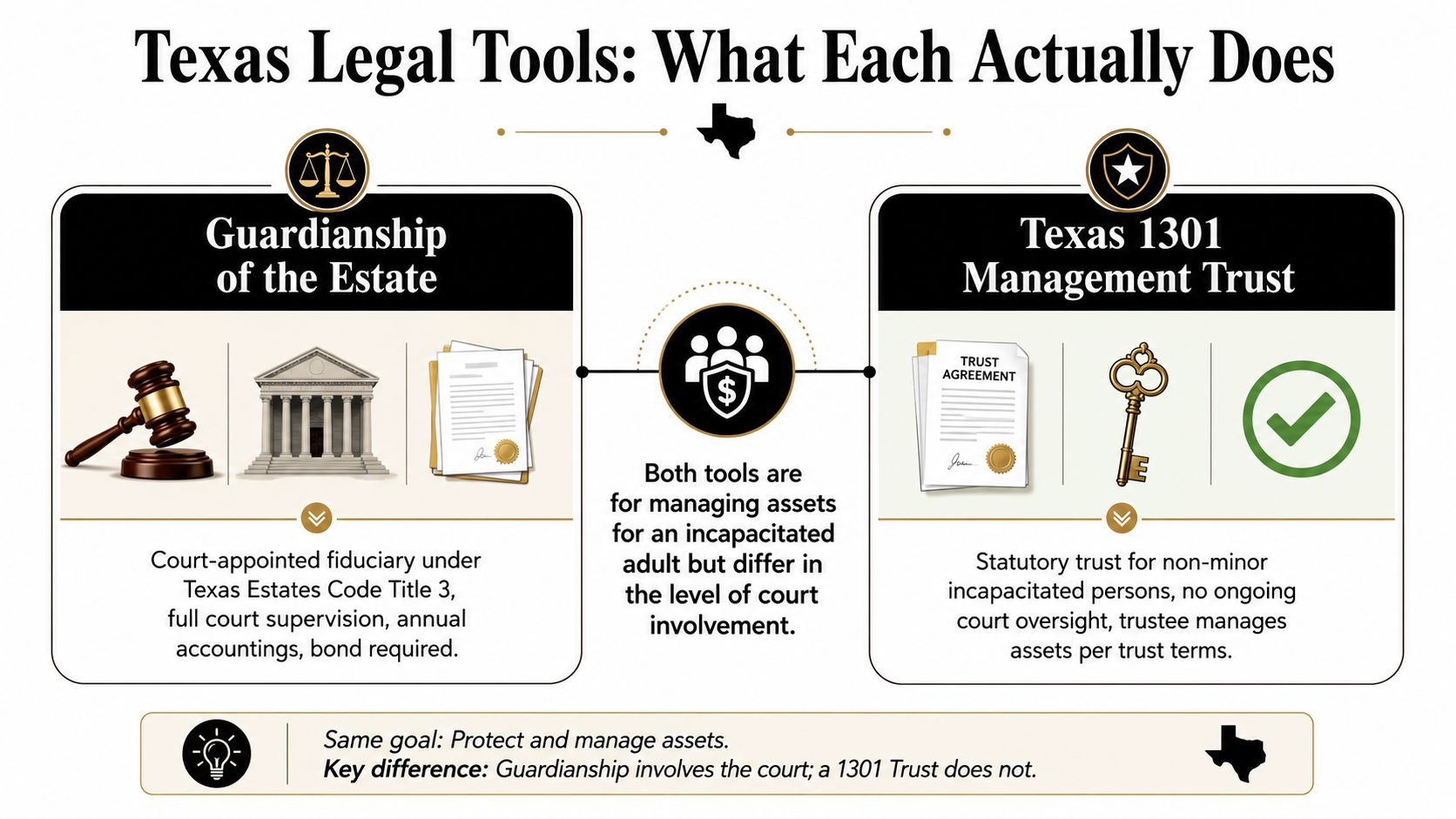
A guardianship of the estate is a court-supervised fiduciary relationship. Under Texas Estates Code Title 3, the court appoints a guardian to manage the ward's property and financial affairs when the person cannot do that safely on their own. In plain English, it gives one person legal authority to pay bills, handle assets, and protect property under the court's supervision.
A Chapter 1301 management trust is different. Texas Estates Code Sections 1301.053 and 1301.054 let the court create a trust for a ward or another incapacitated person instead of opening a full estate guardianship. The trust is still court-created, but the assets sit in a trust structure managed by a trustee rather than in a traditional guardianship estate.
Why the history matters
Texas did not invent this framework yesterday. The modern Chapter 1301 trust grew out of former Texas Probate Code Section 867, which was enacted in 1993 and later developed into today's statutory setup. That history matters because Texas courts have long treated management trusts as a court-supervised substitute for guardianship of the estate when the goal is asset protection.
The law also keeps a safety valve in place. If the court holds a hearing under Section 1301.054 and decides the trust is not in the person's best interests, the judge can appoint a guardian of the person, the estate, or both without starting a separate proceeding. That means the court can move directly from one remedy to the other in the same case.
A trust can also exist with or without a guardian of the person. That's important for families who need financial control, but do not want to take away personal decision-making unless the court has to.
For readers who want a general overview of how Texas lawyers handle these cases, the first-party page for Texas Guardianship Lawyer describes representation in guardianship of the person and estate under the Estates Code. It fits this topic because many families end up weighing both guardianship and trust options at the same time.
Side-by-Side Comparison of Both Options
The easiest way to think about Texas 1301 management trust vs guardianship of the estate is to compare who holds the power, who watches the money, and how much court structure follows the assets. A management trust shifts day-to-day financial control to a trustee, while a guardianship of the estate keeps the asset management inside the guardianship framework.
Chapter 1301 Management Trust vs Guardianship of the Estate
| Criteria | 1301 Management Trust | Guardianship of the Estate |
|---|---|---|
| Statutory basis | Texas Estates Code Chapter 1301 | Texas Estates Code Title 3 |
| Who manages the assets | Trustee | Guardian of the estate |
| Who appoints the fiduciary | The court | The court |
| Court oversight | Court supervision continues, annual accountings are required | Court supervision continues, with more direct guardianship administration |
| Compliance burden | Lighter operational overhead, no JBCC registration, no trustee background check | More formal compliance, including registration and background-check steps |
| Trustee or fiduciary type | Usually a financial institution under Section 1301.057 | Individual guardian or other court-approved fiduciary |
| Best fit | Liquid assets, inheritance, settlement proceeds, and other money that can be managed cleanly | Situations where broader authority over property, disputes, or ongoing management is needed |
| How it ends | The trust can continue under court supervision, and the court may later discharge the guardian of the estate if trust funding serves the ward's best interests | The guardianship stays in place until the court modifies or ends it |
Section 1301.057 matters because it creates a structural preference for institutional trustees. The court must appoint a financial institution as trustee unless a narrow exception applies. If the trust principal is more than $150,000, the applicant must show that no financial institution in the area will serve after due diligence, which makes the trust route especially important for larger estates.
Texas practice materials also note that statutory probate courts “overwhelmingly prefer” management trusts as an alternative to opening a guardianship estate. That preference makes sense when the estate is mostly liquid and the family wants less court friction, because the trust can handle routine financial decisions without repeated prior court approval while still requiring annual accountings.
Practical rule: if the money is already in cash or marketable securities, the trust often moves more smoothly. If the asset is a house, a lease dispute, or something that still needs court-backed action, the guardianship may need to come first.
Texas practitioners also point out a tradeoff families feel right away. Corporate trustees are stable, but they're not family members, and family trustees can be responsive but may need bond and closer court review if a bank or trust company won't take the job. That is one reason the court's choice is so fact-specific.
When Each Option Works Best in Real Life
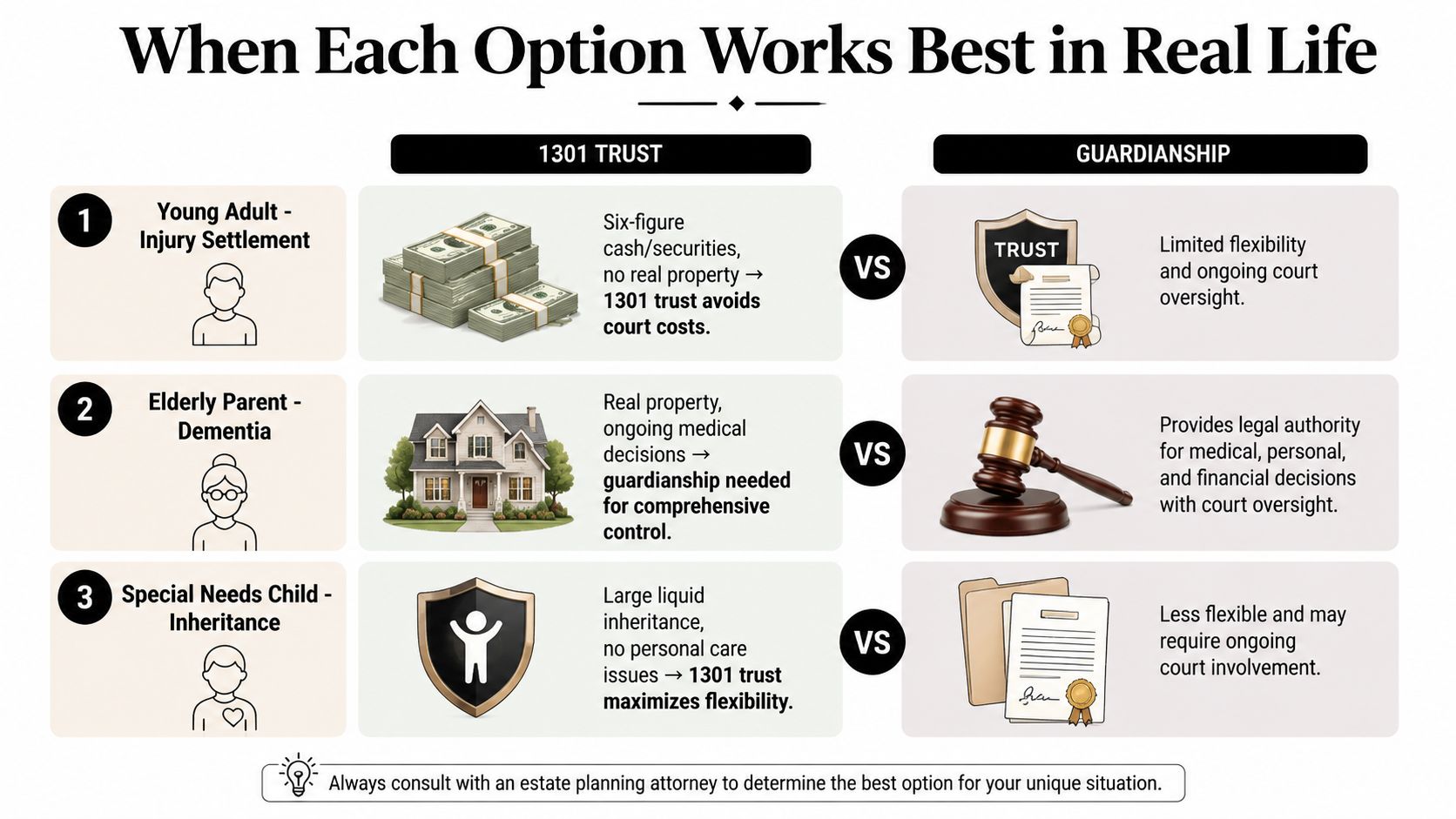
A young adult injured in a crash gets a settlement that sits in cash and marketable securities. There is no house to sell, no business to run, and no ongoing property dispute. In that kind of case, a 1301 management trust often fits better because the court can place the funds under a trustee and avoid dragging the family through a full guardianship estate just to protect money.
A retired homeowner is a different story. Her main asset is a paid-off house, she still needs someone to coordinate care, and the family may need help with Medicaid planning. A guardianship of the estate may be the better first step because the family may need court authority to sell, lease, repair, or otherwise manage a hard-to-handle property before a trust can do the rest.
That's where the asset-by-asset analysis really matters. A management trust works best when the property is already easy to administer. A guardianship can still be necessary when the family needs broader legal power before the trust can function well.
The court also keeps discretion. Under Section 1301.055, if the judge decides after the hearing that a trust is not in the person's best interests, the court can appoint a guardian of the person, the estate, or both without opening a separate case. That gives the judge room to respond to the facts instead of forcing a one-size-fits-all result.
For families who want a deeper Texas-specific breakdown of that trust-first approach, this discussion of when a trust can replace guardianship in Texas is a useful companion piece. It lines up with the world pattern many families face, where the question is not “trust or guardianship forever,” but “which tool first.”
How to Create Each Option in Texas Courts
A Chapter 1301 trust usually starts with a petition under Section 1301.053 or 1301.054. The family identifies the assets, explains why the ward or incapacitated person needs financial protection, and presents a proposed trustee, often a corporate fiduciary. The court then enters an order creating the trust, and the trustee begins managing the assets under court supervision with annual accountings still required.
A guardianship of the estate follows a different path. The family files an application, notice goes out, a capacity evaluation is gathered, and an attorney ad litem is appointed for the proposed ward. Then the case goes to a hearing before a statutory probate court, including courts in places like Harris, Travis, or Bexar County, where the judge decides whether guardianship is necessary and what powers should be granted.
The family should bring the court a clean asset list, recent statements, and a short explanation of why the person can't safely manage the property on their own.
The two paths can connect. Texas Estates Code Section 1301.152 allows the court to discharge the guardian of the estate when a Chapter 1301 management trust is created and the ward still has a guardian of the person, if discharge is in the ward's best interests. That can turn a live guardianship case into a more focused trust arrangement once the money is safely transferred.
Families often get stuck because they think they must choose one path forever on day one. They don't. Texas law gives room to begin with guardianship, then transition to a trust if that better protects the assets and lowers the day-to-day burden.
For a broader Texas filing roadmap, this guide on how to file for guardianship in Texas shows how the court process usually unfolds when the family needs formal authority. It helps readers see where the trust process overlaps with guardianship procedure and where it diverges.
Costs, Timelines, and Day-to-Day Duties
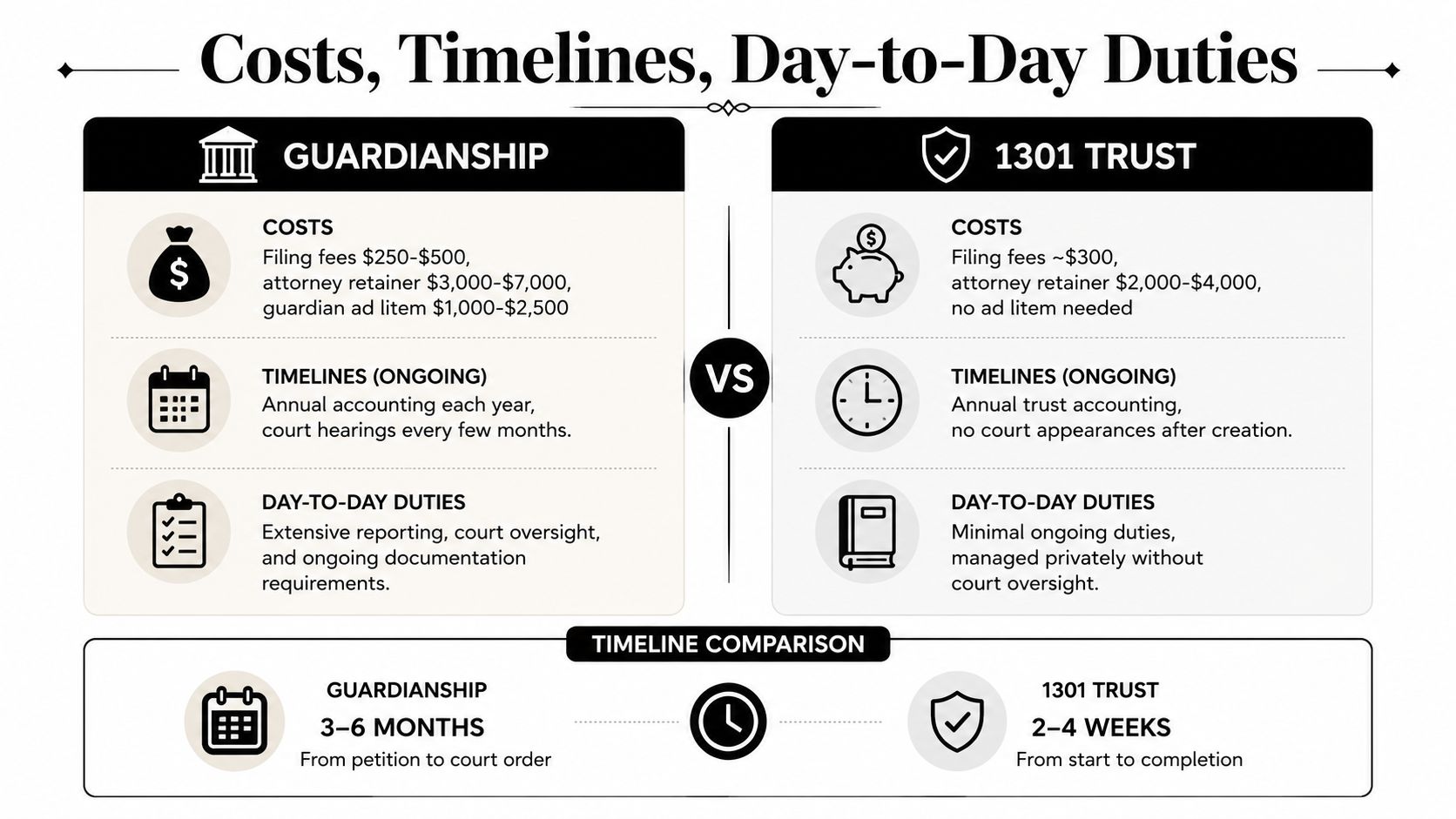
Families usually feel the cost difference in two places, the front end and the long run. A guardianship of the estate tends to carry more moving parts, because the case may require more hearings, more court filings, and more ongoing oversight. A Chapter 1301 trust can reduce some of that friction, but it does not remove court supervision altogether.
One practical difference is compliance. Texas materials note that 1301 trusts are not registered with the Texas Judicial Branch Certification Commission, and the trustee is not required to undergo a background check. That lighter overhead can matter when the estate is already under pressure and the family wants a cleaner administration path.
The day-to-day workload also differs. A guardian of the estate may need to file inventories, annual accountings, and sometimes a final accounting. A trustee under Chapter 1301 still files annual accountings, but the trust structure avoids some of the guardian-specific compliance steps tied to the estate side of guardianship.
Budget reality: professional fiduciaries are steadier, but they may feel less personal. Family fiduciaries can be more flexible, but the court may ask for more safeguards when they handle protected money.
For some families, the biggest practical question is the recurring trustee relationship. Texas practitioner materials note that management trusts are often favored for larger estates, and corporate trustees may be available even at lower asset levels in some situations. That makes the trust route especially useful when the main issue is financial management, not personal-care control.
The cost of choosing the wrong structure can be time, duplicate hearings, and extra supervision that the family did not need. If that risk is on the table, this breakdown of how much guardianship costs in Texas gives families a good starting point for understanding the financial side of a guardianship case.
Decision Checklist and Clear Next Steps
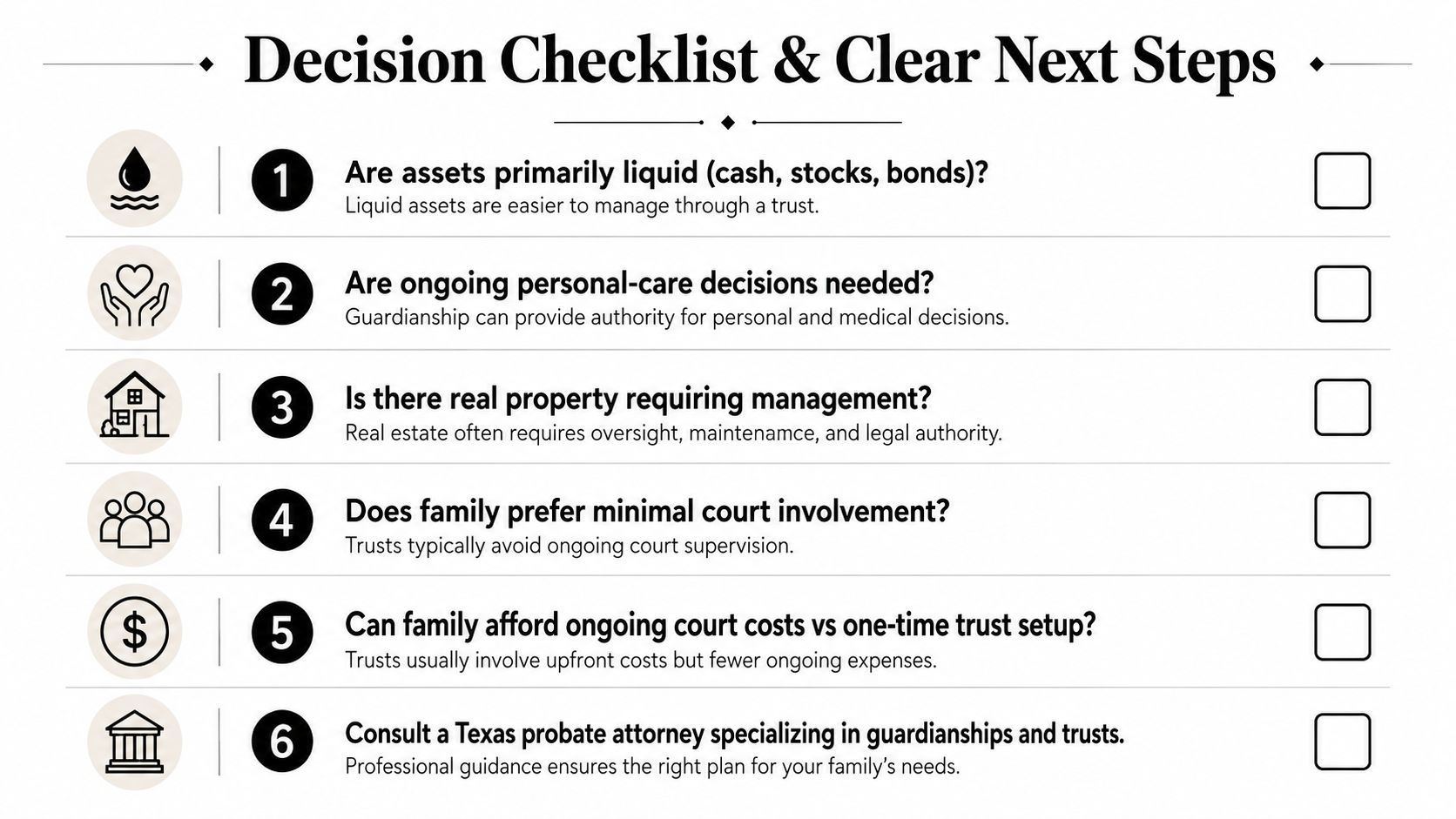
Start with the assets, not the label. If the estate is mainly cash, stocks, or bonds, a management trust may be easier to run. If the person still needs help selling real property, dealing with a business, or resolving property disputes, a guardianship of the estate may need to come first.
Then ask whether personal-care decisions are part of the problem. If the family only needs financial management, a Chapter 1301 trust may solve the main issue without a broader guardianship. If the person's medical or daily-living decisions are also at risk, the guardianship analysis gets bigger.
Next, look at the trustee question. Texas law prefers a financial institution in many Chapter 1301 cases, and if no bank or trust company will serve, the bond and court review issues can become part of the decision. That's one reason families should not assume the trust route is automatically simpler in every case.
The final question is whether the person's condition is likely to improve or decline. A temporary problem, a pending settlement, or a short-term asset issue may call for a different structure than a long-term incapacity. That is where a lawyer can help the family avoid a choice that creates extra hearings later.
If you're gathering documents before a consultation, a useful companion task is organizing records in a way that can be shared quickly and clearly. A practical guide on faxing via iPhone can help families move paperwork when a doctor's note, bank statement, or court document needs to be sent fast.
If your family is trying to choose between a Chapter 1301 management trust and a guardianship of the estate, the Law Office of Bryan Fagan, PLLC can review the assets, the court options, and the sequence that fits your situation. Visit Law Office of Bryan Fagan, PLLC to schedule a free consultation and get guidance for your loved one's needs in Texas.