Skip to content
You probably don't feel like celebrating when the judge signs the guardianship order. For many families, that moment brings relief, then a new kind of stress. The clock starts ticking on one of the first real duties in a Texas guardianship, and the paperwork is more unforgiving than many anticipate.
If you were appointed guardian of the estate, the Texas guardianship inventory appraisement and list of claims filing is not a side task. It is the financial snapshot the court uses to see what the ward owns, what may be owed, and how the estate will be tracked going forward. A helpful plain-English overview of the broader guardianship process and related costs is available through guardianship costs and process explained, which can give families context before they start gathering records.

Families often feel like the hearing is the finish line. It isn't. It's the moment the estate paperwork begins, and the court expects the guardian to move carefully, because this filing becomes the baseline for later accountings and oversight under Texas Estates Code Chapter 1154 and the broader guardianship structure in Title 3, Subtitle G.
The guardian of estate responsibilities in Texas are broader than "taking over the bills." The guardian has to identify property, document value, and report it in a form the court can use. That protects the ward from missed assets and protects the guardian from later claims that something was hidden, forgotten, or handled loosely.
Understanding Your First Major Fiduciary Duty
The first time many families realize how serious guardianship is, it's after the hearing. The order is signed, the letters are issued, and then someone asks, “What assets are in the estate?” That question is where the inventory, appraisement, and list of claims starts to matter.
A daughter in Houston may have just been appointed guardian of her father's estate after months of medical confusion and family worry. She's relieved the court recognized the need for protection, but now she has to gather deeds, bank records, and account statements while also caring for a parent who may still be recovering. That's a very human pressure point, and it's why the law treats the filing as a real fiduciary duty, not a box to check.
Why the court wants this snapshot
The inventory tells the court what exists. The appraisement gives the court a value. The list of claims shows what the estate may owe or what debts may be collectible. Put together, the filing creates a baseline record that later supports annual reporting and court review under the Texas guardianship framework in Title 3, Subtitle G and Chapter 1154.
The Texas Judicial Branch's guardianship help materials explain that the inventory should reach beyond obvious accounts and include real estate, personal property, bank accounts, securities, and other valuable assets found through reasonable efforts. That breadth matters because families often know about the house and a checking account, but forget an old mineral interest, a safe-deposit item, or a small brokerage account.
Practical rule: if the asset has value and belongs to the ward, it belongs on the radar, even if it's inconvenient to track down.
The court's purpose is not to make life harder. It's to create a paper trail that stops confusion later. If a guardian can show the estate was carefully documented right away, later questions about spending, preservation, or missing property are much easier to answer.
If you're trying to understand the larger guardianship structure before this filing, the product page for Guardianship of an Incapacitated Adult in Texas is a plain-language reference for how a court establishes guardianship for an adult who cannot manage their affairs.
Statutory Deadlines and Required Components
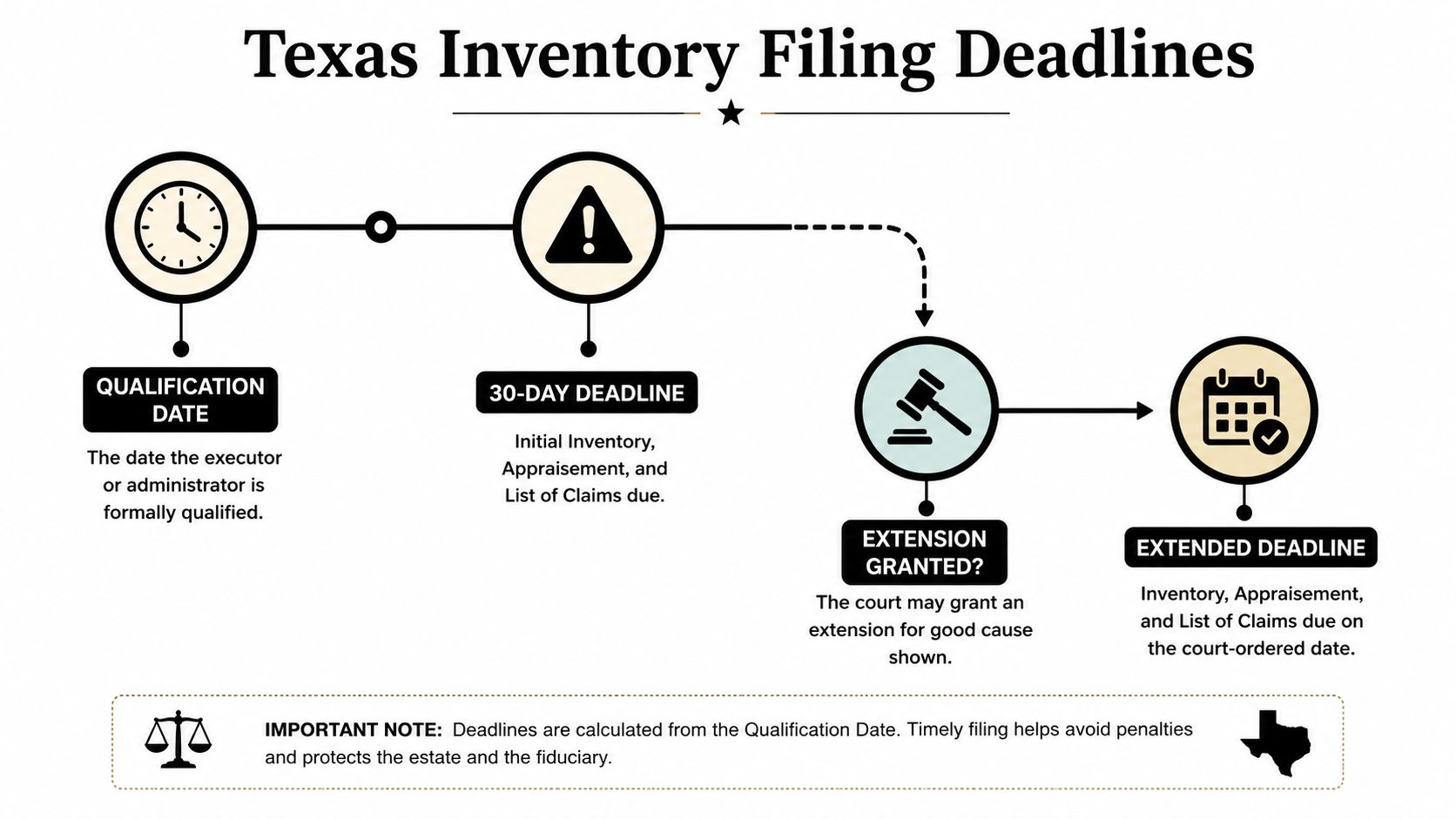
A guardian who qualifies in Texas cannot leave this filing until later and hope to fix it in pieces. The verified inventory, appraisement, and list of claims must be filed no later than the 30th day after qualifying, unless the court grants extra time. It is filed with the clerk as a single verified instrument, which means the court expects one complete sworn filing, not scattered notes, draft pages, or an informal asset list saved on a laptop. The deadline and filing requirements are stated in Texas Estates Code §1154.
What goes into each part
The Inventory is the full list of known property. It includes all Texas real property and all personal property wherever located. The statute also requires the filing to separate separate property from community property, and to show the ward's fractional interest in property that is jointly owned or commonly owned.
The Appraisement covers value. The law calls for fair market values as of the date letters of guardianship were granted. That timing matters because account balances, vehicles, and real estate can move up or down after appointment. The court wants the value tied to the legal starting point, not a later estimate that is easier to pull together.
The List of Claims is the part many first-time guardians miss. It identifies debts owed to the estate and claims connected to the estate administration. If someone owed money to the ward, or if the estate may need to pursue or recognize a claim, that belongs in the filing as well.
A practical way to sort the filing is this:
| Part of filing | What it does | Common examples |
|---|---|---|
| Inventory | Lists property | House, land, bank accounts, vehicles, personal effects |
| Appraisement | Assigns value | Fair market value of real estate, account balances, appraised items |
| List of Claims | Identifies claims | Money owed to the ward, unresolved obligations tied to the estate |
For families putting the broader guardianship picture together, Guardianship of an Incapacitated Adult in Texas gives a plain-language overview of how a court establishes guardianship for an adult who cannot manage personal affairs.
A practical filing example
A guardian in Fort Bend County may need to list a Texas homestead, a vehicle, a checking account, and a small retirement account found after appointment. The same filing may also need to identify a separate property interest if the ward inherited land years earlier. Careful labeling like that helps the clerk, the judge, and the later annual accountant read the estate record the same way.
Families often ask what papers to use to get started, and the answer is usually simpler than they expect. The internal guide on guardianship forms Texas helps show how these filings fit together in practice, especially when the inventory has to be assembled from bank records, title documents, and whatever the guardian can verify from home.
The Reality of Compliance and Court Oversight
Texas courts are not treating this filing as optional paperwork. In Fiscal Year 2025, guardianship compliance specialists reviewed 7,590 cases across Texas courts and found 1,569 cases, or approximately 34%, out of compliance with statutory reporting requirements. Within those deficiencies, 41% of cases lacked the required inventory filings, making inventories one of the most common missing documents statewide. Texas Court Guardianship Compliance FY 2025 Report
That data should get anyone's attention. It shows the inventory filing is one of the most frequent breakdown points in guardianship administration, not because families don't care, but because the process is easy to underestimate when emotions, caregiving, and paperwork all land at once.
What court oversight looks like now
Texas court materials also describe an electronic database created to monitor filings required under Chapter 1154, including inventories, appraisements, and lists of claims. That means compliance is not just a paper file sitting in a county office. It is part of a broader court monitoring system, and missed documents are easier for the system to flag.
Fort Bend County makes the risk especially concrete. Its guardian instructions warn that failing to file the Inventory, Appraisement and List of Claims within 30 days of qualification, or within a court-approved extension, may lead to penalties including revocation of Letters of Guardianship. The same county instructions also require an Annual Account no later than 60 days after the anniversary of qualification. Fort Bend County Guardian Instructions
If the letters are revoked, the family can be left in legal limbo even though the need for protection hasn't gone away.
That's why this filing deserves the same urgency families usually reserve for the hearing itself. In practice, judges, clerks, and court staff want to see that the guardian understands the reporting burden and can follow through. In places like Harris County Probate Court, where dockets can be busy, a clean filing helps avoid delay, deficiency notices, and extra motion practice.
If a family needs a closer look at how courts watch these duties, the internal resource on court monitoring of guardian Texas fits naturally with this issue.
Preparing and Verifying Your Filing
The cleanest filings usually come from a methodical process, not guesswork. Start with what the ward owns today, then work backward through records, mail, online account access, and prior tax or bank paperwork. If the estate includes a home, vehicles, brokerage assets, or titled personal property, gather the documents before anyone tries to value them.
Build the record before you draft
A good inventory packet usually includes:
- Bank statements showing current balances and account ownership.
- Deeds and closing records for real estate.
- Vehicle titles and registration records for cars, trucks, or trailers.
- Brokerage or securities statements for investments.
- Insurance records or valuation documents for valuable personal property.
- Any documents showing debts or money owed to the ward, since the list of claims has to reflect the estate's financial picture.
Fair market value means what a willing buyer would likely pay a willing seller, not what the family hopes the asset is worth or what it cost years ago. That distinction matters most for homes, vehicles, and collectibles. A kitchen table may have sentimental value, but the court wants an honest legal value, not a family estimate padded by memory.
Practical rule: if you can't explain how the number was reached, it probably isn't ready for court filing.
Jointly owned and community property need special care. The filing should identify what belongs to the ward and what portion of an asset is in the estate. In Texas, that can be the difference between a clean inventory and a filing that creates more questions than answers.
E-filing, signatures, and verification
The Texas Court's guardianship help page says the inventory, appraisement, and list of claims must be filed within 30 days and provides a support email and phone number for problems with the online system. That support channel exists for a reason. Technical issues, signature mistakes, and rejected uploads are real filing risks, especially for people using the system for the first time. Texas Guardianship Help
The workflow can also be more layered than families expect. In some counties, the attorney prepares and reviews the inventory, while the guardian verifies it by sworn affidavit. That means the document may need both legal review and personal verification before it can be accepted. If a county clerk or court reviewer rejects the filing, the fix often comes down to signatures, missing schedules, or a mismatch between the stated value and the supporting paper trail.
When a new asset appears after the original filing, do not shrug it off. Add it through the proper follow-up filing the court or clerk requires, because the whole point of the inventory is to keep the estate record accurate over time.
Common Pitfalls and How to Avoid Them
The biggest mistakes in a guardianship inventory are usually not dramatic. They're ordinary, and that's why they cause trouble. A guardian forgets an old account, groups separate property into community property, or leaves out a claim because it doesn't seem urgent yet. The court sees those omissions differently.
What gets people into trouble
The first problem is incomplete asset discovery. Families often find the main accounts and the house, then stop searching. That's how an out-of-state account, a brokerage holding, or a small piece of real property gets missed.
The second problem is valuation sloppiness. A guardian who guesses at fair market value or uses original purchase price may create a filing that looks careless, even if the family meant well. The court does not need perfection, but it does need a defensible number.
The third problem is the List of Claims itself. People tend to think only in terms of debts the ward owes. They forget the other side of the equation, money owed to the ward, disputed obligations, or claims tied to administration. Those items matter because they help the court see the estate's true financial position.
A simple comparison makes the difference clear:
| Common mistake | Better practice |
|---|---|
| Listing only obvious accounts | Search for all known property, including lesser-known assets |
| Guessing values from memory | Use fair market values tied to the filing date |
| Mixing separate and community property | Identify ownership type and the ward's share |
| Ignoring claims because they seem small | List claims that affect the estate's administration |
If the estate is simple, this process can still be handled carefully without drama. If the estate is messy, the safer path is to slow down and verify before filing. A deficiency notice from a clerk usually means more waiting, more back-and-forth, and more cost than the original delay would have caused.
When to Seek Professional Legal Guidance
Some estates are straightforward. Others involve multiple properties, blended ownership, active business interests, or family disagreement over what belongs in the inventory. That is the point where legal help stops being a comfort and starts being risk management.
If a ward has property in more than one state, family members are disputing values, or the estate includes business records that need legal sorting, an attorney's involvement becomes a practical safeguard. The guardian is personally responsible for getting the filing right, and mistakes can create real exposure if the court views the administration as incomplete or careless.
Texas families also reach out when they are still deciding whether guardianship is the right solution at all. Alternatives may fit some situations better, and disputed cases sometimes call for a narrower approach before a full estate guardianship is expanded. A law firm that handles guardianship, probate, and estate planning can help sort out those choices while keeping the filing obligations in view.
The Law Office of Bryan Fagan, PLLC works with Texas families on guardianship of the person and estate, which can be especially helpful when the inventory filing is part of a larger compliance picture. If the documents are overdue, incomplete, or tied to a more complicated appointment, getting advice early can prevent a small mistake from becoming a court problem.
If you're trying to file a guardianship inventory, appraisement, and list of claims in Texas, the safest next step is to get the paperwork reviewed before the deadline becomes a problem. The Law Office of Bryan Fagan, PLLC helps families with guardianship filings, court compliance, and estate-related duties, and you can start that conversation by visiting Law Office of Bryan Fagan, PLLC.