Skip to content
A daughter notices that her mother's guardian has stopped returning calls. Bills are being paid late. A piece of jewelry is suddenly missing from the house. The explanation keeps changing. First it was “a misunderstanding.” Then it was “none of your business.” At that point, most families feel the same mix of worry, guilt, and confusion.
That feeling matters. A guardianship gives one person serious power over another person's daily life, money, medical care, or property. When that power is used for personal benefit instead of the protected person's best interests, the problem isn't just family tension. It may be a guardian conflict of interest texas courts take very seriously.
The hard part is that these situations rarely start with a dramatic confession. They usually begin with small warning signs. Missing paperwork. Pressure to sign something quickly. A guardian who isolates the ward from relatives. A sale of property that doesn't quite make sense. Families often wonder whether they're overreacting. In many cases, they're not.
Protecting a Loved One When Trust is Broken
A guardianship is built on trust. The court appoints a guardian because someone vulnerable needs help making decisions or managing property. That trust can break fast when a guardian starts acting like the role belongs to them, rather than serving the ward.
Texas families aren't imagining the risk. In Fiscal Year 2021, the Texas Guardianship Abuse, Fraud and Exploitation Deterrence Program reviewed 8,942 active guardianship cases, and 39% were out of compliance. The same review found thousands of cases missing required reports that could help expose self-dealing or other conflicts, according to the Texas Guardianship Abuse, Fraud and Exploitation Deterrence Program annual report.
That matters because reporting is one of the main ways probate courts monitor guardians.
Why families get stuck
Most relatives don't know what a conflict of interest looks like in legal terms. They know only that something feels wrong. A brother may be serving as guardian of the estate and suddenly “borrowing” from the ward's account. A family friend may be making medical decisions while also pushing for access to the ward's property. Someone may be both caregiver and buyer in a transaction involving the ward's home.
Those facts can be hard to sort out when you're also dealing with a parent's dementia, a child's injury settlement, or a probate court case in Harris County, Dallas County, Bexar County, or Travis County.
Practical rule: If the guardian's personal money, personal relationships, or personal disputes could affect their judgment, take a closer look.
Fiduciary duty is the center of the issue
A guardian owes a fiduciary duty to the ward. In plain English, that means the guardian must put the ward's interests first. Not second. Not equal to their own. First.
That duty applies whether the guardian is making healthcare decisions, choosing a living arrangement, managing a bank account, or handling property.
Families often ask whether a bad decision automatically means misconduct. Not always. Guardians can make mistakes. But a conflict of interest is different. It means the guardian's own interests pull against the ward's interests. That's when the law becomes especially important.
Here, the goal isn't only to define the problem. It's to help you act. If you're worried about suspicious spending, secrecy, property transfers, or a guardian using their position to gain an advantage in a family dispute, there are proactive steps you can take before a hearing, during a hearing, and after court orders are entered.
What is a Guardian Conflict of Interest in Texas?
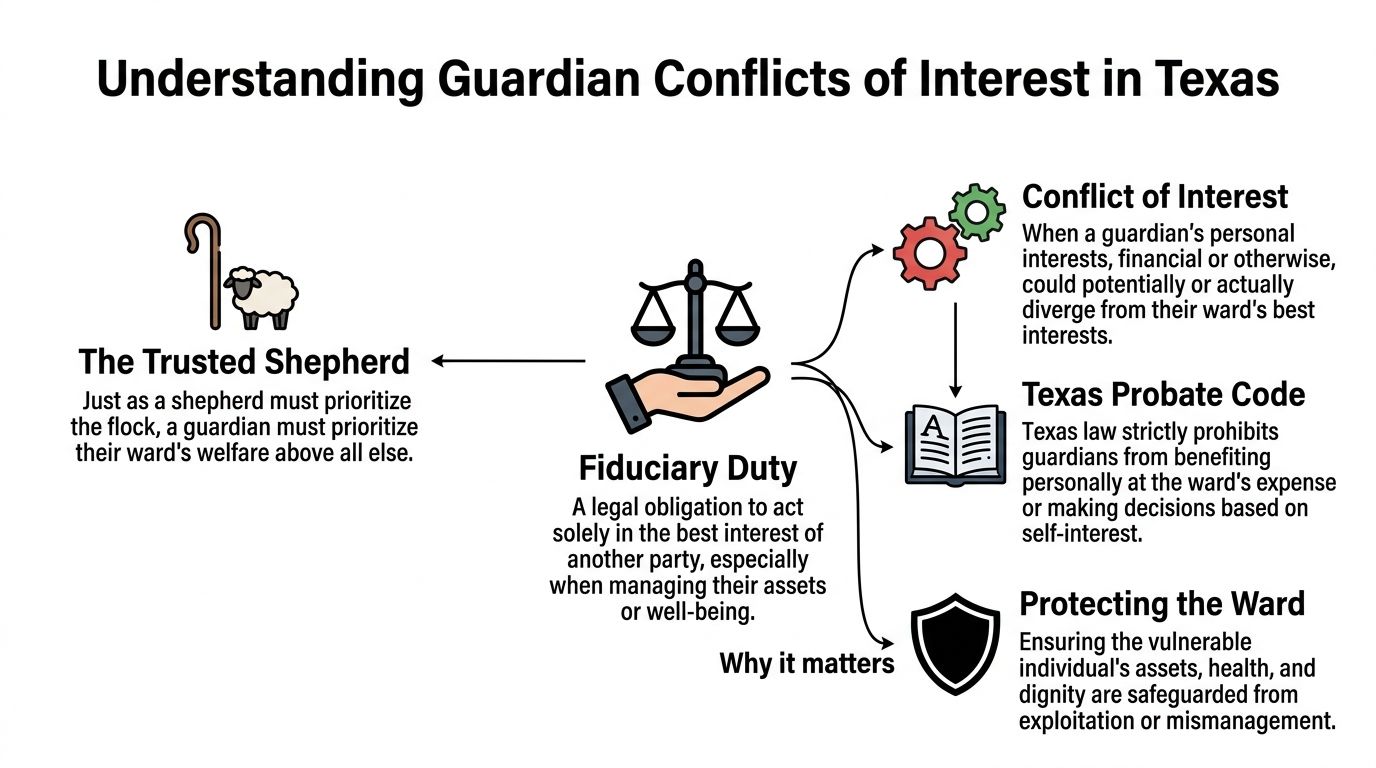
A conflict of interest happens when a guardian's personal interest could interfere with their duty to act for the ward. The simplest way to understand it is this. A guardian isn't allowed to treat the ward's life or property like an opportunity.
Think of a guardian as a person holding someone else's wallet, keys, and medical chart. The law expects that person to protect all three. If they owe the ward money, want the ward's property, or are fighting with the ward in another legal matter, their judgment may already be compromised.
What Texas law specifically bars
Texas doesn't leave this issue to guesswork. Under Texas Estates Code Section 1104.354, a person is disqualified from appointment in certain conflict situations. The statute explicitly bars appointment if the proposed guardian is indebted to the ward or is asserting a claim to the ward's property that is adverse to the ward's interests, as stated in Texas Estates Code Section 1104.354.
That rule gives families a clear legal standard.
Plain-English examples
A person may have a disqualifying conflict if they are:
- Owing the ward money and haven't repaid it
- Claiming ownership of property the ward says is theirs
- In a lawsuit affecting the ward's welfare, depending on the circumstances described in the statute
- Using the guardianship case to gain an advantage in a separate family or financial dispute
A simple example helps. Suppose an adult son says his father promised him the father's house years ago. At the same time, the son asks the probate court to appoint him guardian of the estate. That doesn't mean he can never serve, but it raises a serious question. If appointed, would he protect the father's ownership rights, or push decisions that help his own claim?
Why fiduciary duty matters so much
The legal phrase fiduciary duty can sound abstract. It isn't. It means loyalty, honesty, careful recordkeeping, and no self-dealing. A guardian should make decisions the same way a careful trustee handles someone else's money. They don't get to dip into it, redirect it, or shape decisions around their own convenience.
When a guardian benefits from a decision that should have been made solely for the ward, the court may see that as a warning sign of divided loyalty.
Where readers often get confused
Families sometimes think a conflict exists only if money was stolen. That's too narrow. A conflict can involve money, but it can also involve control, property claims, personal grudges, or hidden incentives.
A guardian of the person may have a conflict if they steer the ward into a living arrangement that benefits the guardian. A guardian of the estate may have a conflict if they hire themselves, a friend, or a business they control to handle the ward's assets. In both situations, the question is the same. Was the decision made for the ward, or for the guardian?
Texas guardianship law under Title 3 of the Estates Code is designed to protect dignity, safety, and property. The conflict rules are one of the law's clearest safeguards.
A Guardian's Core Fiduciary Duties and Responsibilities
Before you can spot a breach, you need a baseline. Guardians don't have unlimited authority. Their powers come from the court, and their duties depend on the type of guardianship.
Guardian of the person and guardian of the estate
A guardian of the person usually handles personal decisions. That may include medical care, living arrangements, and daily supervision, depending on the court's order.
A guardian of the estate manages money and property. That can include paying bills, protecting assets, and keeping records for the probate court.
Sometimes one person serves in both roles. Sometimes the court splits them between different people. In either setup, the guardian must follow court orders closely and stay within the authority granted.
The non-negotiable standards
Texas Supreme Court certified guardians are held to minimum standards that reflect core fiduciary principles. Those standards require guardians to immediately disclose potential conflicts to the court, avoid self-dealing, and never commingle the ward's money with personal or business funds, as stated in the Texas Supreme Court Certified Guardians Minimum Standards.
Those ideas apply broadly, even when a family member thinks of themselves as “just helping out.”
Here are the basic guardrails families should expect:
- Separate funds: The ward's money should stay separate from the guardian's own accounts.
- No self-dealing: The guardian shouldn't buy the ward's property, sell to themselves, or profit from inside control over the estate.
- Court disclosure: If a conflict appears, the guardian should bring it to the court's attention.
- Accurate records: Spending, deposits, and transactions should be documented.
- Limited authority: The guardian must act within the scope of the order signed by the judge.
What proper conduct looks like
A careful guardian of the estate pays the ward's bills from the ward's account, keeps receipts, and seeks court approval when required. A careful guardian of the person consults doctors, respects the ward's dignity, and avoids using care decisions to punish or isolate family members.
By contrast, warning signs include loose bookkeeping, unexplained transfers, cash withdrawals without support, and statements like “I moved the money because it was easier.”
For many Texas families, annual reporting is where accountability becomes visible. If you want a better sense of what courts expect, review this guide to annual accounting in a Texas guardianship.
A guardian's paperwork is often the first place a conflict shows up. Missing records and vague explanations usually make a judge ask harder questions.
Rights and duties don't erase the ward's dignity
Texas courts treat guardianship as a serious remedy, not a shortcut for family convenience. The ward still matters as a person, not just as a case file. The guardian's role is to protect, not to take over every decision possible.
That principle affects disputes about housing, medical treatment, spending, transportation, and visitation. If a guardian says, “I'm the guardian, so I can do whatever I want,” that's a red flag. The law doesn't give blanket permission. It imposes supervised responsibility.
That same supervision matters in related proceedings involving Guardianship, Probate, and Estate Planning, because financial control, property issues, and personal care often overlap.
Common Examples of Guardian Conflicts of Interest
The easiest way to understand a guardian conflict of interest texas families face is to look at realistic situations. Most conflicts don't arrive with a label. They show up as conduct that seems convenient for the guardian and harmful, risky, or unfair to the ward.

Financial conflicts that often trigger concern
Start with money. A guardian of the estate has access, authority, and opportunity. That combination creates risk.
A common example is the “temporary loan.” A guardian takes money from the ward's account to cover personal rent, credit cards, or business expenses and promises to pay it back later. Even if repayment eventually happens, the guardian may have used the ward's funds for personal benefit.
Another example is an inside sale. A guardian arranges for the ward's truck, jewelry, or home to be sold to a friend or relative on favorable terms. The ward loses value. The guardian preserves a relationship or gains a side benefit.
Families should also watch for service arrangements that don't look arm's length. If the guardian hires their own company to repair the ward's property, manage the ward's finances, or provide care without clear court approval and fair pricing, the guardian may be serving two masters.
Personal care conflicts can be just as serious
Not every conflict involves a bank account.
A guardian of the person may move a ward into a facility because it is closer to the guardian's work, not because it is best for the ward. Another guardian may block contact with relatives, not for safety reasons, but because of a family feud. Someone may push medical decisions based on inheritance concerns, convenience, or resentment.
Those cases are harder to prove because the harm may not appear on a ledger. But they still matter. The ward's dignity, comfort, and relationships deserve protection.
Co-guardian disputes
Co-guardianship can work when two people communicate well and stay focused on the ward. It can also collapse when the guardians don't trust each other. Conflicts among co-guardians are significant and often require court intervention, especially when disagreements over finances or care paralyze decisions or lead one co-guardian to act against the ward's interests, as discussed in this article on disputes among co-guardians in Texas.
Here are common co-guardian warning signs:
- Split control with no plan: One guardian handles care, the other handles money, but neither shares information.
- Competing stories: Each guardian tells the court a different version of the same transaction or medical decision.
- Unilateral action: One co-guardian acts alone on major issues and treats the other as a bystander.
- Hidden records: Bank statements, invoices, or facility reports are withheld from the other guardian.
When that happens, the ward often suffers first. Bills go unpaid. Care decisions stall. Relatives become witnesses in a growing probate fight.
If you suspect abuse, exploitation, or misuse of authority, this guide on how to report guardianship abuse in Texas can help you think through immediate concerns.
Families should take seriously any sentence that starts with, “I didn't tell the court because I knew they'd say no.”
A short comparison
| Situation | Why it may be a conflict |
|---|---|
| Guardian borrows from ward's funds | Personal benefit conflicts with fiduciary duty |
| Guardian sells ward's property to an associate | Loyalty may be divided by outside relationship |
| Guardian blocks family visits without clear safety reason | Personal dispute may be driving care decisions |
| Co-guardian hides account records | Lack of transparency can conceal self-interest |
How Texas Courts Address and Resolve Conflicts
Texas probate courts do more than appoint a guardian and walk away. The court remains the supervisor. If a family member, caregiver, or other interested person believes a guardian has a conflict, the court can require answers and impose remedies.
In places like Harris County Probate Court, courts regularly handle disputes involving accountings, care decisions, property management, temporary orders, and requests for removal. The same basic process applies in many Texas counties, though local procedures can differ.

How a concern gets in front of the judge
A concern usually reaches the court through a filed motion, application, objection, or other formal request in the guardianship case. The exact filing depends on the problem. One person may ask for an accounting. Another may seek emergency relief. Someone else may ask the court to remove the guardian and appoint a neutral replacement.
If the ward is in immediate danger, families should act quickly. Temporary or emergency guardianship issues can move faster than ordinary disputes because the court's priority is protecting the vulnerable person.
What evidence persuades a probate court
Judges need proof, not just suspicion. Strong evidence often includes:
- Bank and financial records: Statements, canceled checks, ledgers, transfers, receipts
- Court filings: Missing inventories, missing accounts, or unexplained discrepancies
- Communications: Emails, texts, letters, voicemails, or written instructions
- Third-party testimony: Caregivers, facility staff, doctors, accountants, neighbors, or relatives
- Property documents: Deeds, sale contracts, invoices, repair records, appraisals, or lease agreements
A useful pattern is to build a timeline. If money moved shortly before a disputed property sale, and the guardian also limited family access during that period, the court may see a larger picture of self-interest or concealment.
Remedies a Texas court can use
When a judge finds a serious conflict or breach, the court has several tools available under the Estates Code and its supervisory power over the guardianship.
Common remedies include:
- Ordering a full accounting so the guardian must explain transactions in detail
- Restricting or suspending powers while the dispute is investigated
- Appointing a neutral person to handle estate or care issues temporarily
- Removing the guardian if the conduct shows unfitness, disobedience, or a harmful conflict
- Ordering repayment if the guardian used ward assets improperly
- Issuing instructions on visitation, medical decisions, reporting, or asset handling
Courts want specifics. Dates, documents, names, and transactions usually matter more than broad accusations.
How this fits into the larger guardianship process
Conflict disputes don't happen in isolation. They often overlap with the original guardianship establishment process, fights over suitability, requests for temporary guardianship, and later termination or modification proceedings. In some cases, what begins as a concern about spending turns into a broader challenge to whether the guardianship should continue in its current form.
Alternatives to guardianship may also become relevant. If the ward has regained capacity or if a less restrictive option can protect the person without a conflicted guardian in place, the court may look closely at those possibilities.
For families, the key point is simple. The court has authority, and the court has options. You don't have to prove everything overnight, but you do need to present a clear and organized concern.
Your Step-by-Step Guide to Contesting a Conflict
When families suspect misconduct, they often freeze because they don't want to make things worse. A careful, organized response usually helps more than a rushed accusation.

Step 1 Document what you see
Write down facts while they're fresh. Dates matter. So do exact words.
Gather items like:
- Financial records: Statements, transaction histories, invoices, receipts, screenshots
- Court paperwork: Orders, letters of guardianship, inventories, annual filings, notices
- Messages: Texts, emails, letters, voicemail summaries
- Care records: Facility notes, medication changes, discharge paperwork, appointment summaries
- Property details: Photos, repair estimates, listings, sale terms, access changes
Don't alter documents. Save copies and keep originals where possible.
Step 2 Separate suspicion from proof
You may believe the guardian is dishonest. The court will still need concrete examples. Instead of saying, “She's stealing from Dad,” try, “On these dates, money moved from Dad's account into an account the guardian controls, and I can't find court approval or supporting invoices.”
That shift matters. It turns emotion into evidence.
A comparison can help:
| Weak presentation | Strong presentation |
|---|---|
| “He can't be trusted.” | “He withdrew funds and hasn't produced receipts.” |
| “She's keeping us away for no reason.” | “The facility had no written restriction, but the guardian blocked visits.” |
| “Something feels off.” | “The house sold after a private transfer and the price appears questionable.” |
Step 3 Act quickly when safety or money is at risk
Delay can make a problem harder to fix. Money can disappear. Property can be transferred. A vulnerable adult can be moved, isolated, or pressured.
If there is immediate danger to the ward's health, living situation, or estate, say that clearly when speaking with counsel. Courts take urgency seriously when the facts support it.
Step 4 Talk with a Texas guardianship attorney
Guardianship procedure is technical. Filing the wrong request, in the wrong court, with weak evidence can slow you down. A lawyer can help identify whether the issue involves disqualification, breach of fiduciary duty, removal, temporary relief, accounting problems, or a broader dispute over the guardianship itself.
For a practical overview of how Texas courts view these claims, this article on breach of fiduciary duty by a guardian in Texas is a useful starting point.
Bring a short timeline to the first meeting. Courts and lawyers both understand facts faster when events are organized by date.
Step 5 Prepare for the hearing
Most families feel better once they know what to expect. A hearing may involve testimony, records, objections, and questions from the judge. The court may focus on whether the guardian acted within authority, whether decisions benefited the ward, and whether immediate protective orders are necessary.
Be ready to answer practical questions:
- What happened?
- When did it happen?
- How do you know?
- What documents support your concern?
- What action do you want the court to take right now?
That last question is important. Sometimes the answer is removal. Sometimes it's an accounting, temporary restrictions, or appointment of a neutral party. Clear requests help the judge respond.
Protecting Your Loved One is Paramount
A guardianship should protect a vulnerable person, not expose them to divided loyalties. When a guardian starts acting for personal gain, hiding information, or exploiting power in a family dispute, that trust has been damaged in a way Texas courts can address.
The law gives families real tools. You can document red flags, raise concerns in probate court, seek emergency relief when needed, and ask the court to require accountability. That may involve the initial Guardianship case, a related Probate issue, or planning steps tied to Estate Planning. In some situations, less restrictive alternatives or termination may also need to be considered.
The emotional side of this is just as real as the legal side. Many people hesitate because they don't want more conflict. But protecting a parent, child, or other loved one from a harmful guardian is not stirring up trouble. It's responsible action.
If you're dealing with a guardian conflict of interest texas probate courts may need to review, don't wait for the facts to get worse. Early legal guidance can make the process clearer and help you focus on what matters most, your loved one's safety, dignity, and financial protection.
If you're concerned that a guardian isn't acting in your loved one's best interests, the Law Office of Bryan Fagan, PLLC can help you understand your options. Our team assists Texas families with guardianship disputes, emergency filings, accountings, removals, and other probate court matters in Houston, Dallas, Austin, San Antonio, and statewide through virtual consultations. Schedule a free consultation to discuss your situation and get clear, compassionate guidance specific to your family.