Skip to content
Walking out of a Texas probate courtroom after a guardianship hearing can feel like a finish line. In Harris County, Dallas County, or another probate court, many families leave with a court order in hand and a sense of relief. The emergency has been addressed. A loved one has protection. The legal hurdle is over.
Then the paperwork starts.
That's the part many people don't expect. They prepared for the hearing, gathered medical records, talked with relatives, and worried about whether the judge would approve the application. What often gets underestimated is what comes next. Guardianship is rarely a one-time legal event. It becomes an ongoing job with deadlines, records, decisions, and court oversight.
A daughter may become guardian for her father after a decline in memory. A brother may step in for an adult sibling with a disability. A grandparent may accept responsibility for a minor after a family crisis. In each of those situations, the court appointment is only the beginning. The guardian now has to make careful decisions, track what happened, and report back to the court.
That's why the phrase ongoing responsibilities of a guardian: an often-overlooked aspect matters so much. The hard part isn't only getting appointed. The hard part is doing the role well, month after month, while balancing family stress, work, and the emotional weight of caring for someone vulnerable.
Introduction You Are a Guardian What Happens Now
A common Texas story goes like this. A family spends weeks preparing for court. They file the application, arrange for the required evaluations, notify relatives, and appear before the judge. When the court signs the order, everyone exhales. They think, “Now I can finally help.”
That feeling is real, and it's deserved.
But if you've just been appointed guardian, the next question is the one that matters most. What happens now? In Texas, guardianship sits under Title 3, Subtitle G of the Texas Estates Code, and that part of the law treats guardianship as a supervised fiduciary relationship, not a private family arrangement. The court gives authority, but it also expects follow-through.
The first misunderstanding
Many people think the court order gives broad permission and then steps out of the picture. That's not how it works. Texas courts, including probate courts in places like Harris County and Dallas County, expect guardians to keep serving, documenting, and reporting.
A guardian of the person may need to monitor health care, living conditions, and daily needs. A guardian of the estate may need to protect money, property, and spending decisions. Some guardians do both jobs.
Most families prepare for the hearing. Fewer prepare for the years that can follow.
Why this catches families off guard
Guardianship often begins during a crisis. Someone is declining. Bills aren't getting paid. Medical decisions can't wait. Family members are stretched thin. In that setting, people naturally focus on getting authority as fast as possible.
That's why post-appointment duties can feel like a second shock.
Before appointment, families should look at alternatives to guardianship too. In some cases, powers of attorney, supported decision-making, trusts, or other planning tools may reduce the need for a full guardianship. In other cases, temporary or emergency guardianship may be necessary first, with more permanent arrangements handled later. And if family members disagree, guardianship disputes can continue even after the order is signed.
The practical lesson is simple. If you're a guardian in Texas, your role didn't end in court. It started there.
Beyond the Courtroom Your Core Fiduciary Duties Explained
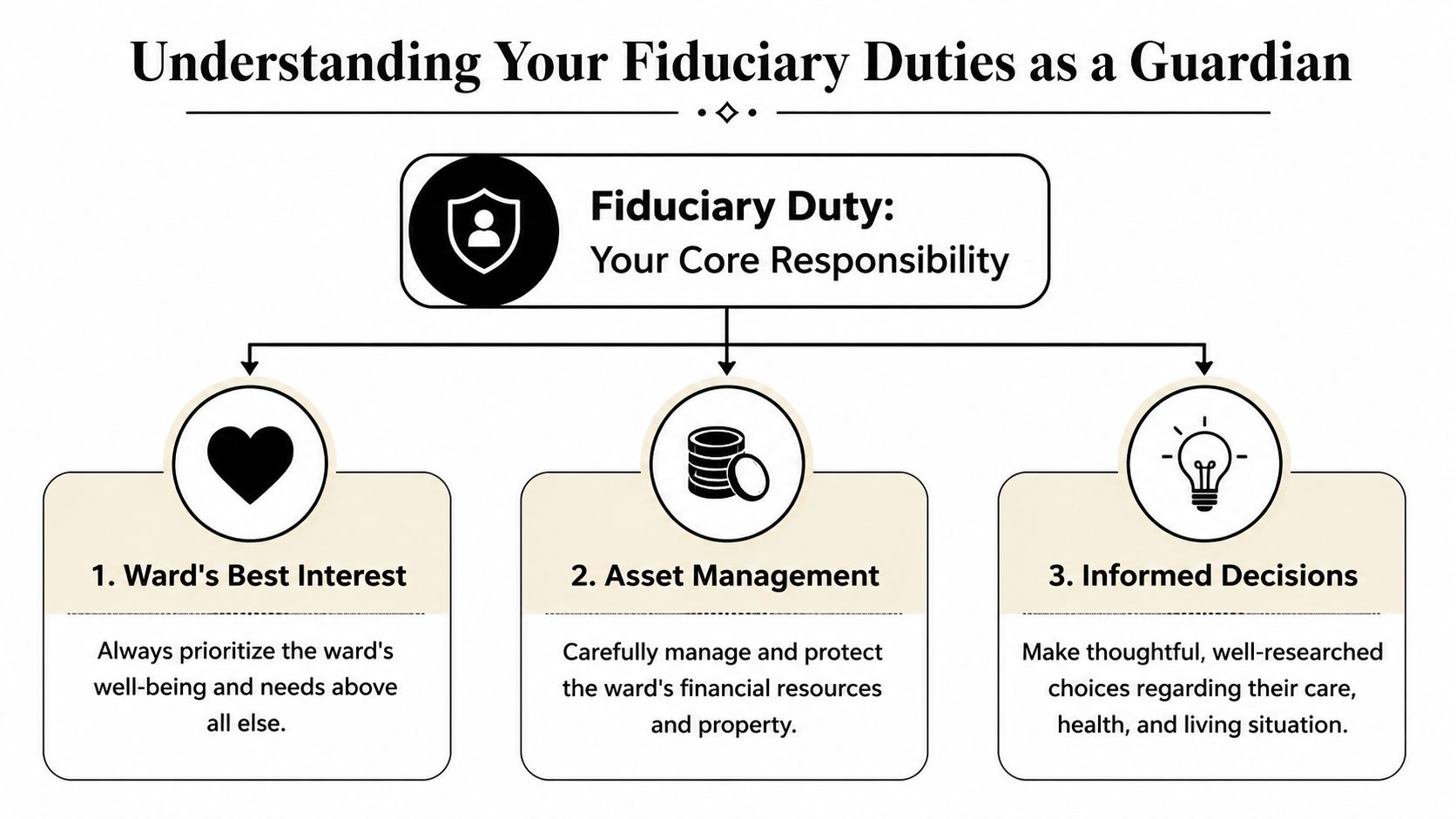
A guardian's legal duty can sound technical, but the basic idea is simple. A fiduciary duty means you must act for the protected person's benefit, not your own convenience, not another relative's preference, and not what feels easiest in the moment.
Texas law in Title 3, Subtitle G of the Estates Code is built around that idea. The court doesn't appoint you because you care. It appoints you because it expects you to exercise authority carefully and loyally.
Loyalty means the ward comes first
If you remember only one principle, remember this one. The ward's interests come first.
That means you don't use the ward's money like family money. You don't make choices because another relative is pressuring you. You don't move property around because “it will all stay in the family anyway.” A guardian must stay focused on the ward's needs, rights, and court-approved interests.
A helpful comparison is a treasurer for a nonprofit. The treasurer doesn't get to treat that bank account as personal money, even if the treasurer has good intentions.
Care means informed decisions
A guardian must gather facts before acting. If a doctor recommends a change in treatment, you may need to ask questions, review options, and consider the ward's current condition. If a housing move is being discussed, you should compare safety, cost, medical access, and daily support.
This is where many family guardians feel overwhelmed. They assumed they would “help out.” Instead, they become the person who coordinates care, keeps records, and makes decisions others may later question.
A peer-reviewed analysis explains why this burden is so widespread. It reports that approximately 1.3 million adults and $50 billion in assets are managed under guardianship or conservatorship in the United States, and notes that the figures are likely underestimated because reporting is incomplete. The same analysis states that about 85% of guardians are family members or friends, which means most guardians are ordinary people handling court-supervised duties rather than professional fiduciaries (peer-reviewed guardianship analysis).
Prudence means careful management
Prudence is practical. It means being cautious, organized, and disciplined. If you manage the ward's estate, every expense should be supportable. If you manage the ward's person, major care choices should be grounded in real information.
Here's a simple way to think about it:
| Duty | Plain-English meaning | Everyday example |
|---|---|---|
| Loyalty | Act for the ward, not yourself | Don't use the ward's funds for a shared family expense unless it is clearly proper and authorized |
| Care | Learn before deciding | Review medical recommendations before consenting |
| Prudence | Keep things organized and careful | Save receipts, track transactions, and avoid shortcuts |
For a fuller discussion of these obligations, families often find it helpful to review responsibilities of a legal guardian in Texas.
Practical rule: If you'd feel uncomfortable explaining a decision to a probate judge with documents in front of you, stop and get guidance before acting.
The Guardian's Annual Checklist Reporting and Accounting in Texas
The most underestimated part of guardianship is usually not the hearing. It's the reporting calendar that begins after appointment. Texas guardians often discover that the court expects regular filings, supporting records, and accurate timelines.
Under Texas Estates Code Title 3, Subtitle G, the exact filing duties depend on whether you are guardian of the person, guardian of the estate, or both. The court may also issue case-specific requirements in its order.

What courts expect after appointment
A court-monitoring guide explains that monitoring happens after appointment, through review of reports, accounts, and plans. It also notes that annual reports are one of the few mechanisms courts use to receive updated case information, and gives examples of recurring deadlines such as care reports within 60 days and annual accountings thereafter (court monitoring guide through the University of Miami archive).
Texas procedure has its own forms and deadlines, so don't assume another state's timeline applies. In Texas practice, guardians commonly deal with an initial inventory for an estate guardianship, annual accountings for estate matters, and annual reports about the ward's condition and well-being for guardianship of the person. Sections within Subtitle G govern qualification, inventories, annual accountings, annual reports, and court review.
Two filings families often confuse
People often mix up these two duties:
- Annual report on the ward's condition. This focuses on the person. You may need to report on residence, health, services, changes in condition, and whether the guardianship still fits the ward's needs.
- Annual accounting. This focuses on money and property. You may need to list receipts, disbursements, assets on hand, and supporting financial records.
Those are not interchangeable. One tells the court how the person is doing. The other tells the court what happened to the person's property.
A working system helps more than memory
Families do better when they build a routine early:
- Create one master calendar with court due dates, doctor visits, benefit renewals, and care reviews.
- Use one filing system for bank statements, invoices, receipts, court notices, and medical records.
- Keep a short monthly log of major decisions, changes in residence, hospital visits, and unusual expenses.
- Review the court's order before taking a major step. Some actions may need approval first.
If the ward owns a home, families should also keep track of recurring property costs. In some situations, Texas homestead-related exemptions may help slash your Texas property tax bill, which can matter when you're trying to preserve the ward's resources responsibly.
For a practical overview of filing obligations, see annual reporting requirements for guardians in Texas.
Missing a filing doesn't just create paperwork trouble. It can cause the court to question whether the guardian is still managing the case properly.
Managing the Ward's Life The Underestimated Day-to-Day Decisions
Most guardians don't struggle because they don't care. They struggle because daily decisions pile up faster than expected. A guardianship can start with one urgent issue, then turn into a long list of ordinary but important choices.

Care decisions become case management
One technical reality often surprises families. Guardianship duties can shift into a case-management model with documentation requirements. Court systems increasingly rely on structured monitoring data such as the type of guardianship, powers granted, reporting status, and changes in the protected person's condition. That means the guardian needs an auditable record of medical status, living arrangement changes, and financial transactions (guardianship monitoring data elements).
That sounds formal, but it shows up in everyday life.
A son serving as guardian may spend part of his week comparing two care facilities. One is closer to the ward's longtime church and friends. The other has easier access to specialists and better supervision at night. Neither choice is simple. The guardian has to weigh safety, continuity, cost, emotional comfort, and medical needs.
The decisions that don't fit neatly on a form
Some duties look like this:
- Medical coordination. Scheduling appointments, tracking prescriptions, and asking follow-up questions when treatment changes.
- Living arrangement reviews. Deciding whether the current setting is still safe and appropriate.
- Benefit and bill management. Making sure insurance, rent, utilities, and care expenses stay current.
- Family communication. Handling calls from relatives who disagree but aren't legally responsible.
A guardian may also face mental health concerns that affect stability, treatment compliance, or the ward's ability to function safely. In those situations, learning about outpatient support options, including Maverick Behavioral Health services, can help families ask better questions of local providers and care teams.
A short example from real life patterns
Consider a hypothetical guardian in Bexar County. Her adult brother wants to stay in his apartment, but his medication errors are becoming more frequent. His doctor recommends closer supervision. One sibling wants him moved immediately. Another says he'll be fine with occasional check-ins.
The guardian's job isn't to keep everyone happy. It's to gather the right information, make a decision grounded in the ward's best interest, and document why that decision was made.
Write down the date, who gave the recommendation, what options were considered, and why you chose the final path. That record may matter later.
That's the hidden labor of guardianship. It is emotional, practical, and ongoing.
Common Pitfalls and How to Avoid Them
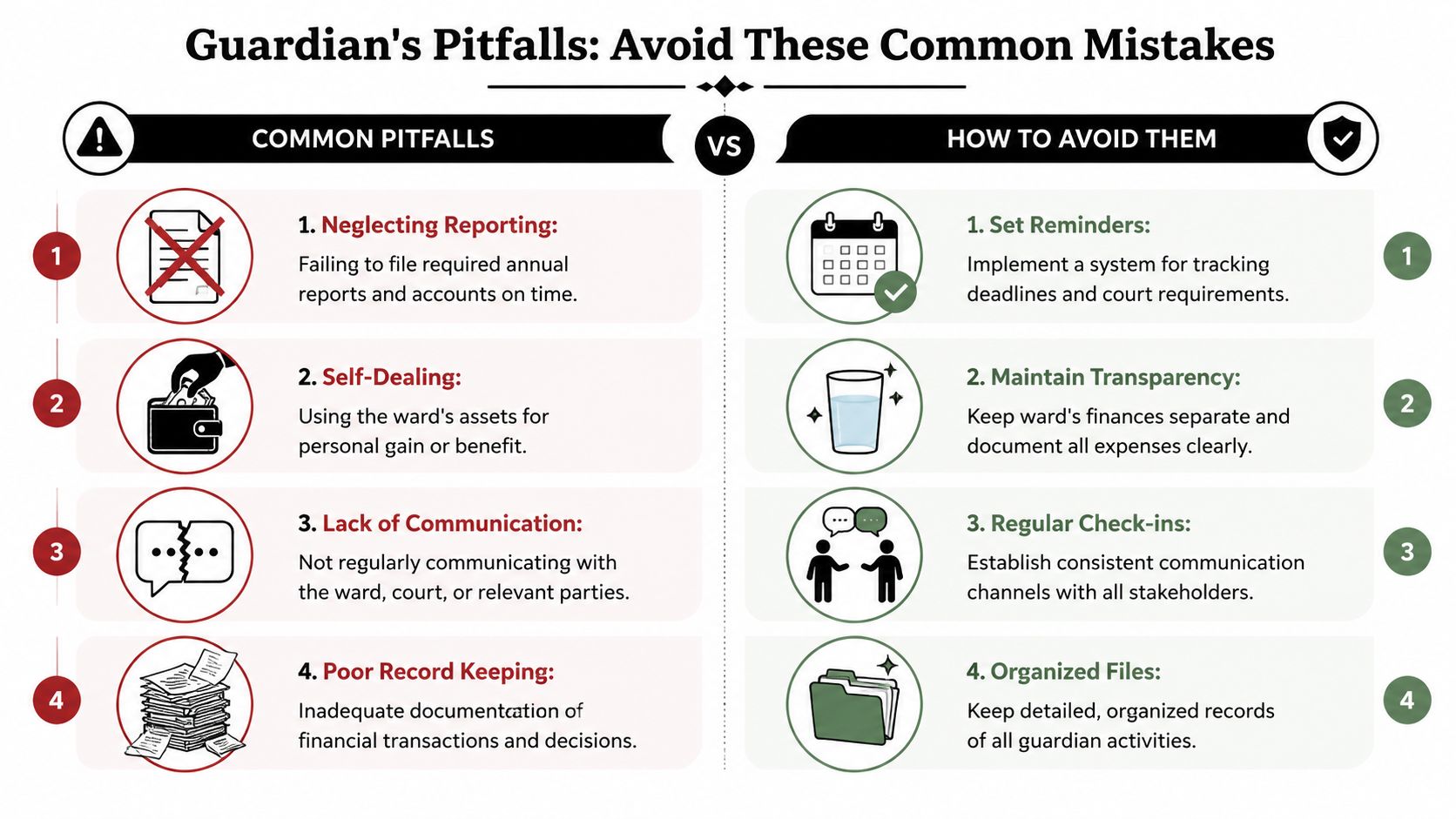
Most guardian problems don't begin with bad motives. They begin with shortcuts. A guardian is tired, trying to help, and assumes a small undocumented decision won't matter. Then a year passes, and those small gaps become a serious court problem.
The biggest mistakes usually look ordinary
Court guidance warns that the highest-risk failure mode is often cumulative recordkeeping gaps. Missing receipts, undocumented spending decisions, and failure to separate the ward's assets from the guardian's own can trigger sanctions or removal (California court guidance on guardian duties).
That warning applies because the pattern is so familiar.
Don't mix money
Keep the ward's funds separate from your own. Even if you plan to sort it out later, commingling creates confusion and suspicion.Don't spend first and explain later
If the expense is unusual, large, or tied to property, pause first. Review the court order and determine whether court approval is needed.Don't rely on memory
You may remember why you bought medical equipment today. You probably won't remember a year from now when preparing an accounting.Don't ignore silence from the court
If you miss a deadline and no one calls immediately, that doesn't mean the problem disappeared.
Better habits that protect you and the ward
Good process protects everyone involved.
| Pitfall | Better habit |
|---|---|
| Using one account for family and ward expenses | Open and maintain separate accounts for the ward |
| Tossing receipts into a drawer | Scan and label receipts by date and purpose |
| Making verbal care decisions only | Keep a written decision log |
| Waiting until filing season to organize records | Review records monthly |
A simple prevention plan
Try this routine:
- Set recurring reminders on your phone and calendar for filing dates and monthly record reviews.
- Keep a guardian binder or digital folder with tabs for court orders, letters of guardianship, medical records, receipts, and bank statements.
- Ask before major actions if you're unsure whether the court must approve them.
- Document conversations with doctors, facilities, and financial institutions.
Families who want a deeper explanation of this issue can review avoiding pitfalls in Texas guardianship and why commingling funds creates problems.
One warning: good intentions won't fix poor records. Courts need documentation, not just explanations.
When Circumstances Change Modifying or Terminating a Guardianship
Guardianship should fit the person's current condition. It is not supposed to become more restrictive than necessary just because it already exists. That point matters in Texas, where courts are expected to balance protection with the person's remaining rights.
When a guardianship may need to change
A guardianship might need modification if the ward's condition improves, declines, or changes in a way the original order didn't anticipate. A guardian may need expanded authority in one area, or the court may need to reduce authority if the ward can handle more decisions independently.
Guidance from court materials outside Texas makes an important point that fits this principle well. Guardianship is not a static status. The authority should be appropriate for the person's actual needs and abilities, and major actions like moving the person or selling real property may require court approval. The arrangement may need to be narrowed, modified, or ended as capacity changes (overview of powers and duties of a guardian).
Common situations in Texas practice
In real Texas cases, changes often arise when:
- The ward regains some capacity and can manage more personal decisions than before
- The current guardian can't continue because of health, distance, or burnout
- A dispute develops about care, money, or whether the guardianship remains necessary
- The ward dies, which typically ends the guardianship of the person and triggers final duties for the estate side
A modification or termination usually requires filing the proper pleadings with the court and providing supporting evidence. Depending on the issue, that may include updated medical information, financial records, or testimony from the people involved.
Don't wait for a crisis
If the guardianship no longer matches reality, delay usually makes things harder. A guardian who knows the order is outdated but keeps operating under it can create risk for the ward and for the guardian personally.
This is also where alternatives to guardianship matter again. If a less restrictive option has become workable, the court may need to consider whether full guardianship is still appropriate. That can be especially important for adult wards whose abilities fluctuate or improve over time.
In counties with busy probate dockets, such as Harris County Probate Court or Dallas County probate courts, clear filings and organized records can make these transitions much smoother.
Your Next Steps with The Law Office of Bryan Fagan
The central lesson is straightforward. Guardianship is an act of care, but it is also a legal assignment with continuing duties. The court hearing may be the most visible part of the process, yet the long-term work happens afterward. That's where many families feel the strain.
A Texas guardian may need to do all of the following at once: make medical and placement decisions, protect funds and property, keep family conflict from disrupting care, prepare annual reports, respond to court requirements, and reconsider whether the current guardianship still fits the ward's needs. That's a lot for one person to carry, especially when the ward is a parent, sibling, spouse, or child.
A practical path forward
If you're preparing for a guardianship hearing, focus not only on getting appointed but on what records and routines you'll need afterward. If you're already serving, review your order, calendar your deadlines, and clean up your documentation now instead of waiting for the next filing. If there's conflict, a sudden decline, or a question about temporary guardianship, modification, or termination, get advice early.
Families often also need related help with Guardianship, Probate, and Estate Planning, because these issues rarely stay in one legal lane.
When families want help with applications, temporary guardianship, contested matters, annual compliance questions, or post-appointment court requirements, Law Office of Bryan Fagan, PLLC handles Texas guardianship matters involving establishment, modification, and compliance under the Estates Code.
You don't have to sort through all of this alone. The right guidance can help you protect your loved one while also protecting yourself from avoidable mistakes.
If you're feeling overwhelmed by the ongoing responsibilities of a guardian, schedule a free consultation with Law Office of Bryan Fagan, PLLC. Whether you're facing a new guardianship in Houston, Dallas, Austin, San Antonio, or anywhere else in Texas, or you need help with annual reporting, temporary guardianship, a dispute, or ending an outdated arrangement, our team can help you understand your options and the next steps with clarity and care.