Skip to content
When a Texas court appoints you as a legal guardian, it places an immense amount of trust in your hands. We understand this isn't just a legal title; it's a profound commitment to protect a loved one who can no longer make critical decisions for themselves. This role, guided by Texas law, boils down to two core functions: managing their personal well-being and overseeing their financial affairs, always putting their best interest first. The journey can feel overwhelming, but our goal is to provide clarity and compassionate direction.
Understanding a Texas Guardian's Core Duties
Taking on the role of a guardian means you are legally accountable to the court and, more importantly, to the person you are appointed to protect—known in legal terms as the "ward." The Texas Estates Code (Title 3), which lays out the rules for these matters, understands that a person's life is complex. Because of this, Texas law often splits guardianship into two distinct roles to ensure every part of the ward's life gets focused, dedicated attention.
This separation is practical. The court, often a specialized probate court like those in Harris or Dallas County, might appoint one person for both jobs or two different people, depending on what the family needs and what will best serve the ward. We know that every family's situation is unique, and the law is designed to be flexible to meet those needs.
Guardian of the Person vs. Guardian of the Estate
The two fundamental types of guardianship are divided based on the kinds of decisions that need to be made. Understanding this distinction is the first practical step for any family considering this path.
- Guardian of the Person: This role is all about the ward's personal, physical, and emotional well-being. Think of it as managing their day-to-day life—making healthcare decisions, deciding where they live, and making sure they have the support needed to live with dignity.
- Guardian of the Estate: This guardian is a financial steward, focused entirely on protecting the ward's assets and financial security. Key duties include paying bills, managing property and investments, and shielding them from financial exploitation.
This diagram helps visualize how a guardian's duties cover both the personal and financial health of the ward.
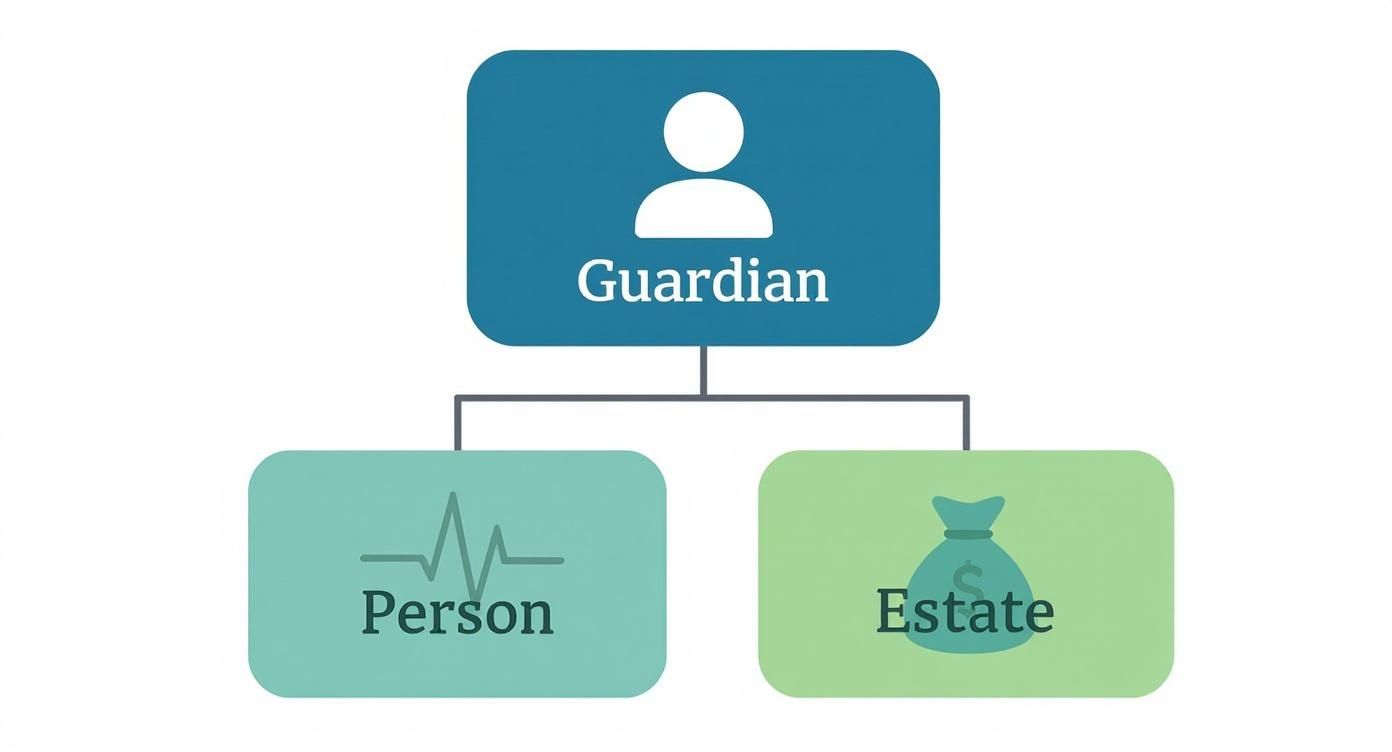
This split makes it clear that guardianship is a comprehensive responsibility, requiring careful attention to both the person and their property.
To make this distinction even clearer, let's look at the primary duties side-by-side.
Guardian of the Person vs Guardian of the Estate At a Glance
| Area of Responsibility | Guardian of the Person | Guardian of the Estate |
|---|---|---|
| Primary Focus | Personal well-being, health, and daily life | Financial security, asset management, and property |
| Key Decisions | Medical treatments, living arrangements, personal care | Paying bills, managing bank accounts, filing taxes, handling investments |
| Main Goal | Ensure the ward is safe, healthy, and cared for with dignity | Protect and prudently manage the ward's assets and income |
| Court Reporting | Files an Annual Report on the Condition of the Ward | Files an Annual Accounting of the estate's finances |
This table provides a quick reference, but it's important to remember that both roles are bound by the same high standard of care.
Your Fiduciary Obligation
No matter which hat you wear—Guardian of the Person, Guardian of the Estate, or both—you are held to a fiduciary duty. This is the highest standard of care the law recognizes, and it's not something to be taken lightly.
A fiduciary duty legally requires you to act with absolute loyalty and good faith, placing the ward's interests above your own, without exception. This means avoiding conflicts of interest and managing their affairs with complete transparency and prudence.
This legal and ethical standard is the bedrock of guardianship in Texas. To really dig into this crucial aspect, you can find more detail on the ethical obligations of guardians under Texas law in our dedicated article. We understand this is a huge undertaking, and our goal is to give you the clarity you need to fulfill these duties confidently.
Duties of a Guardian of the Person
When a Texas court names you as a Guardian of the Person, you’re stepping into a role that is deeply personal and incredibly important. This responsibility is all about your loved one’s day-to-day life, their health, and their overall well-being. Unlike a Guardian of the Estate who is focused on the checkbook, your job is to handle the human side of things—making sure your ward is safe, treated with dignity, and has the best quality of life possible.
This isn't just a checklist of tasks; it’s a commitment to be a compassionate advocate for someone who can no longer speak up for themselves. The decisions you’ll make will directly impact their everyday world, from where they live to the medical care they receive.
Making Critical Life Decisions
As a Guardian of the Person, the Texas Estates Code (specifically Title 3, Subtitle G) gives you the legal power to make some of life's most critical decisions. The court, whether it's in Harris County or anywhere else in Texas, trusts you to always act in the ward's best interests. Your main duties will include:
- Deciding Where the Ward Lives: You have the final say on the ward's residence. This could mean arranging for in-home care, moving them in with a family member, or selecting an assisted living or nursing facility. It's a decision that requires a careful balancing act between their medical needs, safety, personal preferences, and social well-being.
- Consenting to Medical Treatment: You'll be the one making healthcare choices, from routine doctor's visits to major surgeries. This means picking doctors, approving procedures, and managing their medications. Every decision has to be guided by professional medical advice and what you genuinely believe the ward would have wanted for themselves.
- Overseeing Personal Care: This is about ensuring the ward is getting proper nutrition, has good hygiene, and receives the daily support they need. You’ll be the one coordinating with caregivers, therapists, and other professionals to meet both their physical and emotional needs.
Stepping into this role is a heavy responsibility, especially when it comes to healthcare decisions. Most of the time, this duty falls to family. In fact, recent data shows that 81.3% of guardians are family members, which really underscores the personal weight of these choices. You can discover more insights about these findings on guardianship trends here.
The Legal Rules and Real-World Application
Your authority isn't unlimited; it's spelled out clearly in Chapter 1151 of the Texas Estates Code. This part of the law details the specific powers and duties of a Guardian of the Person. Getting familiar with these rules is key to feeling confident and acting correctly in your role.
At the heart of it all is one simple rule: you must always act in the "best interest of the ward." This is a legal standard that demands you put the ward’s well-being ahead of everything else—including your own convenience or financial concerns.
For example, imagine a family in Fort Bend County whose mother has advanced Alzheimer's. Her son, the guardian, has to decide if she can stay at home with a visiting nurse or if she needs to move to a specialized memory care facility. He has to weigh her deep desire to remain in her familiar home against the medical reality of her condition. This is the kind of tough but essential decision a Guardian of the Person faces every day.
Upholding Dignity and Fostering Independence
It's a common myth that guardianship strips a person of all their freedom. That’s not the goal. Texas law actually requires you to use the least restrictive means necessary to keep the ward safe. Your role is to support them, not to control them. This is a key principle in alternatives to guardianship as well.
Whenever you can, you should:
- Involve the ward in decisions as much as they are able to participate.
- Respect their preferences, both past and present.
- Encourage social and fun activities that help maintain their quality of life.
Your job goes beyond just physical care. It's about protecting their dignity and helping them hold on to as much independence as they safely can. It’s a delicate balance that calls for empathy, patience, and a true understanding of what your loved one needs and wants.
Trying to manage all of these personal and legal duties can feel overwhelming and isolating. If you’re thinking about becoming a guardian or are already serving in this role, please know that you don't have to do it alone. We invite you to schedule a free consultation with The Law Office of Bryan Fagan to talk about your unique situation. Our team can offer the compassionate, practical guidance you need to protect your loved one.
Duties of a Guardian of the Estate
When a court appoints you as a Guardian of the Estate, your focus shifts from personal care to financial protection. You become the legal steward of your loved one’s assets, a role governed by a strict legal principle known as fiduciary duty. This isn't just a suggestion; it's the highest standard of care under Texas law, demanding absolute integrity and requiring you to manage the ward's finances solely for their benefit.
This is a massive undertaking, and the courts don’t take it lightly. In the United States, an estimated 1.3 million adults are under some form of guardianship, with guardians managing a staggering $50 billion in assets. That number really puts into perspective the immense trust placed in people who step into this role. You can read the full research about these guardianship statistics to get a better handle on the national scope of this responsibility.

Core Financial Responsibilities Under Texas Law
Under Title 3, Subtitle G of the Texas Estates Code, a Guardian of the Estate has several key duties. Think of yourself as the CEO of your loved one's financial life, with the probate court acting as your board of directors.
Your primary tasks will include:
- Gathering and Inventorying Assets: Your very first job after the guardianship establishment process is to track down, identify, and take control of all the ward's property. From there, you must file a detailed "Inventory, Appraisement, and List of Claims" with the court, usually within 30 days of being appointed. This document is a complete snapshot of the estate—bank accounts, real estate, stocks, personal belongings, everything.
- Managing and Investing Prudently: The law requires you to manage the ward’s assets as a "prudent person" would. This means you’re aiming for sensible, conservative investment decisions that preserve the estate, not taking speculative risks with their money.
- Paying Debts and Collecting Income: You are now responsible for paying all of the ward's legitimate bills and debts. On the flip side, you also have to collect any income they are due, like Social Security benefits, pension checks, or rent from a property.
Getting these initial steps right lays the foundation for transparent and effective financial management down the road.
A Practical Scenario in Harris County
Let’s walk through a quick scenario. Imagine Sarah is appointed Guardian of the Estate for her father in Harris County. Her dad owns his home, has a retirement account, and receives a monthly pension.
Sarah's first official act is filing the inventory with the Harris County Probate Court. Next, she opens a new bank account titled "Sarah, Guardian of the Estate of [Father's Name]." This is critical. All his pension and Social Security checks get deposited directly into this account, and she uses it to pay his mortgage, utilities, and property taxes. That separate account creates a clear paper trail, which is vital in preventing guardianship disputes.
A core principle of estate guardianship is to never commingle funds. The ward's money must always be kept entirely separate from your own personal finances. Mixing them is a serious breach of your fiduciary duty and can lead to severe legal consequences.
Sarah also meets with a financial advisor to make sure her father's retirement funds are invested appropriately, prioritizing preservation over high-risk growth. Every single transaction—each deposit and every expense—is meticulously recorded. This level of detail isn't just good practice; it's a legal requirement.
The Importance of Court Oversight and Reporting
Texas probate courts take the protection of a ward's estate very seriously. They keep a close watch to ensure guardians are acting appropriately, and they do this through mandatory reporting. As Guardian of the Estate, you must file an Annual Account with the court.
This detailed financial report needs to show:
- All money that came into the estate during the year.
- Every single expense paid out from the estate.
- Any changes in the assets held by the estate.
- The current financial status of the estate.
This annual filing is how you prove your compliance and accountability to the court. If you keep meticulous records all year long, pulling this report together becomes a much more manageable task. To dig deeper into the specifics, you can check out our guide on a guardian’s role in managing the ward’s finances under Texas law.
The responsibilities of a Guardian of the Estate are certainly demanding, but they are absolutely essential for protecting your loved one's financial future. If you're facing this role, you don't have to figure it all out on your own. schedule a free consultation with The Law Office of Bryan Fagan to get personalized guidance and make sure you are meeting all your legal obligations with confidence.
Annual Court Reporting Requirements
When you agree to be a legal guardian in Texas, you’re stepping into a role built on trust. To make sure that trust is honored, the probate court system requires consistent oversight. One of your most critical responsibilities is keeping the court updated through annual reporting. This process is how you demonstrate that you're fulfilling your duties and always acting in your loved one’s best interest.
This isn't meant to be a punishment or a burden; it's a vital safeguard. These reports create a transparent, official record of the ward's condition and finances, which protects them and you. For courts across Texas, like the Montgomery County Probate Court, these documents are the primary way they monitor the guardianship and ensure compliance before guardianship termination can be considered.

Report for the Guardian of the Person
If you're the Guardian of the Person, your entire focus is the ward's well-being. The court needs to see that you're actively involved, and you'll do this by filing a document called the "Annual Report on the Condition and Well-Being of the Ward." Think of it as a narrative summary of your loved one's life over the past year.
You’ll be asked to provide details on:
- The Ward's Physical and Mental Health: You'll need to describe their current condition, note any significant changes from the previous year, and list the medical treatments they've received.
- Living Arrangements: This is where you state where the ward is living and confirm that the residence is safe and appropriate for their needs.
- Your Personal Visits: The court wants to know how often you see the ward and what you do during those visits.
- Social and Personal Activities: Here, you can paint a picture of their quality of life. Are they involved in any social, educational, or recreational activities?
This report gives the judge a clear picture, showing that the ward is safe, cared for, and living a life with dignity. It’s your proof that you are an engaged and attentive guardian.
Report for the Guardian of the Estate
When you're the Guardian of the Estate, the reporting shifts to the financials. Your duty is to file an "Annual Account," which is a detailed financial statement that tracks every single dollar that has come into and gone out of the ward’s estate.
Under the Texas Estates Code, the Annual Account is a formal accounting that must be verified by oath. It's not just a simple budget; it's a legal document that demonstrates your financial stewardship and adherence to your fiduciary duty.
This accounting needs to be absolutely meticulous. For many guardians, this is the most challenging part of the job.
What to Include in the Annual Account
The Annual Account has to be precise and backed up by hard evidence like bank statements and receipts. It essentially serves as the court's official financial ledger for the ward.
Your Annual Account must clearly list:
- All Income Received: This includes everything from Social Security benefits and pension payments to investment dividends or rental income.
- All Disbursements Made: Every single expense must be itemized—utility bills, medical co-pays, groceries, clothing, and anything else paid for with the ward's funds.
- A List of Current Assets: You must provide an updated inventory of all property in the estate, like bank account balances, real estate holdings, and investments.
- Supporting Documentation: You'll need to attach bank statements and other financial records that prove the numbers in your report are accurate.
The key to making this manageable is staying organized all year long. Keep a separate bank account just for the guardianship and save every single receipt. This habit will make assembling the Annual Account infinitely easier. Our firm offers detailed guidance on fulfilling these obligations; you can learn more about the specifics in our article on annual reporting requirements for guardians in Texas.
The legal and financial hoops of annual reporting can feel daunting. If you have questions or need help preparing your court-mandated reports, please contact The Law Office of Bryan Fagan for a free consultation. We can help you stay compliant and feel confident in your role.
What a Guardian Is Prohibited from Doing
Knowing your duties as a legal guardian is only half the battle. Just as important is understanding the limits of your authority. The Texas Estates Code (Title 3, Subtitle G) draws some very clear lines, not to tie your hands, but to protect the ward’s rights, dignity, and property. These rules are there to make sure every major decision happens with transparency and court oversight, shielding your loved one from potential harm or disputes.
Think of these prohibitions as guardrails. They’re designed to keep you on the right path and prevent actions that could land you in legal trouble, cause you to breach your fiduciary duty, or even get you removed as guardian by a Harris County Probate Court.

Actions Requiring Court Approval
While you have a lot of authority for day-to-day matters, certain major decisions are simply outside your power to make alone. For these, you must first go back to the court, file a formal request, and get a specific order authorizing the action. This step is a critical part of the process, especially when facing an emergency or temporary guardianship situation where quick, significant decisions might be needed.
Some of the most common actions that require prior court approval are:
- Selling Real Estate: You can't just decide to sell the ward’s home. A judge has to be convinced that the sale is necessary and in the ward's best interest before they'll sign off on it.
- Making Large Gifts or Donations: Using the ward’s money to give significant gifts to family or charities is off-limits unless the court approves it.
- Entering into Major Contracts: Signing long-term leases or other significant agreements on behalf of the ward requires court oversight.
- Settling Lawsuits: If the ward is a party in a lawsuit, you cannot agree to a settlement on your own. The court has to review and approve the terms to ensure they are fair.
These rules exist to stop the ward’s estate from being drained and to guarantee that major life decisions get a second look from a judge.
The requirement for court approval is a cornerstone of Texas guardianship law. It acts as a critical check and balance. Below is a table outlining some of these key actions and why jumping ahead without a court order is a serious misstep.
Common Actions Requiring Prior Court Approval
| Action | Reason for Court Approval | Potential Consequence of Not Seeking Approval |
|---|---|---|
| Selling the Ward's Home | To ensure the sale is necessary, for a fair price, and that the proceeds will be properly managed. | The sale could be voided by the court, and the guardian could be held personally liable for any financial loss to the estate. |
| Making a Gift over $250 | To prevent the depletion of the estate and ensure the gift aligns with the ward's established patterns of giving. | The guardian may be ordered to repay the gifted amount to the estate out of their own pocket and could face removal. |
| Paying Yourself for Services | To prevent self-dealing and ensure any compensation is reasonable and for legitimate, documented work performed for the ward. | The court can deny the payment, order the funds returned, and remove the guardian for a conflict of interest. |
| Settling a Personal Injury Claim | To have a judge review the settlement terms, ensuring they are fair and adequate for the ward's future needs. | The settlement may be invalidated. The guardian might be held liable for accepting an insufficient amount. |
| Choosing a New Residence (especially out of state) | To confirm the move is in the ward's best interest, medically appropriate, and doesn't improperly isolate them from family. | The court can order the ward to be returned to their previous location at the guardian's expense and could lead to removal. |
Ultimately, when in doubt, it is always safer to ask the court for permission than to ask for forgiveness later.
Strict Financial Prohibitions
Your role as a guardian is built on a foundation of absolute trust and loyalty. Because of this, the Texas Estates Code is incredibly strict about your financial conduct to prevent even a hint of self-dealing or mismanagement.
The most fundamental rule is the absolute prohibition against self-dealing and commingling funds. You must never use the ward's assets for your own personal benefit or mix their money with yours. This means no borrowing from the estate and no paying your personal bills from their account.
Breaking this rule is one of the quickest ways to be removed as a guardian and can open you up to personal civil liability.
Adhering to the Least Restrictive Alternative
Beyond specific do's and don'ts, Texas law holds guardians to a powerful guiding principle: the "least restrictive alternative." This is a legal requirement that obligates you to encourage the ward's independence and self-reliance as much as humanly possible.
This core concept means you are prohibited from:
- Making decisions for the ward that they are capable of making for themselves.
- Restricting their personal freedoms, like their right to visit with family, unless there's a clear and substantial risk of harm.
- Placing them in a restrictive facility if a less restrictive setting, like their own home with in-home care, is medically appropriate and feasible.
Your duty is to support, not to control. The goal is always to preserve as much of the ward’s autonomy and dignity as the situation allows, which is also a key factor when considering alternatives to guardianship.
Navigating these complex boundaries can feel overwhelming. For personalized guidance on the specific limitations of your role and help with the process of seeking court approval, we invite you to schedule a free consultation with The Law Office of Bryan Fagan.
So You're a Guardian—What Now?
Stepping into the role of a legal guardian is a profound act of service, but it's natural for the legal and emotional weight to feel immense. You’ve been entrusted to protect a loved one’s well-being and manage their estate with integrity, a responsibility deeply rooted in the Texas Estates Code. From making daily healthcare decisions to filing meticulous annual reports, your duties are both deeply personal and legally binding.
Grasping what's required is the first hurdle. The practical steps families take after a guardianship hearing are where the real work begins. Moving forward successfully takes diligence, compassion, and often, professional guidance to make sure you're meeting every obligation while honoring your loved one’s dignity.
Your Immediate Action Plan
Feeling overwhelmed is completely normal. The key is to break it down into clear, manageable steps that will set you up for success and ensure you stay compliant with Texas law.
Here are your initial priorities:
- Organize Everything, Meticulously: Don't wait. Immediately create separate systems for all guardianship matters. This means a separate bank account just for the estate's finances and a distinct filing system for medical records, court documents, and every single receipt.
- Calendar Your Deadlines: Get out your calendar and mark down every critical deadline, especially for the initial Inventory and the Annual Account or Report. Missing these dates can create serious problems with the probate court.
- Get Professional Guidance: This is the single most important step you can take. Consult with an experienced guardianship attorney. Navigating the Texas Estates Code isn't a DIY project; getting professional legal advice protects both you and the person you're caring for.
Why Legal Counsel Isn't Just an Option
An attorney does more than just file paperwork. They become your strategic partner, helping you see challenges before they arise, understand the nuances of your fiduciary duty, and communicate effectively with the court. From Harris County to Dallas County, probate judges expect guardians to follow the law to the letter, and a good lawyer ensures you do.
Taking on guardianship without legal guidance is like trying to sail a ship through a storm without a map. An attorney provides the map and the compass, making sure you reach your destination safely while avoiding the hidden rocks of non-compliance and legal liability.
The team at The Law Office of Bryan Fagan is here to provide that direction. We understand the emotional and financial challenges Texas families face in these situations. If you want to dive deeper, we encourage you to explore our resources on Texas Guardianship and Estate Planning law.
Your journey as a guardian is a marathon, not a sprint. To make sure you start on the right foot, we invite you to schedule a free, compassionate consultation with our team. Let us help you carry this responsibility with confidence and care.
Frequently Asked Questions About Guardianship
Taking on the role of a legal guardian is a huge commitment, and it's natural for questions to pop up along the way. To help, we’ve put together some straightforward answers to the questions we hear most often from Texas families.
Can a Guardian Be Paid for Their Services in Texas?
Yes, a guardian can be compensated for their time and effort, but it’s not an automatic paycheck. Under the Texas Estates Code, you have to formally request compensation, and the probate court has the final say. The court will only approve an amount it considers reasonable for the work you've done and the size of the ward's estate.
Here's the critical part: you can never just write yourself a check from the ward's funds. Every dollar of compensation must be clearly listed in your annual accounting and officially authorized by a court order. This process protects both you and the ward by preventing any hint of self-dealing.
How Long Does a Guardianship Last?
For an adult, a guardianship is typically a lifelong appointment, continuing for the remainder of the ward's life. However, it can be terminated by the court if the situation changes. This might happen if the ward recovers their capacity to make their own decisions, or if the guardian needs to resign, is removed by the court, or passes away. This process is known as guardianship termination and has its own set of compliance rules.
When the ward is a minor, the guardianship has a clear end date. It automatically terminates when the child turns 18 years old, becomes legally emancipated, or passes away.
Can a Guardian Live Outside of Texas?
It's possible for a guardian to live out of state, but it definitely adds a layer of complexity. The court's number one priority is always the ward's best interest. For a Guardian of the Person, living far away can make it tough to provide the direct, hands-on care and supervision the role requires.
An out-of-state Guardian of the Estate is a bit more common. Even then, you must still follow every Texas court requirement to the letter and might be required to appoint a resident agent in Texas to accept legal notices on your behalf.
What Happens If a Guardian Makes a Mistake?
Honest mistakes happen, and the courts understand that. But when errors are significant or involve a breach of your fiduciary duty, the consequences can be serious. If a guardian mismanages the ward’s money or fails to carry out their duties, the court can order them to personally repay the estate for any resulting losses.
In more severe cases of neglect or misconduct, the court has the power to remove the guardian entirely and appoint someone new. It's a serious responsibility, and it's why meticulous record-keeping and getting good legal advice are absolutely essential. For families exploring various legal planning tools, understanding prenuptial agreements can also offer perspective on how different legal structures protect individuals and assets.
Your journey as a guardian is one of the most important roles you can undertake, but you don’t have to do it alone. The Law Office of Bryan Fagan, PLLC is here to offer the compassionate, expert legal support your family deserves. Schedule a free, no-obligation consultation with us today to ensure you are protecting your loved one with confidence and care. Contact us at https://texasguardianshiplawyer.net.