Skip to content
A lot of families walk out of a Texas probate courtroom feeling the same thing. Relief.
The hearing is over. The judge signed the order. You can finally step in to help your mother pay bills, speak with doctors, or move your adult child into a safer living situation. After weeks or months of stress, that moment can feel like the end of the crisis.
For many families, though, that hearing is only the start.
The phrase ongoing responsibilities of a guardian matters because guardianship isn't just permission to help. It is a court-supervised legal role. In Texas, that means duties under Title 3, Subtitle G of the Texas Estates Code, regular court reporting, careful recordkeeping, and constant attention to whether the guardianship still fits the person's actual needs. Families in places like Harris County Probate Court or Dallas County probate court often underestimate that long tail of work.
The Journey Begins After the Gavel Falls
A daughter in Houston finally gets appointed guardian for her father after a hard stretch of hospital stays, missed medications, and unpaid bills. She thinks, reasonably, that the hardest part was proving incapacity and getting through the hearing. Then the letters of guardianship arrive, and a new reality sets in. She has to learn what the court order allows. She has to keep records. She has to make decisions without overstepping. She has to report back to the court.
That surprise is common.

One recent analysis estimates that about 1.3 million adults and $50 billion in assets are managed under guardianship in the United States, and the authors say those totals are likely underestimated because reporting is incomplete, as explained in this recent guardianship analysis. The same analysis also notes that guardians are expected to communicate with and visit the person regularly, assess living conditions, and provide person-centered care.
That matters because it changes how you should think about the job. Guardianship is not a one-time court filing. It is continuing oversight that can shape a person's housing, medical care, finances, and daily life for years.
What families often expect
Many people expect guardianship to work like a legal key. They assume the judge gives them authority, and then they use that authority as needed.
In reality, Texas guardianship works more like a legal trust. The court grants authority for a specific purpose, keeps oversight, and expects the guardian to justify actions over time.
A guardianship order solves one problem. It also creates a list of new duties.
If you've recently been appointed, it helps to learn what happens after guardianship is granted in Texas before a deadline sneaks up on you.
Why the long tail gets missed
Families are often focused on the emergency that led them to court. A parent is wandering. An adult child can't manage medical care. A loved one is being financially exploited. In that moment, the hearing feels like the finish line.
It isn't. It's the starting line.
Texas courts expect guardians to act carefully, keep boundaries, and stay accountable. If you underestimate that from day one, small mistakes can grow into real legal problems. Missed reports, mixed funds, undocumented spending, or decisions outside the order can all bring you back before the court, and not in the way you want.
The Three Pillars of a Texas Guardian's Role
When families read a guardianship order, the language can feel dense. A simpler way to understand it is to put the job into three pillars.

Guardianship of the person
This pillar covers the human side of the role. In Texas, a guardian of the person may be responsible for decisions about residence, medical care, services, safety, and day-to-day well-being, depending on the court's order under Texas Estates Code Title 3, Subtitle G.
Think of this role as part advocate, part coordinator. You may need to speak with doctors, review medication plans, work with a care facility, and make sure your loved one's basic needs are met.
A simple example helps. If your uncle in Bexar County can no longer understand discharge instructions after a hospital stay, a guardian of the person may need to arrange follow-up care, confirm where he will live, and make sure he receives the treatment plan.
Guardianship of the estate
This pillar is about money and property.
A guardian of the estate handles assets that belong to the ward, not assets that belong to the family. That can include income, bank accounts, personal property, claims, and sometimes real property, subject to the court order and the Texas Estates Code.
This role is less like “helping with bills” and more like serving as a monitored financial manager. If you pay the ward's rent, renew insurance, or handle a vehicle sale, the court may expect documentation showing what you did, why you did it, and whether approval was required first.
Fiduciary duty
This is the pillar families often don't see until there is a problem. A fiduciary duty means the law expects the guardian to act with loyalty, care, honesty, and restraint.
That duty applies whether you are guardian of the person, guardian of the estate, or both.
Practical rule: If an action helps the guardian more than the ward, stop and get legal advice before moving forward.
One role or both
Some Texas guardians are appointed only for the person. Others are appointed only for the estate. Some serve in both roles.
Here is the easiest way to keep the distinctions straight:
| Role | Main focus | Common example |
|---|---|---|
| Guardian of the person | Health, safety, living arrangements | Choosing an appropriate care setting |
| Guardian of the estate | Money, property, financial decisions | Paying expenses from the ward's funds |
| Fiduciary duty | Loyalty and court compliance | Keeping clear records and avoiding self-dealing |
This framework also helps during the establishment process. Before filing in a court such as Harris County Probate Court, families should ask whether both forms of guardianship are necessary, whether a temporary or emergency guardianship is necessary, and whether a less restrictive option could solve part of the problem.
Caring for the Person Beyond the Paperwork
Many new guardians assume their main duty is to make decisions for the ward. That's only partly true. The harder task is knowing when not to take over.
A guardian's role is not limited to substitute decisions. Illinois guidance states that a guardian must assist the ward in developing maximum self-reliance and independence, and Utah guidance requires the guardian to act diligently, encourage the protected person to act on their own behalf, and consider expressed desires and personal values, as summarized in this guardianship guidance on promoting independence. That same idea fits what Texas families should expect in practice. Your authority should match the court order and the person's current abilities.
Protection and independence have to coexist
Suppose your mother has early cognitive decline. She can still choose her clothes, enjoy church, and decide which cousin she wants to visit, but she can't safely manage prescriptions or understand a stack of insurance papers. A careful guardian doesn't erase all of her choices. A careful guardian protects the areas where she is vulnerable and preserves the areas where she still functions.
That balance is where many families get confused.
They ask, “If I'm the guardian, don't I make the decisions?” Often, the better question is, “Which decisions did the court transfer, and which ones did it leave with my loved one?”
A useful way to approach daily decisions
Try this mental checklist before acting:
- Read the order first: Your letters of guardianship and signed order control your authority.
- Ask what the ward can still do: Capacity can change over time. Some people improve. Some fluctuate.
- Use the least restrictive option: If support will work, don't default to control.
- Document major choices: Keep notes of medical updates, care conferences, and living arrangement decisions.
- Listen for values: The ward's religion, relationships, preferences, and routines still matter.
If you can protect a person without taking away a choice, that is usually the better path.
Daily advocacy matters more than many families expect
Being guardian of the person often means showing up. You may need to visit a facility, notice weight loss, ask why medications changed, or push for a safer discharge plan. If you live outside Texas while your loved one lives in Harris County or Tarrant County, that can become difficult quickly.
Families also need practical support. If your goal is improving quality of life at home, personalized care planning can help you coordinate routines, supervision, and comfort in a way that respects the ward's remaining independence.
Before and after hearings in Texas
Before a guardianship hearing, gather medical records, physician evaluations, names of current providers, and a clear summary of what the person can and cannot do safely. During the hearing, be prepared to explain why a full guardianship, limited guardianship, or temporary guardianship is necessary. After appointment, treat every major decision as both a care decision and a legal decision.
That matters in disputed cases too. In guardianship contests, one common issue is whether a family member is helping appropriately or taking over too much.
Managing the Estate A High Stakes Responsibility
The financial side of guardianship is where honest people often get into legal trouble.
A son in Travis County may think he's doing the right thing by depositing his father's Social Security funds into his own account, paying Dad's bills from there, and keeping a rough list in a notebook. From a family standpoint, that may seem efficient. From a guardianship standpoint, it can look like mixed funds, poor controls, and an incomplete paper trail.
Texas law treats a guardian of the estate as a fiduciary. That means the guardian must handle money and property in a way the court can review.
The record chain has to be clean
Courts commonly require a full record chain, including inventory, separate asset control, recurring accounting, and court review of transactions. Guidance summarized in this overview of guardian financial duties explains that the guardian must keep the ward's money completely separate from their own and file an accounting with detailed transaction records. Because the guardian has fiduciary duties, even ordinary expenses become auditable events, and poor documentation can create removal risk.
That principle matches what Texas courts expect under Title 3, Subtitle G. If you are guardian of the estate, assume the court may ask for support for every meaningful transaction.
What that looks like in real life
A careful Texas guardian of the estate usually needs to think about these tasks early:
- Separate accounts: Never blend the ward's funds with yours.
- Inventory and asset control: Identify bank accounts, income sources, vehicles, claims, and property.
- Receipts and ledgers: Keep records for deposits, payments, reimbursements, and transfers.
- Court approval questions: Don't assume you can sell, lease, invest, or gift property without permission.
- Bond and court restrictions: Follow whatever safeguards the court imposed when appointing you.
Here is a common example. Your aunt owns a car she no longer drives. A family member offers to buy it. That may sound simple, but a guardian should slow down and ask whether the court's prior approval is needed, how the value will be documented, where sale proceeds will go, and how the transaction will appear in the next accounting.
Medical bills create pressure points
Medical expenses are one of the biggest stress areas for guardians of the estate because they arrive fast and often feel urgent. You still need to document the bill, verify whether insurance applies, and keep records of payment from the ward's funds. If your loved one is uninsured or underinsured, resources on negotiating healthcare costs, such as these tips to save on medical bills, may help you ask better questions before paying large balances.
Keep the receipt. Keep the statement. Keep the reason for the payment. If you can't explain it a year later, the court may not accept it easily.
For families facing these issues, managing ward assets in Texas often becomes the most technical part of the case.
The Annual Cycle of Court Reporting and Compliance
Many guardians learn the hard way that the court expects regular proof that the guardianship is being handled properly.
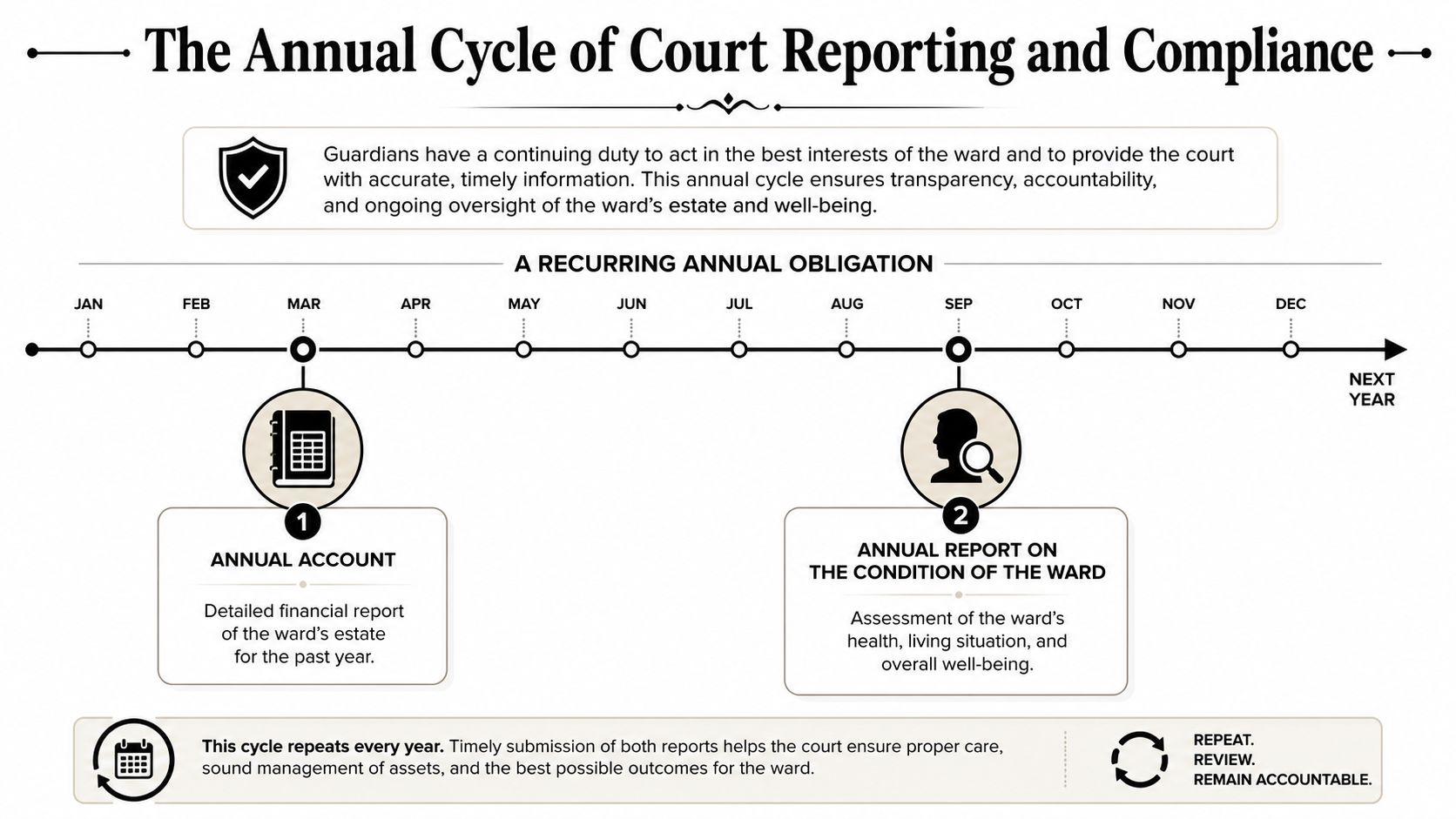
The basic idea is simple. The court appointed you, and the court wants updates.
Florida's professional guardianship report states that a guardian must file an initial report within 60 days after letters of guardianship are signed and must also file an annual report, while Texas similarly requires annual reporting that includes how the ward's money was spent and the ward's current condition, as summarized in this report on recurring guardianship deadlines and oversight. That same report also notes that some actions, including selling property, require prior court approval.
The annual report is not a formality
For a guardian of the person, the court generally wants current information about the ward's condition, residence, services, and well-being. For a guardian of the estate, the court generally wants a financial accounting that matches the money trail.
If you wait until filing season to gather that information, you will probably struggle.
A better approach is to build a simple annual habit.
A workable compliance routine
Use one folder, whether digital or paper, and keep adding to it throughout the year:
- Medical updates: Appointment summaries, diagnoses, medication changes, and care plans
- Living arrangement notes: Address changes, facility records, home care agreements, and safety concerns
- Financial records: Bank statements, invoices, receipts, deposit records, and proof of large expenditures
- Court orders: Signed orders approving special actions, sales, or restricted transactions
- Calendar reminders: Filing deadlines, bond renewals, and hearing dates
Why courts care so much
The court's annual review is one of the few recurring checks on whether the guardian is protecting the ward. If reports are late, incomplete, or unsupported, the judge may require corrections, additional oversight, or further hearings. In serious situations, a guardian can face removal.
That's why compliance should be treated as part of caregiving, not separate from it.
Good intentions don't replace clean records.
If your case includes an estate, learn what the court expects in annual accounting for guardianship in Texas. Families who understand the reporting cycle early usually make better day-to-day decisions all year long.
Temporary guardianships and emergencies still create follow-up work
Emergency or temporary guardianship can feel urgent because it is urgent. But even in those cases, families should expect continuing obligations after the initial hearing. Temporary authority doesn't mean casual authority. The court still expects the guardian to stay within the order, keep records, and return for the next required step.
That is especially important in larger counties like Harris, Dallas, and Bexar, where probate courts often manage high volumes and expect prompt compliance.
Modifying or Ending the Guardianship
Many people assume guardianship is permanent once the judge signs the order. That assumption causes problems.
Guardianship should remain appropriate for the person's actual condition. Guidance from disability-rights sources emphasizes that guardians should involve the ward as much as possible, use the least restrictive alternative, and periodically consider restoration to competency or a limited guardianship, as discussed in this resource on duties, least restrictive options, and restoration. That same guidance explains that a petition to terminate or modify guardianship can be filed if the person no longer needs the same level of restriction.
When modification may make sense
A full guardianship may have been appropriate during a medical crisis, after a serious injury, or during a period of severe mental decline. But conditions change. Rehabilitation may help. Medication may stabilize symptoms. A limited guardianship may become more appropriate than a broad one.
A few examples:
- Recovery after hospitalization: A person regains the ability to make some personal decisions.
- Improved financial skills: The ward can handle a spending allowance but not major assets.
- Overbroad original order: The family realizes some powers were never necessary.
Ending the case is also part of responsible guardianship
A responsible guardian should not hold onto power just because the process was hard. If the ward's capacity is restored, if the guardianship should be narrowed, or if another legal arrangement now works better, the court should be asked to adjust the order.
Texas families should also know that the system has remedies when a guardian is not doing the job properly. If a guardian fails to report, misuses funds, ignores the ward's needs, or acts outside the order, interested persons can raise those issues in court. That can lead to disputes over modification, removal, or replacement.
This is one reason alternatives to guardianship matter from the beginning. Powers of attorney, supported decision-making, trusts, care agreements, and targeted court orders may sometimes solve part of the problem without full guardianship. Even after appointment, those less restrictive tools may become relevant again.
Frequently Asked Questions About Guardian Duties
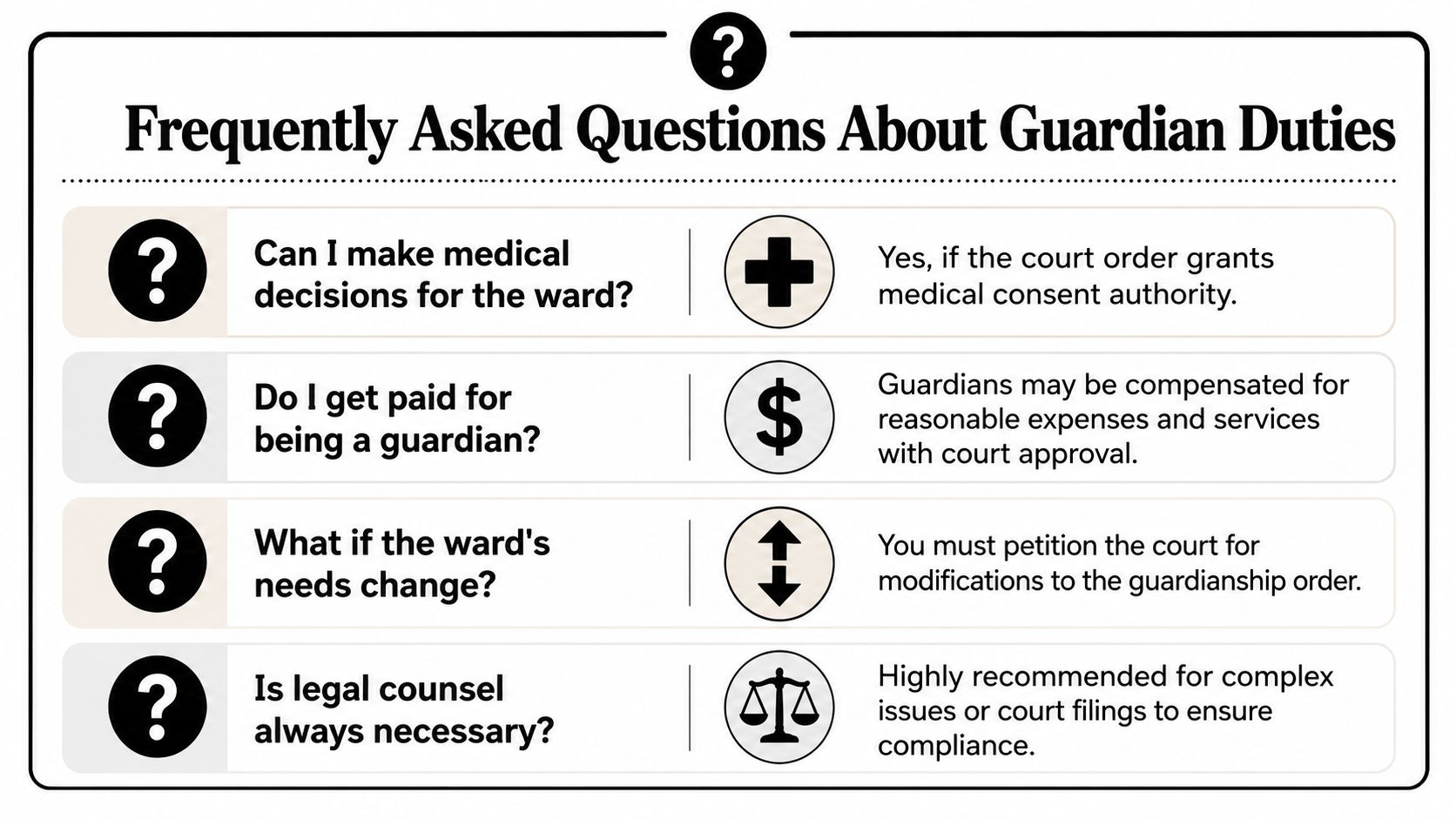
Can I make medical decisions for the ward
Usually, yes, if the court order gives you that authority as guardian of the person. Always read the signed order and letters of guardianship carefully. In Texas, the scope of your authority comes from the court, not from what the family assumes is practical.
Can I be paid for serving as guardian in Texas
It depends. Texas law may allow reimbursement or compensation in some situations, but families should not assume they can directly pay themselves from the ward's funds. Court approval and proper documentation are critical. If you want reimbursement for mileage, caregiving time, or expenses, ask first and document everything.
What if the ward disagrees with me
Disagreement does not automatically mean you are wrong, and it does not automatically mean you are right. Start by asking whether the issue falls within your legal authority and whether the person can still make that choice. Try the least restrictive solution first. If the conflict is serious, especially around medical treatment, residence, or finances, get legal advice before forcing the issue.
What if I make an honest accounting mistake
Fix it quickly. Don't hide it.
Most courts can work with a guardian who made a good-faith error and corrected it promptly. Courts are far less patient when a guardian ignores the problem, keeps poor records, or cannot explain where money went. If you discover a missing receipt, a mistaken reimbursement, or a reporting gap, gather documents and address it directly.
Can I use the ward's money for gifts or family expenses
Usually, that raises risk. The ward's money should be used for the ward's benefit and handled within the court's rules. Gifts, loans, informal reimbursements, and “everyone agreed to it” family arrangements often create trouble later. If a transaction could benefit someone other than the ward, slow down.
Do I really need a lawyer after I'm appointed
Not for every small task, but legal guidance is often helpful for accountings, court approvals, modifications, disputes, temporary guardianships, and property issues. The Law Office of Bryan Fagan, PLLC handles guardianship, probate, and estate planning matters for Texas families who need help with filings, hearings, and compliance questions.
A final practical point. Guardianship often touches nearby legal areas. If your case involves inherited property, a pending estate, or planning for future incapacity, you may also need advice on probate and estate planning, not just the guardianship itself.
If you're carrying the weight of a Texas guardianship, you don't have to sort through every reporting duty, court requirement, and family conflict alone. The Law Office of Bryan Fagan, PLLC helps families with guardianship applications, emergency and temporary guardianships, disputes, annual compliance, probate issues, and estate planning concerns across Houston, Dallas, Austin, San Antonio, and statewide by virtual consultation. Schedule a free consultation to get guidance specific to your loved one, your county, and your court order.