Skip to content
When an aging parent starts missing bill payments, forgetting medication, or making choices that put their safety at risk, most families do not think, “We need a court case.” They think, “How do we help without taking away too much?”
That tension sits at the heart of guardianship in Texas. You want protection. You also want dignity, independence, and fairness for the person you love.
A psychological evaluation for guardianship texas cases can be one of the most important parts of that process. It gives the court something more reliable than fear, frustration, or family disagreement. It gives the judge a structured professional assessment of what the person can still do, where support is needed, and whether a guardianship is necessary.
Texas courts treat guardianship as a serious legal remedy because it can remove a person’s right to make some decisions for themselves. For that reason, the law in Texas Estates Code Title 3, Subtitle G requires evidence of incapacity and careful consideration of less restrictive options before a court appoints a guardian.
When a Loved One Needs Help The First Step in Texas Guardianship
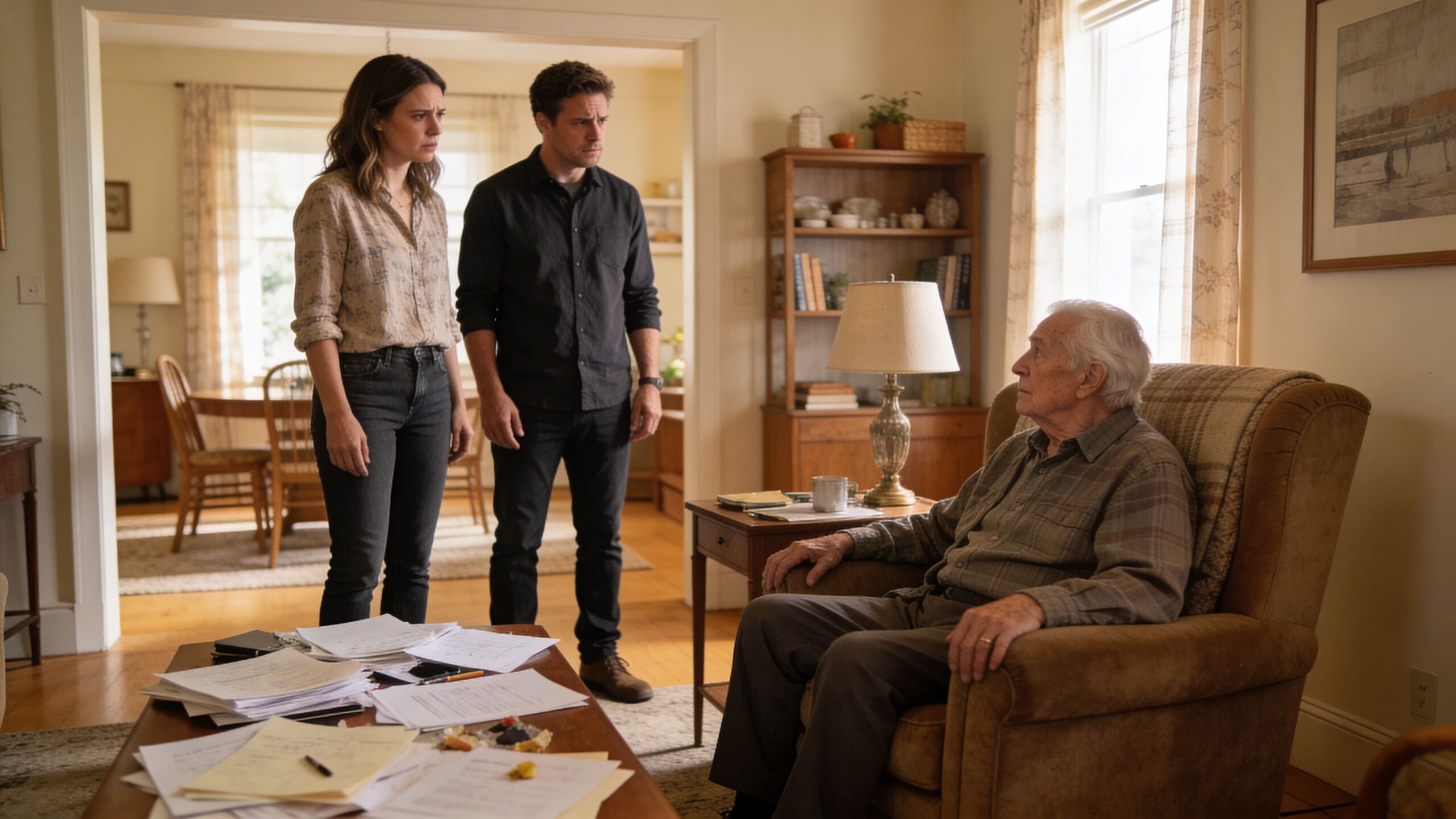
Maria noticed the signs slowly. Her father had always been careful with money, but now he was paying the same utility bill twice and accusing the bank of stealing from him. He left the stove on. He forgot appointments he had talked about the day before. Her family argued about what to do.
One sibling wanted to “just take over.” Another said their father was fine and only needed reminders. Maria felt stuck between urgency and guilt.
That is where many Texas families begin. Not with legal forms, but with a painful question. Is this normal aging, a temporary medical issue, or a level of decline that requires court protection?
Why the court needs more than family concern
A guardianship case cannot rest on a family member saying, “Mom is not herself.” Judges in places like Harris County Probate Court or Dallas County probate court need objective evidence.
That is why the evaluation matters. It is not meant to shame or label your loved one. It is a fact-finding process. The evaluator looks at how the person thinks, understands consequences, communicates choices, and manages everyday tasks.
Texas has seen just how important that protection is. As of August 31, 2016, Texas reported 54,693 active adult guardianships and an estimated $5 billion in assets under guardianship management. A 2016 review also found 43% of cases out of compliance with statutory requirements according to the Texas guardianship compliance report. That scale is one reason courts insist on solid evidence at the front end.
What families often misunderstand
Many people hear “psychological evaluation” and assume the issue is whether a person has dementia, a mental illness, or a disability diagnosis. That is only part of the picture.
The legal question is more practical:
- Can the person meet basic needs such as food, shelter, clothing, and health care?
- Can the person manage money safely
- Can the person understand choices and their consequences
- Can support short of guardianship solve the problem
The evaluation is not a pass-or-fail test for a person’s worth. It helps the court decide what level of support, if any, is needed.
Families usually feel better once they understand this point. A guardianship case is not supposed to strip away every right automatically. In many cases, the primary goal is a limited guardianship or an alternative that keeps as much independence as possible.
Why Texas Courts Mandate a Psychological Evaluation
A Texas guardianship can affect where a person lives, who handles medical decisions, and who controls money. Because the consequences are so serious, courts do not rely on guesswork.
Incapacity under Texas law
Under Texas Estates Code § 1101.101, incapacity is not solely a diagnosis. A person can have a medical condition and still be legally able to make decisions. The key question is function.
In plain English, the court asks whether the person has a substantial inability, because of a physical or mental condition, to do things like:
- provide for food, clothing, or shelter
- care for physical health
- manage financial affairs
That distinction matters. A person may have mobility limits and still make sound choices. Another person may look physically fine but be unable to understand bills, scams, medications, or medical decisions.
Why personal observations are not enough
Families often bring powerful stories to court. Those stories matter. But they are not enough by themselves.
A judge needs professional evidence that connects behavior to capacity. The evaluator helps answer questions such as:
- What condition may be affecting judgment?
- How does that condition affect daily decisions?
- Is the problem mild, moderate, or severe in specific areas?
- Would a narrower option work instead of guardianship?
The court also commonly relies on a physician’s Certificate of Medical Examination. If you want a closer look at that document, this guide on the physician certificate for guardianship in Texas explains how it fits into the process.
Why this protects your loved one
The evaluation requirement protects the proposed ward from two opposite risks.
One risk is under-protection. A vulnerable adult may be exposed to neglect, unsafe living conditions, or financial exploitation if nobody steps in.
The other risk is overreach. A capable adult should not lose decision-making rights just because relatives disagree with choices or find them frustrating.
That is why Texas Estates Code provisions in Title 3, Subtitle G focus on necessity, evidence, and the least restrictive outcome. Courts want to know not only whether the person struggles, but whether those struggles rise to the legal level that justifies court intervention.
A diagnosis may explain what is happening. The evaluation helps the court decide what legal response is justified.
A simple example
Suppose an older adult with early dementia can still choose meals, keep up personal hygiene, and explain medical preferences, but cannot reliably detect financial fraud or manage investments. In that situation, the court may consider a narrower arrangement rather than handing every decision to a guardian.
That is the core reason Texas mandates formal evaluation. The court is not deciding whether someone is “good” or “bad” at life. The court is deciding whether the law should transfer specific decision-making authority from one adult to another.
What to Expect During the Guardianship Evaluation
Most families feel less anxious once they know what the actual appointment looks like. The process is structured. It is not a surprise ambush.
Who may perform the evaluation
Depending on the case, the assessment may involve a licensed physician, psychologist, or psychiatrist. In some matters, especially where cognition, behavior, or complex mental health issues are central, a psychologist’s evaluation gives the court a closer look at decision-making ability.
The evaluator is not there to argue for one side. The evaluator’s role is to assess capacity.
What the evaluator usually reviews
A proper guardianship evaluation looks at more than one source of information. In Texas, evaluators may use clinical interviews, standardized cognitive tests such as the Montreal Cognitive Assessment, and functional capacity measures for tasks like financial management, as described in this overview of Texas guardianship psychological assessments.
That usually includes some combination of the following:
- Interview with the proposed ward about orientation, memory, understanding, and preferences
- Family input about recent incidents and changes over time
- Medical record review to understand diagnoses, medications, and history
- Functional review of daily tasks like paying bills, attending appointments, handling hygiene, and following treatment plans
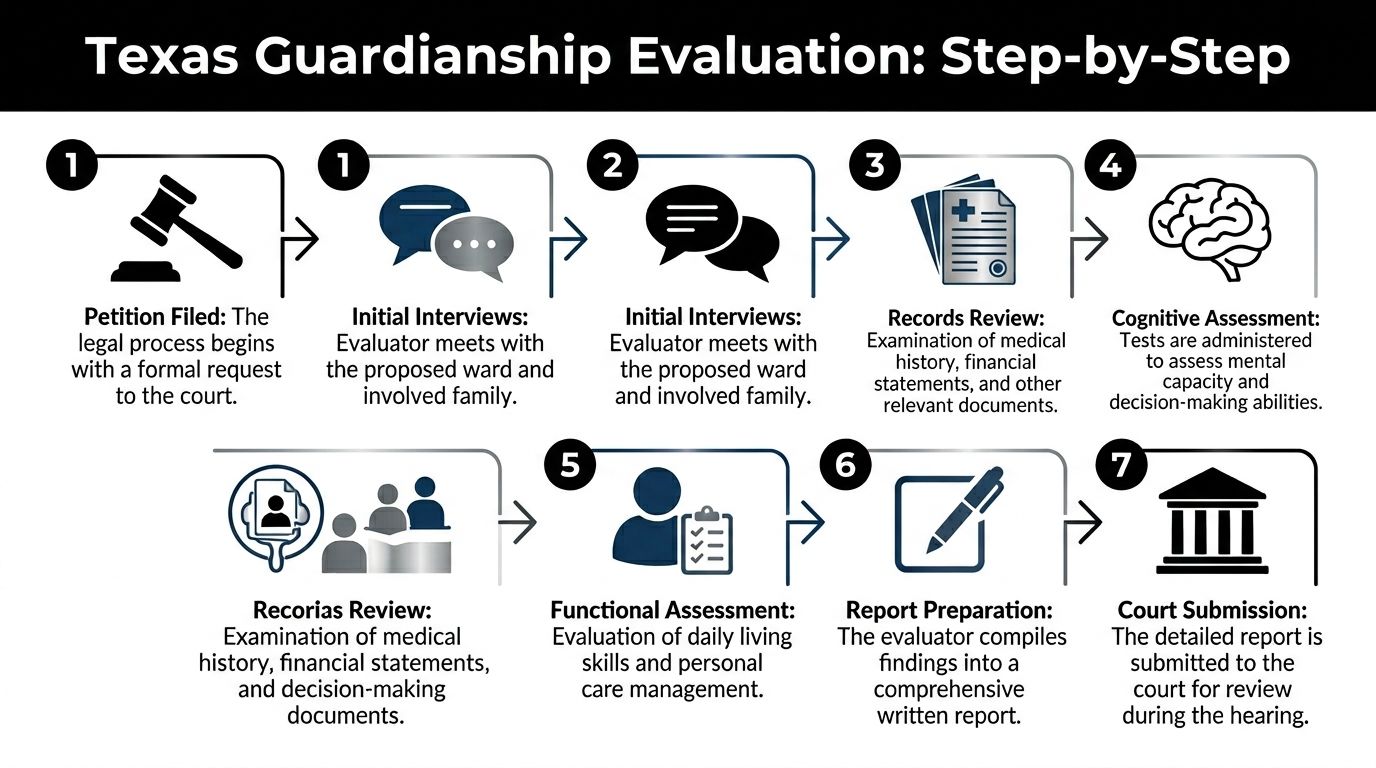
Later in the process, many families benefit from seeing the flow in action:
Common parts of the appointment
The evaluator may ask simple questions that can feel surprisingly basic. That is normal. The point is not to embarrass anyone. The point is to see how the person processes information.
You may hear questions like:
- What day is it?
- Why are you here today?
- If you needed help with your medicine, who would you call?
- What income do you receive each month?
- What would you do if a stranger asked for your bank account number?
Some evaluations also use named tools, such as the Montreal Cognitive Assessment or the Wechsler Adult Intelligence Scale, when appropriate. Emotional functioning may also be reviewed if mood, delusions, paranoia, or severe anxiety affect decision-making.
Functional ability matters as much as test scores
A person can do well on parts of a cognitive screen and still be unsafe in practical situations. That is why evaluators look at Activities of Daily Living, often called ADLs, and related practical skills.
Examples include:
| Area reviewed | What the evaluator may ask |
|---|---|
| Personal care | Can the person bathe, dress, and eat safely? |
| Medical care | Can the person understand treatment instructions and take medication correctly? |
| Money management | Can the person pay bills, detect scams, and handle banking? |
| Home safety | Can the person respond to emergencies and avoid common hazards? |
What families should and should not do
Families help the process by being organized and honest. They hurt the process when they coach answers or try to “win.”
Helpful conduct includes:
- Bring records: medication lists, doctor names, recent hospital summaries, and examples of missed bills or unsafe incidents.
- Be specific: “She left the faucet running overnight” is stronger than “She is getting forgetful.”
- Stay calm: if the proposed ward becomes upset, a steady tone works better than arguing.
Avoid this:
- Do not rehearse responses
- Do not exaggerate symptoms
- Do not interrupt constantly during the interview
The strongest guardianship case is usually the most accurate one, not the most dramatic one.
The Evaluator's Report and its Role in a Guardianship Hearing
After the interviews, testing, and record review, the evaluator prepares a written report. This document often becomes one of the most important pieces of evidence in the case.

What the report usually includes
A good report is more than a diagnosis and a conclusion. It often contains:
- background history
- observations from the interview
- tests administered
- functional findings
- the evaluator’s opinion about capacity
- recommendations about support needs
In a probate courtroom, the judge wants to see the logic behind the recommendation. The report should show how the evaluator moved from facts to conclusions.
Less restrictive alternatives are not optional
Texas courts must consider whether something short of guardianship can meet the person’s needs. According to Disability Rights Texas, the evaluator’s report should address whether options such as a power of attorney, representative payee for Social Security, or a supported decision-making agreement are enough, and explain why they are or are not adequate in the person’s situation. That requirement is discussed in this guide on CMEs and guardianship in Texas.
Many families get confused at this point. They think the report only answers one question: “Does this person need a guardian?” In reality, the report should also help answer a second question: “If support is needed, what is the least restrictive lawful way to provide it?”
How judges use the report
In courts such as Harris County Probate Court or Bexar County probate court, the judge may compare the report against testimony from family members, medical records, and the attorney ad litem’s position.
The report can support very different outcomes, including:
- No guardianship: if alternatives are enough
- Limited guardianship: if the person needs help only in certain areas
- Guardianship of the person only: when daily care decisions are the problem
- Guardianship of the estate only: when finances are the central concern
- Full guardianship: when the evidence shows broad incapacity
For a deeper look at the legal proof required, this discussion of proving incapacity in Texas courts is useful.
Why the report must be careful and balanced
A rushed or poorly reasoned report can create problems for everyone. It may overlook retained abilities, fail to explain why alternatives will not work, or leave the court with gaps.
That is one reason families and lawyers often pay close attention to the qualifications of the evaluator. In complex cases, it can help to understand how other systems approach independent expert review. For broader context, some families also look at how medico-legal experts frame capacity-related opinions in formal legal settings, especially where neutrality and documentation are central.
The report should tell a complete story. What the person can still do. Where the person struggles. Why the proposed legal remedy matches the actual evidence.
A practical courtroom example
Assume a son files for full guardianship over his mother. The evaluator finds that she can still express consistent wishes about housing and medical care, but cannot handle banking, taxes, or insurance. The report also finds that a simple power of attorney is no longer realistic because she no longer understands what she would be signing.
That report may steer the court toward a narrower remedy instead of full control. In other words, the evaluation does not just support guardianship. It can also limit guardianship.
Navigating Practical Challenges Costs Timelines and Finding an Evaluator
A daughter files a guardianship case because her father is forgetting medications, missing bills, and trusting scam callers. She assumes the hardest part will be the court hearing. Then real life steps in. The earliest evaluator is weeks out. Records are scattered across three doctors. Her brother disagrees about whether guardianship is even needed. Money is tight.
That kind of pressure is common. Families are often trying to protect a loved one while also handling jobs, caregiving, and family conflict. The evaluation can feel like trying to assemble a puzzle while the pieces are still arriving.
The timeline problem
Timing causes more trouble than many families expect. A guardianship case may feel urgent at home, but appointments, records, and court calendars do not always move at the same speed.
Delays often happen for practical reasons:
- specialists have limited openings
- medical records arrive slowly or in fragments
- the proposed ward resists the appointment
- relatives disagree about who should provide information
- a temporary emergency issue pushes everyone to act faster than the normal scheduling process allows
That is why families should start early. Call evaluators as soon as guardianship becomes a realistic possibility, not after every other document is gathered. If one office cannot see your loved one soon, ask for a cancellation list or referral to another provider who does this kind of work regularly.
The cost question families ask first
Most families ask the same thing. How much is this going to cost?
The honest answer is that fees vary a great deal. The price can change based on where you live, who performs the evaluation, how many records must be reviewed, whether family interviews are needed, and whether the case is contested. A simple evaluation and a disputed case are rarely priced the same way.
It helps to budget for the whole guardianship process, not just the appointment itself. This article on the costs associated with guardianship in Texas can help families plan. For broader background on why advanced cognitive evaluations can become expensive, some readers also find this overview of the cost of neuropsychological testing useful.
Estimated Costs in a Texas Guardianship Case
| Expense Item | Typical Cost Range |
|---|---|
| Psychological or capacity evaluation | Varies widely |
| Court filing fees | Varies by county |
| Attorney’s fees | Varies by case complexity |
| Service and notice costs | Varies |
| Ongoing compliance costs | Varies over time |
One more point matters here. A low fee is not always a bargain. If the evaluator gives the court a thin report, fails to explain functional limits, or ignores less restrictive alternatives, the family may end up paying more later in delay, follow-up work, or litigation.
How to find the right evaluator
Finding the right evaluator is partly a legal question and partly a practical one. You need someone who understands capacity issues, but you also need someone who can complete the work on a timeline the court can use.
Ask direct questions before booking:
- Do you perform guardianship or capacity evaluations for Texas probate cases?
- What records do you want in advance?
- How long does it usually take to issue the written report?
- Do you assess what the person can still do, not just what they cannot do?
- Will your report address less restrictive alternatives to guardianship?
That last question gets overlooked far too often. Texas courts do not treat guardianship as the automatic answer. The court must consider whether a less restrictive option could protect the person while preserving more independence. An evaluator who skips that issue may leave the judge with an incomplete picture.
Local practice matters too. In large metro areas, you may have more provider options but longer waitlists. In smaller counties, the pool may be smaller, which can mean more driving, fewer appointment times, or a need to work with someone outside the immediate area. Some families hire a private evaluator. Others use a professional already familiar with the local probate court.
A good evaluator does more than test memory or mood. The evaluator should help the court answer a real-world question: what support does this person need, and is guardianship necessary, or would a narrower solution work? That is the difference between a report that adds paperwork and one that helps the judge protect your loved one.
How to Prepare for the Guardianship Evaluation
Preparation helps, but this is not about coaching a loved one to “pass” or “fail.” It is about reducing stress and giving the evaluator accurate information.
How to talk to your loved one
The first conversation matters. If you say, “We are getting tested to prove you cannot manage your life,” many people will become defensive.
A calmer approach often works better:
- Keep it simple: describe it as an appointment to help the court or doctor understand what support may be needed.
- Use respectful language: avoid labels like “crazy,” “incompetent,” or “gone.”
- Choose the right time: do not raise it during an argument or in the middle of a crisis.
For example, you might say, “We want to make sure you get the right kind of help and keep as much independence as possible.”
What to gather beforehand
Families are often surprised by how much useful information they already have. Start pulling it together early.
Bring or organize:
- Medication list: names, dosages, and who prescribed them
- Medical contacts: primary care doctor, specialists, therapist, home health provider
- Recent records: discharge papers, clinic notes, diagnoses, imaging summaries if available
- Financial examples: unpaid bills, duplicate payments, unusual withdrawals, scam concerns
- Behavior examples: getting lost, unsafe cooking, confusion with appointments, inability to follow treatment directions
The best examples are specific
Telling the evaluator, “My brother is making bad choices,” is too vague. The evaluator needs concrete examples tied to functioning.
Better examples sound like this:
- “He gave his debit card number to a caller who claimed to be from Medicare.”
- “She missed multiple insulin doses because she believed she had already taken them.”
- “He cannot explain what income he receives or how rent gets paid.”
These examples help the evaluator connect concerns to legal capacity.
Day-of-evaluation tips
Small practical steps can make the appointment smoother.
- Pick a good time of day: if the person is clearer in the morning, schedule then if possible.
- Bring hearing aids or glasses: sensory problems can make cognition look worse than it is.
- Limit extra stress: allow time for travel, parking, and check-in.
- Stay factual: if asked for information, answer directly and avoid speeches.
The evaluator needs the clearest picture possible. Good preparation helps the truth come through without pressure or confusion.
After the appointment
Write down your own notes while the details are fresh. Record what happened, who attended, and any issues that came up. If the person became tired, confused, or agitated, that context may matter later.
Also be ready for mixed emotions. Relief, grief, anger, and uncertainty often show up at the same time. That is normal. Guardianship work is legal, but it is also very personal.
Frequently Asked Questions About Guardianship Evaluations
Does every Texas guardianship case need a psychological evaluation
Texas courts need reliable evidence about the person’s capacity before they can remove decision-making rights. In some cases, that evidence comes from a physician’s certificate or other medical records. In other cases, a psychological evaluation gives the court a clearer picture of memory, judgment, insight, and the ability to make specific decisions.
The key point is this. The court is not looking for a label. The court is looking for proof tied to function.
What if my loved one refuses to go
That happens often.
A refusal does not always mean the case stops. Sometimes the problem is fear, confusion, pride, cost, or the feeling that strangers are taking over. A calmer explanation, a different appointment time, transportation help, or having a trusted person attend can solve the problem.
If refusal continues, the next step depends on the facts of the case and how urgent the risk is. A lawyer can help you choose the right procedural step without turning a hard family situation into a worse one.
Can a person have dementia and still avoid guardianship
Yes. Dementia is a diagnosis, not an automatic court result.
Some people with early or moderate decline can still make many choices if they have support in place. A good way to look at it is this. The court asks whether the person can still handle the decisions that matter, or whether a less restrictive option can cover the gap. If support works, guardianship may not be appropriate.
What is the difference between a full guardianship and a limited guardianship
A full guardianship gives the guardian broad authority over the person, the estate, or both, depending on the court’s order. A limited guardianship removes only the rights the court finds necessary to transfer.
That distinction matters to families. Guardianship is not supposed to function like a light switch that turns off every right at once. It should fit the person’s actual needs as closely as possible.
What are less restrictive alternatives in real life
This is the part many families do not hear explained clearly enough. Texas courts expect everyone involved to seriously consider options short of guardianship.
Those options may include:
- Power of attorney
- Representative payee arrangements
- Supported decision-making agreements
- Trusts or other estate planning tools
- Direct help from reliable family members or caregivers
These tools can work very well. They can also fail in very specific ways. A power of attorney does not help if the person can no longer understand what they are signing. Informal family help does not solve the problem if relatives are fighting, money is disappearing, or the person refuses needed care. That is why the evaluation often matters so much. It helps the court decide whether support is enough or whether legal authority must shift.
Can there be an emergency guardianship before the full case is finished
Yes, in some cases. Texas law allows temporary guardianship when there is an immediate risk to the person or the person’s property.
Even in an emergency, the court still expects focused evidence and the narrowest order that addresses the danger. Emergency relief is not a shortcut to broad control. It is a temporary response to a pressing problem.
What happens if family members disagree about the need for guardianship
Family disagreement is common, especially when one relative sees daily problems and another sees only good days.
A neutral evaluation can help cut through that conflict. It does not erase family tension, but it gives the court an outside opinion grounded in clinical findings rather than fear, guilt, or old family dynamics.
Does the proposed ward have rights in the case
Yes. The proposed ward has significant legal rights, including notice of the case, representation, and the chance to be heard by the court.
In many cases, the court appoints an attorney ad litem. That lawyer’s job is to represent the proposed ward’s interests, not the family’s preferred outcome.
Can guardianship end later
Yes. Guardianship orders can be modified or terminated if the person’s condition changes or if the order no longer matches the person’s actual needs.
That matters more than families often realize. Some people improve. Others decline in one area but remain capable in another. The order should reflect the current reality, not assumptions made months or years earlier.
What should families do after the hearing
Start with the signed order. Read it carefully.
If guardianship is granted, focus on the exact powers the court gave, the deadlines for qualification, required reporting, recordkeeping, and the rights the ward still keeps. If guardianship is denied, do not assume the case accomplished nothing. The hearing may still clarify what support plan is needed next, such as bill-pay assistance, care coordination, benefit management, or updated legal documents.
How much does the evaluation usually cost, and who pays for it
This is one of the hardest practical questions, and many articles skip it.
Costs vary depending on the evaluator, the county, the complexity of the case, and whether records review or testimony will be needed later. Families should ask about the full scope up front, including the exam, report, record review, missed-appointment fees, and possible court testimony. In some cases, the proposed guardian pays initially and later asks the court about reimbursement. In other cases, payment may come from the proposed ward’s assets if the law and the court permit it.
Ask early. Budget early. A delayed evaluation often means a delayed hearing.
How long does it take to get an appointment
That depends on where the case is filed and how many qualified evaluators are available nearby. In busy counties, scheduling can be one of the biggest bottlenecks.
Call sooner than you think you need to. Ask whether the evaluator handles guardianship matters regularly, what records they want in advance, how long the written report usually takes, and whether they are willing to testify if the case becomes contested. Those details affect both timing and cost.
Does guardianship connect with probate and estate planning
Often, yes. A family dealing with incapacity may also need to address wills, trusts, beneficiary designations, unpaid bills, title issues, or other court-supervised property matters.
These issues tend to overlap in real life. A guardianship case is often one part of a larger family and financial problem, not a stand-alone event.
If your family is facing difficult questions about incapacity, court deadlines, or whether guardianship is even the right option, the Law Office of Bryan Fagan, PLLC can help you sort through the legal and practical issues with clarity and compassion. Schedule a free consultation to discuss your loved one’s situation, your options under Texas law, and the next steps that best protect both safety and dignity.