Skip to content
You may be experiencing this. A parent starts missing medications, paying the same bill twice, or accusing relatives of taking items that were misplaced. At first, it feels like ordinary aging. Then the problems stack up, and caregiving turns into hard legal questions.
That shift is painful. Most families don't want to ask whether a loved one can still make safe decisions. They want to help without taking away dignity. In many Texas families, that tension is what leads them to search for cognitive impairment guardianship texas and hope for a clear answer.
Guardianship can protect someone who can no longer protect themselves. It can also remove important rights, which is why Texas courts treat it seriously. Judges want proof, proper notice, and a plan that uses the least restrictive option possible.

Some families are still in the home-care stage and need support before they step into probate court. If your loved one has dementia or memory loss, practical resources like compassionate Alzheimer's and dementia care at home can help you understand what daily support may look like while you evaluate legal options.
You may be realizing that love, by itself, doesn't give you legal authority. If a bank won't speak to you, a doctor won't accept your direction, or a facility says only the patient can consent, this helpful discussion on the legal side of caring for an aging parent in Texas may clarify why families reach a breaking point: https://texasguardianshiplawyer.net/when-love-isnt-enough-the-legal-side-of-caring-for-an-aging-parent-in-texas/
Introduction When Caregiving Becomes a Legal Matter
The moment families recognize the problem
Cognitive decline rarely announces itself in one dramatic event. More often, it shows up in patterns. A loved one wanders, forgets how to use the stove, signs papers they don't understand, or becomes vulnerable to scams.
Those moments create fear, guilt, and disagreement. One sibling may say, "Mom is fine." Another may say, "She isn't safe alone anymore." Both may be acting out of love.
Guardianship isn't about winning control. It's about creating lawful protection when a person can no longer manage essential decisions safely.
Texas law gives families a path forward, but it's not casual and it shouldn't be. A guardianship case asks a court to step into a person's life and assign another adult legal authority over some decisions.
Why guardianship is usually a last resort
A dementia diagnosis, Alzheimer's disease, traumatic brain injury, or another form of mental decline doesn't automatically mean guardianship is needed. The legal question is narrower. Can the person still make or communicate responsible decisions in the areas that matter?
That question matters because some people need help with finances but can still choose where they live. Others may understand simple health choices but can't recognize exploitation. Texas courts look for that kind of detail.
Families often get overwhelmed because they think the choice is all or nothing. It usually isn't. Sometimes less restrictive planning works. Sometimes a limited guardianship works. Sometimes a full guardianship is necessary.
A realistic view of the road ahead
This process takes paperwork, medical evidence, court review, and ongoing follow-through. It takes emotional stamina. Even a smooth case can be draining because you're asking a judge to evaluate someone you love.
If you're worried, that reaction makes sense. The best first step is learning how Texas defines incapacity, what evidence the court wants, and what happens after a guardian is appointed. Once you understand the roadmap, the situation usually feels less chaotic and more manageable.
Understanding Incapacity and Guardianship in Texas Law
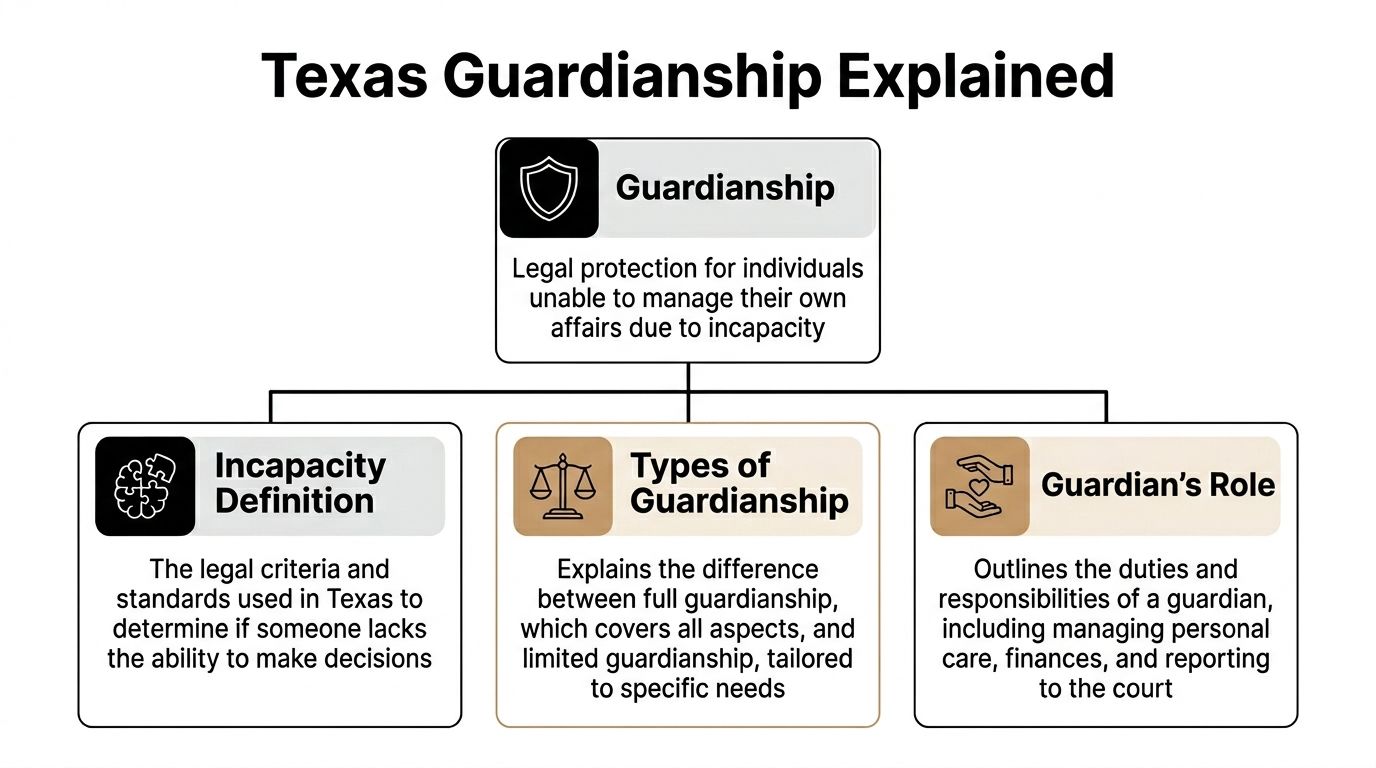
The legal word incapacity often confuses families. It doesn't mean forgetful, stubborn, eccentric, or medically ill. In a Texas guardianship case, incapacity is a legal finding based on evidence.
What incapacity means in practice
Under Texas guardianship law, the court focuses on decision-making ability. Can the person care for basic needs, manage property, understand consequences, and communicate choices in a meaningful way? The answer may differ depending on the subject.
A person with mild memory issues might still be able to decide where to live and what doctor to see. The same person may no longer be able to manage accounts, understand contracts, or detect fraud.
That's why cognitive conditions need careful, individualized review. Families dealing with cognitive impairment often notice that symptoms affect judgment unevenly. The law tries to respond to that reality rather than using one label for everyone.
The court's proof standard is high
Texas doesn't appoint guardians because a family asks. In Texas, a court evaluation for guardianship requires the petitioner to prove incapacity by clear and convincing evidence as the least restrictive option under Texas Estates Code §1101.101. The success rate for uncontested filings with strong medical evidence often exceeds 80%, but this can drop to 50% to 60% in family disputes where an attorney ad litem or court investigator recommends less restrictive alternatives, as noted in this discussion of mental capacity evaluations in Texas guardianship cases: https://fordbergner.com/blog/2025/09/how-is-mental-capacity-evaluated-in-a-texas-guardianship-case/
That phrase, clear and convincing evidence, matters. It's a higher standard than a simple hunch or family concern. The court wants reliable proof because guardianship can limit civil rights.
Guardianship of the person and estate
Texas recognizes different types of guardianship under Title 3, Subtitle G of the Texas Estates Code.
| Type | What it covers | Common example |
|---|---|---|
| Guardianship of the Person | Personal decisions such as residence, medical care, and daily support | A parent with dementia can't safely choose care or living arrangements |
| Guardianship of the Estate | Money, property, bills, income, and assets | A loved one is being financially exploited or can't manage accounts |
| Both | Personal and financial authority | A person needs broad support in both health and financial matters |
A court may grant one, the other, or both. Families often assume they need everything. Judges often ask whether a narrower order would protect the person while preserving more independence.
Full and limited guardianship
A full guardianship gives broader authority. A limited guardianship gives only the powers the ward needs help with.
Consider a simple example. Elena, an older adult in Harris County, knows her family members, wants to stay near church, and can talk clearly about meals and visitors. But she can't understand bank statements, forgets to pay caregivers, and signs suspicious mail offers. A court might see that as a case for limited financial authority rather than total control over every personal decision.
Practical rule: In Texas guardianship cases, the court should choose the least restrictive option that still protects the person.
That principle shows up again and again in hearings. It's why the medical paperwork has to be specific. If the physician only says "memory loss" without explaining how that affects daily function, the court may not have enough to tailor the order.
For families gathering medical proof, this guide on the physician certificate for guardianship in Texas can help explain why the certificate is so central to the case: https://texasguardianshiplawyer.net/physician-certificate-for-guardianship-texas/
The Roadmap to Establishing Guardianship in Texas
When families ask how to begin, the answer is usually less dramatic than they expect. The process starts with documents, not a courtroom speech. Good preparation at the front end often prevents painful delays later.
Start with the medical foundation
The cornerstone of most adult guardianship cases is the Physician's Certificate of Medical Examination, often called the PCME. In a cognitive impairment case, the certificate should describe diagnosis, functional limits, and why the person can't safely make certain decisions.
Texas guardianship practice requires filing an application under Texas Estates Code §1101.001 and obtaining a PCME within 120 days of the hearing. Common pitfalls that delay or derail cases include incomplete PCMEs, which can cause 30 to 60 day delays or dismissal in up to 30% of cases, and failure to properly notify all interested parties, which can void the entire proceeding, according to this step-by-step review of Texas guardianship proceedings: https://www.bryanfagan.com/2025/09/understanding-step-by-step-guardianship-proceedings-texas-for-families/
That means timing matters. So does detail. A short certificate with vague language can create major problems.
File in the right probate court
The application is usually filed in the probate court serving the proposed ward's county. In large counties, that may mean a dedicated probate court such as Harris County Probate Court, the Dallas County Probate Courts, or probate courts serving counties like Travis, Bexar, or Tarrant.
The application should identify the proposed ward, explain why guardianship is needed, state whether you're seeking guardianship of the person, the estate, or both, and include information about relatives and assets if relevant.
Many families discover that "we've been helping for years" isn't the same as "we have legal authority." The petition has to meet statutory requirements and give the court enough facts to act.
If you're trying to understand what the petition itself involves, this page on filing a guardianship petition in Texas gives a useful overview: https://texasguardianshiplawyer.net/filing-a-guardianship-petition-in-texas/
Expect court-appointed professionals
After filing, the court usually appoints an attorney ad litem for the proposed ward. That lawyer doesn't represent the family. The ad litem represents the proposed ward's interests.
The court may appoint an investigator. That person may review records, interview family members, speak with the proposed ward, and look at living conditions.
Families sometimes take this personally. They shouldn't. The court is checking whether guardianship is necessary and whether the requested powers are too broad.
Notice is not optional
Texas requires notice to interested parties. The proposed ward must be served.
This is one of the most stressful parts for families because it can feel harsh or embarrassing. But due process matters. A guardianship order affects rights, so the law requires notice even when everyone already "knows what's going on."
Here are common notice problems that cause trouble:
- Missing relatives: A sibling, adult child, or other required relative isn't properly identified or notified.
- Bad service records: Service isn't documented correctly for the court file.
- Assumptions about agreement: Family members say they support the case, but no formal notice is completed.
- Rushed filing: The petition is filed before the family has gathered names, addresses, and relationship details.
Prepare for what the court wants to know
A judge in a cognitive impairment guardianship texas case usually wants clear answers to a few practical questions.
What can the person still do?
Courts don't want deficits. They want a functional picture.What specific harm is happening or likely to happen?
Missed medication, unsafe driving, financial exploitation, and inability to manage hygiene are all different issues.Why won't a less restrictive option work?
If a valid power of attorney already exists and is functioning, guardianship may not be necessary.Why is this applicant appropriate?
The court will look at trustworthiness, family dynamics, and possible conflicts.
A simple example
Suppose your father in Dallas has moderate dementia. He can still recognize family and enjoy conversation, but he can't track income, is being targeted by phone scams, and no longer understands medical instructions after discharge from the hospital.
In that situation, a family might seek guardianship of the estate, guardianship of the person, or both, depending on the evidence. The application would need to describe those real-world failures, not use medical labels.
Bring specifics, not conclusions. "He forgot to turn off the stove twice this month" is more useful than "He isn't safe."
What families can do before filing
A strong case usually starts with organized information.
- Collect records early: Gather physician records, medication lists, discharge paperwork, and examples of impaired judgment.
- Document functional problems: Keep a dated log of unsafe incidents, missed bills, wandering, or confusion with daily tasks.
- Review existing legal documents: Check for powers of attorney, trusts, advance directives, or supported decision-making arrangements.
- Choose the narrowest request: Ask only for the powers the evidence supports.
- Prepare family communication: Even in tense families, clear notice and honest explanation can reduce conflict.
The legal process is formal. The facts behind it are human. Families usually do best when they treat the case like both a court matter and a caregiving transition.
Navigating the Court Hearing and a Guardian's Duties
The hearing is where paperwork turns into testimony. For many families, it's the most intimidating day of the case. In reality, most probate hearings are structured, focused, and centered on whether the requested guardianship is necessary and properly limited.

What the judge is listening for
The court will usually consider the medical certificate, the attorney ad litem's input, any investigator's report, and witness testimony. The judge wants to know whether the person is incapacitated in the legal sense, whether guardianship is the least restrictive option, and whether the applicant is suitable.
The room may include family members with strong opinions. That can make the hearing feel tense. Even so, the court's focus stays on evidence and the ward's best interests.
A short visual explanation can help families understand how guardianships and alternatives are discussed in practice:
What happens after appointment
Winning the hearing isn't the end of the job. It's the start of a fiduciary role.
Depending on the type of guardianship, the court may require the guardian to take an oath, post bond, complete training, and obtain Letters of Guardianship before acting. If you skip these post-hearing steps, you may have a court order but no usable authority.
That surprises families. They think the judge's signature alone finishes the matter. It doesn't.
The duties continue year after year
Guardianship comes with reporting duties. Those duties are one reason courts supervise guardians closely.
As of August 31, 2016, Texas had 54,693 active guardianships, with an estimated $5 billion in assets managed by guardians. The number had increased by 37% over the preceding five years. In the counties where initial compliance reviews were completed, 43% of guardianship cases were out of compliance with at least one required reporting element, including 44% missing annual accountings, according to the Texas guardianship compliance report: https://www.txcourts.gov/media/1436796/guardianshipcompliancereport__final.pdf
That data shows why probate judges care much about follow-through. The problem isn't only getting appointed. It's staying compliant after the appointment.
What a guardian does
A guardian's exact duties depend on the order, but they often include:
- Protecting personal welfare: Making sure the ward has safe housing, medical care, and appropriate services.
- Managing finances carefully: Paying bills, safeguarding income, tracking expenditures, and avoiding self-dealing.
- Reporting to the court: Filing required annual reports and accountings on time.
- Preserving dignity: Involving the ward in decisions as much as the person's abilities allow.
Court supervision doesn't mean the guardian is distrusted. It means the guardian is accountable.
The commitment many families underestimate
Guardianship isn't a one-time rescue. It's an ongoing legal relationship. If a guardian stops keeping records, misses deadlines, or treats the ward's funds casually, court intervention can follow.
For a worried adult child, the key question isn't only, "Can I get guardianship?" It's, "Can I handle the long-term responsibilities that come with it?" That's the question the court is asking too.
When Guardianship Is Disputed or Needs to Change
Not every case is agreed. Some families disagree about whether guardianship is needed. Others agree that help is needed but fight over who should serve. In still other cases, the original order no longer fits the person's condition.
Challenging the need for guardianship
A common dispute centers on the medical evaluation. Contesting a guardianship often hinges on the quality of the initial medical evaluation. Texas law requires a Certificate of Medical Examination to be no more than four months old, but provides little guidance on quality standards. If a physician's evaluation of incapacity is questionable or fails to properly consider less restrictive alternatives, it can become a key basis for challenging or seeking to modify the guardianship, as discussed in this overview of getting guardianship of a parent with dementia: https://sundaraliving.com/how-to-get-guardianship-of-a-parent-with-dementia/
That means families should read the certificate closely. Does it explain actual functional limits? Does it discuss supports and services? Does it connect symptoms to legal incapacity, or does it recite a diagnosis?
Common dispute patterns
Guardianship disputes often fall into a few categories:
- Capacity disagreement: One side believes the person still has enough ability to make decisions.
- Scope disagreement: The proposed order asks for full guardianship when a narrower order may work.
- Guardian suitability: Relatives question whether the proposed guardian has conflicts, poor judgment, or strained relationships with the ward.
- Changed condition: The ward's abilities improve, decline, or shift in ways the old order doesn't reflect.
Modifying or terminating a guardianship
Guardianship isn't always permanent in its original form. If the ward regains ability in some area, if a less restrictive option becomes workable, or if the current guardian isn't fulfilling duties, the court can be asked to review the arrangement.
A modification might reduce powers, change the guardian, or adjust the order to match current needs. Termination may be appropriate if guardianship is no longer necessary.
For example, a person recovering from a serious medical event may initially need broad support. Months later, the person may be able to manage personal decisions again while still needing help with finances. The court should hear that updated evidence.
A guardianship order should fit the person's present condition, not a stale snapshot from the worst week of their life.
Temporary or emergency guardianship
Some cases can't wait for the usual pace. If there's an immediate risk of harm, exploitation, or medical danger, temporary relief may be necessary.
Emergency or temporary guardianship is designed for crisis situations. Families often seek it when a vulnerable adult is being financially drained, is about to be discharged with no safe plan, or is refusing urgent care due to serious cognitive confusion.
Even in emergencies, courts still expect proof. Urgency doesn't eliminate the need for evidence. It shortens the timeline and raises the stakes.
Alternatives to Guardianship and Their Real-World Costs
A daughter may call my office and say, "I want to protect Mom, but I do not want to take away more rights than necessary." That is the right question to ask.
Texas courts start from that same concern. Guardianship is meant to be a last resort. If a person with cognitive impairment can stay safe through a less restrictive option, the court will usually expect the family to consider that path first. The goal is protection with the smallest loss of independence.
That matters because guardianship is not a single court filing. It is an ongoing legal job.
Many families focus on how to get appointed and overlook what comes after. A guardianship can bring attorney's fees, medical paperwork, bond costs, annual accountings or reports, recordkeeping, court review, and added expense if conflict breaks out later. The emotional cost is often just as real. One sibling may feel shut out. The proposed ward may feel cornered. The person who becomes guardian may discover that love and good intentions do not make the paperwork lighter.
By contrast, a well-chosen alternative can work like a narrower tool for a narrower problem. If the issue is paying bills, a financial document may be enough. If the issue is understanding choices, supported decision-making may help the person stay in charge while getting guidance.
Comparing the main options
| Feature | Guardianship | Durable Power of Attorney (POA) | Supported Decision-Making |
|---|---|---|---|
| Court involvement | Required | Usually not required to create | Usually not court-based |
| Loss of rights | Can limit legal rights by court order | Person keeps rights unless other legal action occurs | Person keeps rights |
| Best for | When the person can't safely make key decisions and lesser options won't work | When the person still has capacity to sign and trust an agent | When the person can decide with help understanding options |
| Speed | Slower because it involves filing, notice, and hearing | Often faster if signed properly | Often faster if the person can participate |
| Ongoing duties | Ongoing court reporting and compliance | Agent duties, but no routine probate supervision like guardianship | Ongoing practical support rather than court reporting |
| Conflict risk | Can increase family conflict because authority is assigned by court | Can still lead to disputes about misuse or validity | Can reduce restriction but may not work in severe impairment |
A practical way to measure cost
Families often count the filing fee and stop there. A better way is to picture the choice as a long road, not a front door.
Guardianship may be the right road, but it asks for stamina. The guardian may need to track spending, respond to court deadlines, maintain organized records, and return to court if circumstances change. If the family is already stretched by caregiving, medical appointments, and worry about memory loss, that legal workload can feel like taking on a part-time administrative role during a family crisis.
Alternatives have costs too. A power of attorney is only helpful if the person still understands what they are signing and if banks, doctors, or other institutions will honor it. Supported decision-making depends on cooperation. It can fail if the person is too impaired to weigh choices or if a bad actor is already influencing them. Disability Rights Texas discusses several of these less restrictive options in its guide to https://disabilityrightstx.org/en/handout/cmes-and-guardianship-in-texas/.
When an alternative may be enough
A less restrictive option may work well when:
- The person still understands the document. They can knowingly sign a valid power of attorney, directive, or related planning paper.
- The need is limited. Help is needed with one area, such as banking or medical communication, rather than every major life decision.
- The family can cooperate. The chosen helper is trusted, and there is not already serious conflict about money or care.
- Outside institutions will accept the arrangement. A document that looks good in a folder does not solve much if the bank or hospital refuses to rely on it.
When guardianship may still be necessary
Some families wait too long because they hope a simpler tool will be enough. Hope is understandable, but it does not fix incapacity.
If the person no longer understands what they are signing, is being exploited, cannot manage basic safety, or cannot make informed medical or financial decisions even with support, guardianship may be the appropriate option. In those cases, the harder path may still be the safer one.
The central question is not which option feels easiest today. It is which option protects your loved one in real life, over time, at a cost your family can carry.
How the Law Office of Bryan Fagan Can Guide Your Family
Cognitive impairment cases are hard because they mix law, medicine, family history, and grief. A worried son may be trying to stop financial abuse. A spouse may be exhausted from caregiving. A sibling may live out of state and feel helpless. All of those realities can exist in the same case.
The law adds strict requirements. Courts want medical proof, proper notice, narrow requests, and continued compliance after appointment. If the matter is disputed, the details matter even more.
Careful legal guidance can help families avoid common mistakes, prepare stronger evidence, and choose the least restrictive path that still protects the vulnerable person. That may mean filing for guardianship. It may mean contesting one. It may mean modifying an old order or using planning tools to avoid court altogether.
If your family is facing questions about an aging parent, an adult with dementia, or a loved one whose judgment is slipping, it helps to talk through the facts before taking action. You may want to review related services involving Guardianship, Probate, and Estate Planning.
The right legal strategy should protect safety without taking more rights than necessary. In Texas probate courts, that balance matters.
If you're dealing with a possible guardianship, a family dispute, or concerns about a loved one's cognitive decline, a free consultation with Law Office of Bryan Fagan, PLLC can help you understand your options and the next step for your family.