Skip to content
You may be reading this because something feels off. A parent under guardianship suddenly has unpaid bills. A bank balance looks wrong. A guardian won’t answer simple questions. Or you’ve learned that property was sold, money was moved, or records are missing.
If that’s where you are, your concern matters. In Texas, guardianship is supposed to protect a vulnerable person, not expose them to financial harm. A guardian has fiduciary duties under the Texas Estates Code, especially within Title 3, Subtitle G, and those duties include acting in the ward’s best interest, preserving property, and making required reports to the court.
Families often hesitate to speak up because they don’t want to make a false accusation. That’s understandable. But reporting a concern is not the same as proving a crime. It’s asking the right people to review what happened and protect your loved one if something is wrong.
The problem is serious in Texas. In 2021, Texas victims of elder fraud lost over $159 million, about $5 billion in assets were under guardian control statewide, and historical reviews found that over 40% of guardianship files were not in compliance with state law, according to Texas Appleseed’s overview of financial abuse affecting seniors. Those numbers help explain why reporting financial abuse by guardian texas is not just a private family issue. Courts and state agencies treat it as a protection issue for vulnerable adults.
Protecting a Loved One from a Guardian's Financial Abuse
Financial abuse in a guardianship case can look obvious, such as missing money, or subtle, such as repeated excuses for why no records are available. In either situation, the law gives you paths to act.
Why families often miss the early signs
A court-appointed guardian usually has legal authority over some part of the ward’s life. That can make family members assume every decision is automatically proper. It isn’t.
A guardian of the estate must manage money and property carefully. A guardian of the person handles care decisions. In some cases, one person serves in both roles. The court’s order matters because it defines what authority the guardian has under the Texas Estates Code. If a guardian goes beyond that authority, that can become a major issue.
Confusion also happens because guardianship cases are court-supervised. Families think, “If the court appointed this person, the court must already know everything.” In reality, courts rely heavily on filings, annual accountings, annual reports, inventories, and the information brought to their attention.
Practical rule: If you see unexplained spending, missing records, unpaid needs, or secrecy around the ward’s finances, don’t wait for things to “make sense on their own.”
Protection, not punishment first
The first question usually isn’t, “How do I prove theft?” It’s, “How do I protect my loved one now?”
That shift matters. If rent, medication, insurance, or facility payments are being neglected, the problem may need immediate court attention even before a full investigation is complete. Texas probate courts, including courts such as Harris County Probate Court, are used to handling urgent guardianship concerns.
Here’s a simple way to think about the process:
| Concern | Immediate focus |
|---|---|
| Missing money | Preserve records and alert the right authority |
| Unpaid care needs | Protect the ward’s health and housing |
| Secretive guardian behavior | Get court oversight and document requests |
| Failed annual filings | Ask the probate court to review compliance |
Families also ask whether guardianship itself was the right arrangement to begin with. Sometimes the answer is no. Texas law prefers less restrictive alternatives when they can protect the person adequately. In other situations, a current guardianship may need to be modified, limited, or terminated if the structure is enabling abuse instead of preventing it.
Recognizing the Warning Signs of Financial Exploitation
Financial exploitation doesn’t always begin with a dramatic event. More often, it starts with small changes that seem easy to explain away. Looking at the pattern is what helps.

Direct financial theft
Start with the most obvious category. Money disappears. Checks are written for unclear reasons. Credit cards are used for purchases that don’t benefit the ward.
A simple example: Maria learns her father’s account has repeated withdrawals, but his nursing home says his personal needs account is nearly empty. The guardian says the money went to “general expenses,” yet can’t show receipts or bank statements. That doesn’t prove criminal conduct by itself, but it’s a strong warning sign.
Look for signs like these:
- Cash withdrawals that don’t match the ward’s needs
- Transfers to the guardian or people close to the guardian
- Purchases unrelated to care, housing, or support
- Property sales with little explanation
- Missing valuables or personal items
Coercion and undue influence
Some abuse is less visible. A guardian may pressure the ward to change financial arrangements, add the guardian to accounts, or approve transactions the ward doesn’t understand.
Take James’s situation. His aunt still has moments of clarity, but the guardian keeps telling relatives she “wanted everything handled this way.” Then James learns the guardian is now tied to multiple accounts and has discouraged visits. Isolation can make coercion easier.
Common signs include:
- The ward seems fearful when money is discussed
- The guardian blocks family communication
- Financial changes happened quickly after the guardianship began
- The guardian insists on handling every conversation alone
- The ward gives inconsistent explanations that sound rehearsed
When a guardian controls both information and access, families often see the effects before they see the documents.
Neglect of fiduciary duty
Not every harmful case looks like theft. Sometimes the guardian fails to do the job the law requires. That still puts the ward at risk.
Consider Elaine. Her brother is guardian of their mother’s estate. He hasn’t paid insurance premiums, the property taxes are behind, and no one can say whether annual paperwork was filed. He says he’s “busy” and will fix it later. In probate court, that kind of neglect can be serious because a guardian’s duty includes careful management and regular reporting.
Neglect may look like:
- Bills going unpaid despite available funds
- Lapsed insurance
- No inventory of estate assets
- No annual accounting
- No annual report on the ward’s condition when required
- No response to court notices
Texas guardianship cases often involve both legal and practical confusion. A family member may think, “He didn’t steal anything, he just handled it badly.” But poor handling can still violate fiduciary duties and harm the ward in real ways.
That’s why it helps to think in three questions:
- Did the action benefit the ward?
- Was the action within the guardian’s authority?
- Can the guardian document it clearly?
If the answer keeps coming back no, your concern is reasonable.
Your Reporting Options Where to Turn for Help in Texas
Texas families usually have three main reporting paths. They are different, and many cases involve more than one at the same time.
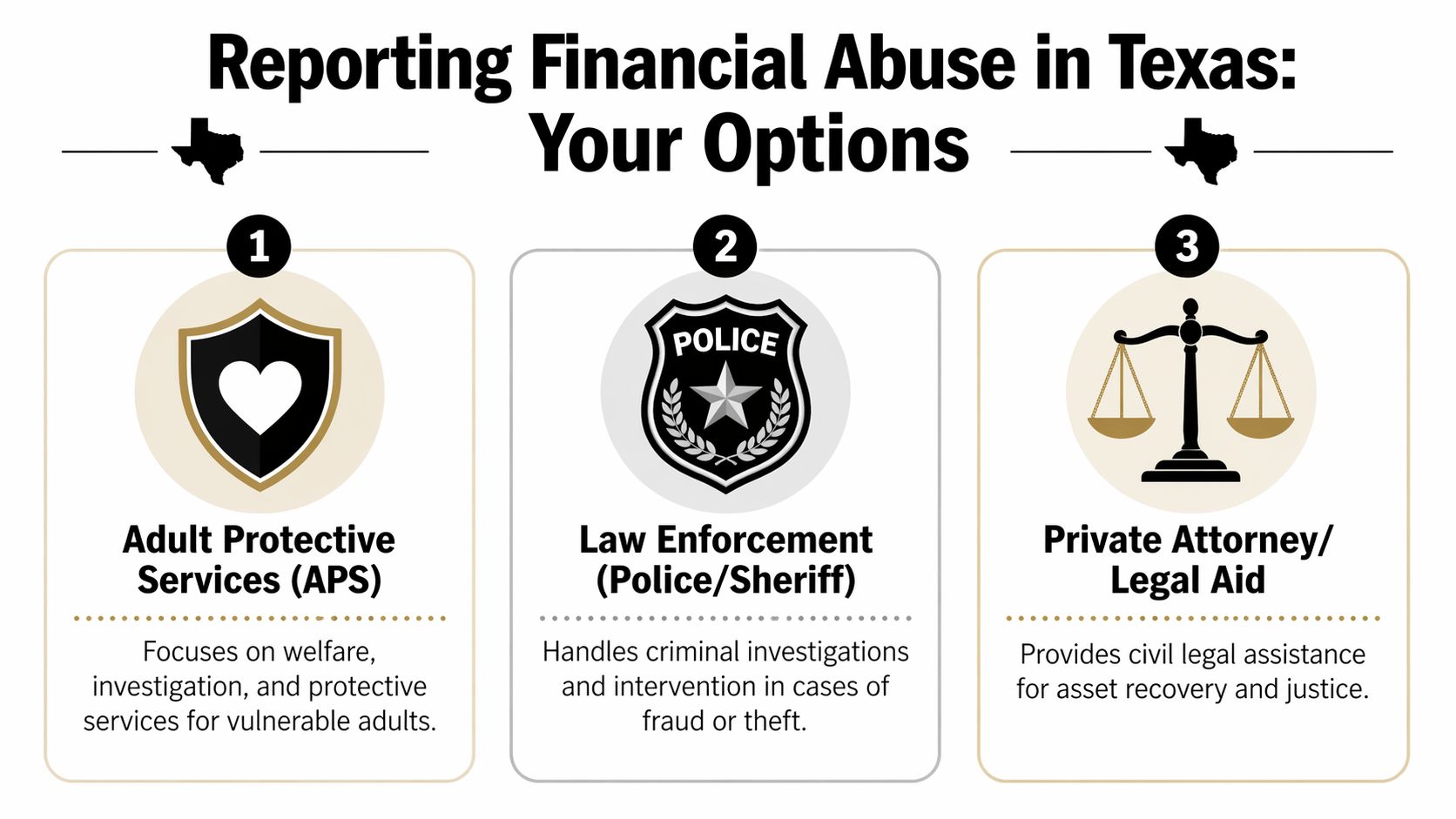
Adult Protective Services
APS is often the first stop when the ward is a vulnerable adult and the concern involves abuse, neglect, or exploitation. For guardianship cases, APS has to sort out an important threshold issue first. It must determine whether the spending or transaction was already court-approved.
That’s why specifics matter so much. Under official policy, APS may close a vague complaint as “Does Not Meet Definition of APS,” while a detailed report with documents can lead to court notification, as explained in the Texas DFPS APS policy on guardianship investigations.
When you contact APS, be ready to provide:
- The ward’s full name and location
- The guardian’s name and role
- The appointing court, if you know it
- Specific transactions or conduct you’re worried about
- Why you believe the spending was not court-approved
- Any records you already have
If you want a plain-language overview of the first report step, this guide on how to report guardianship abuse in Texas can help you organize the basics before you call.
Local law enforcement
Police or sheriff’s departments become important when the facts suggest a clear crime, such as theft, forgery, identity misuse, or fraud. Guardianship status does not protect a person from criminal investigation.
A common point of confusion is this. Families think they must choose between APS and the police. Usually, they don’t. APS looks at protection and vulnerability. Law enforcement looks at potential criminal conduct. Those are different functions.
You may want a police report when you have:
| Situation | Why police may matter |
|---|---|
| Forged checks or signatures | Possible theft or fraud |
| Unauthorized use of bank cards | Potential criminal misuse |
| Asset transfers for personal gain | Possible financial crime |
| Missing property after restricted access | Potential theft investigation |
If the ward lives in Houston, for example, you may also need to think practically about location, records, and which agency has the fastest access to local evidence. The same is true in Dallas, Austin, San Antonio, and county sheriff jurisdictions.
The appointing probate court
This is the step many families miss. The probate court that appointed the guardian has continuing authority over the guardianship. That means the court can review filings, require explanations, order accountings, hold hearings, and consider removal or other corrective action.
If your loved one’s guardianship was opened in a court such as Harris County Probate Court, Dallas County Probate Court, or another county court with probate jurisdiction, that is often where meaningful accountability happens.
Contacting the court usually starts with identifying:
- The case number
- The county and court name
- Whether the guardian is of the person, the estate, or both
- The most recent filings on the docket
Then the issue becomes procedural. Should you submit a written concern, file a motion, request a hearing, or ask counsel to petition the court? That depends on the facts.
The court supervises the guardian. If a guardian isn’t doing the job, the appointing court is often the place where the problem can actually be corrected.
Which option should you use first
There isn’t one answer for every family.
- Start with APS when the ward is vulnerable and you need a protective response.
- Add law enforcement when the facts point to theft, fraud, or forgery.
- Go to probate court quickly when the danger is tied to the guardian’s authority, missing filings, or urgent need for judicial orders.
In many cases, the strongest approach is coordinated action instead of waiting for one agency to solve everything.
Gathering Evidence to Build a Strong Case
Concern gets attention. Documentation gets action.

Start with the core records
Try to gather records that show what existed before the problem and what changed after. Don’t alter documents, and don’t remove original records if you don’t have legal authority to do so. Copies are usually enough to begin.
Focus on these categories:
Bank and credit card statements
These help show withdrawals, transfers, recurring charges, and unusual purchases.Guardianship papers
The order appointing the guardian, letters of guardianship, bond information, and prior court filings can show the scope of authority and what the guardian was required to do.Bills and care records
Unpaid rent, late notices, medication issues, and facility invoices can show that estate funds were not used for the ward’s benefit.Property records
Deeds, sale documents, vehicle titles, and insurance documents can reveal whether assets were transferred, sold, or allowed to lapse.Communications
Emails, text messages, voicemails, and letters can show requests for information, evasive responses, or admissions.
Build a chronology of concern
One of the most useful tools is a simple timeline. Use a notebook, spreadsheet, or document and list events in date order.
Include:
- Date
- What happened
- Who was involved
- What record supports it
- Why it concerns you
A chronology helps in three ways. It keeps your memory straight. It gives APS or an attorney a clearer picture. It also turns scattered problems into a pattern a judge can understand.
Here’s a simple example:
| Date | Event | Record |
|---|---|---|
| March 4 | Utility shutoff notice found at ward’s home | Copy of notice |
| March 8 | Guardian said all bills were current | Text message |
| March 12 | Bank statement showed large unrelated purchase | Statement copy |
Know what investigators often look for
Families sometimes ask how a professional reviews suspicious finances. The answer is usually not magic. It’s careful comparison. A reviewer looks for missing records, inconsistent explanations, unexplained transfers, and spending that doesn’t match the ward’s needs. This overview of how forensic accountants find hidden assets gives a useful outside perspective on how financial irregularities are often traced.
You don’t need to become a forensic accountant yourself. But it helps to sort records by account, month, and type of transaction so someone else can review them efficiently.
Keep the report factual
Avoid labels in your notes like “thief” or “crook” unless a court has already made that finding. Write facts instead.
For example, this is stronger:
“On the April statement, there are repeated withdrawals I can’t connect to my mother’s care. The nursing facility says her balance is overdue, and the guardian has not provided receipts after multiple requests.”
This is weaker:
“He’s obviously stealing everything.”
If you need a practical roadmap for the immediate aftermath of suspected loss, this article on my guardian stole my money, now what steps to take in Texas is a useful companion.
Evidence doesn’t have to be perfect before you act. It does need to be organized enough that another person can follow it.
What Happens Next The Investigation and Court Process
Once a report is made, families often expect a quick yes-or-no answer. Guardianship cases rarely move that way. Different decision-makers review different parts of the problem.

What APS may do
APS may interview the reporter, contact the guardian, review available records, and determine whether the alleged conduct falls within its authority. In a guardianship case, APS also has to account for the fact that some expenditures may already have been approved within the court’s process.
That can feel frustrating to families. But it explains why your report needs dates, documents, and a clear reason you think the conduct was outside proper authority.
Possible APS outcomes include:
- Referral or notice to the court
- Investigation with evidence gathered
- Closure if APS determines the facts do not meet its definition
- Attention to related neglect concerns if financial problems are affecting care
What police may do
Law enforcement may ask for records, statements, bank information, and witness interviews. Their focus is different from the probate court’s focus.
A probate judge may care that a guardian failed to file required reports or mishandled estate property. Police are more likely to focus on whether they can prove a criminal offense. That’s why some conduct can support court action even if criminal charges never follow.
What the probate court may review
The probate court looks at authority, compliance, and the ward’s protection. Consequently, the Guardianship Abuse, Fraud, and Exploitation Deterrence Program, often called GAFEDP, becomes important.
According to the Texas courts FY2025 GAFEDP annual report, the program reviewed 7,590 guardianship cases, and 1,569 cases, or 34%, were out of compliance. The same review found 23% were missing annual reports and 40% were missing annual accounts. Those are not minor paperwork issues. In guardianship court, missing reports and accountings can be warning signs that a judge takes seriously.
The same report also noted missing inventory filings and other compliance problems that affect oversight. When inventories and accountings are missing, the court has less ability to see whether estate assets are being protected the way Texas law requires.
Missing annual reports and annual accounts don’t prove theft by themselves. They do show the court’s safety checks may not be working.
Why annual filings matter so much
Under Texas guardianship practice, annual filings serve as a check on the guardian’s conduct. A guardian of the person typically has reporting duties about the ward’s condition. A guardian of the estate must account for money and property under court supervision.
When those filings are late, incomplete, or absent, several concerns can follow:
| Missing filing | Why the court cares |
|---|---|
| Annual report | The court loses visibility into the ward’s condition and care |
| Annual account | The court can’t evaluate financial management clearly |
| Inventory | The court may not know what assets should exist |
| Bond information problems | Recovery options may be weaker if funds are misused |
Texas courts can respond in different ways. They may issue notices, set compliance hearings, require corrections, increase scrutiny, or consider stronger remedies. In some counties, the court may use compliance dockets and targeted review procedures to address high-risk cases.
What a hearing may look like
If the matter reaches hearing, the judge may review:
- The guardianship order
- The guardian’s filed reports and accountings
- Bank records and supporting documents
- Testimony from family, facility staff, or other witnesses
- Whether the ward remains protected under the current arrangement
The judge may ask direct questions. Why was this money spent? Where are the receipts? Why weren’t annual filings made? Why are bills unpaid? A family that arrives with a clear chronology and supporting documents is in a much stronger position than one relying only on suspicion.
Court review also ties into broader guardianship issues. Sometimes financial abuse concerns reveal that the current guardian should be removed. Sometimes they reveal the need for a temporary guardian, a modification of powers, or a less restrictive alternative if the ward has regained capacity in some areas.
When Initial Reports Are Not Enough Pursuing Legal Action
Many families feel defeated under these circumstances. They made the call. They filed the report. Then nothing seems to happen, or the response feels far too limited.
That does not always mean the concern lacked merit. It often means the next step is legal, not administrative. As noted by Texas DFPS training material on APS reporting and next-step court action, families often feel stuck after APS doesn’t resolve the issue because petitioning the appointing court and triggering deeper review requires specific filings and evidence.
A closed APS case is not the end
APS can close a matter for procedural reasons. Police may decline a criminal case because they believe they don’t yet have enough evidence for prosecution. But the probate court still has authority over the guardianship.
That’s why direct court action can become the most effective route. The court can address fiduciary performance even when another agency does not proceed.
Common legal requests may include:
Motion to compel accounting
This asks the court to require a proper financial accounting and supporting records.Motion to remove guardian
If the guardian is unsuitable, noncompliant, conflicted, or harmful to the ward, removal may be appropriate.Petition to modify guardianship
Sometimes the solution is reducing powers, changing duties, or appointing a different person.Request for temporary or emergency relief
In urgent cases, the court may need to act quickly to protect the ward or preserve assets.
Emergency and temporary guardianship issues
When there is immediate danger to the ward or estate, families sometimes need to ask about temporary guardianship or emergency court measures. This can matter if assets are actively being drained, housing is at risk, or medical care is being disrupted.
Temporary guardianship is serious because it changes control before a final hearing. Courts generally expect a clear showing that immediate intervention is necessary. Supporting records, witness statements, and a focused petition matter a great deal.
What legal counsel actually does here
At this stage, the issue is usually no longer “Who do I call?” It’s “What do I file, where do I file it, and how do I present this so the judge can act?”
That’s the gap legal counsel is meant to fill. An attorney can review the guardianship record, identify the appointing court, evaluate whether the problem involves a guardian of the person, a guardian of the estate, or both, and prepare the motion or petition that fits the facts. For readers looking at whether the guardian’s conduct may violate core legal duties, this discussion of breach of fiduciary duty by a guardian in Texas is directly relevant.
One option families use for this kind of court-focused work is Law Office of Bryan Fagan, PLLC, which handles guardianship filings, disputes, emergency matters, compliance issues, and hearings involving alleged fiduciary misconduct in Texas probate courts.
If your report didn’t solve the problem, the question usually becomes whether the court has been asked, in the correct legal form, to do something about it.
Don’t overlook related probate and planning issues
Sometimes suspected abuse uncovers a bigger problem. There may be no clear estate plan. Beneficiary designations may be outdated. Property may be titled in ways that complicate recovery. The ward may have had alternatives to guardianship that were ignored.
That is why these cases often overlap with broader areas such as Guardianship, Probate, and Estate Planning. The legal answer may involve more than reporting alone.
Take the First Step to Protect Your Loved One and Their Future
When you suspect financial abuse in a Texas guardianship, the path usually starts the same way. Notice the warning signs. Gather records. Make a clear report. Then, if needed, bring the issue directly to the probate court that has power over the guardian.
None of this is easy when the person at the center of the case is someone you love. Families often feel guilty, overwhelmed, or unsure whether they have enough proof. But waiting can make the damage worse. Care can suffer. Money can disappear. Records can become harder to find.
Texas guardianship law is supposed to protect vulnerable people while preserving dignity and using the least restrictive option that still keeps them safe. If a guardian is abusing that role, the legal system does provide ways to intervene.
You don’t have to sort through it alone. A careful review of the court file, the guardian’s duties, and the available evidence can make the next step much clearer.
If you’re worried about a parent, spouse, child, or other loved one in a Texas guardianship, Law Office of Bryan Fagan, PLLC can help you understand your options. We offer free consultations for families dealing with suspected guardian misconduct, probate court concerns, emergency guardianship issues, and questions about modifying or challenging an existing guardianship. A confidential conversation can help you decide what to do next.