Skip to content
When a Texas court grants a guardianship, many families feel two things at once. Relief, because someone now has legal authority to help. And fear, because the job sounds bigger than they expected.
That reaction is normal. A guardianship order doesn't end the court's involvement. It begins an ongoing relationship between the guardian, the court, and the person being protected. If you're trying to understand court monitoring of guardian texas rules, you're probably asking practical questions. What does the court expect now? How often do you report? What happens if a family member is worried something is wrong?
Texas law treats guardianship as serious court supervision, not a private family arrangement. That can feel intimidating, especially for a son, daughter, spouse, or sibling who stepped in out of love, not because they have legal or financial training. The good news is that court monitoring exists to protect the vulnerable person and to give structure to the guardian's role.
Protecting Loved Ones After Guardianship is Granted
Maria finally got through the hearing in a Harris County probate court. Her mother had memory loss, unpaid bills, and increasing confusion about medications. After months of stress, the judge appointed Maria as guardian. She thought the hardest part was over.
Then the next question hit her. What happens now?
That question comes up in nearly every guardianship case. A court order doesn't mean the judge hands over power and then walks away. In Texas, the court continues watching the case because the ward's safety, rights, and property still matter after the hearing. The court wants to know whether the guardian is doing what the law requires and whether the ward is being protected.

Why ongoing oversight matters
Texas has a large guardianship system. As of August 31, 2017, Texas had 50,478 active guardianships with 5,186 new filings in that fiscal year, a 7% increase from the prior year, according to this discussion of Texas guardianship reform findings. With that many cases, judges and court staff can't rely on trust alone. They need reporting, review, and follow-up.
For families, that can sound harsh at first. But court monitoring is really a safety net. If a guardian falls behind, misunderstands a duty, or misuses authority, the court has a way to spot the problem.
Practical rule: A guardianship is not a one-time court event. It's an ongoing duty that stays under court supervision.
Why families often feel overwhelmed
Most family guardians aren't professionals. They're daughters managing doctor's appointments, brothers trying to preserve a small bank account, or grandparents caring for a child after a crisis. They may be grieving, exhausted, or trying to balance work and caregiving.
That reality matters. The law imposes formal duties, but real life is messy. Court monitoring helps create accountability, yet it also means the guardian must keep up with deadlines, forms, and records.
A simple example shows why this matters. If a guardian of the estate spends the ward's money on housing, medication, and food but doesn't keep receipts or file the right paperwork, the court may see only a missing report, not the good intentions behind it. That gap between intention and documentation is where families often get into trouble.
The court's promise to the ward
Texas guardianship law is built around protection. Under Texas Estates Code Title 3, Subtitle G, the court appoints a guardian only when legal requirements are met, and the court keeps jurisdiction over the case afterward. In plain English, the court doesn't just choose a guardian. It remains responsible for making sure the arrangement still serves the ward's best interest.
That's why monitoring exists. It's how the court checks whether the promise made at the hearing is being kept in everyday life.
What is Court Monitoring in Texas Guardianship?
A family often walks out of the guardianship hearing feeling two things at once. Relief that someone now has legal authority to help, and anxiety about what happens next. In Texas, the answer is that the case remains under the court's watch. The guardian makes day-to-day decisions within the powers granted, but the court keeps checking whether those decisions protect the ward and follow the law.
Another way to say it is simple. Guardianship in Texas works like delegated authority, not private control. A judge has allowed someone to step in for a person who cannot fully manage personal care, finances, or both. Because that authority can affect housing, medical care, money, and basic rights, the court requires proof that the guardian is using it properly.
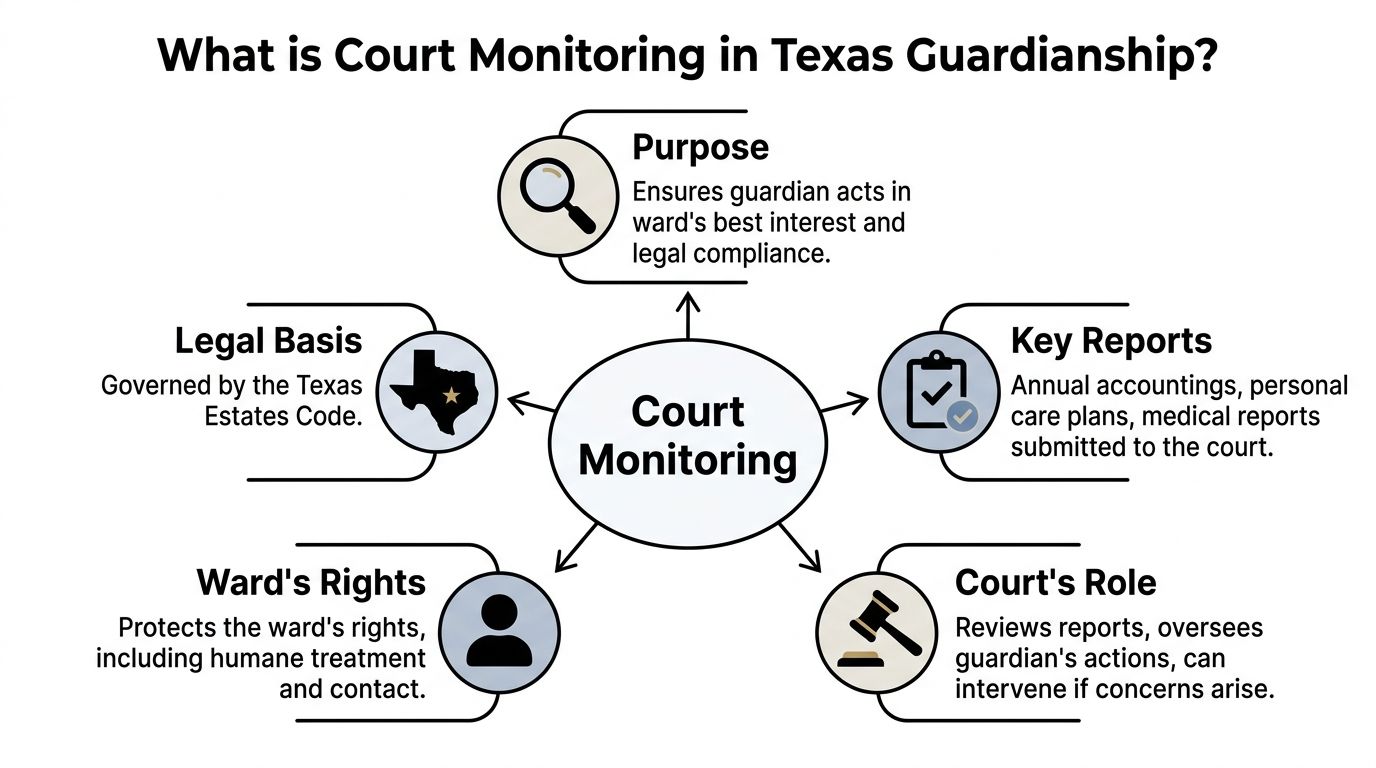
What the court is really checking
Court monitoring is the court's process for verifying four practical things.
- Personal care: Is the ward safe, receiving needed medical attention, and living in an appropriate setting?
- Money management: Is the guardian protecting the ward's income, property, and other assets?
- Legal compliance: Is the guardian filing the reports, inventories, and accountings the law requires?
- Respect for rights: Is the ward being treated with dignity and allowed as much independence as possible?
Those questions come from the basic structure of Texas Estates Code Title 3, Subtitle G. Local probate courts may use different forms or scheduling practices, but the purpose stays the same across Texas. Guardianship gives one person serious authority over another person's life, so the court does not rely on good intentions alone.
Why monitoring can feel harder for family guardians
For a professional fiduciary, reporting rules are part of the job. For a daughter caring for her mother, or a brother trying to manage a modest estate while working full time, the process can feel like learning a second language under stress.
That gap causes real problems. A family guardian may be doing honest, caring work and still fall behind on paperwork, misunderstand what belongs in an annual report, or fail to keep records in the format the court expects. From the judge's perspective, though, missing paperwork creates the same immediate concern either way. The court cannot protect the ward based on assumptions.
A 2024 review by the State Auditor highlighted the issue. According to the State Auditor's review of the Guardianship Program, 28% of the guardianships reviewed had failed to submit at least one required report. That does not prove bad faith in every case. It does show how often families struggle with the administrative side of guardianship.
For a closer explanation of the judge's supervisory role, families can review this guide on understanding court oversight in Texas guardianship cases.
What court monitoring looks like in daily practice
Many guardians assume that hands-on care speaks for itself. A guardian may visit every day, pay for medications, arrange transportation, and still run into trouble if the file does not show it. Courts work from records, sworn filings, and, in some cases, outside review.
In real life, monitoring often includes:
- Reports about the ward's condition and living situation
- Accountings that show money received, spent, and retained
- Inventories identifying the ward's property
- Court visitor review or other direct follow-up in some cases
- Hearings if questions arise, deadlines are missed, or a family member raises concerns
The court may also review requests to sell property, spend estate funds in certain ways, change placement, or resolve disputes between relatives. That can feel strict to a family guardian. It is also the court's way of checking that the ward's well-being, money, and legal rights are being protected with evidence, not guesses.
A short video can help make the process easier to picture.
Court monitoring is the system the judge uses to confirm that a guardianship is working as promised, and to step in before confusion, poor records, or serious misconduct puts the ward at risk.
Key Court Monitoring Mechanisms Explained
Once a guardianship is open, the court usually relies on several tools at the same time. Some tools focus on personal well-being. Others focus on money. Together, they help the judge see whether the guardian is meeting fiduciary duties.
The main tools courts use
The most common monitoring tools are the initial inventory, the annual report, the annual accounting, court review of bond issues when applicable, and direct observation through Court Visitors in some systems. If there is a concern, the court can also set a hearing, order more documentation, or consider sanctions and removal.
Under Texas Estates Code Title 3, Subtitle G, guardianship duties vary depending on whether the guardian serves over the person, the estate, or both. That distinction matters because different filings apply to different roles.
Here is a practical summary.
Texas Guardianship Monitoring Tools at a Glance
| Monitoring Tool | Purpose | Typical Deadline |
|---|---|---|
| Initial Inventory | Lists the ward's estate property so the court knows what must be protected | Shortly after appointment, based on the court's order and governing requirements |
| Annual Report of the Person | Updates the court on the ward's condition, services, living situation, and needs | Annually |
| Annual Accounting | Shows money received, money spent, and assets on hand for the estate | Annually |
| Court Visitor Review | Provides independent in-person observation of the ward | Annually where used |
| Show Cause or Compliance Hearing | Lets the judge address missing filings or suspected problems | As ordered by the court |
The annual report for the person
If you're guardian of the person, the court usually expects a yearly report about the ward's well-being. This filing commonly addresses living arrangements, physical condition, mental condition, medical care, and whether the guardianship should continue as is.
This report matters because the judge needs more than a snapshot from the original hearing. A ward's needs can improve, decline, or change in ways that affect decision-making, services, or placement.
For example, a guardian may need to explain that an elderly parent moved from a private home to assisted living after repeated falls. Or a guardian of an adult child with disabilities may report that the ward is stable, receiving services, and participating in supported daily activities.
The annual accounting for the estate
If you're guardian of the estate, your reporting burden is usually heavier. The court expects a detailed annual accounting showing what came in, what went out, and what remains.
That means you should be prepared to document income, bills paid, account balances, and any property transactions that required court authority. Judges often look closely at these filings because financial misuse can be hard to reverse once money is gone.
Keep this in mind: good intentions don't replace records. In guardianship court, the paper trail matters.
A family guardian sometimes pays a ward's expenses from mixed funds or forgets to separate accounts. That creates confusion fast. Even honest mistakes can lead the court to question whether the estate is being handled properly.
The initial inventory
The initial inventory helps the court understand what property exists at the start of the guardianship of the estate. Without that starting point, later accountings are much harder to evaluate.
An inventory may include bank accounts, real property, vehicles, personal property, claims, or other assets. The purpose is basic but important. The court can't protect what it doesn't know exists.
If the inventory is incomplete, later disagreements can become serious. A sibling may claim the guardian failed to disclose a savings account. A judge may wonder whether a house was sold without adequate reporting. Early accuracy reduces those disputes.
Court Visitors and direct observation
Texas courts may also use Court Visitors as an independent check on the ward's condition. Under the Texas Probate Code, trained Court Visitors must personally visit the ward annually and file a sworn, detailed written report with the court within 14 days of the visit, as described in the Court Visitor protocol material from the National Center for State Courts collection.
That requirement matters because it gives the court eyes on the ward, not just paperwork from the guardian. A visitor can note whether the ward appears safe, whether the living environment matches the guardian's report, and whether there are signs of neglect or unmet needs.
Hearings, investigations, and court intervention
Not every issue is resolved through paperwork. If reports are late, a family member objects, or the court sees a red flag, the judge can require a hearing. In that setting, the guardian may have to explain missing documents, justify spending, or respond to concerns about care.
Courts can also appoint other professionals depending on the issue, including attorneys ad litem or guardians ad litem in some proceedings. In emergency or temporary guardianship situations, the court's pace often becomes faster because the concern is immediate.
Common triggers for closer review include:
- Missed filings: Reports or accountings aren't filed by the deadline.
- Unclear spending: Estate funds were used, but records are incomplete.
- Family complaints: A relative reports isolation, poor care, or financial concerns.
- Change in condition: The ward's health or living situation changes sharply.
- Property issues: The guardian seeks approval to sell or manage significant assets.
That combination of reports, independent review, and court authority is the practical backbone of court monitoring of guardian texas cases.
A Guardian's Guide to Compliance and Reporting
Most guardians don't step into the role because they love paperwork. They do it because someone they care about needs help. But once the appointment happens, love and good motives have to be matched with careful compliance.
That is where many family guardians struggle. The Texas Guardianship Abuse, Fraud, and Exploitation Deterrence Program was created to address significant noncompliance issues, and many non-professional family guardians still struggle with reporting burdens without enough training or resources, as described by Travis County's discussion of court visitor and guardianship oversight support. That support gap is real.

A workable system beats good intentions
The guardians who stay out of trouble usually don't have perfect lives. They have a system. They calendar deadlines, keep a file, save receipts, and ask questions early.
If you're serving now, start with these habits:
- Calendar every court date and reporting deadline: Put reminders on your phone, paper planner, and email. One reminder isn't enough.
- Separate the ward's funds: If you're guardian of the estate, avoid mixing money with your own accounts.
- Keep a running care log: Note doctor visits, hospital stays, medications, changes in housing, and major concerns.
- Save proof of spending: Receipts, statements, invoices, and court orders should all stay together.
- Read the letters of guardianship and court order closely: Those documents define your authority. They don't give unlimited power.
Families often need a plain-English explanation of annual filing duties. This overview of annual reporting requirements for guardians in Texas can help you understand what courts typically expect.
Common mistakes family guardians make
A daughter may use her mother's debit card for groceries and prescriptions, then forget which purchases were personal and which were for her mother. A brother may move the ward into his home but never update the court clearly about the change. A guardian may assume silence from the court means everything is fine.
Those mistakes are common, but they can still bring serious consequences.
Plain answer: If you don't understand a duty, ask before the deadline passes. Courts are much more receptive to a problem addressed early than to a missing report explained late.
What to do before, during, and after hearings
A hearing doesn't always mean someone has done something wrong. Sometimes the court just needs clarification or updated information.
Before a hearing:
- Gather all records in date order.
- Review prior court orders and filings.
- Make a short timeline of major events involving the ward.
- Identify any missing documents before you appear.
During the hearing, answer directly. If you don't know an answer, say so and offer to provide the record. Guessing can damage your credibility.
After the hearing, follow the judge's instructions exactly. If the court gives you a new deadline, treat it as urgent.
Compliance also matters when emergencies arise
Temporary or emergency guardianship situations can make reporting harder because the family is reacting to a crisis. A stroke, severe dementia episode, injury settlement involving a minor, or sudden hospitalization can force fast decisions.
Even then, the court still expects structure. If the emergency continues into an ongoing guardianship, the guardian should quickly build a reporting system. Courts understand stress. They don't waive fiduciary responsibility just because the family had a hard start.
For Families How to Voice Concerns and Request Oversight
Not every concerned person is the guardian. Sometimes you're the sister who lives nearby and sees troubling changes. Sometimes you're an out-of-state son who gets a strange phone call from a care facility. Sometimes you're a family friend who notices isolation, missing property, or untreated medical needs.
Texas courts can only act on problems they know about. If you have a real concern, there are steps you can take.
Red flags worth taking seriously
Some warning signs relate to money. Others relate to personal care. Both matter.
Financial concerns may include sudden withdrawals, unpaid bills despite available funds, unexplained sales of property, or secrecy about accounts. Personal care concerns may include poor hygiene, missed medical appointments, unexplained moves, isolation from family, or a ward who seems fearful around the guardian.
A single issue doesn't always prove abuse. But a pattern deserves attention.
A calm, practical way to raise concerns
Start with information. In many cases, the court file will show whether reports were filed, whether an accounting is overdue, or whether the guardian recently sought court approval for a transaction.
Then consider these steps:
- Review the court record: Probate filings can reveal whether the guardian is keeping up with required duties.
- Document what you observed: Write dates, names, and specific facts. "The house looked dirty on Tuesday" is better than "things seem bad."
- Communicate carefully if appropriate: Some concerns come from misunderstanding and can be addressed without a fight.
- Report urgent danger quickly: If the ward faces immediate harm, contact the proper authorities and the court through counsel as fast as possible.
- Ask the court for relief: Depending on the problem, that may include a request for review, an order to compel filings, or a motion to remove or modify the guardian.
Families who need practical direction can review this page on how to report guardianship abuse.
Local practice matters
Procedure can differ by county. A guardianship issue in Harris County Probate Court, a matter in Dallas County, or a contested case in Travis County may move under different local rules, forms, or scheduling practices. That's one reason families often benefit from legal advice from someone who works regularly in Texas probate and guardianship courts.
When a loved one may be at risk, don't wait for "perfect proof." Start gathering records, preserve facts, and get informed about the right court process.
Disputes, alternatives, and possible outcomes
Not every case ends with removal. Sometimes the court orders missing filings. Sometimes it narrows the guardian's authority, requires more supervision, or appoints someone else. In other cases, the issue reveals that the current guardianship is too broad and should be modified.
There are also situations where a less restrictive alternative may become appropriate. If the ward has regained capacity in some area, or if supported decision-making or another arrangement can safely handle part of the need, the court may consider changes. Guardianship isn't supposed to be broader or longer than necessary.
How The Law Office of Bryan Fagan Provides Support
A family guardian often starts with the right intention and very little practical training. One person is trying to keep up with doctor visits, care decisions, bills, court forms, and worried relatives, all while caring for someone they love. The law expects accuracy and steady reporting, even when family life is already under strain.
That gap is often the true problem. Texas courts expect guardians to follow detailed rules, but many non-professional guardians are learning those rules in real time. A missed filing does not always come from bad motives. Sometimes it starts with confusion about what the court ordered, which records need to be kept, or how a local probate court wants information presented.
A focused guardianship attorney can help resolve these problems. Some families need help setting up a guardianship correctly under Texas Estates Code Title 3, Subtitle G so problems do not begin at the first hearing. Others need help with temporary guardianship, contested matters, annual reports, accountings, compliance issues, or requests to modify or end an existing guardianship.
Legal help also serves an important role outside the courtroom. Families often need a clear answer about whether guardianship is the right tool at all, or whether a less restrictive option would better fit the person's needs. In many cases, guardianship questions overlap with probate administration, property concerns, benefits issues, and long-term planning for a vulnerable adult or child.
Good legal support is often practical and plainspoken. It means helping a guardian build a filing calendar, organize receipts and medical records, prepare for what the judge may ask, and respond quickly if concerns are raised about care or finances. It also means helping relatives understand the process so suspicion does not grow because no one explained the rules.
If your case is in Houston, Dallas, Austin, San Antonio, or another Texas court, local procedure can shape how smoothly the guardianship proceeds. Clear advice helps families work through pressure, avoid preventable mistakes, and keep the focus where it belongs, on the ward's safety, dignity, and well-being.
Frequently Asked Questions About Guardian Monitoring in Texas
Does the court keep watching the case after the guardian is appointed
Yes. The court keeps jurisdiction over the guardianship and expects continued compliance with reporting and fiduciary duties. Appointment is the beginning of supervision, not the end of it.
What is the difference between a guardian of the person and a guardian of the estate
A guardian of the person handles decisions about care, living arrangements, and day-to-day well-being within the scope of the court's order. A guardian of the estate manages money and property. Some people serve in both roles, but the duties are different, and the court may require different filings depending on the appointment.
What if a family guardian misses a deadline
A missed deadline can trigger court action. The judge may require the filing, set a hearing, issue further orders, or consider sanctions depending on the circumstances. Missing a deadline isn't something to ignore just because the court hasn't contacted you yet.
Can a guardian be removed
Yes. If a guardian fails to perform required duties, mismanages property, neglects the ward, exceeds authority, or becomes unsuitable, the court can consider removal. Removal cases can be fact-specific and often involve records, testimony, and local court procedure.
Can someone ask the court for more oversight without trying to remove the guardian
Often, yes. A family member may ask the court to review concerns, require compliance, or address a specific problem without immediately seeking full removal. Sometimes the main problem is lack of reporting, not intentional misconduct.
Are emergency guardianships monitored too
Yes. Temporary or emergency guardianship arrangements still operate under court authority. Because those cases arise from urgent facts, judges often expect careful attention to the limits of the order, updated information, and close compliance with whatever deadlines apply.
Is a Court Visitor the same as a guardian ad litem
No. They serve different functions. A Court Visitor focuses on visiting and reporting observations to the court under the court's monitoring structure. A guardian ad litem is appointed for a different legal role in certain proceedings and does not merely duplicate the visitor's function. If your case involves either one, the appointment order should be read closely.
Can the court waive some financial reporting requirements
Sometimes courts have authority to address reporting issues in ways that depend on the facts of the case and the nature of the estate. But no guardian should assume an accounting or other filing is waived unless the court has clearly said so in an order. Assumptions create risk.
What can out-of-state family members do to stay involved
Distance makes oversight harder, but not impossible. Out-of-state relatives can monitor the case by reviewing filings, keeping written records of concerns, maintaining contact with care providers when appropriate, and getting Texas legal advice when they need to request court action.
When does guardianship end
A guardianship may end for several reasons, including death of the ward, restoration or modification of capacity, the ward aging out of a minor guardianship setting when the law no longer supports the arrangement, or a court order terminating or changing the guardianship. The proper ending depends on the type of guardianship and the facts of the case.
Are there alternatives to guardianship
Sometimes, yes. Depending on the person's capacity and needs, a less restrictive option may be available. The right answer depends on the person's condition, safety needs, assets, and support network. Because guardianship affects important rights, courts generally expect families to consider whether a narrower solution could work.
If you're facing questions about reporting, a dispute over a guardian's conduct, emergency protection for a loved one, or whether guardianship is even the right tool, the Law Office of Bryan Fagan, PLLC can help you understand your options. Our team works with Texas families in guardianship, probate matters, and estate planning concerns with a clear, practical approach. Schedule a free consultation to get guidance suited for your family, your county, and your loved one's needs.