Skip to content
Let's be blunt: no, Texas law doesn't force you to have a will. But framing it that way misses the entire point. Choosing not to create a will isn't a neutral act; it's an active decision to hand over your voice—and all your most personal choices—to the state.
When you die without a will, you give up your right to decide who gets your property, who raises your children, and who closes out your final affairs. All those deeply personal decisions are handed over to a judge and a rigid set of Texas laws.
Why a Will Is Your Final Act of Protection
It’s a common story we hear from Texas families. Many people think, "I don't have enough assets to need a will," or they assume, "My family will know what to do." We understand why people think this way, but these are dangerous assumptions. Sadly, this way of thinking can create a nightmare of unintended consequences, family stress, and staggering costs for the very people you want to protect.
Dying without a will is called dying "intestate." When that happens, the Texas Estates Code kicks in with a one-size-fits-all formula to divide up everything you own. This legal process almost never matches what someone would have actually wanted. The state’s rules don’t care about your stepchildren, your best friend who was like a sibling, or the specific financial needs of one of your children over another.
A will is far more than a legal document. It's your final act of care for your family.
A thoughtfully prepared will is one of the most powerful tools you have to protect your loved ones. It replaces the impersonal decisions of a court with your personal, loving instructions, ensuring your wishes are honored and your family is secure.
Think about the control a will gives you. It's your chance to:
- Appoint a Guardian for Your Children: This is huge. You, not a judge who doesn't know your family, get to decide who will raise your minor children if the unthinkable happens.
- Choose Your Beneficiaries: You can leave your property to anyone you want—family, friends, a beloved charity—instead of letting a generic state law dictate who gets what.
- Simplify the Probate Process: A clear will can make the court process much faster and less expensive for your grieving family.
Your Choices with a Will vs. State Decisions Without One
The difference between having a will and leaving it to chance is stark. You're either in the driver's seat, or you're letting the state's impersonal rulebook take over.
| Area of Decision | With a Will You Decide | Without a Will The State Decides |
|---|---|---|
| Who Inherits Property | The specific people, charities, or trusts you name. | A rigid formula based on blood relatives only. |
| Guardian for Children | The person you trust most to raise your kids. | A judge appoints someone, who may not be your first choice. |
| Executor of Your Estate | A trusted person you choose to manage your final affairs. | A court-appointed administrator who doesn't know you. |
| Gifts to Friends/Partners | You can leave assets to anyone, regardless of legal relation. | Only legal relatives inherit; unmarried partners and friends get nothing. |
| Probate Process | Generally simpler, faster, and less expensive for your family. | Often more complex, costly, and time-consuming. |
As you can see, a will is your opportunity to make your wishes legally binding, providing clarity and peace of mind when your family needs it most.
At The Law Office of Bryan Fagan, we understand that Estate Planning is about so much more than documents—it's about protecting your legacy and your loved ones. We're here to guide you with compassion, ensuring your will accurately reflects your wishes and provides lasting security.
Schedule a free consultation to discuss how we can help protect your family's future.
What Happens When You Die Without a Will in Texas
When someone passes away in Texas without a legally valid will, the law considers them to have died "intestate." It’s a legal term that simply means you left no instructions behind for your property. When this happens, your personal wishes—no matter how clearly you might have stated them to family—become legally irrelevant. The state of Texas steps in and makes all the decisions for you.
The rules for who gets what are spelled out in the Texas Estates Code. This isn't a flexible system where a judge in a Harris County Probate Court can try to guess what you would have wanted. Instead, they must follow a strict, predetermined formula based entirely on your family tree at the time of your death. As you can imagine, this can lead to outcomes that are worlds apart from what you would have chosen for your loved ones.
The State's Impersonal Formula for Your Assets
To figure out who gets what, Texas law first splits your assets into two buckets: community property and separate property. Understanding this distinction is absolutely critical because the state has different rules for each.
- Community Property: This is generally everything you and your spouse picked up during your marriage. Think of the family home, shared bank accounts, or cars you bought together. It’s the "ours" pile.
- Separate Property: This bucket holds assets you owned before you got married. It also includes any gifts or inheritances you received personally (even during the marriage) and settlements from personal injury claims. This is the "mine" pile.
The state’s distribution plan can get complicated fast, often leaving families confused and overwhelmed during an already heartbreaking time.
This infographic really breaks down the core choice every Texan faces: you can decide how your legacy is handled, or you can let the state decide for you.
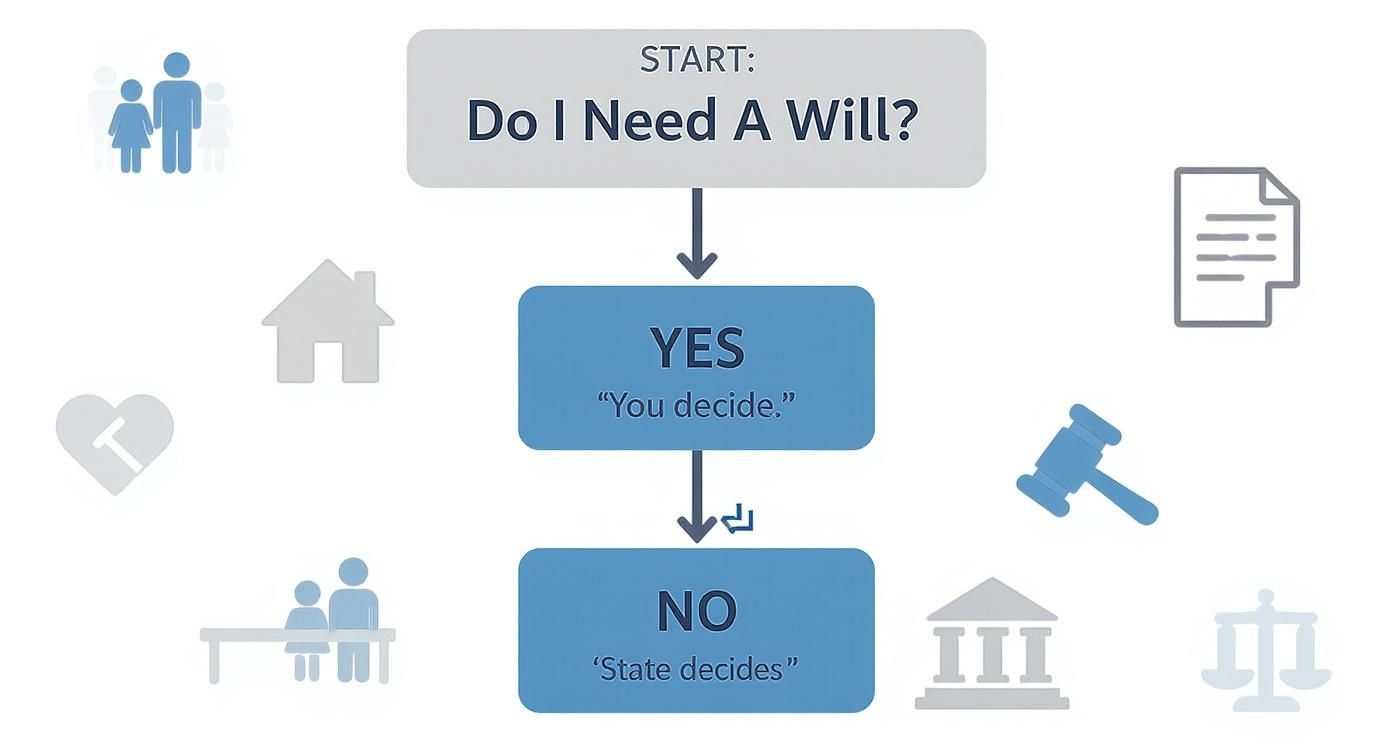
As the flowchart shows, if you have assets or children, a will becomes essential for maintaining control over what you've built.
How Intestacy Plays Out in Real Life
Let’s walk through a few common family situations to see just how these inflexible rules can impact your family. These examples show how the Texas Estates Code dictates where your assets go, often with surprising results.
Scenario 1: Married with Children (All from that marriage)
Most people assume their surviving spouse automatically inherits everything. That's a dangerous assumption in Texas. While your spouse gets all the community property, they only receive one-third of your separate personal property. The other two-thirds of your separate property goes directly to your children. This could force the sale of beloved family heirlooms or other personal assets your spouse was counting on.
Scenario 2: Married with Children from a Previous Relationship
Here, things get even more tangled. Your surviving spouse keeps their half of the community property, but your half goes straight to your children from the prior relationship. All of your separate property also gets divided up between your spouse and your children. This can create immediate financial hardship for your spouse and breed resentment between them and your kids.
Scenario 3: Single with No Children
If you're unmarried and don't have children, your entire estate will go to your parents if they are alive. If they've passed, it gets divided among your siblings. Without a will, your close friends, a long-term unmarried partner, or your favorite charity will receive absolutely nothing.
Dying intestate means your legacy is managed by a legal script you didn't write. The law doesn't account for complex family dynamics, special needs, or personal relationships—it only follows a rigid bloodline formula.
Many people put off creating a will, but this is a nationwide problem with serious consequences. A shocking 76% of Americans don't have an up-to-date will. This leaves the vast majority of families vulnerable to these impersonal state laws when a loved one passes.
At The Law Office of Bryan Fagan, we see the emotional and financial fallout that intestacy causes families all the time. A properly drafted will is your best and only defense against this uncertainty.
Taking the step to create a will ensures your voice is heard long after you're gone and that your family is protected according to your wishes, not a generic state statute.
How a Will Protects What Matters Most: Your Family

A will isn't really a document about death. Think of it as one of the most profound acts of love and protection you can give your family. When you create a will, you're essentially replacing the state's cold, impersonal rulebook with your own thoughtful, caring decisions.
This single document provides stability and clarity during what will undoubtedly be one of the most difficult times your loved ones ever face. It ensures your wishes are honored, preventing the kind of confusion that can splinter families and create lasting resentment.
The most powerful part of having a will is the control it gives you over your family's future, especially when it comes to your children.
Appointing a Guardian for Your Children
For parents with minor children, this is arguably the single most important reason to have a will. If you and the other parent were to pass away without one, a judge in a place like the Dallas County Probate Court would be forced to decide who raises your kids. This decision is made by a stranger who doesn't know your family, your values, or your relationships.
A will allows you to name a guardian—someone you know, love, and trust to care for your children according to your values. This is your choice, not a court's best guess.
According to the Texas Estates Code, Title 3, Subtitle G, a will is the primary legal tool parents can use to designate a guardian for their minor children. This appointment provides immediate clarity and helps avoid a potentially lengthy and distressing court battle among relatives.
Choosing a Capable Executor
Your will also lets you appoint an executor, sometimes called a personal representative. This is the person or institution you trust to manage your estate, pay your final bills, and make sure your assets are distributed exactly as you’ve instructed.
Without a will, the court appoints an administrator who may be completely unfamiliar with your finances or your family. By choosing your own executor, you can:
- Reduce Stress: Your family won't have the added burden of figuring out who should be in charge of everything.
- Prevent Conflict: You can select a neutral, organized person who can handle the process without causing friction between loved ones.
- Save Time and Money: A trusted executor who already knows your affairs can often settle the estate far more efficiently.
When planning for your family's future, a will is a crucial piece of the puzzle. It's also wise to consider the bigger picture by hiring a long term care attorney who can help design a comprehensive plan. A well-prepared will serves as the cornerstone of this planning.
Imagine a family whose grief was eased because a clear will was in place. Instead of arguing over heirlooms or property, they could focus on supporting each other. The executor, chosen by their parents for her calm demeanor, handled all the complicated paperwork, shielding the family from the legal process. This gift of foresight provided stability when they needed it most. Your will can do the same for your loved ones.
Making the Texas Probate Process Simpler and Faster
The word "probate" can sound intimidating, expensive, and complicated. For families navigating the loss of a loved one without a clear plan, it often is all of those things. But at its core, probate is simply the legal process of validating a will, settling any outstanding debts, and distributing the remaining assets to the right people.
A well-thought-out will completely changes the game. It turns a potential legal maze into a straightforward, manageable path for your family.
Think of it this way: a will is like leaving your family a detailed map and a set of keys after you're gone. It provides crystal-clear instructions, empowers the person you trust most to carry them out, and unlocks a much simpler probate journey. Without that map, your loved ones are stuck asking a judge for directions at every single turn. This constant court oversight is time-consuming, makes your private affairs public, and can quickly eat away at the estate's resources—piling on stress when your family needs it least.
Unlocking a Simpler Path with Independent Administration
Texas law offers a massive advantage for those who plan ahead: independent administration. This is a specific instruction you can include in your will that acts as a game-changer for your executor and your estate.
When your will specifies independent administration, you’re essentially telling the court, "I trust the person I've chosen to handle my affairs without needing constant supervision." This allows your executor to perform most of their duties—like paying bills, selling property if needed, and distributing assets—without having to get the court's permission for every move they make.
As outlined in the Texas Estates Code, Title 3, a will that provides for independent administration can drastically reduce court involvement, saving the estate significant time and money and lessening the burden on the grieving family.
This freedom streamlines the entire process. A probate that could drag on for over a year with endless court hearings can often be wrapped up much more efficiently when your executor has this authority.
Comparing the Probate Journey
Let's put this into a real-world context. Imagine a case before a Travis County Probate Court and see how differently it plays out.
- Probate With a Will: Your chosen executor presents your will to the court. Once it's validated and they're granted independent administration, they can get to work managing the estate's business, guided by your clear instructions. The court's role becomes largely supervisory.
- Probate Without a Will (Intestate): The court has to appoint an administrator. This person must post a bond (an insurance policy against mistakes) and ask for permission to take almost any action. This process, known as a dependent administration, is slower, far more expensive, and much more public.
A well-structured will is one of the most valuable gifts you can give your grieving family. It minimizes legal headaches and lets them focus on healing, much like the comfort found in personalized bereavement gifts. It’s a final act of care that simplifies one of the hardest parts of saying goodbye.
At The Law Office of Bryan Fagan, we specialize in creating wills that protect your family and simplify the Probate process. Schedule a free consultation to learn how we can provide your loved ones with a clear path forward.
Common Myths That Stop Texans from Creating a Will
It’s easy to keep putting off creating a will. Life gets hectic, and estate planning can feel like a problem for "future you." Many Texans get stuck on a few common myths that create unnecessary roadblocks, but getting past the fiction is the first step to protecting your family.
One of the biggest misconceptions we hear is, "I don't own enough to need a will." This completely misses the point of what a will actually does. A will isn't just for the wealthy; it's a vital tool for anyone who wants to make crucial decisions for their family's future. Even if your assets are modest, a will is the only legal way to name a guardian for your minor children, making sure they end up with someone you know and trust.
You Are Never Too Young
Another line of thinking is, "I'm too young to worry about this." While everyone hopes for a long, full life, the unexpected can happen at any age. Having a will in place provides a clear, legally-binding roadmap. It spares your loved ones from guessing your wishes or being forced to navigate the cold, impersonal rules of Texas intestacy law during an already heartbreaking time.
Similarly, people often say, "My family knows what I want." Unfortunately, verbal promises and good intentions don't hold up in court. Without a written will, disagreements can erupt between even the closest relatives, leading to painful disputes and expensive legal fights in a Harris County probate court that could have been easily avoided. The effort to create a will is a tiny investment compared to the potential emotional and financial cost to your family. To learn more about other critical planning documents, check out our guide on the role of a Power of Attorney in Texas.
A will is your legally recognized voice. It ensures your instructions are followed, provides clarity, and safeguards your family from unnecessary conflict and stress.
The good news is that creating a will is more accessible today than ever before. The global online will writing service market was valued at over $1.2 billion and is expected to more than double by 2034. This surge shows a growing understanding that this kind of planning is for everyone, not just a select few. You can discover more insights about this growing trend on businessresearchinsights.com.
At The Law Office of Bryan Fagan, we are here to help you move past these myths with compassionate, clear guidance.
How to Create Your Legally Valid Texas Will
Alright, let's talk about actually getting this done. Creating your will is one of the most powerful things you can do for your family. It might seem like a heavy topic, but Texas law lays out a pretty straightforward path to make sure your wishes are legally rock-solid.
Think of it this way: the Texas Estates Code provides the official rulebook. Following these rules isn't about jumping through complicated legal hoops; it's about making sure your will stands up in court without a hitch.
Core Requirements for a Texas Will
For a standard will to hold up in court, whether you're in Tarrant County or Bexar County, it has to check three specific boxes. They're non-negotiable.
- It must be in writing. Texas doesn't recognize verbal wills, so you need a physical document.
- It must be signed by you. As the person creating the will (the "testator"), you have to sign it. If you're physically unable, someone can sign for you, but it must be done in your presence and at your direction.
- It must be witnessed correctly. You need two credible witnesses, both at least 14 years old, to sign the will in your presence. Critically, these witnesses cannot be people who will inherit something in your will.
The witness requirement is where many DIY wills fall apart. A simple mistake, like having a son who is a beneficiary also sign as a witness, can cause massive legal headaches down the road. It could even invalidate parts of your will, completely undermining all your careful planning.
The Invaluable Role of an Attorney
It’s tempting to grab a generic template off the internet, but the guidance of an experienced estate planning attorney is worth its weight in gold. A good lawyer does so much more than fill in blanks on a form; they act as a strategist for your family's future.
For a better sense of the different tools available, you can explore various will forms in Texas and see how they're used.
An attorney helps you tackle the tricky stuff—like navigating blended families, protecting assets from creditors, or minimizing taxes. They make sure your will isn't just a document, but a thoughtful, comprehensive plan. It's truly a final gift of care for the people you love most.
Ready to take that first step? Schedule a free consultation with The Law Office of Bryan Fagan today for personalized guidance.
Frequently Asked Questions About Texas Wills
It’s completely normal to have questions as you start exploring the world of estate planning. Here are some of the most common ones we hear from Texas families who are thinking about how to protect their loved ones.
Can I Write My Own Will in Texas?
Yes, you can. Texas law recognizes handwritten wills, which are officially called “holographic” wills.
However, there’s a major catch: for a holographic will to be valid, it must be written entirely in your own handwriting. This is an incredibly strict rule, and it’s where many do-it-yourself wills fall apart, often forcing families into expensive court battles down the road.
Working with an attorney is the surest way to know your will is legally solid, correctly witnessed, and says exactly what you mean it to say. This small step now provides the best shield against future legal fights for your family.
How Often Should I Update My Will?
A good rule of thumb is to pull out your will and review it every three to five years. It's also absolutely crucial to update it after any major life event happens.
Think about things like:
- Getting married or divorced
- The birth or adoption of a child
- A significant change in your finances (for better or worse)
- The death of someone you named as a beneficiary or executor
Keeping your will current ensures it grows and changes with your life, always reflecting your wishes and serving your family’s needs.
What Happens if I Own Property Outside of Texas?
This is a great question. If you own real estate in another state, your family might have to go through an additional court process there called ancillary probate. This is essentially a separate probate case just to legally transfer that out-of-state property to your heirs.
Proper estate planning can help you get ahead of this. An experienced attorney can walk you through different strategies, like setting up a living trust, to make things much simpler for your loved ones and help them avoid the headache of managing probate in multiple states.
Understanding whether you have to have a will is the first step toward securing your family's future. The compassionate attorneys at the Law Office of Bryan Fagan, PLLC are here to provide clear answers and personalized guidance. Schedule a free, no-obligation consultation with us today to discuss your unique situation by visiting our website.