Skip to content
When you're navigating the complexities of a Texas child custody case, you’ll hear many legal terms. One of the most important is "sole managing conservator." While it sounds formal, the concept is straightforward: this is the parent who has the exclusive right to make the most important decisions in a child's life.
We understand this journey is often born from difficult circumstances, and our goal is to provide you with clear, compassionate guidance. Think of this role as the primary decision-maker for your child's future—from which school they attend to what kind of medical care they receive, ensuring their stability and well-being above all else.
Defining the Role of a Sole Managing Conservator

In Texas family law, the term "custody" is replaced with conservatorship, which outlines a parent’s legal rights and responsibilities for their child. Courts strongly prefer for parents to share these duties as joint managing conservators, as it is presumed to be in the child's best interest.
However, when a judge in a Texas court, such as a Harris County Probate Court, appoints one parent as the sole managing conservator, they are granting that parent exclusive authority to make critical life decisions. This is not the standard outcome. It is a specific legal solution for situations where the other parent's involvement in decision-making could harm the child's physical or emotional well-being, as outlined in the Texas Family Code.
Why Texas Courts Appoint a Sole Decision-Maker
For any family court in Texas, from Harris County to Travis County, every decision hinges on one guiding principle: the "best interest of the child." A judge will only move away from the standard joint managing conservatorship if there is powerful evidence showing it’s necessary to protect the child from harm.
This appointment places the full weight of responsibility on one parent's shoulders because the law recognizes that in some challenging situations, having one stable decision-maker is far better than exposing a child to constant conflict. The reasons for this kind of appointment are serious and often involve issues such as:
- A history of family violence or child neglect
- Substance abuse by the other parent, like drug or alcohol addiction
- Extreme conflict that makes co-parenting impossible
- Abandonment or a pattern of instability from the other parent
Understanding the Legal Framework
The Texas Family Code clearly lays out the rights and duties that come with conservatorship. Being named the sole managing conservator gives you the power to act alone on major issues, but it’s crucial to understand this isn't the same as guardianship. You can learn more about the important differences in our guide to guardianship vs. custody. This legal status is designed to create stability for a child caught in turbulent family dynamics.
A sole managing conservator has the primary authority to make pivotal decisions about the child’s life, including their primary residence, education, and non-emergency medical care. This structure is designed to shield a child from conflict and ensure their needs are met consistently.
This arrangement is a reality for families across the country. In fact, around 15 million children under 18 in the U.S. live exclusively with their mothers, reflecting custody outcomes that mirror sole managing conservatorship. In Texas, this decision is reserved for cases where one parent has been proven to be a risk, placing the full burden of the child's welfare on the other parent to create a safe, stable home.
At The Law Office of Bryan Fagan, we understand the immense emotional and financial weight of these situations. We're here to offer clear, compassionate guidance. If you believe this arrangement is necessary for your child's safety and well-being, schedule a free consultation with our team today.
The Exclusive Rights and Duties You Would Hold

When a Texas court names you a sole managing conservator, it is a profound statement of trust in your ability to protect and nurture your child. It means you have been given the exclusive authority to make the life-shaping decisions for them. This isn't a responsibility the court grants lightly; it's a legal structure designed to create a single, stable source of guidance when a child's well-being is at stake.
While the other parent (the possessory conservator) still has rights and time with your child, the final say on major life choices rests squarely with you. The purpose is to shield children from ongoing parental conflict and provide them with a secure, predictable environment in which to grow.
The Exclusive Rights of a Sole Managing Conservator
Holding this title gives you a set of powerful, exclusive rights that shape your child's future. These powers, detailed in the Texas Family Code, allow you to act decisively in your child's best interest without needing the other parent's consent for every major decision.
Here are some of the most critical exclusive rights you'd have:
- Designating the Child's Primary Residence: You alone have the right to decide where your child lives. This power is usually limited to a specific geographic area, like a county and its neighbors, to ensure the other parent can maintain a strong relationship with the child.
- Consenting to Medical and Dental Care: You are the one who makes all non-emergency medical, dental, and surgical decisions. For instance, you can authorize braces for your child, consent to a necessary surgery, or select their pediatrician without needing the other parent's approval.
- Making Educational Decisions: You have the exclusive right to make decisions about your child’s schooling. This includes everything from choosing which school they attend to approving field trips and managing any special education programs they may need.
- Representing the Child in Legal Actions: You are given the authority to act on your child's behalf in legal matters and make other decisions of a legal nature that concern them.
These rights come hand-in-hand with a serious set of duties. It’s important to understand the full scope of what’s expected. You can learn more about the general responsibilities of a legal guardian to see how these ideas connect in the broader legal world of protecting vulnerable people.
The Profound Duties That Accompany Your Rights
With great authority comes even greater responsibility. The court expects a sole managing conservator to provide a safe, stable, and nurturing home. These duties aren't just about making decisions; they cover the day-to-day care and moral guidance of your child.
As a sole managing conservator, your primary duty is to provide the child with care, control, protection, and reasonable discipline. You are responsible for their physical and emotional well-being at all times when they are in your care.
Your obligations are both practical and deeply personal. You are legally required to provide the essentials—food, clothing, shelter. But it goes far beyond that. You’re also tasked with supporting your child's emotional growth and providing moral and religious guidance. In short, it’s about creating a home where your child feels safe, loved, and encouraged to become their best self.
We recognize the emotional and financial weight of this role is significant, but you aren't expected to carry it all by yourself. The possessory conservator is almost always ordered to pay child support to help cover the financial costs of raising your child.
At The Law Office of Bryan Fagan, PLLC, we know that truly understanding these rights and duties is the first step toward building a secure future for your child. If you're navigating a difficult custody battle and need clarity, our experienced team is here to empower you with understanding and direction. Schedule a free consultation with us today.
How Texas Courts Look at These Critical Cases
When you step into a Texas courtroom to ask a judge to name you sole managing conservator, you are asking for one of the most significant rulings in family law. Judges do not take this request lightly. In every courtroom, from Harris County to the Panhandle, every decision is driven by one core principle: the best interest of the child.
This isn't an abstract legal phrase; it's the solid foundation upon which every decision is built. Texas law starts with a presumption that it’s best for a child to have both parents involved in making decisions (joint managing conservatorship). To move a judge away from that standard, you must present clear, compelling evidence that making one parent the sole decision-maker is essential for your child’s physical and emotional health.
Pulling together this evidence can be an incredibly draining process. It often means revisiting painful memories and confronting difficult situations, but it’s a crucial step in protecting your child from further harm.
What a Judge Will Scrutinize
A judge's job is to sift through all the information, look past raw emotions, and focus squarely on the facts. They are trying to piece together a complete picture of your child’s life to determine the safest path forward.
Here are some of the key factors that will be under a judge’s microscope:
- Evidence of Family Violence: This is often the most persuasive factor. A documented history of physical, emotional, or sexual abuse can make a strong case for sole managing conservatorship.
- Substance Abuse: If a parent has an ongoing battle with drug or alcohol addiction that clouds their judgment or makes them unable to properly care for a child, the court will see this as a major red flag.
- History of Instability or Neglect: This isn’t about one bad day. It’s about a pattern of behavior, like failing to provide a stable home, neglecting a child’s basic needs, or having a criminal history that puts the child at risk.
- Parental Alienation: When one parent actively works to destroy the child’s relationship with the other parent, a judge may view this toxic behavior as grounds for changing the conservatorship.
Getting a firm grasp of this legal standard is vital. To learn more, we highly recommend you review our detailed guide on understanding the child’s best interest standard and how Texas courts apply it.
Building Your Case with Rock-Solid Evidence
In court, your word alone is not enough. A judge needs tangible, credible evidence to justify limiting a parent’s rights. Your attorney’s role is to help you gather proof that paints a clear, undeniable picture of why your child needs the stability of a single decision-maker.
The entire strength of your case hinges on the quality of your evidence. A judge can’t act on suspicion or what you think happened; they need documented proof that shows a clear and present danger to your child's well-being.
Strong evidence comes in many forms, and every piece helps build a more convincing argument. Some of the most powerful examples include:
- Official Reports: Police reports, protective orders, and records from Child Protective Services (CPS) investigations carry immense weight.
- Digital Footprints: Text messages, emails, and social media posts can offer a direct, unfiltered look into a parent's behavior, threats, or instability.
- Witness Testimony: Testimony from credible people like teachers, counselors, or family members who have personally witnessed concerning behavior can be incredibly impactful.
- School and Medical Records: These documents can reveal patterns of neglect, such as frequent, unexplained absences from school or a failure to address a child’s medical needs.
The importance of thorough vetting in these cases cannot be overstated. Across the U.S., about 1.3 million guardianship or conservatorship cases are active, managing assets worth over $50 billion. Sadly, high-profile cases have shown the risks of abuse when unqualified individuals gain control. Shockingly, studies reveal that 60% of courts nationwide do not review the credit histories of potential conservators, and about 40% skip criminal background checks. You can discover more insights about these national trends on Healthday.com.
At The Law Office of Bryan Fagan, PLLC, we help Texas families build strong, evidence-based cases focused on protecting children. If you are facing this difficult journey, schedule a free consultation with our team for compassionate and experienced legal guidance.
Navigating the Legal Process Step by Step
The path to becoming a sole managing conservator is a structured legal journey that can feel overwhelming when you're under emotional and financial stress. Our goal is to illuminate that path for you, providing a clear roadmap so you know what to expect and can move forward with confidence.
The Texas court system, whether you're in Harris County or Dallas County, follows specific procedures to ensure every decision is made with the child's best interest as the top priority. Think of it as a series of checkpoints, each designed to gather the facts needed for a ruling that truly protects your child.
The court process is designed to weigh specific factors and evidence before making a final decision on what is best for a child.
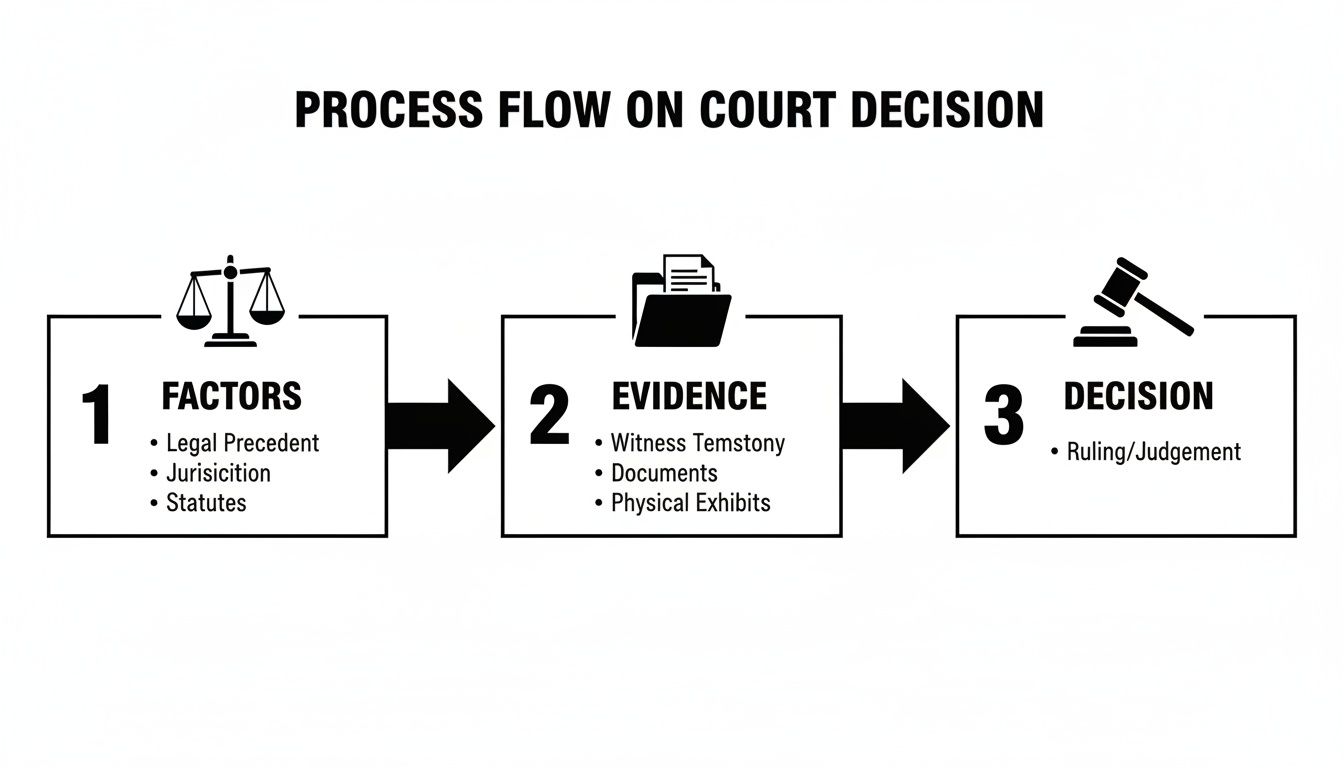
This visualization shows that a judge's ruling is the end result of a careful evaluation of legal factors and the evidence presented.
Filing the Initial Petition
The very first step is filing a Petition with the court. This official document initiates your case, identifying you, the other parent, and your child, and clearly stating what you are asking the court to do: name you the sole managing conservator.
This isn't a simple request. Your petition must state the specific reasons why this arrangement is in your child's best interest. You must allege the grounds, such as a history of family violence, neglect, or substance abuse by the other parent.
Seeking Immediate Temporary Orders
Because a final resolution can take months, the next critical step is often to request a Temporary Orders Hearing. These orders act as a set of ground rules that provide stability and safety for your child while your case moves forward.
At this hearing, a judge has the power to issue orders that:
- Appoint you as the temporary sole managing conservator.
- Establish a temporary possession (visitation) schedule.
- Order temporary child support payments.
- Restrict a parent's contact or behavior if there's a risk of harm.
These orders are vital for creating immediate safety and predictability for your child during a turbulent time.
The Discovery and Evidence Gathering Phase
Once initial orders are set, your case moves into the discovery phase. This is the formal process where both sides exchange information and gather evidence to build their arguments. It is your opportunity to collect the hard proof that will convince a judge.
Discovery involves a few key tools:
- Requests for Production: Asking the other side for documents like police reports, bank statements, or text messages.
- Interrogatories: Sending written questions that the other parent must answer under oath.
- Depositions: Questioning the other parent or key witnesses in person, under oath, with a court reporter transcribing everything.
This entire stage is about backing up the claims you made in your petition with facts. Every piece of evidence helps paint a clearer, more complete picture for the court. As you navigate the legal process step by step, understanding approaches like child custody law firm marketing can offer insights into the legal services available.
Mediation: The Mandatory Settlement Conference
Before a final trial, Texas courts require parents to attend mediation. This is a confidential meeting where a neutral third-party mediator helps you and the other parent try to find common ground and reach an agreement, with the goal of resolving disputes without putting the final decision in a judge's hands.
Mediation gives you control over the outcome. While it can be emotionally challenging, reaching a settlement allows you to create a customized plan for your family instead of having one imposed by the court.
If you reach a full agreement, it's written into a Mediated Settlement Agreement (MSA). This document is binding and is presented to the judge to become your final order. If you cannot agree on everything, your case will proceed to trial only on the issues that remain unresolved.
The legal journey to protect your child can feel like a marathon. At The Law Office of Bryan Fagan, PLLC, we are here to guide you every step of the way. If you need to establish a sole managing conservatorship, contact us for a free consultation.
Common Mistakes to Avoid in Your Custody Case
Seeking to be named a child's sole managing conservator is one of the most emotionally draining legal challenges a parent can face. The stakes are incredibly high. One wrong move can undermine your credibility and damage your case. When your child's future and safety are what you're fighting for, you must approach this with a clear head and a solid strategy.
It's easy to let raw emotions—anger, hurt, or fear—take over. Those feelings are valid, but acting on them can be catastrophic in a courtroom. A judge in Harris County or Dallas County is not interested in emotional drama; they want facts and evidence. Everything you do, from the texts you send to what you post online, will be scrutinized.
Knowing the common pitfalls ahead of time can help you steer clear of them and build a stronger, more convincing case.
Letting Emotions Dictate Your Actions
One of the most common mistakes we see is parents letting their personal feelings about their ex-partner cloud their judgment. This often leads to impulsive, damaging behaviors that can be used against you in court.
- Hostile Communication: Sending angry text messages or leaving furious voicemails creates a paper trail of conflict. Even if you feel justified, responding with hostility makes you look unstable and difficult to co-parent with.
- Social Media Vents: Posting negative comments or sharing details about your case on social media is a gift to the other side's attorney. They will find these posts and use them to portray you as an uncooperative or vindictive parent.
For example, a frustrated Facebook post about the other parent being late can be twisted in court to suggest you are actively trying to damage their relationship with your child. That behavior contradicts the "best interest of the child" standard the judge must uphold.
Failing to Document Everything
When you make serious allegations—like substance abuse, neglect, or instability—your claims are only as good as the proof you can provide. A lack of solid documentation is a fatal flaw in many custody cases.
You have to be meticulous. Keep records of every incident that supports your case. This is not about being petty; it is about building a factual, undeniable timeline for the judge.
Keep a detailed journal with dates, times, and specific descriptions of what happened. Save every relevant text, email, and voicemail. Your attorney can help you organize this information into a compelling narrative backed by solid evidence.
When it comes to proving your case, you can never have too much evidence. A "he said, she said" argument rarely wins.
Disregarding Court Orders
Violating a court order, especially a temporary order, is one of the fastest ways to lose credibility with a judge. These orders are not suggestions; they are legally binding commands.
If a temporary order outlines a specific visitation schedule, you must follow it precisely, even if you disagree with it. If you withhold visitation, you will appear to believe you are above the law, which can destroy your chances of being named sole managing conservator.
If you genuinely believe the other parent poses a danger to your child, the correct action is to file a motion with the court—not to defy the existing order. Showing respect for the court's authority is non-negotiable.
When preparing to fight for sole managing conservatorship, organization and strategic thinking are your best allies. Many parents feel overwhelmed and aren't sure where to focus their energy. This checklist can help you channel your efforts productively and avoid the kind of mistakes that can weaken your position.
Checklist for a Stronger Sole Conservatorship Case
| Action Item | Why It's Important | Example |
|---|---|---|
| Start a Detailed Journal | Creates a chronological record of events, making your testimony more credible and easier for the judge to follow. | Log every missed visitation, late pickup, or concerning phone call with the date, time, and a factual summary of what occurred. |
| Organize All Digital Communication | Texts, emails, and social media messages are powerful evidence. Having them organized saves time and strengthens your arguments. | Create folders on your computer or in a cloud drive for screenshots of texts and emails, sorted by month or by issue (e.g., "Financial Issues," "Visitation Conflicts"). |
| Gather Third-Party Witness Info | Unbiased testimony from teachers, counselors, or neutral family friends can corroborate your claims and add significant weight to your case. | Make a list of potential witnesses with their contact information and a brief note about what they observed (e.g., "Jane Doe, neighbor, witnessed Parent X's erratic behavior on 5/15/24"). |
| Review Your Social Media History | The opposing attorney will scrutinize your online presence for anything that can be used against you. Clean it up before it becomes a problem. | Delete old posts that show excessive partying, complain about the other parent, or discuss details of your legal case. Adjust privacy settings to be as strict as possible. |
| Follow All Court Orders Perfectly | Demonstrates to the judge that you are responsible, stable, and respect the legal process—qualities a sole managing conservator must have. | Even if you disagree with a temporary visitation schedule, ensure the child is ready and available at the exact times specified in the order. Document your compliance. |
This checklist isn't just a to-do list; it's a framework for building a disciplined, evidence-based case. By focusing on these concrete actions, you can move past the emotional turmoil and present yourself as the calm, capable parent the court is looking for.
At The Law Office of Bryan Fagan, PLLC, we guide families through these complex challenges with compassion and legal precision. We can help you avoid these common mistakes and present the strongest possible case. Schedule a free consultation today to get the support and guidance you need.
Frequently Asked Questions About Sole Conservatorship
Navigating the complexities of child custody naturally brings many questions. Getting clear, straightforward answers is the first step toward making confident decisions for your child's future. Here are some of the most common questions we hear from Texas families about what it means to be a sole managing conservator.
Does Being the Sole Managing Conservator Mean the Other Parent Has No Rights?
This is one of the biggest misconceptions, and the answer is a firm no. While you gain the exclusive power to make major decisions, the other parent is almost always named the possessory conservator. They are not erased from the child's life and still hold many important parental rights.
For instance, the possessory conservator can still access the child's school and medical records and has the right to get information from you about the child's well-being. More importantly, they have a court-ordered visitation schedule, known as a possession order.
Even as a sole managing conservator, you cannot legally deny visitation just because you have the final say on other matters. The court's primary goal is to support a healthy relationship between a child and both parents, provided it is safe and in the child's best interest.
Can I Move Out of State With the Child?
This is a critical question, and the answer is almost always detailed in your specific court order. You may have the exclusive right to decide where your child lives, but that power is not unlimited.
Nearly every Texas custody order contains a geographic restriction. This clause specifically limits where the child’s primary home can be—usually to the county where the case was decided and its surrounding, or "contiguous," counties. The purpose is to keep the child close enough for the other parent to have consistent and frequent time with them.
If you want to move beyond that restricted area, you generally have two options:
- Get the other parent's written, notarized agreement.
- File a modification case with the court and convince a judge to lift the restriction.
Attempting to move without the court's permission is a serious violation of your order that can result in legal consequences and could even cause you to lose your status as the sole managing conservator.
How Can I Change a Custody Order to Become the Sole Conservator?
You cannot change a final court order without going back to court. To begin, you must file a Petition to Modify the Parent-Child Relationship in the same court that issued your original order. To be successful, the law requires you to prove two key things.
First, you must show the judge that there has been a "material and substantial change" in the family’s circumstances since the last order was signed. This must be a significant event that fundamentally alters the situation.
Second, you must prove that changing the order to make you the sole managing conservator is now in the child's "best interest." A material change could be the other parent developing a substance abuse problem, engaging in criminal activity, or becoming dangerously neglectful. Proving both of these points requires solid, compelling evidence.
What Is the Difference Between a Conservator and a Guardian in Texas?
People often confuse these two roles, but they operate in different areas of Texas law and serve different purposes. It is vital to understand the distinction.
Conservatorship is a term from the Texas Family Code. It defines a parent's legal rights and responsibilities for their own child during a custody case. It is the legal framework for the parent-child relationship.
Guardianship, on the other hand, is governed by the Texas Estates Code (specifically Title 3, Subtitle G). A court appoints a guardian to care for someone who is legally incapacitated and cannot manage their own affairs. This most often applies to an adult with a disability, an elderly person with dementia, or a child whose parents have passed away or had their parental rights terminated.
Think of it this way: Conservatorship is for managing a parent's relationship with their own child. Guardianship is for protecting a person—a minor or an adult—who legally cannot protect themselves.
While both roles involve making critical decisions for another person, they are handled under different laws, follow different procedures, and are held to different standards.
We know that every family’s story is unique, and these questions barely scratch the surface. The emotional and financial challenges of these legal battles can feel overwhelming, but you do not have to face them alone.
The legal team at the Law Office of Bryan Fagan, PLLC is here to give Texas families the clarity and compassionate guidance they deserve. If you're considering seeking a sole managing conservatorship or have more questions about protecting your child, schedule a free, no-obligation consultation with us today. Let our experience work for you.