Skip to content
When a loved one passes away, the last thing your family needs is a complicated and stressful legal process. For many Texas families dealing with a modest estate, the Texas Small Estate Affidavit (SEA) offers a simpler, faster path for transferring property. It can help you avoid the full expense and time commitment of formal probate court, but the estate must meet specific legal requirements. This guide will walk you through what the SEA is, who it’s for, and how it can provide a compassionate alternative during a difficult time.
Understanding This Vital Probate Alternative
Losing a family member is overwhelming. We understand that the added stress of court proceedings is the last thing you want to face. We have seen many Texas families find themselves in a tough spot: their loved one left behind a modest estate—maybe a car, a bank account, and their home—but didn't have a will. The idea of hiring attorneys and spending months in probate court can feel like too much to bear.
This is exactly the kind of situation the Texas Small Estate Affidavit was created for, as outlined in the Texas Estates Code. It's a sworn legal document used to collect and distribute the assets of someone who died without a will (also known as dying "intestate"), as long as their estate's value is below a certain limit.
Key Benefits for Texas Families
Think of the SEA as a more direct path through the legal system. Instead of a full-blown probate administration, which can be both expensive and time-consuming, the SEA lets heirs manage the estate with far less court involvement. The biggest advantages are clear:
- It Costs Less: You can often avoid the significant attorney's fees and court costs that come with traditional probate.
- It's Faster: While you must wait 30 days after your loved one's passing to file, the entire SEA process can often be completed in weeks, not months or even years.
- It's Simpler: The process bypasses complex legal procedures, making it more manageable for families to handle. However, seeking professional guidance is always a wise step to prevent costly errors.
A Common Scenario in Harris County
Imagine a family in Houston whose mother recently passed away without a will. Her only assets are her homestead, a checking account with $15,000, and a car valued at $10,000. Her total assets, not counting her home, come to $25,000—well under the legal limit.
Without the SEA, her children would face the daunting task of opening a full probate case in the Harris County Probate Court just to access that bank account and transfer the car title. Instead, they can work together to fill out a Texas small estate affidavit form, file it with the court, and once it's approved, present that court order to the bank and the DMV to legally transfer the assets. It’s a game-changer for families in this position, providing a sense of control and closure.
A Note on Other Probate Shortcuts
While the SEA is a powerful tool for estates without a will, it’s not the only simplified option in Texas. If there is a valid will but the estate requires minimal administration, a process called Muniment of Title might be a better fit. You can learn more about how Muniment of Title in Texas works to see if it applies to your situation.
The Small Estate Affidavit is a crucial tool for thousands of families. In Texas, the value limit was recently raised to $75,000 (excluding the homestead and other exempt property), which has made it accessible to more people than ever. This change, found in the Texas Estates Code, has been particularly helpful in major counties like Harris, Bexar, and Dallas. In fact, Texas probate courts processed over 15,000 small estate affidavits statewide in 2023 alone.
Ultimately, the goal of the SEA is to provide relief during a difficult time. If your family’s situation aligns with the legal requirements, it can be the most compassionate and efficient way to settle your loved one's affairs.
Small Estate Affidavit vs Full Probate At a Glance
To help you see the difference more clearly, here’s a quick comparison. This table breaks down the key distinctions families need to consider when deciding between a Small Estate Affidavit and a full probate administration.
| Factor | Small Estate Affidavit (SEA) | Full Probate Administration |
|---|---|---|
| Total Cost | Typically $300 – $800 (mostly court filing fees). | Can range from $3,000 to $10,000+ including attorney fees, court costs, and other expenses. |
| Timeline | Can be completed in 1-2 months after the mandatory 30-day waiting period. | Often takes 6 months to over a year, sometimes longer for complex or contested estates. |
| Complexity | Simple. Involves one form, a court filing, and a brief hearing. Manageable for many families. | Complex. Requires multiple court filings, hearings, inventories, and strict legal procedures. |
| Attorney Required? | Not legally required, but highly recommended to avoid mistakes. | An attorney is almost always necessary to navigate the complex legal requirements. |
| Best For | Small, straightforward estates under $75,000 (excluding the homestead) with no will and no debts. | Larger or more complex estates, estates with a will, or situations where there are debts or disputes. |
As you can see, when an estate qualifies, the SEA offers a much more manageable path. It saves families significant time, money, and emotional stress during an already challenging period.
Meeting the Strict Eligibility Criteria in Texas
Before you can use the simpler Small Estate Affidavit (SEA) process, your family must be absolutely sure the estate checks a few very specific boxes. These aren't just guidelines; they're firm legal requirements laid out in Chapter 205 of the Texas Estates Code (Title 3, Subtitle G).
Getting this first part right is the most critical step. We have seen families have their affidavits rejected over a small mistake, forcing them into the full probate process they were trying to avoid. Let’s walk through each requirement carefully to make sure that doesn't happen to you.
This decision tree gives you a quick visual to see if the Small Estate Affidavit might be the right path for your family.
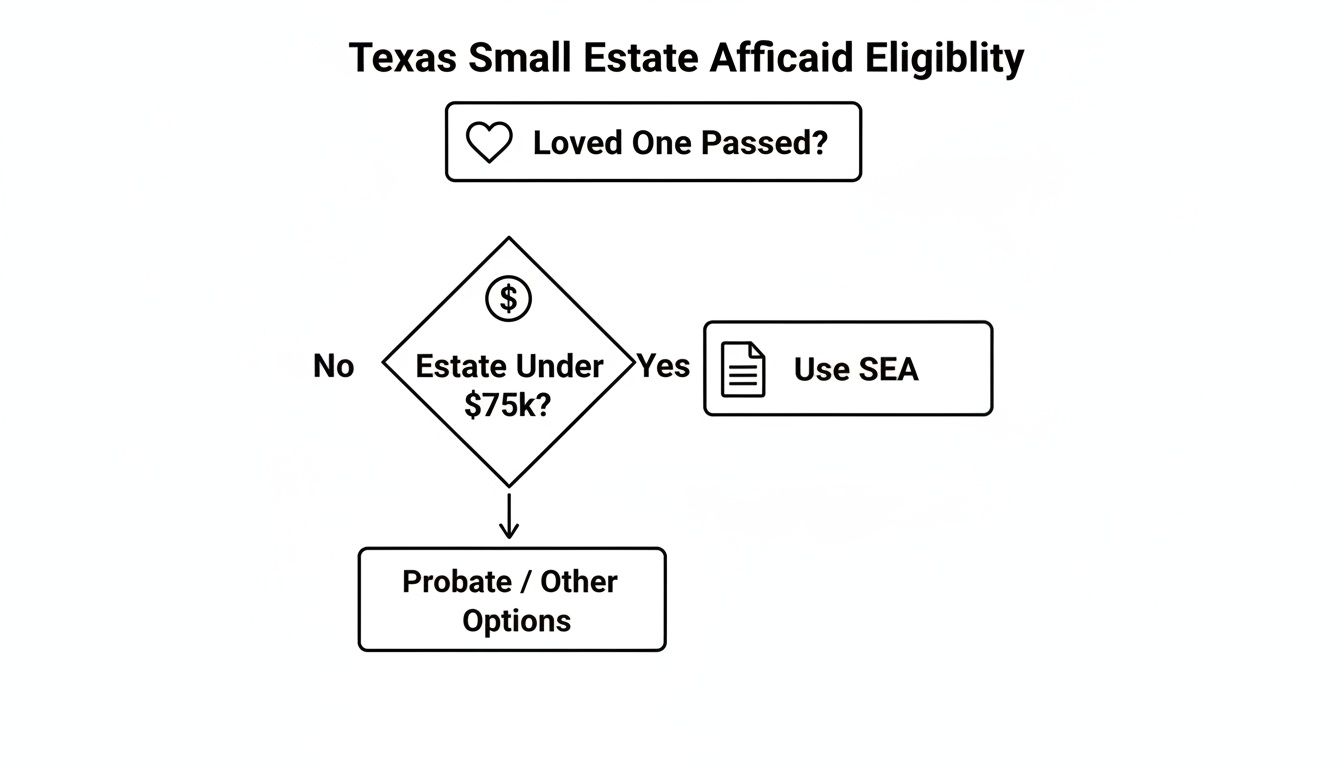
As the chart shows, the two biggest hurdles are confirming your loved one passed away without a will and that their qualifying estate is worth less than $75,000.
The No-Will Requirement
First and foremost: the person who passed away (the "decedent") cannot have left a valid will. The Small Estate Affidavit is designed only for situations where someone dies "intestate," meaning without a will.
If you find a will, even an old one you think might not be valid, the SEA is off the table. The estate will need to go through a different probate process. Don't worry, there are other streamlined options, but the SEA won't be one of them.
The Asset and Debt Balance
Here's another non-negotiable rule: the estate’s assets must be worth more than its known debts. The court needs to see that there’s enough money and property to cover what the decedent owed.
Now, there's an important exception. This calculation does not include the mortgage on a homestead or other secured debts on exempt property.
If the debts are greater than the assets, the estate is considered "insolvent," and you can't use the SEA. This is a safeguard to make sure creditors are paid through a more formal administration process.
A Critical Financial Checkpoint
You must create a detailed and honest list of all known liabilities—from credit card bills and medical expenses to personal loans. A common mistake we see is overlooking a significant debt, which can bring the entire process to a halt and force your family to start over with a different legal approach. This can be an emotional and financial setback.
Calculating the $75,000 Estate Limit
The biggest requirement—and the one that trips up most people—is the $75,000 limit on the estate's value. But here’s the good news: Texas law gives families a significant break by excluding the value of the decedent’s homestead and other exempt property from this calculation.
This is a game-changer. It means your loved one could have owned their home outright, and as long as their other assets fall under the $75,000 threshold, the estate can still qualify.
Figuring out what counts and what doesn't is often the trickiest part. To make it easier, we've put together a table breaking it down.
Calculating Your Estate's Value for the Affidavit
This table should help you sort assets into the right buckets when you're adding everything up. It's crucial to get this number right for the court.
| Asset Type | Include in $75,000 Calculation? | Texas Estates Code Reference (Example) |
|---|---|---|
| Homestead | No | Section 205.001(a)(3)(A) |
| Exempt Personal Property | No | Texas Property Code Chapter 42 |
| Bank Accounts | Yes | N/A |
| Stocks and Bonds | Yes | N/A |
| Cars, Boats, RVs | Yes (one vehicle per family member is exempt) | Texas Property Code Section 42.002 |
| Non-Homestead Real Estate | Yes | N/A |
Let's look at a real-world example. Imagine a father in Bexar County passes away, leaving his home (his homestead), a car, a savings account with $20,000, and about $5,000 in personal belongings. Since his home and one car are exempt, only the $25,000 from the bank account and belongings count toward the limit. His estate is well under the cap and eligible for the SEA.
One final, critical point: the only real estate you can transfer with an SEA is the decedent's homestead. If your loved one owned any other property, like a rental house or a piece of land, you cannot use the Small Estate Affidavit. In that situation, you'll need to look at other options, like an Affidavit of Heirship in Texas, to handle the property.
Meeting these criteria is the foundation of a successful Small Estate Affidavit filing. If you have any doubts about whether your family's situation qualifies, it's always best to get professional advice to avoid unnecessary delays and stress.
How to Gather the Necessary Documents and Information
Getting the affidavit right starts with solid preparation. Think of this as laying a strong foundation—a little extra effort now saves you from the huge headache of a court rejection later. It can feel like an emotional task, but let's break this down into a few manageable pieces.
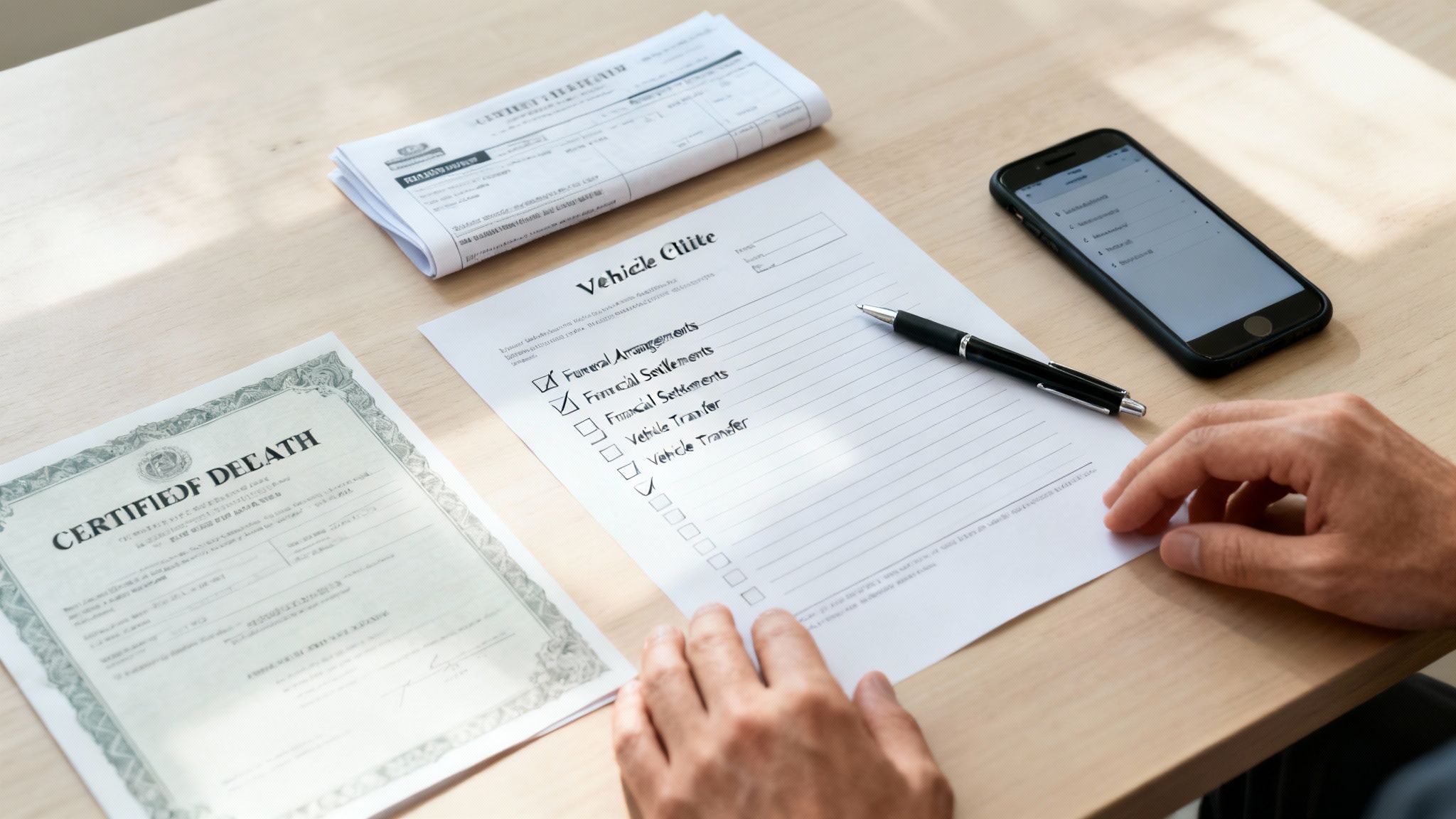
This whole phase is about painting a clear, evidence-backed picture of the estate for the judge. Every document you track down has a specific job, from officially proving the date of death to confirming the value of a car.
Starting with the Official Death Certificate
First things first: you absolutely must have a certified copy of the death certificate. This isn't just a piece of paper; it's the official legal document that kicks off the entire process. You can get one from the county clerk’s office where your loved one passed away.
A pro tip from experience? Order several copies. Places like banks, the DMV, or life insurance companies often require an original certified copy to transfer assets. Having extras on hand will save you multiple trips and a lot of time down the road.
Compiling a Detailed List of Assets
Next, you'll need to create a complete and thorough list of every single thing the decedent owned. This is where accuracy is king. This list is what you'll use to prove the estate's total value is under the $75,000 limit.
For each asset, make sure you note:
- A specific description (e.g., "2019 Toyota Camry" or "Chase Bank Savings Account ending in 5678").
- Its fair market value on the date of death.
- Any key identifiers, like a Vehicle Identification Number (VIN), account number, or serial number.
You can typically find these values on recent bank statements, vehicle titles, or by using online resources like Kelley Blue Book. This detailed inventory shows the court you’ve done your homework and are being transparent.
Identifying All Debts and Liabilities
Just as critical as listing what’s owned is listing what’s owed. The court has to see that the estate’s assets are worth more than its debts. This is a non-negotiable requirement for using the texas small estate affidavit form.
Your list of liabilities needs to be complete, covering everything from outstanding medical bills and credit card debt to car loans. Missing a major debt is a common mistake that can get your affidavit thrown out, potentially forcing the family into a more complicated probate process.
Identifying Heirs and Witnesses
Finally, you need to lock down two groups of people: every legal heir and two disinterested witnesses.
Figuring out the heirs according to Texas intestacy law is often simple, but it can get messy with blended families or more complex family trees. You have to list every single legal heir by name, their relationship to the person who passed, and their current address.
You'll also need two disinterested witnesses. These must be people who:
- Knew the decedent and their family history well.
- Are not heirs and will not get a penny from the estate.
- Are willing to sign the affidavit under oath, swearing that the family facts you've laid out are true.
Choosing credible witnesses who understand their role is vital for getting the court’s stamp of approval. Taking the time now to get all these documents and details buttoned up will let you move forward with confidence. If you're dealing with a complex family situation or have other estate planning questions, our team is here to help.
Completing the Texas Small Estate Affidavit Form
Alright, this is where all your preparation comes together. At first glance, the official Texas Small Estate Affidavit form can look pretty intimidating—it’s packed with legal language and very specific instructions. Let's break it down, section by section, and turn this confusing document into something you can confidently handle.
Getting the details right at this stage is the single most important factor in getting the court to approve your affidavit without frustrating and emotionally draining delays.
We'll use some real-world examples to show you exactly what the court is looking for. This will help you sidestep the common mistakes that can send you right back to square one.
Detailing Heirship Information Accurately
The first major part of the affidavit is where you identify every single legal heir. This isn't just a simple list of relatives; it's a sworn statement that must follow Texas intestacy laws, which spell out who inherits property when someone dies without a will.
For each heir (or "distributee," in legal terms), you'll need to provide:
- Their full legal name and current address.
- Their relationship to the person who died (e.g., spouse, son, daughter, parent).
- The exact share of the estate they're entitled to under Texas law, which is usually a fraction or percentage.
For instance, if someone is survived by their spouse and two children from that marriage, the law dictates how their property is split. A frequent mistake we see is families forgetting to include a child from a previous marriage or simply miscalculating the inheritance shares. An error like that will get the affidavit rejected by the court almost immediately.
Describing Assets and Liabilities with Precision
This is the financial heart of the document. The court needs a perfectly clear snapshot of what the decedent owned and owed. Vague descriptions are one of the top reasons affidavits get disapproved, so you have to be precise.
For Assets:
Instead of just writing "Bank Account," you need to get specific:
- "Wells Fargo Checking Account #…ending in 1234, with a balance of $8,450.21 on the date of death."
And instead of "Car," be much more descriptive:
- "2018 Ford F-150, VIN #… with a fair market value of $22,500 on the date of death."
For Liabilities:
The same rule applies to debts. Provide total clarity:
- "Capital One credit card #…ending in 5678, with an outstanding balance of $1,230.50."
- "Medical bill from Houston Methodist Hospital, Account #…, for $2,500."
This level of detail shows the judge you've done your homework and conducted an honest, thorough inventory. It builds credibility and proves you're complying with the Texas Estates Code. Most importantly, it demonstrates that the estate falls under the $75,000 limit and that the assets are greater than the liabilities.
A Critical Legal Declaration
The affidavit requires you to swear under oath that, "to the best of your knowledge, the value of the estate assets, on the date of the affidavit, not including homestead and exempt property, does not exceed $75,000." This is a legally binding statement—honesty is absolutely essential.
Understanding Key Legal Statements and Oaths
This affidavit is more than just a form; it's sworn legal testimony. It includes several critical declarations that you absolutely must understand before you sign. These statements are your official confirmation that every condition for using a Small Estate Affidavit has been met.
You will be asked to swear to facts like these:
- Thirty days have passed since the decedent’s death.
- No one has applied to be the personal representative of the estate, and no one has been appointed by a court.
- The value of the estate assets (not counting the homestead and other exempt property) is $75,000 or less.
- The estate’s assets are worth more than its known debts.
- All heirs have reviewed and sworn to the information in the affidavit.
Each one of these points ties directly back to the eligibility rules in the Texas Estates Code. When you sign your name, you are legally affirming that every single statement is true. Misrepresenting any facts can lead to serious legal consequences.
The Role of Disinterested Witnesses
As we've mentioned, two disinterested witnesses must also sign the affidavit. Their job is to back up the family history you've provided. By signing, they are confirming under penalty of perjury that they knew the person who passed away and that, to the best of their knowledge, your list of heirs is correct.
Witness Requirements Checklist:
- They cannot be an heir or stand to inherit anything from the estate.
- They must be credible people who can honestly speak to the decedent's family situation.
- They must sign the affidavit in front of a notary public.
Choosing reliable witnesses adds another layer of validation to your filing. Many families ask a trusted neighbor, a long-time family friend, or a coworker of the decedent to serve in this role. These individuals help solidify the affidavit's legitimacy in the court's eyes.
Navigating the complexities of heirship or any other aspect of this process can be challenging. If you run into issues, discussing your options with a professional can provide the clarity you need on your probate and estate administration journey. Completing the form correctly is your best shot at a smooth and quick approval.
Filing the Affidavit and Transferring Assets
You’ve meticulously filled out the Texas Small Estate Affidavit, and now you’re on the home stretch. This is where your careful preparation pays off, transforming all that paperwork into a powerful legal tool that allows you to finally settle your loved one's affairs.
The last phase involves a series of official actions to make the document legally effective. The first step is getting everyone together for the signing, which is a formal, legally significant event that demands precision.
The Importance of Proper Signing and Notarization
Every single heir with legal capacity—known as a distributee—is required by Texas law to sign the affidavit. This isn’t optional. In fact, a missing signature is one of the fastest ways to get an affidavit rejected by the court. These signatures confirm that everyone is on the same page about the facts presented, from the assets and debts to who the rightful heirs are.
Every signature must be made in the presence of a notary public. The notary’s seal is the court's assurance that the signatures are authentic and legitimate. This step is critical; it turns a simple form into a sworn statement with legal weight.
In addition to the heirs, your two disinterested witnesses must also sign the affidavit before a notary. Their signatures act as sworn testimony, verifying the family history and heirship details you’ve laid out. This requirement is in place to protect the integrity of the process, giving the court third-party confirmation of the family circumstances.
Filing with the Correct County Probate Court
Once all the signatures and notary seals are in place, it’s time to file the affidavit with the county court. It is absolutely crucial to file in the correct jurisdiction. This will be the probate court in the Texas county where the decedent resided.
For example, if your loved one lived in Austin, you would file with the Travis County Probate Court, not the Dallas County court where one of the heirs might live.
You’ll need to take the original, signed affidavit to the county clerk’s office and pay the filing fee. These fees vary from county to county, so it's a good idea to call the clerk's office beforehand to confirm the current amount and what payment methods they accept. Some courts may also require you to file a copy of the death certificate along with the affidavit.
Using the Approved Affidavit to Transfer Assets
After you file the affidavit, a judge will review it. If everything is in order, the judge signs an order approving the Small Estate Affidavit. This court order is the golden ticket you need to legally start collecting and transferring the estate’s assets.
With a certified copy of the approved affidavit and court order, you can finally approach the banks, the DMV, and other institutions holding the decedent's property.
- For Banks: Present the certified copy to close the decedent's account and have the funds released to the heirs as laid out in the affidavit.
- For the DMV: Use the document to transfer the title of a vehicle into an heir’s name.
- For Homestead Property: You'll want to file a certified copy of the affidavit in the county's real property records. This creates a clear chain of title for the decedent's homestead.
This final step brings a practical and compassionate close to what can be a painful and confusing process. It empowers families to finalize a loved one’s affairs without the drawn-out stress of formal probate. A key part of this is knowing which assets qualify. For more on this, you can learn about the differences between probate and non-probate assets in our detailed article.
Common Questions About the Texas SEA
When you're dealing with a loved one's estate, questions are bound to pop up. Let's tackle some of the most common ones we hear from families using the Texas small estate affidavit form so you can move forward with a clearer picture.
What Happens If I Discover Another Asset Later?
It’s a scenario that happens more often than you’d think: you’ve gone through the whole process, the affidavit is approved, and then you stumble upon another bank account or a forgotten savings bond. This can be a stressful moment.
If this newly found property pushes the total value of the estate over the $75,000 limit (not counting the homestead), the Small Estate Affidavit (SEA) could be invalidated by the court. This would unfortunately mean starting over with a more formal probate process, like a Determination of Heirship. It’s a powerful reminder to be as thorough as humanly possible during that initial asset search. If this happens to you, your best bet is to get legal advice right away to figure out the next steps.
Can a Small Estate Affidavit Transfer a House?
Yes, but there's a big string attached. An SEA can only be used to transfer the decedent’s primary residence, legally known as their homestead. The good news is that the value of the homestead doesn't count toward that $75,000 asset limit, which is a huge relief for many Texas families.
Once a judge approves the affidavit, you'll need to file a certified copy of it in the county's real property records. This is the crucial step that officially updates the chain of title and transfers ownership to the heirs. Keep in mind, this only works for the homestead. Any other real estate, like a vacation cabin or a rental property, can't be transferred with an SEA and will require a different legal approach.
Key Takeaway
The SEA is a fantastic tool for transferring a primary residence, but it’s not a one-size-fits-all solution for real estate. Always confirm the property's legal status as a homestead before you begin.
Do All Heirs Need to Sign the Affidavit?
Absolutely, without exception. Texas law is crystal clear on this: every single legal heir (or "distributee") who is legally an adult must sign the affidavit. They have to do it under oath, in front of a notary.
What about heirs who are minors? In that case, their legal guardian or "next friend" must sign for them. This rule ensures everyone with a stake in the property is on the same page about how the assets are being divided. Honestly, failing to get every single signature is one of the top—and most preventable—reasons we see a Texas small estate affidavit form get rejected by the court.
The legal path after losing a family member can feel confusing and lonely, but you don't have to navigate it by yourself. For personalized guidance on the Small Estate Affidavit or other estate matters, the experienced team at The Law Office of Bryan Fagan, PLLC is here to help. Schedule a free consultation today to ensure your family's rights are protected with compassion and care.
- Schedule Your Free Consultation: https://texasguardianshiplawyer.net